Junior Doctor Notified to Ahpra: Your Training, Registration and Next Steps
A notification in your first or second postgraduate year lands on top of term assessments, rosters and a registration standard with its own deadlines. This guide separates the two processes now running, explains what the Medical Board actually measures you against, and gives you a week-one plan.
In short
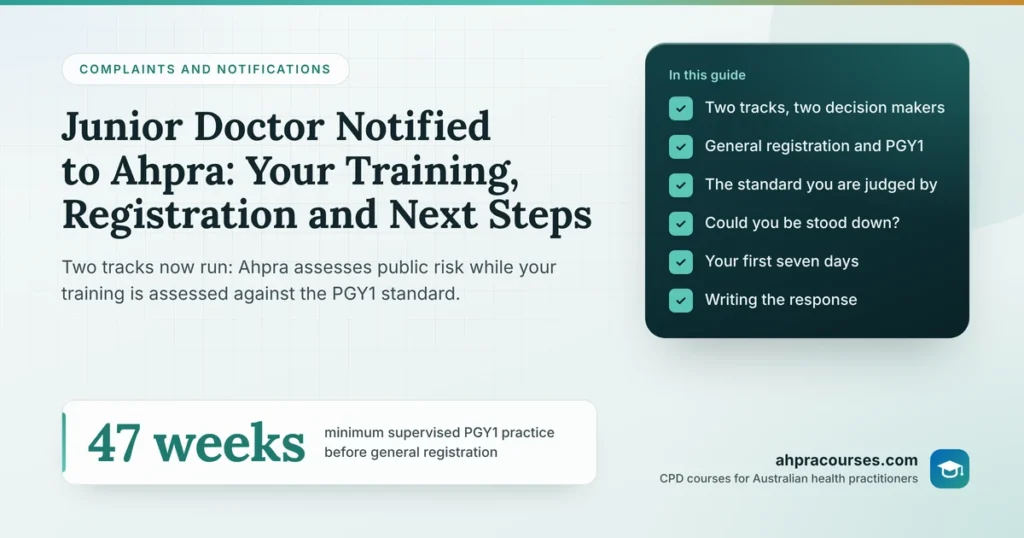
Being notified as an intern or prevocational doctor does not by itself end your training or block general registration. Two separate tracks now run: Ahpra and the Medical Board assess risk to the public, while your employer and its training structures assess your progress against the PGY1 standard (at least 47 weeks of supervised practice, four terms of 10 weeks or more, finished within three years). Most notifications close at assessment, which Ahpra aims to finish within 60 days. What you do in the first week, how honestly you engage with your supervisor, and the evidence of learning you can show carry real weight. Our How to Deal with a Notification or Investigation course walks you through that first week step by step.
What does an Ahpra notification mean when you are an intern or PGY2 doctor?
It means someone has raised a concern about your conduct, performance or health with the national regulator, and the Medical Board of Australia now has to decide whether there is a risk to the public that needs a regulatory response. It is not a finding, and it is not a verdict on whether you will make a good doctor.
Notifications about doctors are common enough that many senior colleagues have had one. The Medical Board's November 2024 newsletter reported 11,207 notifications made about 8,418 medical practitioners Australia-wide in 2023/24, against 142,569 registered medical practitioners that year. Ahpra's annual report for the same year shows that 29.4% (343) of all mandatory notifications concerned medical practitioners.
What is different for you is timing. You are still working toward general registration, rotating through terms and being assessed against entrustable professional activities, and the people who supervise you are often the people who will be asked about the concern. If you want a plain description of the general process first, our explainer on how the Medical Board handles a notification about a doctor covers the stages in order.
Which processes start after the notification, and who decides what?
Two tracks usually run at once. Ahpra and the Medical Board deal with risk to the public under the National Law. Your employer and its prevocational training structures deal with your progress, your rotations and any workplace investigation. They share information in places, but they are different processes with different decision makers.
| Question | Ahpra and the Medical Board | Employer and prevocational training |
|---|---|---|
| What is being decided | Whether your practice poses a risk to the public that needs a regulatory response | Whether you are progressing safely through terms and meeting the PGY1 or PGY2 requirements |
| Who decides | The Board (or a committee, panel or tribunal for referred matters) | Term supervisors complete end-of-term assessments; an Assessment Review Panel of at least three members makes the overall judgement |
| Possible results | No further action, caution, undertaking, conditions, or referral to a panel or tribunal | Feedback, a formal discussion and action plan, managed supervised practice, or an extended or repeated term |
| What helps you | A factual, reflective response and evidence of reduced risk | Open engagement with your supervisor and visible progress on the agreed plan |
Never assume what you tell one track stays there. Your statement to a hospital investigator and your response to Ahpra must tell the same story; inconsistency turns a performance matter into a credibility matter.
Can a notification stop you getting general registration?
Not automatically. General registration depends on completing the requirements in the Medical Board's PGY1 registration standard, and your employer confirms completion directly with Ahpra. A notification only changes that picture if the Board decides to restrict your registration, or if the underlying concern also means you do not reach a satisfactory overall rating.
From 1 January 2024 the relevant standard is the Board's Registration standard: Granting general registration as a medical practitioner to Australian and New Zealand medical graduates on completion of postgraduate year one training. It replaced the older intern standard, so the former fixed terms in medicine, surgery and emergency medicine no longer describe the current rule. The current requirements are set out below.
minimum full-time equivalent experience as a PGY1 doctor in supervised clinical practice
at least, each of 10 weeks or more, in different specialties
maximum period in which PGY1 must be completed
minimum on the Assessment Review Panel that gives the overall rating
Three points in the standard matter most when a notification is open. First, the overall satisfactory rating is made by an Assessment Review Panel "based on structured assessments", which means your end-of-term assessments and EPA assessments are the evidence, not the notification itself. Second, under the National Law provisional registration can only be renewed twice, so the three-year limit is real. If a concern leads to time away from work, talk early with your Director of Clinical Training or medical education unit about how the remaining weeks fit. Third, if you do not meet the requirements, the standard says the Board can impose a condition or conditions on your registration. That is a registration consequence of incomplete training, separate from any outcome of the notification.
The administrative steps do not change either: the Board tells interns not to renew provisional registration unless Ahpra asks, and interns may only work in accredited intern positions, which matters if an outcome affects where you can work.
Which standard will your conduct be measured against?
You are measured against Good medical practice and the standard reasonably expected of a doctor at your level of training and experience. That second part is not a loophole, but it is a genuine difference from how a consultant would be assessed.
Good medical practice: a code of conduct for doctors in Australia applies to every registered doctor, provisional registrants included. The current code was issued on 1 October 2020; because the codes are under review, confirm the version on the Board's site before quoting section numbers.
Several sections of the code speak directly to the junior doctor's position. Section 5.3.6 asks doctors working in teams to support students and practitioners receiving supervision. Section 12.2.2 says a doctor being supervised should receive adequate oversight and feedback. Sections 8.3.1 and 11.2.6 deal with recognising and minimising the risks of fatigue and its impact on your ability to care for patients. Section 11.2.1 asks every doctor to have a general practitioner.
The definition of unsatisfactory professional performance looks at the standard reasonably expected of a practitioner of an equivalent level of training or experience. In one Victorian case the Board's own summary records that this definition was why a doctor in GP training was found to have engaged in unprofessional conduct rather than professional misconduct.
Honesty, boundaries, respect and following lawful directions do not scale with seniority. A first-year doctor who alters a record, misstates a rotation or ignores a supervisor's instruction is judged on integrity, and inexperience gives little cover there.
For a clinical judgement concern, the questions are whether you recognised your limits, escalated and had supervision available. For an honesty or behaviour concern, the question is whether you met the standard every doctor must meet.
Why was your employer the notifier, and what did they have to meet?
Under section 142 of the National Law, an employer who reasonably believes a practitioner has behaved in a way that constitutes notifiable conduct must notify Ahpra. Many notifications about junior doctors come from hospitals for this reason, often after an incident review.
The mandatory notification requirements changed on 1 March 2020, and Ahpra's guidelines set out the thresholds. Notifiable conduct covers working while intoxicated, sexual misconduct connected with practice, impaired practice that exposes the public to a substantial risk of harm, and practice that significantly departs from accepted professional standards and places the public at risk of harm. Ahpra's guidelines also state that mandatory notifications should not be used as a performance or risk management measure. That sentence is worth reading twice if you believe the hospital used a notification instead of supporting you through a training issue.
A notification from the hospital means the hospital has decided I am unsafe.
It means someone formed a reasonable belief that a threshold may be met. Ahpra and the Board still assess the concern independently.
If I keep quiet at work, the training track will not be affected.
Your supervisors will usually know, and silence tends to look like a lack of insight. Raising it early lets you agree how the two tracks interact.
A notification will stop me getting general registration.
General registration depends on the PGY1 standard. Only a Board decision to restrict your registration, or an unsatisfactory overall rating, changes that.
I should contact the colleague who reported me and sort it out.
Do not. Since December 2025, retaliation against a notifier is a criminal offence, with a maximum penalty of $60,000 for an individual.
That last point deserves emphasis. The National Law amendments that took effect in December 2025 made retaliation against a notifier a criminal offence and clarified that non-disclosure agreements cannot stop someone notifying Ahpra. In a hospital, where the notifier may be your registrar, a nurse unit manager or a fellow resident, keep every interaction professional and focused on patients. If you want to understand how employer notices and the register interact, our guide to whether Ahpra tells your employer about a notification covers that question in detail.
Could you be stood down from practice while it is assessed?
Only in serious cases. Immediate action under section 156 of the National Law is an interim step that requires the Board to reasonably believe you pose a serious risk to persons and that action is necessary to protect public health or safety. Ahpra describes the threshold as high.
Before taking immediate action, the Board must give you an opportunity to make a submission about what it proposes. That submission is often the most time-sensitive document a junior doctor will ever write, so get advice from your medical defence organisation straight away if you receive a proposed immediate action notice. Your employer may separately change your duties or roster while its own review runs. That is an employment decision, not a regulatory one, and it does not appear on the public register. For a fuller explanation of what a proposed immediate action letter means and the options at that stage, see our guide on immediate action and keeping your ability to work.
What should you do in the first seven days?
Slow down, protect the record, get advice and tell the right people at work. The aim of week one is a calm, accurate foundation for the response, not a finished letter.
- Day 1Read the whole letter twice. Note the response date, the reference number and exactly which conduct or events are described. Do not reply on the day it arrives.
- Day 1 to 2Call your medical defence organisation or indemnity insurer. Most have advisers who handle notifications about junior doctors every week, and they can tell you whether the concern is likely to stay at assessment.
- Day 2Tell your Director of Clinical Training or term supervisor that you have been notified, in a short factual conversation. You do not need to share the letter, but they need to know so the training track is managed sensibly.
- Day 2 to 3Write a private chronology while your memory is fresh: dates, shifts, who was on, what you were asked to do, what you escalated and to whom. Keep it for your adviser.
- Day 3Request access to the relevant records through the proper channels. Never alter, add to or tidy up an existing clinical note after the event; late entries must be clearly dated as late entries.
- Day 4Start honest reflection on what you would do differently, separate from whether you think the notification is fair. Insight is about your own practice, not the notifier.
- Day 5 to 6Choose targeted learning that matches the concern and start it now, so the response can describe learning already underway rather than a promise.
- Day 7Check in with your own GP and look after sleep and rostering. A notification during a run of nights is a known risk period for poor decisions.
If you prefer to work from a structured template, the free notification response planner on this site breaks these tasks into dated steps you can share with your adviser.
How do you write a response that reads as insightful, not defensive?
Answer the concern the Board actually raised, describe your role honestly within the team you worked in, and show what has already changed. A good response from a junior doctor is usually shorter and more specific than a first draft.
The Board wants to know what happened, whether you understand why it matters for patients, and whether the risk has reduced. Context about supervision or staffing is legitimate, but context offered instead of reflection reads as blame. Put the reflection first and the context second. The How to Deal with a Notification or Investigation course has a full section on writing a factual, reflective response with your adviser.
Helps a junior doctor's response
- A short chronology tied to the records, with times where you have them
- A clear statement of what you escalated, to whom, and what you would escalate differently
- Plain acknowledgement of the patient's experience
- Named learning already completed or underway, with certificates
- A supervisor's informed reference that knows about the notification
Weakens it
- Long criticism of the registrar, consultant or roster
- Claims that you were "only the intern" without showing what you learned
- A different version from the one in the hospital's incident review
- Promises of future courses with no dates
- Generic reflection copied from templates or written by someone else
Reflection is a skill, and many junior doctors have not yet had to write one for a regulator. Our step-by-step guide to writing a reflective statement for the Medical Board shows how to structure it, and the Module on Insight course explains what insight looks like from the Board's side.
Quick self-check before you send anything
- Could a reader tell, from the first paragraph, that you understand why the concern matters for patients?
- Does every factual statement match the clinical record and what you told the hospital?
- Have you separated what you did from what the system or team did, without blaming either?
- Is there at least one change in your practice you can prove, such as a completed course, a new handover habit or supervisor feedback?
- Has your medical defence organisation adviser read the final version?
If any answer is no, the draft is not ready yet.
What do tribunal decisions about junior doctors show?
Published decisions are rare at this level because most notifications about junior doctors close earlier. The ones that reach a tribunal show two consistent themes: level of training matters to the finding, and later insight and training matter to the outcome.
A doctor about three years into general practice training also worked one day a week at an anti-ageing clinic, where he prescribed testosterone and growth hormone without clinical justification. The Board's summary records that the tribunal found unprofessional conduct rather than professional misconduct because the National Law definition refers to the standard expected of a practitioner of an equivalent level of training and experience.
Outcome: reprimand and conditions on registration, including education and mentoring.
A doctor working as a junior doctor in obstetrics between 2008 and 2011, under the supervision of the unit's director, provided inadequate care or inadequate records for seven patients, four of whom had adverse outcomes. Fourteen allegations were found proven, amounting to three instances of professional misconduct. The tribunal treated inadequate supervision as a mitigating factor because the director held ultimate authority over critical decisions.
Outcome: reprimand only. A short suspension was considered and rejected because the doctor acknowledged the skills gap, completed further obstetric training, had no further complaints in about ten years, and was described as safe and competent.
A PGY1 doctor on a surgical term misses a deteriorating patient's rising early warning score overnight. The ward reports it, and the hospital makes a mandatory notification. In week one the doctor tells the term supervisor, contacts their defence organisation, and writes a chronology showing two calls to the registrar that went unanswered. Their response leads with what they now do differently (escalating by a second route after one unanswered call), attaches a completed course certificate and an informed supervisor reference, and mentions the staffing context in one neutral paragraph.
The concern is still taken seriously, but the Board now has evidence that the risk has been addressed by the doctor and the workplace. That is the kind of picture that lets a matter close at assessment.
The pattern in these decisions is consistent with what our article on demonstrating insight to Ahpra describes: panels and tribunals look forward, at whether the doctor in front of them now is safe.
What if fatigue, stress or your health is part of the story?
Say so, get your own care, and do not carry it alone. Health concerns follow a different path from conduct concerns, and asking for help is protected.
Your treating GP or psychologist is held to a much higher reporting bar than a colleague: Ahpra calls it a very high threshold, deliberately set so practitioners can get help, and in Western Australia treating practitioners are exempt from it altogether. Confidential support for doctors, funded by the Medical Board and run independently of it, is also available, including while a notification is open.
If the notification itself concerns your health, read our guide to doctors' health and impairment notifications, and for learning on how conduct, performance and health are weighed see the Fitness to Practise course. Doctors who come through an early-career notification well tend to engage early, keep supervisors informed and turn the experience into documented learning. More doctor-specific options are listed on our doctors' CPD courses page.
For PGY1 and PGY2 doctors answering a notification
Learning that supports your response and your training file
Each course is online and self-paced, with 2 CPD hours and a dated certificate you can attach to a response or a training portfolio. Learning supports your evidence; it does not determine any regulatory outcome.
How to Deal with a Notification or Investigation
- Reading the notice and planning week one
- Writing a factual, reflective response with your adviser
- Immediate action, panels and outcomes explained
Module on Insight
- What insight looks like to a Board reader
- Owning your part within a supervised team
- Turning reflection into practice change
- Good medical practice applied to junior roles
- Escalation, teamwork and supervision duties
- Professional behaviour under pressure
Fitness to Practise for Healthcare Professionals
- Conduct, performance and health streams
- Fatigue, wellbeing and safe practice
- Evidence a Board finds persuasive
Browse all courses at ahpracourses.com.
Questions junior doctors ask about Ahpra notifications
Will an Ahpra notification stop me moving from provisional to general registration?
Not on its own. General registration depends on meeting the Medical Board's PGY1 standard, including at least 47 weeks of supervised practice and an overall satisfactory rating. Only a Board decision to restrict your registration, or not meeting those requirements, changes the timing.
Should I tell my Director of Clinical Training about the notification?
In most cases yes, in a brief factual conversation. Supervisors usually learn about it anyway, and early openness lets the training process and the regulatory process be managed together. Ask your medical defence organisation how much detail to share.
Is the standard different because I am a junior doctor?
For clinical performance, the National Law looks at what is reasonably expected of a practitioner of an equivalent level of training or experience. For honesty, boundaries and behaviour, the same standard applies to every doctor regardless of seniority.
How long will Ahpra take to deal with the notification?
Ahpra aims to finish assessment within 60 days and says most notifications are closed within 90 days. Matters that go to investigation, a panel or a tribunal take longer.
My hospital notified Ahpra instead of supporting me. Is that allowed?
Employers must notify when they reasonably believe notifiable conduct has occurred. Ahpra's guidelines also say mandatory notifications should not be used as a performance or risk management measure. Raise any concern about process with your defence organisation rather than with the notifier.
Can I keep working while the notification is assessed?
Usually yes. Immediate action under section 156 needs a reasonable belief of serious risk to persons and you must be given a chance to make a submission first. Your employer may still adjust your duties under its own processes.
Will seeing a GP or psychologist about stress lead to another notification?
Treating practitioners only have to notify where there is a substantial risk of harm to the public, a threshold Ahpra describes as very high, and treating practitioners in Western Australia are exempt. Seeking care is encouraged, not penalised.
Do I need to do a course before I respond?
No course is mandatory at the notification stage. Targeted learning started early can show the Board that you have recognised the issue and acted on it, but it does not decide the outcome. Choose learning that matches the concern raised.
Official sources
- Medical Board of Australia: Registration standard, granting general registration on completion of PGY1 training
- Medical Board of Australia: Registration standards (effective dates)
- Medical Board of Australia: Provisional to general registration
- Australian Medical Council: National Framework for Prevocational (PGY1 and PGY2) Medical Training
- Australian Medical Council: Guide to prevocational training for PGY1 and PGY2 doctors
- Medical Board of Australia: Good medical practice, a code of conduct for doctors in Australia
- Medical Board of Australia: Newsletter, November 2024
- Ahpra: Annual report 2023/24, Notifications
- Ahpra: How we manage concerns
- Ahpra: How long does it take?
- Ahpra: Immediate action
- Ahpra: Guidelines for mandatory notifications
- Ahpra: Mandatory notifications (changes from 1 March 2020)
- Medical Board of Australia: Register updated under landmark reforms (December 2025 amendments)
- Ahpra: Reporting concerns and the retaliation offence
- Ahpra: Support services for practitioners
- Medical Board of Australia: Newsletter, June 2017 (doctors' health services)
- Medical Board of Australia: Tribunal summary, doctor in GP training reprimanded ([2017] VCAT 1627)
- Medical Board of Australia: Tribunal summary, October 2022 (junior doctor, obstetric care)