Unsatisfactory Professional Performance: Meaning, Examples and What Happens Next
Unsatisfactory professional performance is the competence finding in Australian health regulation. Here is what knowledge, skill, judgement and care mean in practice, who you are compared with, how concerns are assessed, what real panels have ordered, and how to rebuild competence with evidence.
In short
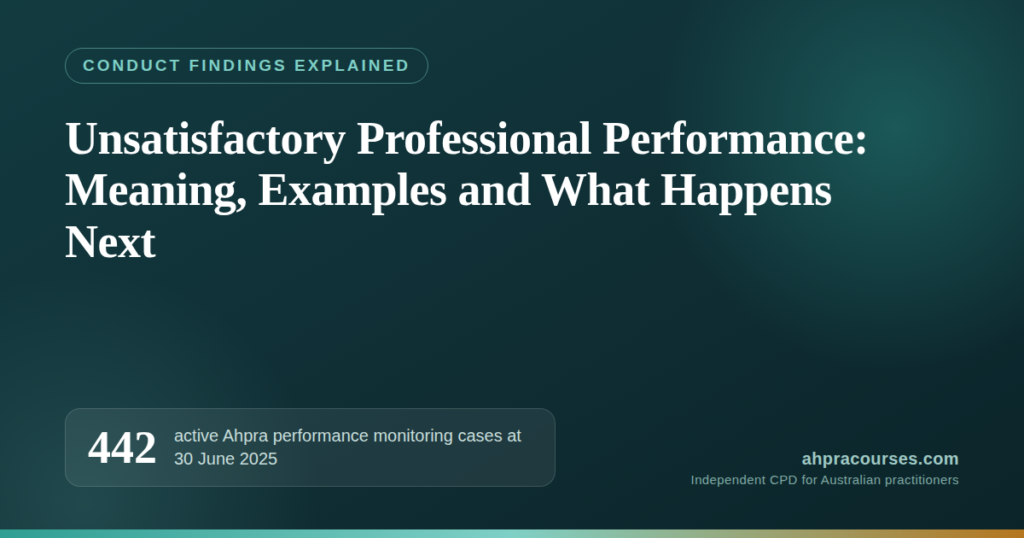
Unsatisfactory professional performance (UPP) is a National Law finding that a practitioner's knowledge, skill or judgement, or the care they exercised, was below the standard reasonably expected of a practitioner of equivalent training or experience. It is about competence, not character. Panels and tribunals can make it, usually on peer evidence such as a performance assessment. Published panel decisions show outcomes such as cautions, reprimands, supervision and records audits. Ahpra had 442 active performance monitoring cases at 30 June 2025.
What does unsatisfactory professional performance mean?
It is a finding that your competence fell below the standard of your peers. It says nothing, on its own, about your honesty or character.
Unsatisfactory professional performance, often shortened to UPP, is one of the findings defined in section 5 of the Health Practitioner Regulation National Law. A performance and professional standards panel or a responsible tribunal can make it. It is the only one of the three main findings built entirely around clinical competence rather than behaviour.
National Law, section 5
Unsatisfactory professional performance means "the knowledge, skill or judgment possessed, or care exercised by, the practitioner in the practice of the health profession in which the practitioner is registered is below the standard reasonably expected of a health practitioner of an equivalent level of training or experience."
Read slowly, the definition has three working parts: four elements that can fall short (knowledge, skill, judgement and care), a setting (practice of the profession you are registered in), and a comparator (a practitioner of equivalent training or experience). Each part shapes how a concern is investigated and what you need to show in response. For the wider picture, see how unsatisfactory professional performance compares with unprofessional conduct and professional misconduct.
What do knowledge, skill, judgement and care mean in practice?
Any one of the four is enough. A finding does not need all of them to fall short.
The National Law does not define the four words further, so their meaning comes from ordinary usage and from how panels apply them. The breakdown below is our practical reading, not a legal test, but it helps you see which part of your practice a concern is really about.
Current understanding of conditions, medicines, guidelines, contraindications and the limits of your scope. A gap might be not knowing a drug is unsuitable for a particular route.
Often tested by: case questions, guideline knowledge, interview
Technical and procedural ability: examination technique, procedures, risk assessment tools, documentation. A gap might be an examination that is incomplete or poorly performed.
Often tested by: observed practice, simulated scenarios
Clinical reasoning: weighing history, forming a differential, choosing investigations, knowing when to escalate or refer. A gap might be not acting on information other staff gave you.
Often tested by: case review, reasoning in interview
Care exercised on the day: follow-up, monitoring, safety-netting and records. A practitioner can know and be able to do the right thing and still not exercise it.
Often tested by: audit of clinical records, colleague input
The wording is precise. Knowledge, skill and judgement are things the practitioner "possessed"; care is something "exercised". In practice, this means a single lapse in care can engage the definition even where a practitioner's underlying knowledge is sound, although decision-makers also look at whether the lapse was isolated or part of a pattern. Records sit across all four elements: they are how you show your reasoning, and poor records alone have supported a UPP finding, as one of the panel cases below shows.
If a concern centres on knowledge, skill, judgement or care, structured learning on clinical competence and safe practice is a sensible place to start.
Enrol in Ensuring Clinical Competence and Patient SafetyWho is the "equivalent level of training or experience" comparator?
You are measured against a reasonable peer at your stage and in your field, not against the best practitioner in the country.
The comparator protects practitioners from unfair benchmarks, but it also cuts the other way: more training and experience means a higher expected standard. The examples below are illustrative, not real cases, and show how the comparator tends to move.
In practice, the standard is usually set by peer evidence: an independent expert opinion, the report of performance assessors from your profession, or the practitioner members of a panel, who must make up at least half of it. Relevant National Board codes, guidelines and registration standards also inform what is reasonably expected.
Does a poor patient outcome mean a UPP finding?
No. The question is the standard of the knowledge, skill, judgement or care, not whether things went badly.
Complications happen in competent hands. A panel looks at what a reasonable peer would have done with the information available at the time. One South Australian matter shows the distinction clearly. An oral and maxillofacial surgeon, registered with both the Dental and Medical Boards, faced allegations that he did not adequately examine or investigate a persistent mouth ulcer later diagnosed as squamous cell carcinoma, and that his records were inadequate. The panels found no case to answer on the clinical allegation. But he accepted his record-keeping fell below accepted standards, and the panels found that his poor record-keeping constituted unsatisfactory professional performance. For a doctor-specific view of how outcome and standard differ, see clinical care concerns for doctors.
How are performance concerns assessed?
Most performance concerns are tested with peer evidence before anyone decides whether a finding is needed.
The most common type of concern raised with Ahpra relates to the way a practitioner is practising their profession, including clinical care and medication management. Ahpra received 13,327 notifications in 2024/25. A performance concern typically moves through these stages, although not every matter goes through every step:
Ahpra and the Board review the concern, your response and early records. Many matters close here with no further action.
The Board may investigate, or require a performance assessment if it believes the way you practise is, or may be, unsatisfactory. Independent assessors from your profession may observe practice, interview you, audit records and use simulated scenarios.
You receive the assessors' report and can respond, usually at a meeting with a Board representative, or in writing.
No action, a caution, conditions, an undertaking, or referral to a panel or tribunal where a formal finding may be needed.
A performance and professional standards panel can find unsatisfactory professional performance or unprofessional conduct, and can impose conditions, caution or reprimand. Hearings are not open to the public.
We cover the assessment day itself, how assessors are chosen and how to prepare in our guide to what happens in an Ahpra performance assessment, so we do not repeat it here.
What do real UPP panel decisions look like?
The published summaries show a consistent theme: orders aimed at rebuilding and verifying competence.
Ahpra publishes de-identified summaries of panel decisions. The four below, across medicine, psychology and dentistry, each included a finding of unsatisfactory professional performance. They are summaries only; the full reasons are not published.
Medical · WA Decision 2020.0891
A doctor providing an emergency telehealth service was alleged not to have adequately assessed a patient, taken account of history from nursing staff, investigated, planned management or escalated to a higher-level facility, and not to have kept clear records.
The panel cautioned him, noting the events were six years earlier, he had reflected appropriately and had taken steps through remedial education.
Psychology · WA Decision 2019.0875
Concerns included not meeting accepted standards in assessment and case formulation, suicide risk assessment and delivering an evidence-based intervention, and an inappropriate diagnosis.
Caution plus conditions requiring supervision in assessment, case formulation, intervention and record keeping, with a supervisor holding an endorsement in counselling or clinical psychology.
Dental and Medical · SA Decision 2019.0876
An oral and maxillofacial surgeon: the clinical allegation about an ulcer was not substantiated, but he accepted his record-keeping fell below accepted standards.
Caution and conditions requiring regular audits of his clinical records.
Medical · QLD Decision 2020.0902
A doctor's clinical management of a patient, including treatment, prescribing and record keeping, fell below the expected standard, with almost all allegations proved.
Reprimand. He was not registered at the time, and the panel recommended the Board impose conditions if he is reinstated.
Two patterns stand out. First, reflection and completed remedial education were expressly noted in the case that ended with a caution alone. Second, where gaps were current, panels used conditions that build skill (supervision) or verify it (audits), rather than relying on a warning.
What orders typically follow a UPP finding?
A panel can impose conditions, caution or reprimand. For performance findings, conditions usually do the real work.
| Order | What it usually requires | On the public register? |
|---|---|---|
| Caution | A written warning intended to deter repetition. No ongoing requirement. | Not usually, unless the Board considers it appropriate |
| Reprimand | A formal rebuke or expression of disapproval. | Yes, reprimands are published |
| Education condition | Complete further education or training, often in a defined topic and within a set time, sometimes with a reflective report. | Conditions that restrict practice are published |
| Supervision condition | Practise only under the supervision of another practitioner, sometimes graduated and with a supervisor meeting set criteria. | Yes |
| Mentoring | Regular sessions with an approved mentor on defined topics, with reports to the Board. | Usually, as a condition on registration |
| Audits | Regular audits of clinical records or practice by an approved auditor, reported to the Board. | Usually, as a condition on registration |
| Reporting | Report to a named person, such as an employer, at specified times while practising. | Yes |
Where education is required, you usually nominate a course or provider and the Board decides whether it meets the condition. Once conditions are in place, our guides to conditions and undertakings explained and getting conditions removed explain compliance and review.
How many practitioners are monitored for performance?
Source: Ahpra annual report 2024/25, compliance. Most of the 4,478 active cases were suitability and eligibility matters.
Performance was the largest of the three groups Ahpra monitors for conduct, health and performance. Monitoring is how Ahpra checks that conditions and undertakings are actually being met, typically through reports from supervisors, mentors, auditors and education providers. In practice, a practitioner who engages early and documents progress gives the Board the evidence it needs to consider changing or removing conditions later.
How do you rebuild competence after a performance concern?
Treat it as a structured learning project with evidence at every step, whether or not a finding has been made.
The plan below is a practical framework, not a regulatory requirement. Discuss timing and content with your adviser so it fits the specific allegations.
Map each allegation to knowledge, skill, judgement or care. A records problem needs a different fix from a gap in clinical reasoning.
Evidence: a short gap analysis linked to the relevant Board code or guideline
Ask what a reasonable peer at your level and in your field would have done, using current guidelines rather than habit.
Evidence: the guidelines or standards you have benchmarked against
Choose education that matches the gap. Generic hours rarely persuade; learning aimed at the specific deficit usually does.
Evidence: dated certificates and notes on what you learned
Build in safeguards such as templates, checklists, escalation rules or peer review, and invite a colleague or mentor to observe or review.
Evidence: before and after examples, peer or mentor feedback
Run a simple audit of your own records or decisions against the standard after the changes have bedded in.
Evidence: audit tool, results and actions taken
Write a reflection linking what went wrong, what you learned and what is now different, with examples over time.
Evidence: a dated reflective statement and a portfolio that ties it together
For how Boards weigh this kind of evidence, see how to demonstrate remediation.
Want a structured competence rebuild with evidence you can show? The program groups clinical competence, documentation and remediation learning.
Get the Clinical Competence & Patient Safety ProgramDoes this apply in NSW, and when should you get advice?
NSW uses a different framework, and advice is worth getting early wherever you practise.
Unsatisfactory professional performance is a national finding. NSW does not use it in the same way: its version of the National Law uses unsatisfactory professional conduct, which includes knowledge, skill, judgement or care significantly below the expected standard, and NSW Councils run their own performance pathways. See unsatisfactory professional conduct in NSW.
Wherever you practise, contact your indemnity insurer, defence organisation or a health law solicitor as soon as a performance concern is raised, and certainly before a performance assessment, panel hearing or written response. A panel summary can read as routine, but conditions affect where and how you work for months or years. You can browse every course and guide on the Ahpra Courses home page.
Rebuild and evidence competence
Courses for a performance concern
Two hours of structured CPD each, with a dated certificate. Pick the course that matches the element that fell short.
Ensuring Clinical Competence and Patient Safety
- Knowledge, skill and clinical judgement
- Recognising limits and escalating
- Practising within scope
Professionalism in Documentation for Healthcare Professionals
- Records that show clinical reasoning
- Common documentation gaps
- Preparing for a records audit
Module on Remediation
- Planning targeted remediation
- Gathering evidence of change
- Sustaining improvement over time
Module on Reflection
- Structured reflective practice
- Linking reflection to practice change
- Writing a reflective account
Frequently asked questions
What is unsatisfactory professional performance under the National Law?
It means the knowledge, skill or judgement possessed, or care exercised, by a practitioner is below the standard reasonably expected of a practitioner of equivalent training or experience. It concerns competence, not character or honesty.
What does UPP mean in an Ahpra matter?
UPP is shorthand for unsatisfactory professional performance. A performance and professional standards panel or a responsible tribunal can make the finding, usually after peer evidence such as an expert opinion or performance assessment report.
What are examples of unsatisfactory professional performance?
Published panel examples include inadequate assessment and failure to escalate in emergency telehealth, substandard suicide risk assessment and case formulation, poor clinical record keeping, and inappropriate treatment and prescribing for a patient.
Does a bad patient outcome mean unsatisfactory professional performance?
No. The test is whether your knowledge, skill, judgement or care met the standard of a reasonable peer at the time. In one South Australian matter the clinical allegation failed, but poor records still amounted to UPP.
Who is the comparator for unsatisfactory professional performance?
A health practitioner of an equivalent level of training or experience. An early-career practitioner is compared with similar peers, and a specialist with specialists in that field, so more experience usually means a higher expected standard.
What orders can follow a UPP finding?
A panel can impose conditions, caution or reprimand. Performance conditions often require further education, supervision, mentoring, audits of clinical records, or reporting to a named person such as an employer, with reports to the Board.
Is a UPP finding published on the register?
Reprimands and conditions that restrict practice are published on the public register. A caution is not usually recorded on the register unless the Board considers it appropriate. Panel hearings themselves are not open to the public.
How many practitioners does Ahpra monitor for performance?
At 30 June 2025, Ahpra had 442 active performance monitoring cases, the largest of its conduct, health and performance groups, which totalled 1,195. Monitoring checks that conditions and undertakings are being met.
Official sources
- Health Practitioner Regulation National Law (Queensland), section 5
- Ahpra: Performance assessments
- Ahpra: Panel hearing
- Ahpra: Possible outcomes
- Ahpra: Panel decisions
- Ahpra: Panel hearing summary 2020.0891
- Ahpra: Panel hearing summary 2019.0875
- Ahpra: Panel hearing summaries 2019.0876 and 2019.0877
- Ahpra: Panel hearing summary 2020.0902
- Ahpra: Annual report 2024/25, notifications
- Ahpra: Annual report 2024/25, compliance