Bundle & save Studying more than one course? Save 15% on 3, 22% on 5 and 30% on 10 or more, taken off in your cart.
Free Course AdvisorQuestions about which course fits your case?
Ahpra Courses

Fitness to practise CPD for health, conduct and performance concerns

Fitness to Practise: Health, Conduct and Performance in Australia

Last updated

Every regulatory decision about a registered practitioner comes back to one question: can this person practise safely and keep public confidence, now and in the foreseeable future? This course explains how the National Law tests that through health, performance and conduct, what happens on each pathway from health assessment to tribunal, and how to stay fit to practise through competence, self-care and reflection.

  • 2 hours, CPD-aligned
  • Written to your Board's code
  • 9 sections with graded checks
  • 20-question final assessment
  • Dated, verifiable certificate
  • Self-paced on any device
  • 1-to-1 AI tutor, Dr AI Alma
Enrol now, A$99Bulk buy from A$70 a course

Free tools to use alongside this course: Response planner, Reflective statement builder, Evidence organiser

Dated certificate with a number anyone can verify

36CPD courses for Australian practitioners
16Professions covered
24/7Self-paced, online, any device
A$99Per course, no subscription

Which of these is your situation?

At a glance

Who it is for
Practitioners in all National Scheme professions who want to understand how health, conduct and performance are assessed, including those already responding to a concern
Boards and codes
Good medical practice (2020); NMBA codes of conduct for nurses and for midwives (2018) and standards for practice; Code of conduct for psychologists (2025); shared Code of conduct (2022); each Board's registration standards
Regulators covered
Ahpra and the fifteen National Boards; in NSW the Health Professional Councils and the HCCC; in Queensland the OHO
Format
Online and self-paced: nine sections with cases from occupational therapy, radiography, nursing, dentistry, Chinese medicine, surgery, optometry and paramedicine
Assessment
A knowledge check after each section, a final assessment and reflection prompts that build a personal development plan
Certificate
Course title, your name, completion date and estimated learning time
Best taken with
How to Deal with a Notification or Investigation
Learning time
About 2 hours, self-paced, online on any device. Progress is saved to your account.
Price
A$99 for one course. Bundles: 5 courses for A$450, 10 courses for A$700.

In short

Fitness to Practise for Healthcare Professionals is a course explaining how Australia's National Law assesses whether a registered practitioner can practise safely. It separates the three statutory lenses: health (impairment that affects capacity to practise), performance (whether practice falls short of what peers with similar training and experience would deliver) and conduct (unprofessional conduct and professional misconduct). It follows each pathway through health and performance assessments, health panels, performance and professional standards panels and tribunals, with the NSW Council and HCCC model and the Queensland OHO model. It covers mandatory notification thresholds, including the very high threshold for treating practitioners and the Western Australian exemption, practitioner support services, renewal declarations, and how competence, self-care and structured reflection keep a practitioner fit to practise.

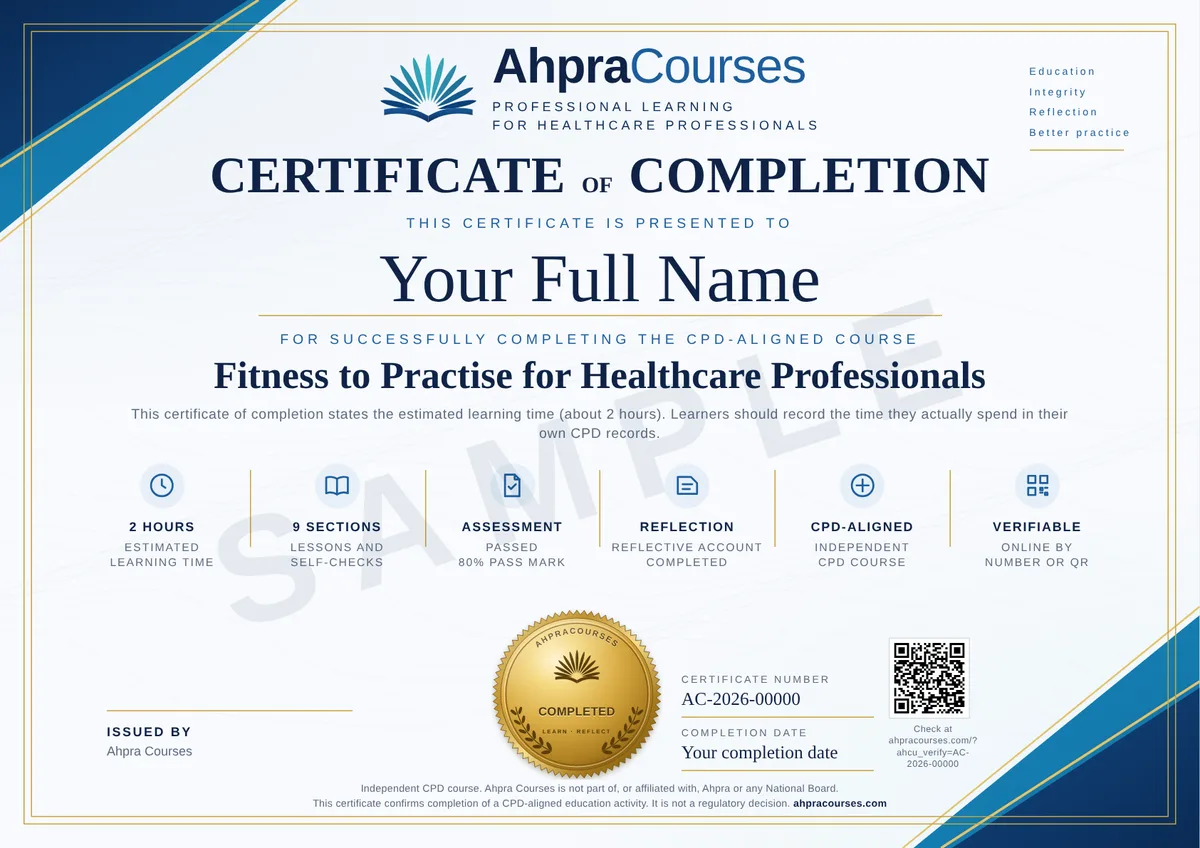
The certificate you receive

Sample certificate of completion for Fitness to Practise Health, Conduct & Performance from Ahpra Courses, showing the learner's name, the course title, an estimated learning time of about 2 hours, the completion date and a certificate number that can be checked online
Sample. Your certificate shows your name, the course title, the completion date and its own certificate number.

The certificate shows your name, the course title, the date you completed it and the estimated learning time. Your CPD record should show the time you actually spent and what the learning led you to change.

How practitioners use it

  • Show a Board delegate, at the meeting after a health or performance assessment, that you have studied how the pathway works and what is expected of you.
  • Support a submission that you understand the difference between a managed health condition and an impairment, alongside a treating practitioner's letter.
  • Add to the evidence for a review of health or performance conditions, with your development plan and audit results.
  • Document annual learning on professional obligations and practitioner health in your CPD portfolio.
  • Give a new supervisor or mentor a common starting point for discussions about safe practice.

Who this course is for

Practitioners whose health has been raised with the regulator

A colleague, employer or treating practitioner may have made a notification about your health. The course explains what impairment means in law, why a diagnosis alone is not the issue, and what the health pathway looks like from assessment to monitoring.

Practitioners living with a chronic illness, mental health condition or substance use disorder

Most practitioners with a health condition never come to the Board's attention because they manage it well. You will learn what the codes expect of you, what renewal asks you to declare, and how to get confidential help early.

Practitioners told their performance may be unsatisfactory

Performance is measured against peers at an equivalent level of training and experience. The course explains how a performance assessment works and how to build a credible development plan from its findings.

Practitioners with a criminal charge or off-duty incident

Conduct outside practice can raise a fitness to practise question when it bears on whether you are a fit and proper person. The course covers the seven-day reporting duty and how Boards weigh such matters.

Employers, managers and supervisors

You may need to decide whether a mandatory notification is required, and you may later supervise a colleague under conditions. The course explains the thresholds, the reprisal protections and the separate roles of supervision, mentoring and support.

Early-career and returning practitioners

New graduates, practitioners changing scope and those coming back after a break face particular competence and recency risks. The course shows how needs-based CPD and reflection protect you.

The concerns this course addresses

Impairment: when a health condition becomes a regulatory matter

The National Law is concerned with a physical or mental condition, disability or substance dependence that detrimentally affects, or is likely to affect, capacity to practise. Insight into the condition and adherence to treatment are central to how risk is judged.

National Law s5 (impairment); Good medical practice 11.2; shared Code 9.1; Code of conduct for psychologists 9.1

Health assessments by an independent assessor

A Board may require an assessment where it reasonably believes you have or may have an impairment. The assessor has relevant expertise and no conflict of interest, may arrange drug screening or neuropsychological testing, and reports to you or your nominated treating practitioner.

National Law s169; Ahpra Health assessments

Unsatisfactory professional performance

Concerns about knowledge, skill, judgement or care are compared with the standard reasonably expected of a practitioner of equivalent training or experience. Performance assessments use observation, record audit, interviews and simulated scenarios.

National Law s5 and s170; shared Code 7.2 and 7.3; Good medical practice 8.3 and 9.2

Unprofessional conduct

Conduct of a lesser standard than the public or peers would reasonably expect, including breaching the National Law, a condition or an undertaking. Boards often deal with it through cautions, conditions or a performance and professional standards panel.

National Law s5; shared Code 8.1; Good medical practice 10.3

Professional misconduct and conduct outside practice

The most serious category covers conduct substantially below the expected standard and conduct, connected with practice or not, that is inconsistent with being a fit and proper person. It is decided by a tribunal.

National Law s5 and ss193-196; Good medical practice 2.2

Renewal declarations and the seven-day reporting duty

At renewal you declare matters such as impairment affecting practice and criminal history. Between renewals you must tell the Board of certain events, such as a relevant charge or a change in insurance, within seven days. A missed report can become a conduct matter of its own.

National Law s130; criminal history and PII registration standards

Health panels and, in NSW, Impaired Registrants Panels

Outside NSW, a health panel includes a practitioner of your profession, a medical practitioner with relevant expertise and a person from outside the profession; it hears matters privately and can impose conditions or suspend registration. In NSW, a Council refers an impairment matter that is not being handled as a complaint to an Impaired Registrants Panel.

National Law s181; Health Practitioner Regulation National Law (NSW) s150F

Living with health conditions or a health undertaking

Typical requirements include treatment with a nominated practitioner, drug and alcohol screening and limits on hours. Health details are not published in detail, and exact compliance is the best evidence for later review.

Ahpra Notification outcomes; Ahpra Monitoring and compliance

What the course covers

Nine sections take you from the meaning of fitness to practise, through each Board's requirements and the causes of investigations, to the three pathways and the habits that keep a practitioner fit to practise over a career.

1Overview of Fitness to Practise5 lessons

Defines fitness to practise as the question behind every regulatory decision and explains the three statutory lenses of health, performance and conduct. It shows why public confidence matters even for conduct outside practice, and why competence is specific to scope.

  • 1.1 Understanding Fitness to Practise
  • 1.2 Significance of Fitness to Practise
  • 1.3 Overview of Regulatory Standards Related to Fitness to Practise
  • 1.4 The Role of Fitness to Practise in Maintaining Public Trust
  • 1.5 Fitness to Practise, Competence, and Accountability
  • Section check (graded)
2Understanding Regulatory Requirements2 lessons

Maps what each Board requires through its code, standards for practice and registration standards, and the renewal and seven-day reporting duties. It sets out the regulatory, criminal, civil, employment and Medicare consequences of not meeting requirements, and the 2026 register and reinstatement changes.

  • 2.1 Fitness to Practise Requirements Across the National Boards
  • 2.2 Regulatory and Legal Implications of Not Meeting Fitness to Practise Requirements
  • Section check (graded)
3Common Causes of Fitness to Practise Investigations3 lessons

Uses Ahpra's 2024/25 figures to show the concerns most often raised and the factors that raise the likelihood of a notification, such as isolated practice, vulnerable patients and high-volume models. It teaches you to recognise warning signs in yourself and colleagues and act on them early.

  • 3.1 Types of Issues That May Trigger a Fitness to Practise Investigation
  • 3.2 Factors That Influence the Likelihood of an Investigation
  • 3.3 Recognising Warning Signs and Proactively Addressing Concerns
  • Section check (graded)
4The Fitness to Practise Investigation Process3 lessons

Follows a concern from receipt and assessment into the separate health, performance and conduct pathways, including immediate action, assessments, panels and tribunals, and the NSW and Queensland arrangements. It sets out your rights and duties and how to match a response to the pathway you are on.

  • 4.1 Steps in a Fitness to Practise Process
  • 4.2 Rights and Responsibilities of Professionals Under Investigation
  • 4.3 How to Respond Effectively to a Notification or Investigation
  • Section check (graded)
5Professional Competence and Fitness to Practise3 lessons

Describes the skills and behaviours that make up competence, the daily habits that maintain standards, and the role of needs-based CPD for each Board. It explains employers' obligations not to push practitioners toward unsafe practice.

  • 5.1 Skills and Behaviours That Demonstrate Professional Competence
  • 5.2 Maintaining and Improving Professional Standards in Daily Practice
  • 5.3 The Role of Ongoing CPD in Ensuring Fitness to Practise
  • Section check (graded)
6Managing Fitness to Practise Challenges3 lessons

Gives strategies for angry patients, pressure to work outside scope, unsafe colleagues and commercial targets. It treats your own health as a professional obligation and lists the confidential support services available to each profession.

  • 6.1 Strategies for Handling Challenging Situations
  • 6.2 Addressing Personal Health and Wellbeing
  • 6.3 Seeking Support and Guidance
  • Section check (graded)
7Maintaining Ethical and Professional Standards3 lessons

Grounds fitness to practise in ethical principles, cultural safety and integrity in records, billing, certificates and advertising. It offers practical routines for keeping standards high when you are tired, rushed or under pressure.

  • 7.1 The Ethical Foundations of Fitness to Practise
  • 7.2 Integrity, Accountability, and Respect
  • 7.3 Practical Approaches for Upholding High Standards
  • Section check (graded)
8Reflection and Continuous Improvement2 lessons

Explains why reflection is built into CPD standards and how it makes insight visible. It walks you through Ahpra's four-step reflective structure and through writing a personal development plan that moves from needs to evidence and review.

  • 8.1 The Importance of Reflective Practice
  • 8.2 Developing a Personal Development Plan
  • Section check (graded)
9Conclusion and Summary1 lesson

Summarises the course into daily commitments for competence, health and conduct, and closes with the final assessment.

  • 9.1 Conclusion and Summary
✓Reflection, final assessment and certificate3 steps
  • Your reflective account, which you can download for your records
  • Final assessment: 20 questions, 80% to pass
  • Certificate of completion, dated and numbered

Health, performance and conduct: three separate fitness to practise questions

The phrase fitness to practise is not defined as a single term in the Health Practitioner Regulation National Law. It is the shorthand for what Part 8 of the Law, headed health, performance and conduct, is designed to test. Each heading asks a different question, and the answer to each one leads to different regulatory tools.

Health asks about capacity, not diagnosis

In plain terms, the Law treats impairment as a physical or mental condition, disability or disorder, including substance abuse or dependence, that detrimentally affects or is likely to detrimentally affect the capacity to practise. The test is the effect on practice. A practitioner with well-treated depression, epilepsy, diabetes or a past alcohol problem may have no impairment at all. Ahpra says that a health condition does not by itself mean a health assessment is needed, and that it judges risk by looking at matters such as the practitioner's insight into the condition and whether recommended treatment is followed. Health matters are handled with privacy built in: health conditions and undertakings are not published in detail and private health information is never published.

Performance asks about the standard of peers at your level

Unsatisfactory professional performance means knowledge, skill or judgement, or care exercised, below the standard reasonably expected of a practitioner with equivalent training or experience. A new graduate is compared with new graduates, a specialist with specialists. Performance concerns usually arise from clinical outcomes, record audits or patterns of complaints, and the tools are assessment, education, mentoring, supervision and audit.

Conduct is graded

Unprofessional conduct is conduct below what the public or peers would reasonably expect, and it includes breaching the National Law or a condition or undertaking. Professional misconduct is conduct substantially below that standard, or conduct inside or outside practice that is inconsistent with being a fit and proper person to be registered. Only a tribunal can find professional misconduct. Because public confidence in the safety of services is a guiding principle of the Law, conduct that has nothing to do with patients, such as dishonesty or violence, can still be a fitness to practise matter.

Why the lens decides the route

One event can raise all three questions. A practitioner who drinks after a bereavement, misses visits and attends one visit smelling of alcohol raises a health question, a performance question and a conduct question, and an outcome may combine a health undertaking, an education condition and a caution. Knowing which lens a decision-maker is using tells you what evidence will help. For health, that is treatment engagement and a treating practitioner's view. For performance, it is a gap analysis and verified change. For conduct, it is honest acknowledgement, understanding of the standard and a record that the behaviour has not recurred.

How to respond to an Ahpra notification about this kind of concern

Whichever lens applies, the early steps are similar. The order below is designed for fitness to practise concerns, where your own health and wellbeing often need attention at the same time as the regulatory response.

  1. Work out which question is being asked

    Read the notice for words such as impairment, health assessment, performance, or conduct. Many notices raise more than one. The pathway affects who you need to speak to and what evidence matters.

    In the course: Section 1 and Section 4 explain the three lenses and how a matter can move from one pathway to another.

  2. Contact your indemnity insurer or defence organisation

    Tell them about the notice promptly and ask for an adviser who handles health or performance matters if that is the pathway. Union and professional association advice services also help many employed practitioners.

    In the course: Section 6.3 covers using advisory services early and what they can and cannot do for you.

  3. Look after your health first, with your own doctor

    See your GP or treating practitioner, especially if sleep, mood, alcohol use or concentration have changed. If a health concern has been raised, a current treatment plan is both the right thing for you and the most useful evidence for the Board.

    In the course: Section 6.2 explains the codes' expectations about your own health and how planned adjustments show insight.

  4. Gather the information the pathway needs

    For performance, collect your records, protocols and scope documents. For health, ask your treating practitioner whether they will provide a report. For conduct, gather documents about the event and anything you have already done in response.

    In the course: Section 4.3 shows how to match a response to the health, performance or conduct pathway.

  5. Answer honestly and keep to the facts

    Respond to each question, explain your reasoning, accept what is valid and say what you have changed. Do not overstate recovery or understate a problem; assessors and Board delegates compare your account with what others report.

    In the course: Section 8 gives a reflective structure and a development plan template you can adapt for your own response.

Stopping treatment, hiding a relapse or missing a screen while a health matter is open does far more damage than the original concern.

Before you reply, talk to your professional indemnity insurer or medical defence organisation, your union or professional association, or a lawyer, and see your own doctor about your health.

How this course helps with an Ahpra notification

It shows you which pathway you are on and why that matters

Health, performance and conduct matters use different assessors, different panels and different outcomes. The course follows each pathway separately, so you can understand why a health matter leads to a treating practitioner's report and screening, while a performance matter leads to an assessment plan and audit. Knowing the route stops you preparing the wrong kind of evidence.

It treats your own health as part of fitness to practise

The codes make managing your own health a professional duty: have your own GP, do not self-treat, and adjust practice when your health could affect patients. The course explains these duties for each Board, the very high threshold that applies when a treating practitioner considers notifying, the Western Australian exemption, and the confidential services available to each profession, so that fear of the regulator does not stop you getting care.

It builds reflection and a development plan you can show a Board

Section 8 uses Ahpra's four-step reflective structure and then turns reflection into a personal development plan: identified needs, objectives, activities, evidence and review dates. A plan of that kind answers the question Boards ask at assessment, which is what has changed and what will reduce the risk in future.

Remediation evidence that carries weight

Carries weight

  • A treating practitioner's letter confirming diagnosis, engagement in treatment and their view of your capacity to practise
  • Negative screening results over time where alcohol or drugs were part of the concern
  • A written plan for adjusted hours, shifts or procedures, agreed with your treating practitioner and employer
  • A performance gap analysis from an assessment report, with matched education and a later audit
  • Supervisor reports from someone who knows the concern and has observed you over months
  • A personal development plan with needs, activities, evidence and review dates
  • Records of contact with a practitioner health service or peer support program

Carries little weight

  • A statement that you feel well now, with no treating practitioner involved
  • Assurances that a health condition is private and not the Board's business
  • Generic CPD unrelated to the gap an assessor identified
  • References that praise your clinical skill but do not mention the health or conduct issue
  • A plan to cut back on alcohol without any monitoring
  • Explanations that blame the employer's rostering without any step you have taken yourself

A remediation plan, phase by phase

  1. First 2 weeks

    Stabilise health and clarify the pathway

    • Book an appointment with your own GP or treating practitioner
    • Call your insurer, defence organisation or association adviser
    • Identify whether the concern is about health, performance, conduct or more than one
    • Contact the confidential support service for your profession if you are struggling
  2. Weeks 2-6

    Build the evidence your pathway needs

    • For health: agree a treatment plan and ask whether your treating practitioner will report
    • For performance: list the specific gaps and match each with targeted learning
    • For conduct: write an honest account of the event and the standard that applied
    • Agree any temporary changes to hours, shifts or procedures with your employer
  3. Weeks 6-12

    Show the change is working

    • Collect screening results, supervisor observations or audit results
    • Write a reflection using description, feelings, analysis, and conclusion and change
    • Draft a personal development plan with review dates
    • If an education condition applies, nominate the program and wait for written approval
  4. Ongoing

    Stay fit to practise

    • Keep regular appointments with your treating practitioner after formal monitoring ends
    • Review your development plan every six months
    • Keep peer review or supervision going where it helped
    • Answer renewal declarations accurately and report relevant events within seven days

Writing your reflective statement

1What happened

Describe the events and how they came to the regulator's attention, without identifying anyone.

Example only: Over three months of night shifts I fell asleep twice in the reporting room, and once a CT scan request waited forty minutes before I reviewed it.

2Which lens applies and why

Say whether this was a health, performance or conduct issue, or a mix, and why.

Example only: It was mainly a health matter, because untreated sleep apnoea affected my alertness, but it also affected the timeliness of my work.

3Impact

Explain the effect, or possible effect, on patients, colleagues and trust.

Example only: A delayed scan in a stroke pathway could have cost a patient their chance of treatment, and my colleagues had to cover for me without knowing why.

4The standard

Name the code provision or guideline that applied.

Example only: Section 9.1 of the shared Code expects me to seek help and adjust my practice when my health may affect patients, and I did neither for months.

5Insight into my condition

Explain how you now understand the condition, its warning signs and how treatment affects practice.

Example only: I now recognise morning headaches and micro-sleeps as signs that my treatment is not working, and I tell my GP within a week.

6What I have changed

List treatment, workplace adjustments and other changes with dates.

Example only: Since February I use CPAP nightly, my sleep physician reports good adherence, and I worked only day shifts until my review in May.

7Keeping it changed

Describe monitoring and support that will continue after any formal requirement ends.

Example only: I see my sleep physician every six months and have agreed with my manager that I will step off nights if my symptoms return.

The example sentences are fictional and show structure only. Your statement has to be your own honest account of what happened.

A weak and a strong response, side by side

Fictional example: A hospital notifies Ahpra that Mr L, a medical radiation practitioner on night shifts, was twice found asleep at work and that one urgent scan was delayed.

Weak

I strongly reject any suggestion that I am impaired. Everyone on nights gets tired, and the department has been short-staffed for a year, which management knows. I have never harmed a patient. The scan was delayed because the referring doctor did not call me, so it was not my fault. My health is a private matter and I do not see why the Board needs to know about it. I am happy to keep working as normal and I am sure this will not happen again.

Strong

I accept that I fell asleep at work twice and that an urgent scan waited longer than it should have. After the second episode my GP referred me for a sleep study, which diagnosed moderate obstructive sleep apnoea. I started CPAP treatment on 2 February, and my sleep physician's letter confirms good adherence and improved daytime alertness. With my manager's agreement I moved to day shifts until my review. I understand that section 9.1 of the shared Code expects me to act when my health may affect patients, and I should have sought help earlier.

Why the second one works: The strong response treats the matter as a health question, which is what the Board is asking. It gives a diagnosis, a start date for treatment, an independent clinician's view and a workplace adjustment. It cites the standard and accepts a delay in seeking help. The weak response denies any impairment, blames staffing and a colleague, and refuses to engage with the health issue, which makes a health assessment more likely, not less.

Mistakes practitioners make when responding

Treating a health notification as an insult

Refusing to discuss your health leaves the Board with no information except the concern. Engaging, with advice, is what allows it to judge that the risk is managed.

Self-treating or prescribing for yourself

The codes expect you to have your own doctor. Self-management of a serious condition is itself the kind of behaviour that worries a Board.

Under-declaring at renewal

The renewal question is about impairment affecting capacity to practise, not every diagnosis, but an inaccurate answer to a question you understood is an integrity problem.

Missing the seven-day report

Failing to tell the Board about a relevant charge or a change to your insurance within seven days can turn a manageable matter into a conduct concern.

Preparing for the wrong pathway

Character references do little in a health matter; a treating practitioner's report does a great deal. Match evidence to the lens being applied.

Breaching health conditions

A missed screen or appointment is treated seriously and can lead to further action. Ask Ahpra's compliance team before you assume an exception applies.

Dropping support once the matter closes

Relapse after monitoring ends is a common route back to the regulator. Keep the treatment and peer support that worked.

The code provisions this course works through

These provisions describe what each Board expects about your own health and about performance. They are the standards a decision-maker has in mind when a concern about fitness to practise is assessed.

Good medical practice 11.2Your health

Doctors should have their own general practitioner, seek independent advice rather than self-diagnose or self-treat, avoid prescribing for themselves, be immunised against relevant communicable diseases, and change their practice if their health may affect patients.

In the course: The baseline against which a doctor's own handling of a health problem is judged; acting on it early is the strongest protection.

Good medical practice 11.3Other doctors' health

Doctors treating colleagues should give them the same quality of care as any other patient and recognise the impact on the colleague's practice, within the notification thresholds.

In the course: Explains how treating practitioners should approach a practitioner-patient and why the high threshold encourages colleagues to seek care.

Shared Code 9.1Your health

Practitioners in the twelve shared Code professions are expected to seek independent help for their health, to be immunised where relevant and to adjust practice when health could affect patients.

In the course: The standard cited in health matters for pharmacists, dental, allied health and paramedicine practitioners.

Shared Code 7.2Practitioner performance

Practitioners should take steps to protect patients when they believe their own or a colleague's health, conduct or performance may put patients at risk, and seek advice when they are unsure what to do.

In the course: Links performance concerns to the duty to act on warning signs, in yourself and in colleagues.

Code of conduct for psychologists 9Proactive management of health, wellbeing and work-related psychological risk factors

Psychologists are expected to manage their health and wellbeing actively, including risks that arise from the emotional demands of the work.

In the course: Makes self-care an explicit regulatory expectation for psychologists from 1 December 2025, alongside the updated professional competencies.

Also relevant: Guidelines: Registered health practitioners and students in relation to blood-borne viruses (2020) Particularly relevant to practitioners who perform exposure-prone procedures.; NMBA codes, health and wellbeing principle Nurses and midwives are expected to promote their own health and the health of colleagues.; Good medical practice 8.3; shared Code 7.3 Performance and capability expectations that frame a performance assessment.

How this applies in each profession

Medical practitioners

Medical Board of Australia; Good medical practice (2020) section 11

Doctors are expected to have their own GP and not to self-prescribe. Doctors' health advisory services operate in each state and territory. Medical practitioners were the subject of 32.6% of mandatory notifications in 2024/25.

Nurses and midwives

Nursing and Midwifery Board of Australia; Codes of conduct (2018)

Nurses were the subject of 40% of mandatory notifications in 2024/25, often from employers. Medication access, fatigue from shift work and substance use are recurring health themes. Nurse and Midwife Support (1800 667 877) is available at any hour.

Pharmacists

Pharmacy Board of Australia; shared Code of conduct (2022)

Ready access to medicines makes self-medication a particular risk. The Pharmacists' Support Service (1300 244 910) offers confidential peer support. From 1 October 2026 practice is also assessed against the Guidelines on the safe provision of pharmacy services.

Dental practitioners

Dental Board of Australia; shared Code of conduct (2022)

Practitioners performing exposure-prone procedures must follow the blood-borne viruses guidelines. Musculoskeletal injury and solo practice are common risks. Dental Practitioner Support (1800 377 700) is available around the clock.

Psychologists

Psychology Board of Australia; Code of conduct for psychologists (2025)

Section 9 requires proactive management of health and work-related psychological risk, and the 2025 competencies add self-care and reflective practice. Burnout and vicarious trauma are recognised fitness to practise risks.

Paramedics

Paramedicine Board of Australia; shared Code of conduct (2022)

Shift work, exposure to trauma and fatigue are significant health risks. Employers are a common source of notifications, so early conversation with a manager and a treating practitioner matters.

Aboriginal and Torres Strait Islander health practitioners

Aboriginal and Torres Strait Islander Health Practice Board of Australia; shared Code of conduct (2022)

Practitioners often work in their own communities, which brings boundary and wellbeing pressures. 13YARN (13 92 76) provides crisis support run by Aboriginal and Torres Strait Islander people.

What happens after a notification reaches Ahpra

Every fitness to practise concern starts the same way and then follows a health, performance or conduct route. The stages below describe the National Law process outside NSW and Queensland; the arrangements in those states follow.

  1. 1. A shared entry point

    Ahpra receives the notification, checks the statutory grounds and consults the health complaints entity. During assessment it speaks to the notifier and the practitioner, reviews history and asks what has been done to reduce risk. In 2024/25 about half of notifications were handled as lower risk through early determination.

  2. 2. Interim protection where risk is serious

    At any point a Board may suspend, impose conditions, accept an undertaking or accept surrender of registration under s156 if it reasonably believes the practitioner poses a serious risk to persons and immediate action is needed to protect the public. A show cause notice and the practitioner's submission come first.

  3. 3. The health route

    Where the Board reasonably believes there is or may be an impairment, it can require a health assessment by an independent practitioner. The report goes to you or your nominated treating practitioner and is discussed at a meeting with a Board representative and an Ahpra officer, at which you can bring a support person or lawyer. In 2024/25, 39.2% of notifications managed by Ahpra's health management team were completed within three months.

  4. 4. The performance route

    Where practice is or may be unsatisfactory, assessors from your profession and scope complete a pre-assessment questionnaire with you, agree an assessment plan, then observe practice, audit records, interview you and colleagues, and may use simulated scenarios. You receive the report and meet a Board member or delegate to discuss it.

  5. 5. The conduct route

    Conduct concerns are usually investigated. Investigators can require documents and information and draw on records, witnesses, experts and other agencies. The Board then decides whether to take action itself, refer to a panel or, where it reasonably believes the conduct constitutes professional misconduct, refer to the responsible tribunal.

  6. 6. Panels

    A health panel has at least three members, including a practitioner of your profession, a medical practitioner with relevant expertise and someone who has never been a practitioner of your profession; it can impose conditions or suspend. A performance and professional standards panel can impose conditions, caution or reprimand. Both sit in private, and legal representation needs the panel's leave.

  7. 7. Monitoring, review and return

    Conditions and undertakings are monitored by Ahpra. You can seek review once the requirements are met or circumstances change, and some applications take up to 12 weeks. After cancellation or disqualification, a reinstatement order from a tribunal has been required since 10 April 2026 before any new application.

Who handles your matter in New South Wales and Queensland

New South Wales. Complaints about NSW practitioners are managed by the relevant Health Professional Council, supported by the HPCA, together with the HCCC. They consult on each complaint and agree who deals with it. Councils manage health matters through their health programs: under s150F of the Health Practitioner Regulation National Law (NSW), where a Council has acted under s150 because it believes a practitioner has an impairment, it must notify the HCCC within seven days and consult on whether the matter proceeds as a complaint or goes to an Impaired Registrants Panel. Councils can also arrange performance assessments, refer matters to a Professional Standards Committee and take urgent interim action. The HCCC investigates serious conduct matters and prosecutes them before NCAT. Mandatory notifications about NSW practitioners are made to Ahpra.

Queensland. The OHO receives every health service complaint first. Under its policy on retaining serious matters, matters that may amount to professional misconduct are generally kept by OHO, while matters about impairment are referred to Ahpra and the relevant Board; a mixed matter can be split so that the health part goes to Ahpra. The Health Ombudsman also holds immediate action powers. Ahpra's annual report records 3,975 notifications considered jointly with OHO in 2024/25.

Mandatory notifications and treating practitioners. The four notifiable concerns are impairment, intoxication while practising, significant departure from accepted professional standards and sexual misconduct in connection with practice. In 2024/25 possible impairment accounted for 23.9% of the 1,542 mandatory notifications Ahpra received. A practitioner treating another practitioner need only notify the first three where there is a substantial risk of harm to the public, and may weigh the nature of the impairment, the steps the practitioner is taking and whether treatment can manage it. Sexual misconduct must still be notified at a lower threshold. In Western Australia, treating practitioners are exempt from mandatory notification about their practitioner-patients and may notify voluntarily.

Since 1 December 2025 (4 December in South Australia), reprisals against anyone who makes a notification in good faith are an offence, and non-disclosure agreements cannot stop a good-faith notification. This protects colleagues who raise a concern about a practitioner's health as much as any other.

Possible outcomes and what they mean for you

OutcomeWhat it isWhat it means for you
No further actionThe Board is satisfied the concern does not raise an ongoing risk, often because a health condition is well managed or the issue has been fixed.Keep the treatment, supervision or practice changes that made the Board comfortable; they remain your best protection.
CautionA formal warning about conduct or performance, usually not shown on the register.Common where a conduct lapse is isolated and acknowledged. Use it to set a specific goal in your development plan.
Health undertakingA binding agreement you enter into about treatment, screening or limits on practice, shown on the register with limited health detail.Allows you to keep practising under agreed safeguards. Comply exactly and keep your own record of every appointment and screen.
ConditionsRequirements imposed by a Board or panel, such as supervised practice, education, audit or screening.Performance conditions usually end once a re-audit or supervisor report shows the gap has closed.
ReprimandA formal rebuke given only by a performance and professional standards panel or tribunal, and published.Signals a conduct finding. You can later ask the Board to remove it from the register.
SuspensionRegistration is suspended by a health panel, a Board on an interim basis, or a tribunal.In health matters, suspension is often linked to treatment; a return usually depends on a treating practitioner's evidence of recovery.
Cancellation and reinstatementA tribunal can cancel registration or disqualify a person from applying; since April 2026 a reinstatement order is needed before reapplying.Reserved for the most serious conduct. A future application must show the tribunal that the underlying risk has been resolved.

If a condition or undertaking requires education

Health and performance outcomes often include an education or treatment requirement. Where a Board condition or an undertaking requires you to complete education, Ahpra or the Board's delegate usually has to approve the program before you start. Ahpra's requirements for formal education restrictions say the nomination must include a detailed curriculum, that insufficiently detailed nominations will not be approved, that online programs generally need interactive content or an assessment, and that education finished before approval may not count. You then provide evidence of completion and a reflective practice report, and an audit may follow.

To use this course for a condition, send Ahpra the course outline, learning objectives and assessment details as part of your nomination and wait for written approval before enrolling. Health requirements, such as treatment with a nominated practitioner or screening, are approved and monitored separately and are not met by any course. Hours that count toward a condition cannot also be claimed as CPD for that period. NSW practitioners on a Council health program should ask the Council how its approvals work.

Using this course as CPD

Fitness to practise is what CPD registration standards exist to protect, so this course sits naturally in any Board's CPD year. Requirements differ. The Medical Board requires membership of a CPD home, an annual professional development plan and 50 hours a year, at least 25 of them reviewing performance and measuring outcomes and at least 12.5 in educational activities. The NMBA requires at least 20 hours a year for a registered nurse, enrolled nurse or midwife, with learning needs identified by reflection against the standards for practice and records kept for five years. The Physiotherapy Board requires at least 20 hours a year, and the Dental Board 60 hours across the cycle running from 1 December 2025 to 30 November 2028. Psychologists, pharmacists and other practitioners should apply their own Board's current standard.

Section 8 of the course teaches you to build a development plan from evidence of your own needs, which is the approach every standard rewards. Revised CPD and recency standards were consulted on by Ahpra and fourteen Boards between May and July 2026 but are not yet in force.

  • Use the course's development plan template as the plan your Board or CPD home asks for
  • Record actual time spent and the specific need the learning met
  • Link the learning to a practice activity, such as a self-audit of records or a supervision session
  • If the course is used for a condition, do not also count those hours as CPD for that period

How this course is written and kept current

The content was written against the Health Practitioner Regulation National Law in its April 2026 form, Ahpra's published material on health and performance assessments, panels, tribunals, immediate action and outcomes, the mandatory notification guidelines, the codes of conduct for each Board, and the NSW and Queensland co-regulatory sources. Figures are taken only from Ahpra's Annual report 2024/25. It was last checked against current Board documents in October 2026 and is updated whenever a code, guideline or registration standard changes.

Health Practitioner Regulation National Law (in force 10 April 2026), Part 8Ahpra: Health assessments; Performance assessments; Panel hearings; Tribunal hearingsAhpra: Regulatory principles for the National SchemeGuidelines: Mandatory notifications about registered health practitioners (2020)Good medical practice (2020), section 11Shared Code of conduct (2022), section 9Code of conduct for psychologists (2025), section 9NMBA Code of conduct for nurses and Code of conduct for midwives (2018)Ahpra: Support servicesAhpra Annual report 2024/25

Last reviewed: October 2026.

Key terms explained

Fitness to practise
Shorthand for whether a practitioner can practise safely and maintain public confidence. The National Law tests it through health, performance and conduct rather than defining it as one term.
Impairment
A physical or mental condition, disability or disorder, including substance dependence, that detrimentally affects or is likely to affect capacity to practise. A diagnosis alone is not an impairment.
Unsatisfactory professional performance
Knowledge, skill, judgement or care below the standard reasonably expected of a practitioner of equivalent training or experience.
Unprofessional conduct
Professional conduct below what the public or peers would reasonably expect, including breaches of the National Law, conditions or undertakings.
Professional misconduct
Conduct substantially below the expected standard, or conduct inside or outside practice inconsistent with being a fit and proper person. Only a tribunal decides it.
Fit and proper person
The broad test of character and integrity that underlies registration and the most serious conduct findings.
Treating practitioner
A registered practitioner providing a health service to another practitioner or student. They must notify only where there is a substantial risk of harm to the public, except for sexual misconduct.
Substantial risk of harm
The threshold for treating practitioners' mandatory notifications about impairment, intoxication or departures from standards, described in the guidelines as very high.
Health assessment
An examination by an independent practitioner with relevant expertise, required where the Board reasonably believes you have or may have an impairment.
Performance assessment
An assessment by practitioners from your profession and scope using observation, interviews, record audit and simulated scenarios.
Health undertaking
A binding agreement about treatment, monitoring or practice limits, shown on the register with limited detail.
Impaired Registrants Panel
A NSW body to which a Council can refer an impairment matter that is not being dealt with as a complaint.
Practitioner health service
A confidential support or advisory service for practitioners of a profession, such as Nurse and Midwife Support or the doctors' health advisory services.

Frequently asked questions

Do I have to tell the Board about my mental health condition?

Renewal asks about impairment that detrimentally affects, or is likely to affect, your capacity to practise, not about every diagnosis. A well-managed condition that does not affect practice is generally not an impairment. If you are unsure, talk to your treating practitioner and your indemnity adviser before answering.

Will my doctor or psychologist report me if I seek help?

Treating practitioners must notify about impairment only where there is a substantial risk of harm to the public, which the guidelines call a very high threshold. Sexual misconduct has a lower threshold. In Western Australia treating practitioners are exempt from mandatory notification about practitioner-patients.

What happens at a health assessment?

An independent practitioner with relevant expertise assesses you and may arrange tests such as drug screening or neuropsychological testing. The report goes to you or a treating practitioner you nominate, and you then meet a Board representative and an Ahpra officer to discuss it.

Can I bring someone with me?

Yes. You can bring a support person or lawyer to the meeting after a health assessment. At a panel hearing you may be accompanied, although legal representation needs the panel's leave.

Will health conditions appear on the public register?

Health conditions and undertakings are shown with limited detail, and private health information is never published. Conduct and performance restrictions are usually published in full.

Can something I did outside work affect my registration?

Yes. Professional misconduct includes conduct, connected with practice or not, that is inconsistent with being a fit and proper person. Criminal charges and some convictions must be reported to the Board within seven days.

How do I prepare for a performance assessment?

Know your scope, review the guidelines that apply to your work, make sure your records are complete and be ready to explain your reasoning. You cannot cram for it, but you can make sure your everyday practice is visible and documented.

What is an Impaired Registrants Panel?

It is a NSW body. Where a Council believes a practitioner has an impairment and the matter is not being dealt with as a complaint, the Council refers it to an Impaired Registrants Panel, after consulting the HCCC.

In Queensland, who handles a health concern?

The complaint goes to the OHO first. Its policy is to refer impairment matters to Ahpra and the Board and to keep serious conduct matters itself, splitting mixed matters where appropriate.

Can this course meet an education condition?

Only with approval. Nominate it with the course outline and wait for Ahpra's written decision before starting. It cannot meet a treatment or screening requirement.

Where can I get confidential help?

Ahpra lists services including the doctors' health advisory services, Nurse and Midwife Support (1800 667 877), Dental Practitioner Support (1800 377 700), the Pharmacists' Support Service (1300 244 910), the Bush Support Line (1800 805 391), Lifeline (13 11 14) and 13YARN (13 92 76).

What is the fit and proper person test for registration?

It is the character test behind registration. Under section 55 of the National Law a Board can decide a person is not suitable for registration if, in its opinion, they are not a fit and proper person to hold it or are unable to practise competently and safely. The same idea appears in the definition of professional misconduct, which includes conduct, whether connected with practice or not, that is inconsistent with being a fit and proper person to hold registration. The phrase is not reduced to a checklist; it is applied to the facts of each case, and honesty with the regulator is part of it.

Does Ahpra check my criminal history?

Yes. When you apply for registration you must declare your criminal history from Australia and overseas, and Ahpra carries out a criminal history check, including an international check where you meet its criteria. At renewal you declare any change since your last declaration, and between renewals you must tell Ahpra within 7 days about certain charges and convictions, such as scheduled medicine offences and offences punishable by 12 months' imprisonment or more. A revised Criminal history registration standard commenced on 15 July 2026. It lists 12 factors a Board weighs, including the seriousness and relevance of the offence, how long ago it was and what you have done since, so a criminal record does not automatically end registration.

How long does the course take, and how long do I have access?

The estimated learning time is about 2 hours (about 120 minutes), covering the lessons, the section checks, your reflective account and the final assessment. People work at different speeds, so record the time you actually spend in your own CPD records. Your progress is saved to your account and you can return to the course and your certificate at any time.

How is the course assessed?

Lessons open in order. Each section closes with a graded check that you answer before moving on. The course ends with a 20-question final assessment, marked on our server, with a pass mark of 80%. If you do not pass, review the sections it points you to and try again.

Does completing the course decide the outcome of my matter?

No course can decide or predict the outcome of a notification, investigation, panel or tribunal. Decision-makers weigh all of the evidence, including your insight, your reflection and the changes you have made and sustained. The course is designed to support that learning and to give you a dated record of it.

Start today, finish at your own pace

Instant access after checkout. Work through 9 sections in order, write your reflective account, pass the final assessment and download your dated certificate.

Primary sources

Always read the current version on the publisher's website. This page is general information, not legal advice.

Course Content

1

Section 1 – Overview of Fitness to Practise

  • 1.1 Understanding Fitness to Practise

  • 1.2 Significance of Fitness to Practise

  • 1.3 Overview of Regulatory Standards Related to Fitness to Practise

  • 1.4 The Role of Fitness to Practise in Maintaining Public Trust

  • 1.5 Fitness to Practise, Competence, and Accountability

  • 1.6 Section 1 Self-Check

2

Section 2 – Understanding Regulatory Requirements

  • 2.1 Fitness to Practise Requirements Across the National Boards

  • 2.2 Regulatory and Legal Implications of Not Meeting Fitness to Practise Requirements

  • 2.3 Section 2 Self-Check

3

Section 3 – Common Causes of Fitness to Practise Investigations

  • 3.1 Types of Issues That May Trigger a Fitness to Practise Investigation

  • 3.2 Factors That Influence the Likelihood of an Investigation

  • 3.3 Recognising Warning Signs and Proactively Addressing Concerns

  • 3.4 Section 3 Self-Check

4

Section 4 – The Fitness to Practise Investigation Process

  • 4.1 Steps in a Fitness to Practise Process

  • 4.2 Rights and Responsibilities of Professionals Under Investigation

  • 4.3 How to Respond Effectively to a Notification or Investigation

  • 4.4 Section 4 Self-Check

5

Section 5 – Professional Competence and Fitness to Practise

  • 5.1 Skills and Behaviours That Demonstrate Professional Competence

  • 5.2 Maintaining and Improving Professional Standards in Daily Practice

  • 5.3 The Role of Ongoing CPD in Ensuring Fitness to Practise

  • 5.4 Section 5 Self-Check

6

Section 6 – Managing Fitness to Practise Challenges

  • 6.1 Strategies for Handling Challenging Situations

  • 6.2 Addressing Personal Health and Wellbeing

  • 6.3 Seeking Support and Guidance

  • 6.4 Section 6 Self-Check

7

Section 7 – Maintaining Ethical and Professional Standards

  • 7.1 The Ethical Foundations of Fitness to Practise

  • 7.2 Integrity, Accountability, and Respect

  • 7.3 Practical Approaches for Upholding High Standards

  • 7.4 Section 7 Self-Check

8

Section 8 – Reflection and Continuous Improvement

  • 8.1 The Importance of Reflective Practice

  • 8.2 Developing a Personal Development Plan

  • 8.3 Section 8 Self-Check

9

Section 9 – Conclusion and Summary

  • 9.1 Conclusion and Summary

On call with Dr AI Alma