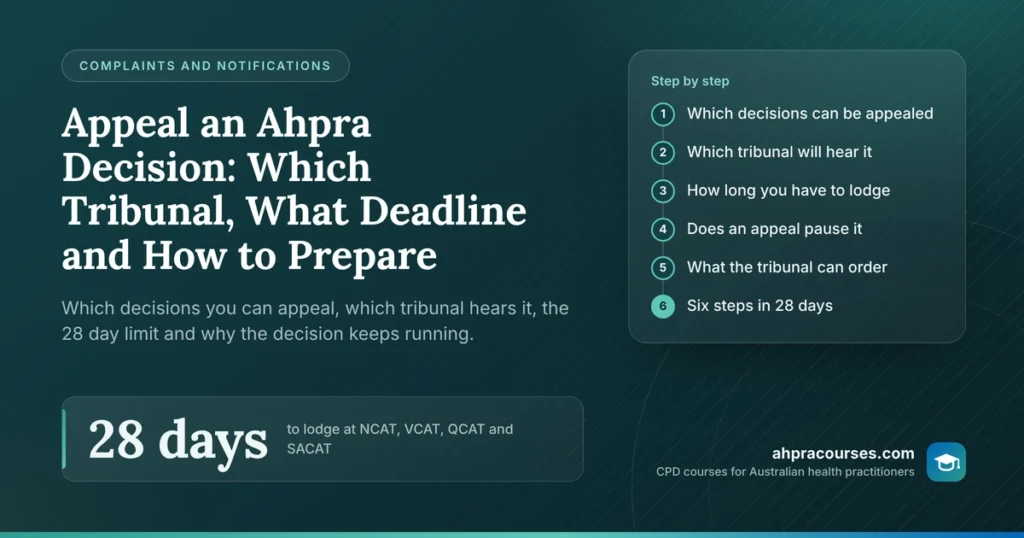
Appeal an Ahpra Decision: Which Tribunal, What Deadline and How to Prepare
A Board or panel has made a decision you believe is wrong. You have a right to take many of these decisions to a tribunal, but the clock is short, the decision usually keeps running while you appeal, and the evidence you build now matters more than the anger you feel today.
The answer in one paragraph
Section 199 of the Health Practitioner Regulation National Law lists the decisions you can appeal, from a refusal to register to conditions, suspensions, interim prohibition orders and a panel reprimand. The appeal goes to the responsible tribunal in your state or territory, and NCAT, VCAT, QCAT and SACAT each give you 28 days from notice. An appeal does not automatically pause the decision, so you keep complying while it runs. Get advice in the first few days, lodge early, and use the waiting time to build evidence of insight and remediation. Our How to Deal with a Notification or Investigation course walks through each stage up to a tribunal and how to show change a decision-maker can rely on.
Most practitioners who read this page have just opened a letter. It might say a National Board has decided to take immediate action, that conditions will be placed on your registration, that a panel has reprimanded you, or that your application to register or renew has been refused. The first reaction is often to write back immediately and explain why the decision is unfair. That instinct is understandable, and it is usually the wrong first move. A decision that is appellable has a formal route, a formal deadline and a formal decision-maker, and the letter you write to the Board in frustration is not part of it.
This guide explains that route for practitioners regulated by Ahpra and the 15 National Boards. It covers what the National Law lets you appeal, where the appeal goes, how long you have, what happens to your practice while the appeal is running, what the tribunal can do at the end, and how New South Wales differs. It also explains how to use the months an appeal can take to build the kind of evidence that tribunals and Boards look for. If you have not yet reached a final decision and are still answering a notification, start with our step by step guide to responding to an Ahpra notification instead.
Which Ahpra and Board decisions does the National Law let you appeal?
Only the decisions listed in section 199(1) of the National Law are appellable decisions. If yours is on the list, you may appeal it to the appropriate responsible tribunal. If it is not, the tribunal has no appeal to hear under this section.
Section 199(1) opens with these words, which set the whole scope of your right:
National Law, section 199(1)
"A person who is the subject of any of the following decisions (an appellable decision) may appeal against the decision to the appropriate responsible tribunal for the appellable decision"
Ahpra's own appeals page adds a point people often miss: "Only a health practitioner who has been the subject of a decision can appeal that decision." A notifier who disagrees with an outcome cannot appeal it to a tribunal under this section. The table below sets out each item in the current list, grouped by who made the decision.
| Item | Decision | Made by |
|---|---|---|
| (a) | Refusing to register you | National Board |
| (aa) | Withdrawing your registration | National Board |
| (b) | Refusing to endorse your registration | National Board |
| (c) | Refusing to renew your registration | National Board |
| (d) | Refusing to renew an endorsement | National Board |
| (e) | Imposing or changing a condition on your registration (with two exceptions, below) | National Board |
| (f) | Refusing to change or remove a condition, or a condition on an endorsement | National Board |
| (g) | Refusing to change or revoke an undertaking you gave | National Board |
| (h) | Suspending your registration | National Board |
| (ha) | Issuing or extending an interim prohibition order | Regulatory body |
| (hb) | Making or revising a public statement | Regulatory body |
| (i) | Imposing a condition on your registration | Panel |
| (j) | Suspending your registration | Health panel |
| (ja) | Refusing to revoke a suspension | Health panel |
| (k) | Reprimanding you | Performance and professional standards panel |
Wording paraphrased from section 199(1) of the National Law as in force at November 2026. Read the section itself before relying on any item.
Immediate action does not appear as a separate heading, because what a Board does when it takes immediate action is to suspend your registration or impose conditions, which are already on the list. Ahpra's immediate action fact sheet confirms that these decisions "can be appealed to the responsible tribunal". If you are dealing with immediate action right now, our explainer on whether you can keep working under immediate action covers the show cause stage that comes before this one.
The two exceptions to item (e) are narrow. A condition relating to qualification for general registration, and a condition imposed under section 112(3)(a), are carved out of the appeal right. If your condition looks like one of these, ask your adviser to confirm before you rely on an appeal.
What sits outside the appeal list, and what can you do instead?
Several common outcomes are not appellable decisions under section 199, and knowing this early saves weeks.
A caution
A caution is not on the section 199 list. The practical response is to show the Board, and any future decision-maker, that the concern has been dealt with. Our guide to what each notification outcome means explains how cautions differ from reprimands and conditions.
An undertaking you offered
You gave the undertaking, so there is no decision against you to appeal. A later refusal by the Board to change or revoke it is appellable under item (g).
A tribunal's own finding
Section 199 covers decisions by Boards, panels and regulatory bodies. A decision made by the tribunal itself, such as cancellation after a misconduct hearing, has its own appeal path through the courts and the tribunal legislation of that state.
A decision to investigate or refer
Opening an investigation, or referring you to a panel or tribunal, is a step in the process rather than a listed decision. Concerns about how that step was handled can go to the Ombudsman.
One more category deserves care: reprimands. Item (k) covers a reprimand by a performance and professional standards panel. If your reprimand came from somewhere else, check which body made it before assuming the appeal right applies. Separately, if a reprimand has already been on the register for some time, our explainer on removing a reprimand from the register sets out what can and cannot be done.
Which tribunal will hear your appeal?
The appeal goes to the responsible tribunal of a particular state or territory. Section 199(2) decides which one.
For a decision about health, conduct or performance, the appropriate tribunal is generally the one for the jurisdiction where the behaviour happened. If the behaviour spans more than one jurisdiction, it is the tribunal for your principal place of practice. For other decisions about a registered practitioner, such as a refusal to renew, it is generally the tribunal for your principal place of practice. Students are dealt with where they study or train. Ahpra's appeals page puts it simply: "each state has its own tribunal."
| Jurisdiction | Responsible tribunal | Published time limit |
|---|---|---|
| New South Wales | NSW Civil and Administrative Tribunal (NCAT) | 28 days |
| Victoria | Victorian Civil and Administrative Tribunal (VCAT) | 28 days |
| Queensland | Queensland Civil and Administrative Tribunal (QCAT) | 28 days |
| South Australia | South Australian Civil and Administrative Tribunal (SACAT) | 28 days |
| Western Australia | State Administrative Tribunal (SAT) | Check the tribunal's rules |
| Tasmania | Tasmanian Civil and Administrative Tribunal (TASCAT), Occupational and Disciplinary Stream | Check the tribunal's rules |
| Australian Capital Territory | ACT Civil and Administrative Tribunal (ACAT) | Check the tribunal's rules |
| Northern Territory | NT Civil and Administrative Tribunal (NTCAT) | Check the tribunal's rules |
Tribunal names from Ahpra's tribunal hearings page. Time limits shown only where we found them on the tribunal's own published guidance. For the other four, we could not confirm a figure on an official page, so ask the tribunal registry on day one.
If you practise across state lines, such as a locum who works in two states or a telehealth practitioner whose patients are elsewhere, the location of the conduct can matter more than your home address. This is one of the first questions to put to your adviser.
How long do you have to lodge, and when does the clock start?
The appeal sections of the National Law do not set a number of days. The limit comes from the tribunal's own legislation and rules, and where we could confirm it, it is 28 days.
VCAT tells practitioners: "You must lodge your application at VCAT within 28 days after you have been given notice of the appellable decision." NCAT says a practitioner or student "has 28 days" to file its External Appeal Form. SACAT says "An application for review must be made within 28 days". In Queensland, section 33(3) of the QCAT Act requires an application to be filed "within 28 days after the relevant day", and QCAT has a separate form for asking permission to apply outside that timeframe.
Notice that the clock is tied to when you were given notice, not the date printed on the decision. Write down the day the email or letter actually reached you, keep the envelope or the email header, and count from there. A request for an extension is possible in some tribunals, but it is an application you must justify, not a right. The safest plan treats the 28th day as a wall and aims to file several days before it.
Practitioners often lose days in three ways: waiting for the Board to reply to an angry email, waiting until they "feel ready" to call their insurer, and waiting for the full written reasons before they start. If the reasons have not arrived, tell your adviser straight away. Do not let the time limit run while you wait for paperwork.
Does an appeal put the decision on hold?
No, not automatically. This is the point that surprises practitioners most, and it shapes everything about how you plan the next months.
Sections 199 to 203 of the National Law contain no stay provision. Ahpra says of immediate action that the decision continues until "the decision is set aside after appeal to the responsible tribunal." The tribunal statutes say the same thing in their own words:
- Queensland. Section 22(1) of the QCAT Act says starting a review "does not affect the operation of the decision". QCAT can order a stay of some decisions, but its health practitioner page states that "QCAT may not stay prohibition orders or immediate action decisions during the review process."
- New South Wales. For appeals against conduct decisions, NCAT says: "Unless NCAT orders otherwise, the filing of the External Appeal Form will not stay the effect of the decision being appealed".
In practical terms, if you have a supervision condition, you practise under supervision while you appeal. If your registration is suspended, you do not practise. Breaching a condition while an appeal is pending does not help your appeal; it creates a new problem. Our guide on what happens when conditions are breached explains why. Whether to ask for a stay, and whether the tribunal can grant one for your kind of decision, is a legal judgement to make with your adviser in the first week.
The decision keeps running. Your evidence should too.
While the appeal is pending you will be living with the decision, often for months. That time can be used to show a tribunal that you understand the concern and have changed how you practise.
- Seven courses and 14 hours of structured learning, with assessment and reflection activities
- Each with graded checks and a dated certificate you can put in front of a decision-maker
- Structured so your reflection links each concern to specific learning and practice change
14 hours, A$520. Learning supports your evidence. It does not determine any Board, panel or tribunal outcome.
What can the tribunal do once it has heard the appeal?
Under section 202(1), after hearing the matter the responsible tribunal may confirm the decision, amend it, or substitute another decision for it.
When the tribunal substitutes its own decision, section 202(2) gives it the same powers the original decision-maker had. That cuts both ways. A tribunal hearing an appeal against conditions can lighten them, remove them, or in principle replace them with something it considers more suitable on the evidence before it. Tribunal statutes add further options. In Queensland, for example, section 24(1)(c) of the QCAT Act lets the tribunal "set aside the decision and return the matter for reconsideration to the decision-maker".
Section 201 lets the tribunal make any costs order it considers appropriate. In both Queensland decisions discussed below, the later costs rulings left each party to bear its own costs, but costs depend on the facts and are not guaranteed either way. Ask your adviser to estimate them before you file.
Tribunals also look at the matter as it stands at the hearing. Evidence of what you have done since the decision, such as completed learning, supervisor reports or audit results, can be relevant. That is one reason to start building it now rather than after the hearing is listed. Our overview of what happens at a panel or tribunal hearing explains how hearings run.
How is an appeal different in New South Wales?
NSW runs a co-regulatory system. The National Boards still make registration decisions, but conduct, performance and health matters are handled by the NSW health professional Councils with the Health Care Complaints Commission, and the appeal provisions reflect that.
Appeal under section 175
Decisions by a National Board about registration in NSW are appealed to NCAT under section 175, which NCAT describes as decisions a person "may appeal to NCAT to have reviewed". NCAT can, among other orders, "confirm the decision made by the National Board".
External appeal to NCAT
Decisions by a Council, a Committee or a Performance Review Panel go to NCAT as an External Appeal. NCAT may "dismiss the appeal", "set aside the original decision" or "vary the original decision as it thinks appropriate". The limit is 28 days and the appeal does not stay the decision unless NCAT orders otherwise.
If your matter started with the HCCC or a NSW Council, read our guide to how notifications work in NSW and Queensland before you choose a form, because the wrong form can cost days you do not have.
If an appeal is not the right tool, what else is there?
Three alternatives come up again and again.
The National Health Practitioner Ombudsman. The Ombudsman says it can "assist with complaints about the health practitioner registration process". It is just as clear about its limits: "We cannot assess whether a National Board's decision to take action against a health practitioner was correct." It looks "at whether the way the matter was handled was fair and reasonable." That makes it the right place for unreasonable delay, poor communication or procedural unfairness, and the wrong place for an argument that a condition is too harsh.
An application to the Board. If time has passed and your circumstances have changed, an application to change or remove a condition may get you further than an appeal against the original decision. A refusal of that application is itself appellable under item (f), so this route does not cost you your tribunal rights. Our step by step guide on getting conditions removed explains what Boards look for.
Judicial review. Some decisions that are not appellable may be open to challenge in a court on legal grounds. That is specialist territory with its own time limits, and it is a conversation for a lawyer rather than a self-help guide.
What do published Queensland decisions show about appeals?
Two published QCAT matters show that tribunals do change Board decisions, and how long the process can take. Practitioners are not named here; we cite the official neutral citations only.
The Pharmacy Board took immediate action on 13 July 2020 and suspended a pharmacist's registration. The pharmacist sought review at QCAT, and the decision was delivered on 27 September 2021, roughly 14 months later.
The tribunal found that "there is presently no basis for taking immediate action" and ordered that the immediate action decision be set aside. A key reason was concern about the reliability, at that stage, of the main witness account.
What it teaches: a tribunal will test whether the evidence supports the Board's decision. It also shows that the decision operated for over a year before it was set aside, which is why compliance and evidence building cannot wait for the hearing.
A doctor had immediate action conditions that prohibited him from undertaking any surgical procedures. This 2021 costs ruling records that QCAT had earlier made "an order amending the conditions on the applicant's registration".
On costs, the tribunal ordered: "Each party will bear the party's own costs of the proceeding."
What it teaches: success on appeal does not have to mean the condition disappears. Amendment, so the restriction fits the actual risk, is a realistic and common aim.
A physiotherapist and a refused application. A physiotherapist in Adelaide has had a Level 2 supervision condition for a year. Her supervisor reports are positive and she has completed the education the Board required. She applies to remove the condition, and the Board refuses, saying it wants six more months of reports.
That refusal is an appellable decision under item (f), and SACAT's 28 day limit applies from notice. Before appealing, she and her adviser weigh two paths: appeal now with a strong compliance file, or provide the further reports and reapply. Either way, her file is what decides how strong her position is. The scenario is invented to illustrate the process and is not based on a real practitioner.
What should you do in the next 28 days? Six steps
- Record the notice dateWrite down when the decision actually reached you. Count forward to the tribunal's limit and diarise a target several days earlier.
- Check the decision against the listMatch it to an item in section 199(1), or the NSW provisions if a Council or the HCCC was involved. If it is not on the list, look at the other routes above.
- Brief your insurer or a health lawyer this weekSend the notice, the reasons and every earlier letter. Ask about grounds, the right tribunal, costs risk and whether a stay is worth seeking.
- Keep complying, and prove itFollow the decision exactly. Keep a dated log of supervision sessions, reports, chaperone records or anything else the decision requires.
- Lodge the right form earlyUse the responsible tribunal's health practitioner form. File with days to spare and keep proof of filing.
- Build the evidence in parallelReflection, targeted learning and practice changes that someone else can verify. The notification response planner helps you map each concern to evidence.
Which beliefs about appeals cost practitioners the most?
How do you use the waiting time to strengthen your position?
Whatever your grounds, tribunals and Boards repeatedly look for three things: whether you understand the concern, whether you have done something about it, and whether that change can be checked.
A strong appeal file often includes a clear chronology, the decision and reasons, records showing full compliance since the decision, a reflective statement that engages with the concern rather than the notifier, evidence of targeted learning, and practice changes confirmed by a supervisor, colleague or audit. Our guide to demonstrating insight to Ahpra explains what decision-makers mean by insight, and why defensiveness in a reflective statement can weaken an otherwise good appeal.
Learning should match the concern. If the decision followed a documentation problem, a generic ethics certificate adds little. If it followed a boundary issue, learning on boundaries and an explanation of what you now do differently matters more. Choose courses whose content you can describe in your own words, and keep the certificates with your reflection on what each one changed in your practice.
Quick self-check: is your appeal file ready?
- Do you know the exact date you were given notice, and the last day to lodge?
- Can you name the section 199 item, or NSW provision, your decision falls under?
- Has a lawyer or your insurer seen the reasons?
- Do you have a dated record proving full compliance since the decision?
- Does your reflection address the Board's concern rather than the notifier?
- Can someone other than you confirm a change in your practice?
Fewer than five "yes" answers? Start with numbers 1 to 3 today; they are the ones with a deadline.
Evidence for the months between notice and hearing
Courses that support an appeal file
Each course is 2 CPD hours with graded checks and a dated certificate. Pick the ones that match the concern in your decision. Learning supports your evidence and does not determine any Board, panel or tribunal outcome.
How to Deal with a Notification or Investigation
- Each stage from receipt to a tribunal, in order
- Writing responses a decision-maker can rely on
- Showing remediation alongside an appeal
Module on Insight
- How tribunals infer insight from what you write
- Answering the concern without blaming others
- Insight that stays consistent across documents
- Practising transparently while restrictions apply
- Complying with conditions during an appeal
- Evidence that unrestricted practice is safe again
Module on Remediation
- Diagnosing the gap behind the decision
- Assembling evidence of change for a hearing
- Preparing for review of conditions
Prefer the full set? The Notification and Investigation Response Program brings seven courses together in 14 hours, or browse every option at ahpracourses.com.
Appeal questions practitioners ask us most
How long do I have to appeal an Ahpra or National Board decision?
The time limit comes from the tribunal that hears the appeal. NCAT, VCAT, QCAT and SACAT each publish a 28 day limit, counted from when you were given notice of the decision. Check the rules of the tribunal in your state on the day the notice arrives and do not assume you have longer.
Can I appeal a caution from a National Board?
A caution is not one of the appellable decisions listed in section 199 of the National Law. Ask your adviser whether any other remedy applies, and focus on showing the Board that the concern has been addressed.
Does lodging an appeal stop the decision from applying?
No. The National Law appeal provisions do not create an automatic stay. QCAT says it may not stay immediate action decisions or prohibition orders during a review, and NCAT says filing an appeal does not stay a conduct decision unless it orders otherwise. Keep complying while the appeal runs.
Which tribunal hears my appeal?
The appropriate responsible tribunal. For health, conduct or performance action it is usually the tribunal for the state or territory where the behaviour happened, and for other decisions it is usually the tribunal for your principal place of practice.
Can I appeal an undertaking I agreed to?
An undertaking you gave is not itself appellable because you offered it. A Board decision refusing to change or revoke an undertaking is on the section 199 list, so you can appeal a refusal once you have applied to change it.
Can the National Health Practitioner Ombudsman overturn a Board decision?
The Ombudsman says it cannot assess whether a National Board decision to take action was correct. It looks at whether the matter was handled fairly and reasonably, so it suits complaints about process, delay or communication rather than the merits.
Will doing a course change the result of my appeal?
No course can decide or change a tribunal result. Structured learning is one piece of evidence of insight and remediation, alongside compliance records, reflection, supervisor reports and changes to your practice that someone else can verify.
Do I need a lawyer to appeal to a tribunal?
You are not always required to have one, but tribunal appeals involve legal tests, evidence rules and costs risks. Most practitioners start with their indemnity insurer or defence organisation, which often provides or funds advice.
Official sources checked for this guide (15)
- Health Practitioner Regulation National Law (Queensland), current version, sections 199 to 202
- Ahpra: Appealing a decision
- Ahpra: Immediate action fact sheet
- Ahpra: Tribunal hearings, list of responsible tribunals
- Ahpra: National Law amendments and commencement dates
- NCAT: Appealing decisions about registration of health professionals
- NCAT: Appealing decisions about conduct of health professionals
- VCAT: Health Practitioner Regulation National Law review and referral
- QCAT: Health practitioners, before you apply
- Queensland Civil and Administrative Tribunal Act 2009, sections 22, 24 and 33
- SACAT: Health practitioners, decisions we can review
- TASCAT: Health practitioners applications
- National Health Practitioner Ombudsman: Complaints we assist with
- Queensland Judgments: [2021] QCAT 286
- Queensland Judgments: [2021] QCAT 92