Ahpra Chaperone Condition: What It Means for Your Practice and Patients
Chaperone conditions are now rare, but practitioners who still hold one must follow a detailed protocol every working day. This guide explains the rules, the logs, how Ahpra checks them, what replaced chaperones, and how to seek a review.
Quick answer
A chaperone condition means you must not have any contact with the patients it covers unless an approved or patient-chosen chaperone is physically present and directly observing. Since 2017 the Medical Board and Ahpra have stopped using chaperones as an interim measure while sexual misconduct allegations are investigated, and the restrictions library Ahpra has used for new restrictions since 16 September 2024 does not include a chaperone restriction. Practitioners with an older chaperone condition still have to follow Ahpra's chaperone protocol: tell each patient, display the Ahpra sign, keep a co-signed log of every contact and accept compliance checks. You can apply to the Board under section 125 of the National Law to change or remove the condition, subject to any review period.
Jump to
- Is it still used?
- The core rule
- Who can chaperone
- Telling patients
- The chaperone log
- How Ahpra checks
- Breaches and cases
- What replaced chaperones
- Changing the condition
- Moving clinics: a scenario
- Courses
- FAQ
Is a chaperone condition still something Ahpra imposes?
Rarely, and not in the way it once was. In 2016 the Medical Board commissioned an independent review of the use of chaperones to protect patients, led by Professor Ron Paterson. The report was published in February 2017, and on 11 April 2017 the Medical Board and Ahpra announced they had adopted all of its recommendations.
The central change was that chaperones would no longer be used as an interim restriction while allegations of sexual misconduct are investigated. In their place the Board and Ahpra said they would use alternatives such as gender-based restrictions, restrictions on patient contact, or suspension. The same announcement said Ahpra's chaperone protocol would be strengthened and would apply wherever chaperone conditions remain in place, including conditions imposed in the past that "cannot legally be replaced unless there is evidence of increased risk to the public".
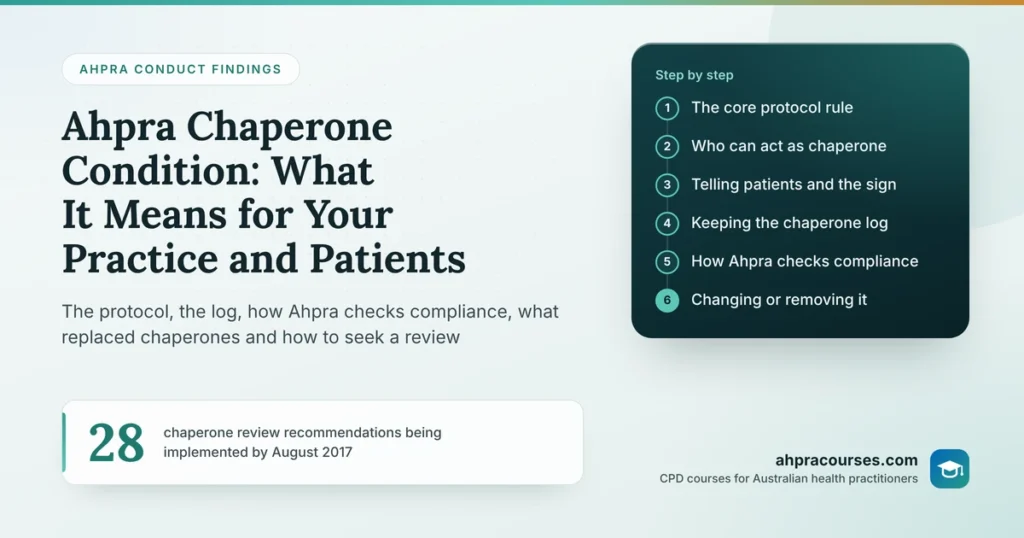
By 4 August 2017 a status report said all 28 recommendations were being implemented and that no new decisions had been made by the Board to require a practitioner to practise with a chaperone present. It also described a national committee to deal with all matters about sexual misconduct, specialist investigators, and a national specialist compliance team within Ahpra.
The more recent step came in 2024. Ahpra's National Restrictions Library 2.0 applies to restrictions imposed or accepted from 16 September 2024, and its published list of restrictions does not include a chaperone restriction. Ahpra keeps the older chaperone protocol online because practitioners with restrictions that require compliance with it "continue to be subject to the requirements" of it.
What does the chaperone protocol require you to do?
The core rule is short. Ahpra's chaperone protocol says a practitioner whose conditions require it "must not undertake any contact with a patient without the presence of an appropriate chaperone".
Everything else in the protocol builds on how widely "contact" is defined. It is not limited to a consultation in the room. The protocol includes prescribing, advising, treating or seeing a patient, whether in person or by a communication device. A phone call to give results, a telehealth review or a quick conversation in a corridor can all count. The protocol also points out that a condition may cover all patients or only a defined group, so the first job is to read your own restriction closely.
The chaperone must be physically present and directly observe all contact, from start to finish.
Prescribing, advice and remote contact are included, not only physical examinations.
If a patient refuses or seems reluctant, the contact must not go ahead or must stop immediately.
The protocol says it is generally aimed at practitioners in private practice; your own condition sets where it applies.
Every contact goes in a chaperone log, co-signed by the chaperone at the end.
You acknowledge in writing that Ahpra can check compliance through several sources.
The protocol is dated December 2016 on Ahpra's website. If you hold a chaperone condition, ask your Ahpra case officer to confirm which version of the protocol and forms apply to you, because your restriction wording takes precedence over any general summary, including this one.
Who is allowed to act as your chaperone?
There are two kinds of chaperone under the protocol, and some restrictions allow only one of them. The comparison below sets out the differences.
| Question | Patient-chosen chaperone | Board or Ahpra approved chaperone |
|---|---|---|
| Who can it be? | A person at least 18 years old who is acceptable to the patient, such as a spouse, partner, parent, other family member, guardian or carer. | A registered health practitioner with no restrictions on their own registration, at least 18 years old. |
| Who cannot? | The protocol notes that some restrictions do not allow patient-chosen chaperones at all. | Your relatives or friends, and generally not your direct employees or anyone in a direct contractual or financial relationship with you. |
| What do they receive? | Ahpra's information sheet for patient-nominated chaperones, and they confirm their agreement before contact starts. | Ahpra's information sheet for approved chaperones, with written confirmation that they understand the role. |
| How are they approved? | By the patient's choice, recorded in the log with their relationship to the patient. | You nominate them on the approved form, with contact details, photographic identification and sample signatures. |
| How many? | One for that contact. | The protocol suggests nominating several people so absence or illness does not stop your practice. |
Approved chaperones are not passive bystanders. Ahpra's information sheet for them says that if they or the patient are concerned about the contact or the practitioner's conduct, they should ask for the contact to be brought to an end immediately, and it gives them a number to contact Ahpra's compliance team. It also reminds chaperones who are registered practitioners that their own mandatory notification duties may still apply. Nominees must be told that they can contact Ahpra with concerns and that Ahpra may contact them to monitor compliance.
This independence is the main reason employees are generally excluded. A receptionist who depends on you for their job is not in a position to stop a consultation. If you work in a small practice, plan your roster of approved chaperones early, because finding unrestricted registered practitioners who are willing and available is often the practical bottleneck.
Working under a boundary-related condition? Build the evidence a review will look for.
- Maintaining Professional Boundaries for Clinicians in Australia is a self-paced online course of about 2 hours, written to your Board's code
- The Professional Boundaries and Conduct Program groups related courses into about 12 hours of structured learning with a certificate per course
- Both give you dated certificates and material for a reflection you can share with your adviser
What must patients be told, and what goes on the practice sign?
Before any contact with a patient in the group your condition covers, the protocol says you or your staff must tell the patient that a chaperone must be present and observing at all times.
The patient is then offered three options: a chaperone of their choice, an Ahpra-approved chaperone, or an appointment with another practitioner. That third option matters. A patient who does not want anyone else in the room is entitled to see someone else, and the protocol expects you to make that possible rather than to persuade them.
For the sign, the protocol states that "the template provided by AHPRA must be used". It must be displayed in a clearly visible place in the waiting area, or the equivalent, at every place where you practise. A home visit service, an aged care facility round or a second clinic one day a week each needs its own plan for how the sign requirement is met.
Common slips at the front desk
- New reception staff not told about the condition and booking covered patients without a chaperone.
- The sign moved during a refurbishment and not replaced.
- A patient-chosen companion who is under 18 accepted as the chaperone.
- A follow-up phone call to a covered patient made without anyone observing.
Habits that prevent them
- A written front desk procedure for every location, reviewed when staff change.
- Covered appointments flagged in the booking system with the chaperone's name.
- Results and advice for covered patients scheduled as observed contacts.
- A weekly check that the sign is still in place at each site.
How do you keep a chaperone log that will stand up to an audit?
The log is the heart of compliance, because it is the main evidence that the condition was followed. Under the protocol it must record every contact with a covered patient and confirm the chaperone was present throughout. It must be completed in indelible ink at the end of the contact and co-signed by the chaperone at that time.
Each entry needs the patient's full name and date of birth, the date and time of the consultation, and the chaperone's full name, contact address, phone number and signature. For a patient under 18, a parent or guardian signs for the patient. Where the patient chose the chaperone, the entry also records that the chaperone has received the information sheet, that they authorise Ahpra to contact them, and their relationship to the patient. Because the log holds other patients' details, the protocol recommends obscuring previous entries when a patient-chosen chaperone signs.
The protocol requires you to give Ahpra a copy of the log "at such times as requested by AHPRA". It does not set a fixed schedule, so keep the log complete and legible at all times rather than tidying it before a request. A log that is later found to be inaccurate can do more harm than a gap that was reported honestly, as the case in Part 7 shows.
How does Ahpra check that the condition is being followed?
Compliance with a chaperone condition is not checked only through the log. Under the protocol you acknowledge, on the approved form and within the time your restriction sets, that Ahpra may use a range of sources. You must also show that you have told any private health insurers about your registration conditions.
Ahpra may contact Medicare and obtain information, and may access public and private billing data.
Ahpra may contact private health insurers, and you show you have notified them of your conditions.
Ahpra may access appointment diaries and booking schedules to compare with the log.
Ahpra may carry out random practice inspections.
Ahpra may contact patients, chaperones, staff or employers.
Approved chaperones know they can contact Ahpra with any concern during or after contact.
Ahpra's general guidance on monitoring says the practitioner is responsible for complying with restrictions, and that Ahpra assesses the results and reports it receives for the National Board to consider. Cross-checking the log against billing and booking records is the obvious test, so a covered patient who appears in Medicare data but not in the log will raise a question straight away. Our explainer on how Ahpra conditions and undertakings work covers the wider monitoring framework that sits around a chaperone condition.
What happens if a chaperone condition is breached?
The protocol's own warning: contact with a patient without a required chaperone is a breach of the restriction, and it "may constitute behaviour for which the Board may take action, including the suspension of registration".
Under the National Law, a Board that has concerns about non-compliance may take further action under Part 8, which can include disciplinary steps.
Published decisions show that tribunals take chaperone breaches seriously, and that the chaperone can be held responsible too. The examples below come from official Board publications; practitioners are not named.
A registered nurse agreed in 2012 to act as chaperone for a doctor during consultations with female patients while the doctor was under investigation. She admitted not attending some consultations or not staying for all of them, giving Ahpra misleading chaperone logs, and not telling Ahpra when she had difficulty meeting the arrangement. The tribunal described the repeated breaches as a "grave departure from the high professional standard expected of an experienced registered nurse".
Outcome: reprimand, two-month suspension, conditions requiring further education in ethics and legal obligations, and a $2,000 costs contribution (Nursing and Midwifery Board summary, 15 February 2019).
A medical practitioner had been allowed, after an appeal in 2016, to see female patients and patients under 18 only with a chaperone present while an investigation continued. The tribunal later found unprofessional conduct involving inappropriate touching and a breach of an earlier undertaking, and a pattern of inappropriate sexual conduct.
Outcome: reprimand; nine chaperone conditions removed and replaced with gender-based conditions for 18 months, plus supervised practice and education (Medical Board summary, 24 April 2018).
The first case is a reminder to anyone asked to chaperone a colleague: signing a log for a consultation you did not fully observe is itself a professional failing. The second shows the direction of travel after 2017, with chaperone conditions giving way to restrictions that do not rely on a third person in the room. If you are worried that something has already gone wrong with your own compliance, read our guide on what happens when Ahpra conditions are breached and speak with your adviser before contacting your case officer.
What has replaced chaperones for sexual misconduct concerns?
For restrictions imposed or accepted from 16 September 2024, Ahpra uses the National Restrictions Library 2.0. Its "Restricted patient contact" category lists four restrictions, including a prohibition on a patient group defined by sex and gender.
Ahpra's published wording for that restriction shows how different it is from a chaperone model. The practitioner must not practise other than at practice locations that are approved and published, and must not practise at all until a location is approved. After approval, the practitioner must not have contact with patients in the restricted group, which includes patients who have not provided their assigned sex and gender. "Patient" includes anyone accompanying the person receiving care.
- Practice only at locations that are approved and published
- Senior people and practice staff physically present at the location
- Staff complete Ahpra's Compliance Third Party Induction
- Sex and gender confirmed at booking, including for companions
- Patients given Ahpra's information sheet on the restriction
- Regular appointment and billing reports listing every patient seen
- Any emergency treatment of a restricted patient reported to the case officer
- Loss of an approved location reported, with practice stopped if it was the only one
Ahpra says it places significant weight on practice locations having independent people it can communicate with, and that it may refuse a solo practice location or ask for further assurance. In other words, the protective role a chaperone once played is now carried by the practice environment, the staff and the reporting, rather than by one person in the room. Practitioners facing an interim restriction of this kind can find more on how these decisions are made in our article on immediate action and keeping working.
Can you apply to have a chaperone condition changed or removed?
Yes. Section 125 of the National Law lets a registered practitioner apply to their National Board to change or remove a condition on their registration, or to change or revoke an undertaking. The application must be in the form the Board approves, and the Board must either grant or refuse it and give written notice of its decision. A refusal notice must tell you about your right to appeal and how and when to lodge one.
Two limits apply. You cannot apply during a review period that applies to the condition unless you reasonably believe there has been a material change in your circumstances. And a condition imposed by an adjudication body in a co-regulatory jurisdiction can only be dealt with this way if that body decided the provision applies. Ahpra's monitoring guidance adds that most Boards publish an application form under the registration section of their websites.
For a chaperone condition specifically, remember the 2017 position: older conditions remain in place unless they are changed through a proper process, and the Board described them as conditions that cannot legally be replaced unless there is evidence of increased risk to the public. An application to remove one therefore needs to show why the risk the condition was addressing is now managed. That usually means a clean compliance history, evidence of insight into professional boundaries, completed learning, and supporting reports. Our step-by-step guide on how to get Ahpra conditions removed explains how to assemble that application, and the free remediation evidence portfolio helps you organise each piece.
What should you do before moving clinics with a chaperone condition? A scenario
Hypothetical scenario, for illustration only
A practitioner has held a chaperone condition for several years, covering consultations with one patient group. She has a clean compliance record at her current clinic, with two approved chaperones on staff rotation. She is offered a part-time role at a second clinic across town, starting in a month.
A sensible plan before the first shift:
- Re-read the exact wording of her condition to see whether it limits practice locations or only requires a chaperone.
- Tell her Ahpra case officer about the new location before she starts, and ask what is needed.
- Nominate approved chaperones for the new clinic on the approved form, with identification and sample signatures, and wait for approval.
- Arrange the Ahpra sign in the new waiting area and brief reception staff on booking covered patients.
- Notify any private health insurers if her details or provider arrangements change.
- Consider whether her compliance history and learning now support an application under section 125.
This scenario is invented to show the steps. Always follow your own restriction and the advice of your case officer and insurer.
The common thread is doing the work before the contact, not after it. Most breaches arise from a change in circumstances: a new site, a new staff member, a new appointment type. A short written plan for each change is easy evidence of the care a Board wants to see.
Courses for practitioners under boundary-related restrictions
Structured learning to support compliance and review
Each course runs for about 2 hours online, self-paced, with a dated certificate you can verify. Choose the topics your restriction and your adviser point to. The learning supports your evidence of insight and change; it does not determine any regulatory outcome.
- Boundary principles behind chaperone and patient-group restrictions
- Early warning signs and how to act on them
- Material for a reflection supporting a review application
Ethical Boundaries with Patients and Colleagues in Australia
- Boundaries with patients, companions and chaperones
- Respecting a patient's choice to decline
- Working relationships with approved chaperones
- Showing you understand why the condition was imposed
- Writing about risk without minimising it
- Linking insight to changes in your practice
- What patients and Boards need to see over time
- Using a clean compliance record as evidence
- Planning the path toward fewer restrictions
Chaperone condition questions, answered
Does Ahpra still impose chaperone conditions?
Since April 2017 the Medical Board and Ahpra have not used chaperones as an interim restriction during sexual misconduct investigations, and the National Restrictions Library 2.0 used for restrictions from 16 September 2024 does not list a chaperone restriction. Older chaperone conditions can remain in place.
Does a chaperone condition cover telehealth and phone calls?
Under Ahpra's chaperone protocol, contact includes prescribing, advising, treating or seeing a patient in person or by a communication device. Check the wording of your own condition, which may cover all patients or only a defined group.
Can my receptionist or practice nurse be my chaperone?
Approved chaperones must be registered health practitioners with no restrictions, must not be your relatives or friends, and generally must not be your direct employees or in a direct contractual or financial relationship with you. Ask your case officer before nominating anyone who works for you.
What happens if a patient refuses to have a chaperone present?
The contact must not go ahead, or must stop straight away. The protocol expects patients to be offered a chaperone of their choice, an approved chaperone or an appointment with another practitioner.
How often do I send my chaperone log to Ahpra?
The protocol says you must give Ahpra a copy of the log at such times as Ahpra requests. It does not set a fixed schedule, so keep the log complete and accurate at all times.
Is a chaperone condition shown on the public register?
Ahpra reported in 2017 that restrictions from its National Restrictions Library continue to be published on the register of medical practitioners. Check your own entry on the public register to see exactly what is shown.
Can I apply to remove a chaperone condition?
Yes. Section 125 of the National Law allows you to apply to your National Board to change or remove a condition, unless a review period applies and there has been no material change in your circumstances. If the Board refuses, the notice must explain your appeal rights.
Can a chaperone get into trouble too?
Yes, if they are a registered practitioner. In a published South Australian tribunal decision, a nurse who did not stay for consultations and gave Ahpra misleading chaperone logs was reprimanded and suspended for two months.
Will a course help me get the condition lifted?
A course cannot decide the outcome of an application. Completed learning, a reflection showing insight and a clean compliance record are evidence the Board can weigh alongside reports and the original reasons for the condition.
Official sources (15)
- Ahpra: Medical Board and AHPRA adopt all recommendations of chaperone report (11 April 2017)
- Ahpra: Significant progress made on chaperone recommendations (4 August 2017)
- Ahpra: Gender based restrictions and chaperone protocol (National Restrictions Library 1.0)
- Ahpra: Chaperone protocol (December 2016)
- Ahpra: Information sheet for chaperones approved by the Board
- Ahpra: Information sheet for patient nominated chaperones
- Independent review of the use of chaperones to protect patients in Australia (February 2017)
- Ahpra: National Restrictions Library 2.0 (restrictions from 16 September 2024)
- Ahpra: Prohibition on patient group, sex and gender
- Ahpra: Ahpra protocols
- Ahpra: Monitoring and compliance
- Health Practitioner Regulation National Law, section 125 (AustLII)
- Nursing and Midwifery Board of Australia: Tribunal suspends nurse for failing to provide chaperoning (15 February 2019)
- Medical Board of Australia: Tribunal reprimands medical practitioner and imposes gender-based restrictions (24 April 2018)
- Medical Board of Australia: Chaperone report recommendations adopted (11 April 2017)
A chaperone condition is demanding, but it is also a structure you can use to show reliability over time. For learning across professional boundaries, ethics and communication, explore the full course range at ahpracourses.com, or compare the grouped options on our professional boundaries and conduct program page.