Breaching Conditions on Registration: Why It Is Unprofessional Conduct and How to Stay Compliant
Missing a deadline or seeing one patient outside your restrictions can become a fresh unprofessional conduct finding. Here is how Ahpra monitors conditions, what panels and tribunals have done about breaches, and a practical system for staying compliant.
In short
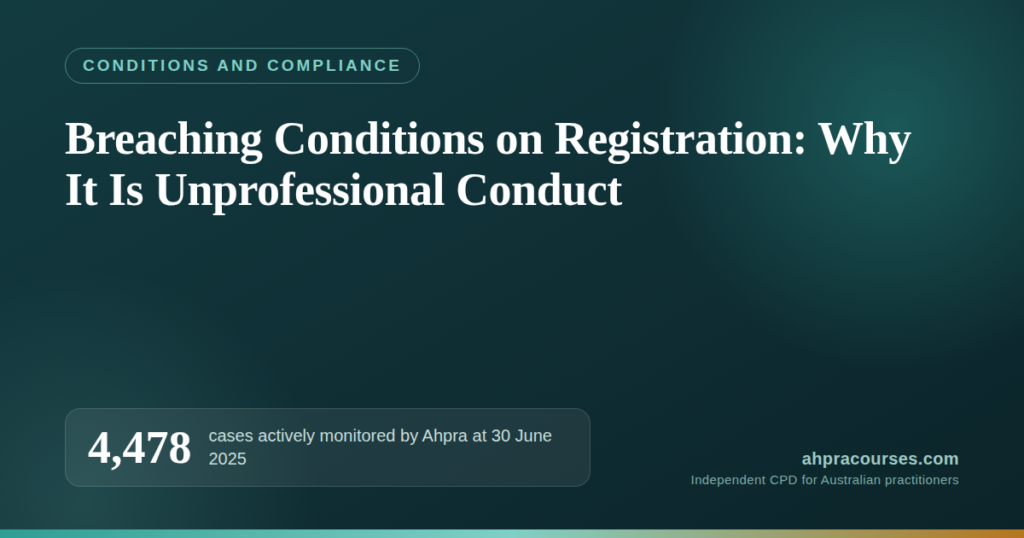
Under section 5 of the National Law, contravening a condition on your registration or an undertaking given to your National Board is specifically included in unprofessional conduct. Ahpra was monitoring 4,478 cases at 30 June 2025 and relies on independent information rather than self-reporting. Non-compliance usually starts with a request for an explanation, then may lead to a caution, further restrictions, a panel reprimand or, for serious breaches, a tribunal finding of professional misconduct. Most published breaches involve missed nominations, missing forms and poor engagement, so a deadline calendar and early nominations prevent most problems.
Why is breaching a condition treated as unprofessional conduct?
Because the National Law says so in terms. A breach does not need to harm anyone to count.
Conditions and undertakings are how a National Board lets a practitioner keep working while a risk is managed. If you do not comply, the Board loses the assurance that justified letting you practise. That is why the definition of unprofessional conduct in section 5 of the Health Practitioner Regulation National Law lists contravening a condition or an undertaking as one of its eight specific inclusions.
National Law, section 5, definition of unprofessional conduct
"a contravention by the practitioner of" either of the following:
- "a condition to which the practitioner's registration was subject; or"
- "an undertaking given by the practitioner to the National Board that registers the practitioner; and"
Two consequences follow. First, the original concern and the breach are separate matters: you can be dealing with the conduct that led to the conditions and, at the same time, a fresh allegation about how you complied with them. Second, the question for a panel is often simple and factual. Did you meet the deadline, nominate the educator, keep the chaperone in the room? Good intentions rarely answer it. For the wider framework, including the other seven inclusions, see our guide to how unprofessional conduct compares with professional misconduct. If you are new to restrictions, start with what conditions and undertakings are.
How does Ahpra monitor compliance?
Through a dedicated monitoring and compliance team, a written monitoring plan and checks that do not rely on your word alone.
Source: Ahpra annual report 2024/25, Compliance. Ahpra closed 2,148 monitoring cases during the year. Cases monitored by the HPCA in NSW and the OHO in Queensland are counted separately.
Ahpra says its monitoring is designed to confirm practitioners are complying with their restrictions and to identify when they are not, so that risks to patients can be managed. Each practitioner receives a monitoring plan setting out what they must provide and when. In its 2024/25 annual report Ahpra describes checking the systems at a practice location, whether staff understand the restrictions and whether the practitioner's details are accurate, and states: "We place greater weight on independent sources of information and avoid relying on self-reported compliance."
In practice, that means reports from supervisors, mentors and senior people at your workplace, attendance logs, screening results and records can all be compared with what you tell Ahpra. Around 70% of restrictions in the most common categories follow an assessment of a registration or renewal application rather than a notification, so compliance obligations are not only a disciplinary issue.
What does compliance look like for each type of restriction?
Every restriction comes with its own paperwork, deadlines and failure points.
Since 16 September 2024, new restrictions are drawn from Ahpra's National Restrictions Library 2.0, which sets standard wording for each restriction type. Your actual timeframes are inserted into your own conditions, so read them rather than assuming a standard period.
| Restriction type | What you usually have to do | Common failure point |
|---|---|---|
| Complete formal education | Nominate a program with a detailed curriculum, wait for approval, complete it, submit evidence and a reflective practice report | Late nomination, or starting before approval |
| Complete one-on-one education | Nominate an educator with their CV and an education plan; education must include real-time interaction | No educator nominated; audio-only or pre-recorded plans |
| Complete mentoring | Nominate a mentor with a CV and mentoring plan; mentor reports and your reflective report follow | Not renominating within 30 days if the mentor withdraws |
| Supervised practice | Acknowledge the condition, nominate a supervisor and a senior person at each practice location, provide reports | Practising when no supervisor is approved or available |
| Chaperone and patient restrictions | Only see defined patients with an approved chaperone present, or not at all | One unchaperoned consultation |
| Health restrictions | Attend treatment, manage health as directed, complete drug or alcohol screening | Missed or diluted screens, missed appointments |
Ahpra's education pages add two rules worth knowing. "It is recommended that you do not commence the program of education before your nomination has been considered and approved." And "You must not include the program of education as part of your CPD requirements for the renewal period." For the full step-by-step on education conditions, see our guide to complying with an education condition.
How do practitioners end up in breach?
Published panel decisions show that most breaches are about process and engagement rather than deliberate defiance.
No educator, mentor or supervisor nominated within the period set by the condition.
Acknowledgements, reports and evidence of completion not lodged by the date required.
Seeing a restricted patient group, practising alone or practising at an unapproved location.
Continuing to work, or prescribing, when supervision was not in place.
Ignoring prompts, letters or notices about compliance, which panels treat as aggravating.
Giving the Board or an employer an inaccurate picture of your work or your conditions.
The last two matter most. In the decisions below, poor engagement and misleading information appear again and again where outcomes were most serious.
A breach finding usually turns on how you engage with Ahpra. Get structured support for responding to a notification and building your evidence.
Get the Notification & Investigation Response ProgramWhat happens when Ahpra finds non-compliance?
It usually starts with a request for an explanation. What happens next depends on the breach, the risk and your response.
Ahpra says that where a practitioner does not do what the restrictions require, it first seeks an explanation from them.
The Board that placed the restrictions may take further action, including a caution or further restrictions. Repeated failures or delays in nominating education "may be considered non-compliance and may result in further regulatory action".
Persistent or more serious breaches can be referred to a panel, which can find unprofessional conduct and reprimand, caution or impose new conditions. Panels sit in private.
Where the Board believes the breach may amount to professional misconduct, it can go to a tribunal, which can suspend or cancel registration. Practising while not permitted can also lead to criminal proceedings.
The steps are not a fixed ladder. A Board can move straight to a panel or tribunal where the risk warrants it, and a single breach that exposes patients to harm will be viewed very differently from a late form. Our guide to panel and tribunal hearings explains how each forum works.
What have panels and tribunals actually decided?
Six published decisions show the range, from a caution to cancellation.
The pattern is consistent. Administrative failures handled at panel level tend to attract a caution or reprimand plus mentoring aimed at understanding obligations. Breaches that put patients at risk, or that involve misleading the regulator, are where tribunals have found professional misconduct and removed practitioners from practice. Remorse and cooperation helped in some cases, but no decision treated being busy as an excuse.
How do you build a compliance system that works?
Treat your conditions as a project with a calendar, an owner and evidence, not as a letter to file away.
Week one
- Read every condition and your monitoring plan line by line
- Lodge the acknowledgement forms by the date required
- Put every deadline in a calendar with reminders well before each one
- Ask your case officer about anything unclear, in writing
Nominations
- Identify educators, mentors or supervisors before the deadline, with backups
- Send CVs, plans and curricula that map to the topics in your condition
- Do not start education until it is approved
- If a mentor or educator withdraws, renominate within 30 days
Workplace
- Make sure the senior person at each practice location has your conditions
- Build chaperone, supervision or patient limits into booking systems
- Do not practise if your required supervisor is not approved or available
- Before starting at a new location, check whether your conditions require approval or a nominated senior person there
Evidence
- Keep a compliance log with dates, documents and submission receipts
- Ensure supervisor, mentor and senior person reports go in on schedule
- Write reflective reports that show learning, not a list of topics
- Keep copies of every email; Ahpra aims to acknowledge emails within 48 hours
Red flags to act on immediately
- A deadline is approaching and you have no approved nominee
- Your supervisor, mentor or chaperone is unavailable but patients are booked
- You have received a letter from Ahpra asking you to explain non-compliance
- You are changing jobs, locations or hours and are unsure what your conditions require
If any of these apply, contact your case officer and your indemnity insurer, defence organisation or a health law solicitor before the deadline passes. A prompt, honest explanation is far easier to give than a late one. Ahpra notes it does not provide templates for mentoring plans, one-on-one education plans or audit plans; plans need to give the Board assurance that the issues leading to the restrictions will be adequately addressed.
Where does nominated education fit in?
Education conditions are one of the most common restrictions and one of the easiest to breach through delay.
Where education is required you usually nominate a course and the Board, through Ahpra, decides whether it covers the topics in your condition. Ahpra states: "Generally, only online programs of education with interactive content and/or an assessment component will be approved." Choosing structured, assessed learning that maps to your topics, and nominating it early, removes the most common cause of breach in the decisions above.
The reflective practice report that follows is where many practitioners struggle. Ahpra may ask for a further report, or a reflective practice discussion, if it is unsatisfactory. Our guide to writing a reflective statement explains how to show genuine learning, and our guide to demonstrating insight covers what decision-makers look for.
Need to show insight and real change after a breach or an education condition? Build reflection, insight and remediation evidence in one structured program.
Get the Insight, Reflection & Remediation ProgramCan conditions be changed or removed after a breach?
Yes, but a breach usually makes that harder, because removal depends on the Board being satisfied the restrictions are no longer needed.
Ahpra states that restrictions remain on your registration until the Board is satisfied they are no longer necessary. A practitioner who has missed deadlines or needed reminders gives the Board less evidence that the risk is managed, and panels have re-imposed conditions with new review periods after breaches. Rebuilding a clean record of compliance is usually the first step.
If a condition is genuinely unworkable, for example because no suitable supervisor exists where you work, raise it with Ahpra before the deadline rather than after. The process for applying to change or remove conditions, and the evidence that helps, is covered in our guide to how to get conditions removed. You can browse every course and guide on the Ahpra Courses home page.
Learning that supports compliance
Courses for practitioners managing conditions
Two hours of structured CPD each, with a dated certificate. If you have an education condition, nominate before you start and wait for approval.
How to Ensure a Mistake or Misconduct is Not Repeated
- Analyse what led to the breach
- Plan safeguards against recurrence
- Document the changes you make
Professional Ethics
- Duties to regulators and patients
- Ethical decision-making under pressure
- Applying your Board code
Module on Remediation
- Structure targeted remediation
- Link learning to identified concerns
- Record evidence of change
Module on Reflection
- Reflective models for practice
- Writing reflective reports
- Linking reflection to action
Frequently asked questions
Is breaching conditions on registration unprofessional conduct?
Yes. Section 5 of the National Law lists a contravention of a condition on your registration, or of an undertaking given to your National Board, as specifically included in the definition of unprofessional conduct, whether or not anyone was harmed.
What happens if I miss an Ahpra compliance deadline?
Ahpra says it first seeks an explanation. The Board may then caution you, impose further restrictions or refer the matter to a panel. Contact your case officer and indemnity insurer once a deadline is at risk.
Is breaching an undertaking treated the same as breaching a condition?
Yes. The National Law definition of unprofessional conduct covers a contravention of a condition on registration and a contravention of an undertaking given to the National Board, so both can lead to the same kinds of regulatory action.
How does Ahpra know if I am complying with conditions?
Ahpra gives each practitioner a monitoring plan and checks compliance through reports, records and workplace checks. Its annual report says it places greater weight on independent sources of information and avoids relying on self-reported compliance.
Can breaching conditions lead to cancellation of registration?
It can. Published tribunal decisions include a Queensland doctor and a WA enrolled nurse found to have engaged in professional misconduct for breaching conditions, with cancellation or disqualification from applying for registration for a set period.
Can I start a course before Ahpra approves it?
Ahpra recommends you do not start an education program before your nomination has been considered and approved, because earlier learning may not count. Nominate early, include the curriculum, and wait for written approval before you begin.
What if my supervisor or mentor becomes unavailable?
Restriction wording often requires you to stop practising if no approved supervisor is available. If a mentor or educator withdraws, Ahpra's restriction pages require a new nomination within 30 days. Tell your case officer straight away.
Does a breach stop me getting conditions removed later?
Not permanently, but it usually makes removal harder. Restrictions stay until the Board is satisfied they are no longer necessary, and a breach weakens that case. A sustained, documented record of full compliance helps rebuild it.
Official sources
- Health Practitioner Regulation National Law (Queensland), section 5
- Ahpra: Annual report 2024/25, Compliance
- Ahpra: Monitoring and compliance
- Ahpra: National Restrictions Library 2.0
- Ahpra: Complete formal education
- Ahpra: Complete one-on-one education
- Ahpra: Complete mentoring
- Ahpra: Supervised practice across entire practice area
- Ahpra: Monitoring and compliance FAQs
- Ahpra: Panel hearing summary 2025.0929 (Medical, QLD)
- Ahpra: Panel hearing summary 2023.0922 (Occupational Therapy, QLD)
- Ahpra: Panel hearing summary 2023.0923 (Chiropractic, VIC)
- Ahpra: Panel hearing summary 2022.0916 (Nursing and Midwifery, WA)
- NMBA: Tribunal disqualifies nurse for 12 months for breaching conditions
- Medical Board of Australia: Medical practitioner disqualified for two years for breach of conditions