Writing the Reflective Report After an Ahpra Education Condition
Finished the education your conditions require? The reflective practice report is what Ahpra assesses next. Here is what it must show, how to structure it, what to attach and what happens if it falls short.
In short
If your restriction requires formal education, one-on-one education or mentoring, Ahpra's protocols require a reflective practice report after you finish. It must show, to Ahpra's satisfaction, that you reflected on the concerns behind the restriction and that the education addressed them, with evidence of practice change. Ahpra suggests four parts based on Gibbs' reflective cycle, at about 200 to 250 words each. If the report falls short, Ahpra may ask for another, offer a reflective practice discussion or consider further action.
Key facts: reflective reports under education conditions
- 16 Sep 2024Ahpra's current protocols and National Restrictions Library 2.0 apply to restrictions imposed or accepted from this date.
- 30 daysUnder the formal education protocol, you acknowledge the restriction (Form HPA.2.02) within 30 calendar days of the start date.
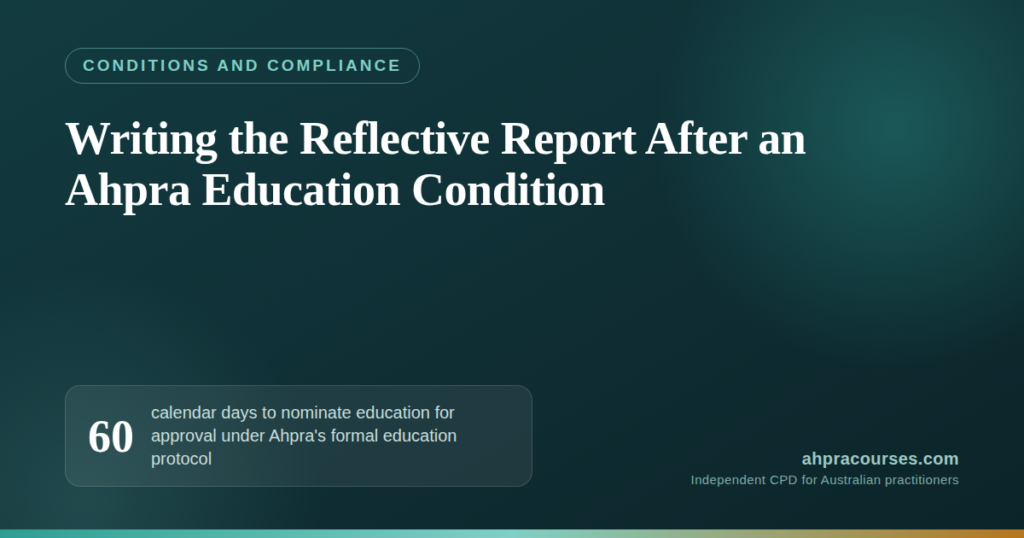
- 60 daysUnder the formal education protocol, you nominate a program for approval within 60 calendar days of the restriction start date.
- 4 stepsAhpra's information sheet suggests description, feelings, evaluation and analysis, and conclusion and change, based on Gibbs' reflective cycle.
- 200 to 250Words per section is Ahpra's general guide, with no strict word limit.
- Not CPDEducation completed under the protocol cannot count toward your CPD, and writing the report cannot count toward the required hours.
- DoctorsThe information sheet is endorsed by every National Board except the Medical Board of Australia.
- 4,478Cases Ahpra was actively monitoring at 30 June 2025 (Ahpra Annual report 2024/25).
Sources: Ahpra Practitioner restrictions and protocols; Ahpra reflective report information sheets; Ahpra Annual report 2024/25.
When do you have to write a reflective report after an Ahpra education condition?
A reflective practice report is required when your restriction says so. Ahpra's restrictions for formal education, one-on-one education and mentoring each tell the practitioner to write and submit a reflective practice report that shows reflection on the issues behind the restriction, after the education or mentoring is complete.
An education condition is a restriction on your registration, usually imposed or accepted after a notification. Since 16 September 2024, Ahpra uses standard wording from the National Restrictions Library 2.0, with placeholders such as #timeframe#, #date# and #insert topics(s)# that are filled in for each practitioner. That means there is no single national deadline: your own restriction and monitoring plan set the timeframe. Our overview of conditions and undertakings explains how these restrictions arise; this guide covers the report itself.
| Restriction (Library 2.0) | Reflective report | If the report falls short |
|---|---|---|
| Complete formal education | Required Write and submit after completing the education, within the timeframe in your restrictions | Further report, reflective practice discussion, or further regulatory action |
| Complete one-on-one education | Required Same wording: a report that demonstrates your reflections on the issues | Further report, reflective practice discussion, or further regulatory action |
| Complete mentoring | Required After the mentoring, alongside regular and final mentor reports | Further report, reflective practice discussion, or further restrictions |
| Complete education for suitability and eligibility | Check wording The protocol only mentions the report in its extensions section, but the restriction page FAQs explain how to write one and what happens if it is not satisfactory | Follow your own restriction and monitoring plan |
Source: Ahpra restriction pages and Ahpra protocols for each restriction, National Restrictions Library 2.0. Restrictions imposed before 16 September 2024 follow Library 1.0.
What does Ahpra assess in a reflective practice report?
Ahpra's Protocol for formal education says the report must show, to Ahpra's satisfaction, that you reflected on the concerns behind the restriction and that the education addressed those concerns. You must also provide evidence of practice changes appropriate to the focus of the education and the severity of the concerns.
Read closely, that sentence and the clause before it set a three-part test. A report that only describes the course meets none of them.
The report engages with the specific concerns in your restriction, not the topic in general.
It shows how the education addressed those original concerns, linking named lessons to the gaps identified.
It gives evidence of practice changes appropriate to the focus of the education and the severity of the concerns.
The mentoring protocol uses parallel wording: the report must show that you reflected on the concerns and that the mentoring addressed them. In practice, the strongest reports read as if the author had the restriction wording open beside them, because every section answers part of it. That is also the core of demonstrating insight.
How should a reflective report for Ahpra be structured?
Ahpra's information sheet on reflective reports (education) suggests four parts based on Gibbs' reflective cycle: description, feelings and response, evaluation and analysis, and conclusion and change. Ahpra says this is guidance and not the only acceptable format, and suggests about 200 to 250 words per section.
The sheet also asks you to refer to relevant registration standards, codes and guidelines where appropriate. An action plan is optional. Here is what each part should cover, drawn from Ahpra's prompts:
Describe the situation objectively, without drawing conclusions, and protect the confidentiality of anyone involved.
- What happened, when, where and who was involved
- What you did, what others did, the outcome and its impact
- The education you completed and its key lessons
Reflect honestly on your reactions, which is often the section practitioners rush.
- Your thoughts and feelings before, during and after the education
- How you view those reactions now
Judge the learning and analyse the original event.
- Whether the education helped, and what you learned or relearned
- What was most valuable, and why
- The critical features of the original situation
Ahpra's prompts include "what will you do differently if the event, situation or activity were to happen again in the future?" Also cover:
- Positive and negative outcomes of the whole experience
- How you would respond if you saw a colleague practise in a similar way
- The skills you have developed or need to develop, and the steps you are taking
For doctors, there is a wrinkle. The information sheet is endorsed by all National Boards except the Medical Board of Australia, and Ahpra's monitoring FAQ states that the reflective report guidance does not apply to medical practitioners. The formal education protocol still requires a reflective practice report where your restriction includes one. If you are a medical practitioner, ask your Ahpra case officer whether a particular format is expected, and make sure the report still meets the three-part test above.
Writing to a standard Ahpra will assess is a skill. Build structured evidence of insight, reflection and remediation in one program.
Get the Insight, Reflection & Remediation ProgramWhat evidence should you submit with the reflective report?
Under the formal education protocol, you submit evidence of completing the approved program together with your reflective practice report, within the timeframe in your restrictions. Evidence of completion includes a certificate of completion or written confirmation from the education provider, and Ahpra may contact the provider to confirm it.
Required by the protocol
- Certificate of completion or written provider confirmation
- Formal assessment results, if your restriction requires assessment
- The reflective practice report itself
- Evidence of practice changes appropriate to the concerns
Often useful in practice
- A copy of the approval of your nominated course
- Dated examples of changed processes, such as a revised template or checklist
- Audit results, if your restriction includes an audit
- A brief note confirming the hours were not counted as CPD
The second column is our suggestion, not an Ahpra list. Keep everything de-identified. Some practitioners find it easier to collect this as they go; our remediation evidence portfolio tool is one way to organise it. If you are still choosing a course, our guide to complying with an order to complete a course covers nomination and approval, including Ahpra's statement that education done before approval may not count.
What makes a reflective report fall short?
A reflective report falls short when it does not show reflection on the specific concerns or how the education addressed them. In practice, the most common weaknesses are describing the course instead of the event, minimising responsibility, and promising change without any evidence of it.
Weakness
Stronger approach
A course summaryPages on what the module covered, with little about your own event.
Spend most words on the event, your analysis and your changes; mention course content only where it changed your thinking.
Missing the concernsReflecting on a general topic, such as communication, when the restriction names a narrower concern.
Quote or paraphrase each concern from your restriction and answer it directly.
Blame or minimisingExplaining why others, workload or systems were at fault.
Acknowledge context briefly, then focus on what was within your control.
No evidence of changeVague promises to be more careful, with nothing to show for it.
Describe a specific, dated change and how you check it is working.
Skipping feelingsJumping from description straight to lessons.
Complete Ahpra's feelings step honestly; it shows self-awareness.
Breaching confidentialityNaming patients or colleagues.
Use roles, not names, as Ahpra's sheet asks you to preserve confidentiality.
What happens if Ahpra is not satisfied with your reflective report?
Ahpra's protocols say it may require a further reflective report, invite you to a reflective practice discussion, or propose alternative regulatory action if it is not satisfied that your report addresses the original concerns. A report is not a formality: the restriction stays until requirements are met.
The restriction pages describe the reflective practice discussion as something that may be offered if your report does not satisfactorily demonstrate reflection on the concerns. The Ahpra pages we reviewed do not describe a format for that discussion, so treat it as a chance to show the reflection the written report missed. The mentoring page adds that Ahpra may impose further restrictions to protect the public if the mentor's reports and your reflective report do not show the risk has been addressed.
Not engaging at all is far more serious. Published panel summaries show where repeated non-compliance with education conditions led:
Breached conditions requiring education and disengaged from Ahpra's compliance team, after two cautions.
Outcome: reprimand, with advice that further breaches could lead to tribunal action.
Extended failure to comply with conditions requiring education, with two prior cautions for non-compliance.
Outcome: reprimand.
Breaches included failing to nominate an educator for one-on-one education and failing to provide compliance forms on time.
Outcome: unprofessional conduct, reprimand and a mentoring requirement.
Source: Ahpra panel hearing summaries 2020.0895, 2022.0910 and 2025.0929. Practitioners not named.
If timing is the problem, the formal education protocol says extension requests are assessed case by case and must be made in writing before the due date in your monitoring plan. Our guide to what happens when conditions are breached explains the wider compliance picture. If a report is challenged, consider advice from your professional indemnity insurer, a medical defence organisation or a health law solicitor.
What does a model reflective report structure look like?
A model reflective report follows Ahpra's four parts, opens with the restriction details, and closes with evidence. The outline below is illustrative only: it shows how the headings and sentences might read for a documentation concern, and should be rewritten entirely in your own words about your own event.
Illustrative example, not a real case
Header
Practitioner name and registration number. Restriction: complete formal education on clinical documentation. Approved course, provider, dates completed and hours.
1. Description
In March, a notification led to a review of my records for a series of consultations. The review found that my notes did not record examination findings or the advice given. I completed the approved course over two sessions. Its key lessons were contemporaneous recording and documenting advice and follow-up.
2. Feelings and response
When the notification arrived, my first reaction was defensive, because I believed my care had been appropriate. During the course, I recognised that the record is part of the care, not an afterthought. I now see my earlier reaction as a barrier to learning.
3. Evaluation and analysis
The most valuable part was the case-based exercise on records read by another clinician. The critical features of the original situation were late note-writing at the end of long sessions and reliance on memory. I reread the parts of my Board's code of conduct that deal with health records and mapped my gaps against them.
4. Conclusion and change
I now write notes during or immediately after each consultation and use a structured template. I audit ten of my own records each month against the course checklist; the last three audits are attached. If I saw a colleague recording notes as I did, I would raise it with them directly.
Attachments
Certificate of completion. Course approval. De-identified template. Three monthly self-audit summaries.
Notice that the course occupies a small share of the words. The event, the analysis and the evidence of change carry the report. For a mentoring restriction, the same structure applies, with your mentor's reports alongside; our guide to mentoring conditions covers that process.
How is a reflective report different from a reflective statement?
A reflective report is written after Board-required education or mentoring, to show the restriction's purpose has been achieved. A reflective statement is usually written earlier, when responding to a notification, to show insight before any decision. They overlap in skills but differ in timing, audience and test.
| Feature | Reflective report (condition) | Reflective statement (notification) |
|---|---|---|
| When | After completing required education or mentoring | Usually with your response to a notification |
| Why | A requirement in your restriction and protocol | Voluntary evidence of insight and remediation |
| Test | Reflection on the concerns, the education addressed them, proportionate change | Helps the Board decide what, if any, regulatory action is needed |
| Ahpra guidance | Information sheets on reflective reports (education and mentoring) | Your Board's code of conduct and the notice you received |
| Focus | The approved education or mentoring and what changed | The event, your insight and early remediation |
| If it falls short | Further report, reflective practice discussion or other action | Weighed with all evidence in the Board's decision |
If you are earlier in the process, our step-by-step guide on how to write a reflective statement covers the notification stage, and our guide to responding to a notification explains the wider response. Once your report is accepted and all requirements are met, see our guide to applying to have conditions removed.
How can you prepare before writing the report?
Preparation starts on the day the restriction begins. Keep the restriction wording in front of you, keep notes during the education, and record each practice change with a date. Reflection written from contemporaneous notes is usually more specific than reflection reconstructed months later.
- List each concern named in your restriction as a heading in a working document.
- During the education, note which lessons relate to which concern, and your honest reaction.
- Make one or two concrete practice changes and start recording evidence that they work.
- Draft the four parts, then check each against the three-part test.
- Remove names and identifying details, then submit with your evidence on time.
Our Module on Reflection course works through reflective models and writing structured reflection. Remember that Ahpra must approve any course nominated for a condition, the decision is Ahpra's, and those hours cannot also be claimed as CPD.
Still at the notification stage, or responding to new concerns? Plan your response and evidence in a structured program. You can browse every course and guide on the Ahpra Courses home page.
Get the Notification & Investigation Response ProgramLearning that supports reflection under conditions
Relevant courses
Two hours of structured CPD each, with a dated certificate. If you nominate a course for a condition, Ahpra decides whether to approve it. Completing a course does not determine any regulatory outcome.
Module on Reflection
- Recognised reflective models
- Writing structured, specific reflection
- Linking learning to practice change
Module on Insight
- What insight means to regulators
- Recognising the impact on others
- Expressing responsibility clearly
- Analysing what went wrong
- Building systems that prevent repeats
- Recording the changes you make
Module on Remediation
- Planning targeted remediation
- Gathering evidence of change
- Reviewing whether changes work
Frequently asked questions
Do I have to use Ahpra's four-step structure?
No. Ahpra says its recommended approach is not the only acceptable format. The four steps, based on Gibbs' reflective cycle, are a useful default because they cover what Ahpra assesses: reflection, learning and practice change.
How long should a reflective report for Ahpra be?
Ahpra's information sheet suggests about 200 to 250 words per section as a general guide, with no strict word limit. Across four sections that is roughly 800 to 1,000 words, plus any optional action plan.
When is the reflective report due?
Under the formal education protocol, you submit it after completing the education and within the timeframe set in your restrictions. Ahpra's standard wording uses placeholders, so your own restriction and monitoring plan set the date.
What is a reflective practice discussion?
It is a discussion Ahpra may offer if your reflective practice report does not satisfactorily show that you reflected on the concerns behind the restriction. Ahpra may alternatively require a further report or consider other regulatory action.
Can the education for my condition count toward CPD?
No. Ahpra's education protocols say education completed to satisfy the restriction cannot count toward your CPD requirements. Writing the reflective report also cannot count toward the hours or duration of the required education.
Does the reflective report guidance apply to doctors?
The information sheet is endorsed by every National Board except the Medical Board of Australia, and Ahpra's FAQ says the guidance does not apply to medical practitioners. Doctors should ask their case officer what format is expected.
Is a reflective report the same as a reflective statement?
No. A reflective report is a restriction requirement written after Board-required education or mentoring. A reflective statement is usually written when responding to a notification, before any decision, to show insight and early remediation.
Who can I ask for help with my reflective report?
Your Ahpra case officer can explain your restriction's requirements. For advice on wording that may affect your registration, consider your professional indemnity insurer, a medical defence organisation or a health law solicitor.
Official sources
- Ahpra: Information sheet, Reflective reports (education)
- Ahpra: Information sheet, Reflective reports (mentoring)
- Ahpra: Restriction, Complete formal education
- Ahpra: Restriction, Complete one-on-one education
- Ahpra: Restriction, Complete education for suitability and eligibility
- Ahpra: Restriction, Complete mentoring
- Ahpra: Ahpra protocols (National Restrictions Library 2.0)
- Ahpra: Annual report 2024/25, Compliance
- Ahpra: FAQ, Monitoring and compliance
- Optometry Board of Australia: Guidance on reflective practice reports (2021)
- Ahpra: Panel hearing summary 2020.0895
- Ahpra: Panel hearing summary 2022.0910
- Ahpra: Panel hearing summary 2025.0929