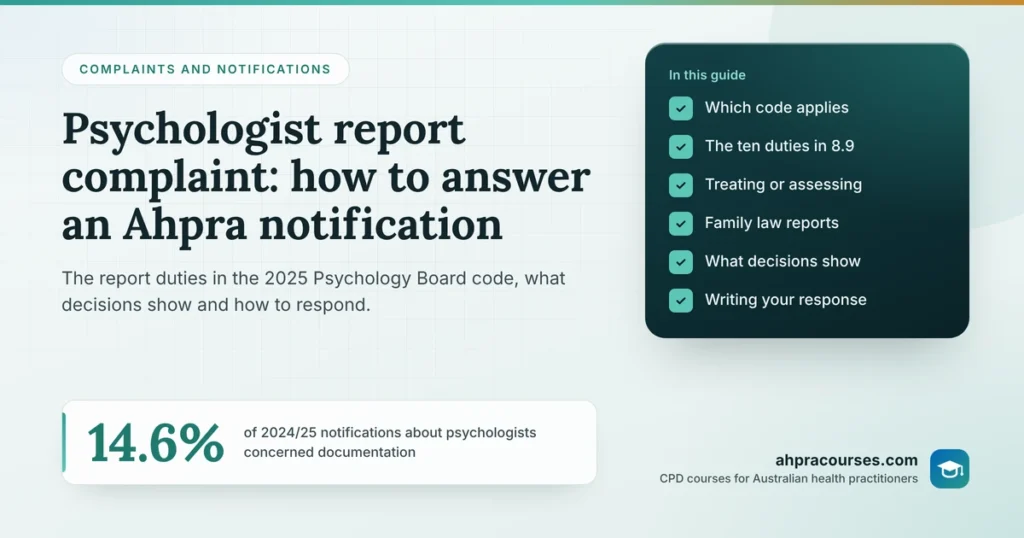
Psychologist report complaint: how to answer an Ahpra notification
Reports are where psychology meets conflict: one party reads your words as unfair, and a notification follows. This guide sets out the duties the 2025 Psychology Board code attaches to reports and assessments, what published decisions show, and how to write a response that shows judgement rather than defensiveness.
Key points first
Since 1 December 2025, psychologists must practise in line with the Psychology Board of Australia's Code of conduct, and section 8.9 sets ten duties for reports, certificates and evidence: true and objective statements, honesty about your competence, no opinions beyond your knowledge, verified content and disclosure of any earlier relationship with a client. Section 8.8 adds rules for assessments done for third parties. A notification about a report is usually decided on whether you kept to your role, stayed within your evidence and kept records that show how you reached each opinion. Answer on those points, with records and a frank account of what you would now do differently.
Best course for a report notification
Documentation Professionalism for Health Practitioners in Australia
A report notification is a documentation case at heart: what you recorded, what you relied on and how you wrote it. This course covers accurate, objective records and reports, the habits that keep opinions traceable to evidence, and gives you a dated, numbered certificate to place with your reflection.
See the documentation courseWhy do psychologists' reports attract so many notifications?
Because a report is often written into a dispute. Someone loses something because of it, and the quickest way to challenge it outside court is to notify the regulator about its author.
That does not make every notification unfair, and it does not make every one dangerous. The Psychology Board's 2024/25 annual summary gives the scale:
Source: Psychology Board of Australia 2024/25 annual summary. Reports and certificates fall within the documentation group, though a report concern can also be classed as clinical care or communication.
The same summary records 895 notifications lodged with Ahpra about 661 psychologists, out of 50,409 registered psychologists, and 1,549 notifications Australia-wide once the NSW and Queensland co-regulators are included. Of the 802 notifications Ahpra closed, 68.7% ended with no further regulatory action and 2.5% with a caution or reprimand. Patients, relatives or members of the public made 72.4% of notifications.
The NSW Psychology Council is blunt about where the risk sits. Its guidance on treatment reports says "The Council receives many complaints about court reports written by treating psychologists." If you are the treating psychologist and you wrote for a court, a tribunal or a lawyer, you are in the group most often complained about, and the role question below will matter most to you. For the broader process, our guide to what happens after a Psychology Board notification covers the general route.
Which code will your report be judged against?
It depends on when you wrote it. The Board's own Code of conduct came into effect on 1 December 2025, and it is now mandatory.
"Psychologists now have a mandatory obligation to practice in accordance with the Psychology Board's code of conduct as a requirement of their registration."
Psychology Board of Australia, Code of conduct pageThe new code replaced the Australian Psychological Society's Code of Ethics as the Board's standard. The Board notes that the APS code is no longer used by the Board but remains a valuable resource. The NSW Health Professional Councils Authority explains that the NSW Psychology Council "will now use the new Code of conduct when assessing conduct that has occurred since 1 December 2025", and describes the main change as the transition from ethical principles to "explicit standards contained in the Code of conduct."
So check the date of your report first. A report signed before 1 December 2025 will usually be assessed against the expectations that applied then, while anything you wrote afterwards, including any addendum or further letter, sits under the new code. Ask your adviser to confirm which standard the Board will apply, and write your response so it shows you understand both. Whatever the date, the new code's report sections are the clearest statement of what the Board now expects, and they are what your remediation should be built around.
What are the ten duties for reports in section 8.9?
Section 8.9, "Reports, certificates and giving evidence", opens with the principle that psychologists "should only make verbal or written statements that they know, or reasonably believe, are true and objective." It then lists ten practices. Map each allegation in your notification to one of them.
| 8.9 | What the code says, in short | Allegation it usually answers |
|---|---|---|
| a | Warn clients or other recipients of the reasonably foreseeable risks the information in your reports might hold for them | "I did not know the report would be used against me" |
| b | If agreed, prepare or sign documents within a reasonable and justifiable timeframe | Delay that harmed a court date, claim or treatment |
| c | Be honest about your qualifications, experience and the limits of your competence | Overstated expertise or titles |
| d | Make clear the limits of your knowledge and give no opinions beyond them | Opinions on people not assessed, or on questions outside your field |
| e | Verify the content before signing, and do not deliberately omit relevant information | Factual errors, missing information that cut the other way |
| f | Be honest, unbiased and truthful, and only sign documents you believe are accurate | Bias toward the party who paid or referred |
| g | Give honest and unbiased reports and evidence when legally obliged to provide information | Evasive or selective answers to a subpoena or court |
| h | Recognise and try to resolve conflicts between legal obligations and obligations to your client, and tell the client what your legal obligations are | Client surprised by what you disclosed |
| i | Behave as a witness in line with the legal rules that govern witnesses | Conduct in giving evidence |
| j | Recognise how a previous relationship with a client might affect your objectivity, and disclose the potential conflict | A treating psychologist writing as if independent |
Two other sections often sit beside 8.9. Section 1.1(c) asks you to "recognise, and work within, the boundaries of your competence", which matters when a report strays into risk prediction or parenting capacity without the training for it. Section 4.8(b) asks you to "be clear about the boundaries that must exist to ensure objectivity in service provision, and avoid conflicts of interest". Notifications about reports often turn on objectivity, so expect these to be quoted back to you.
Were you the treating psychologist or the assessor, and does it matter?
It matters more than anything else. Many report notifications are, underneath, about a psychologist who held one role and wrote as if they held the other.
If you were treating
- The NSW Council says you are "under no obligation to provide a report if the client initially engaged their services for treatment"
- Consider "only providing a treatment report, regardless of what has been requested by the client or their lawyers"
- State that you are the client's treating psychologist and set out the limitations of the report due to that relationship
- Use "extreme caution" before giving opinions about people you have not directly assessed
If you were assessing for a third party
- Section 8.8 says the usual psychologist and client relationship "does not exist"
- Clarify your role with the third party and explain to the person the purpose, nature and extent of the assessment and your reporting obligations
- Explain what refusal means and that it will be reported to the third party
- Obtain explicit consent to assess and report, or record the reasons if consent is not given, and provide an impartial report
Section 4.9 of the code sets the rule on multiple relationships: psychologists "must discontinue, or avoid, multiple relationships unless they hold a reasonable belief that they are ethically, legally or organisationally obliged to continue or enter into such relationships." If you decide to continue, the code expects contemporaneous records of the reasons and of how you will protect the interests of everyone involved. If you moved from treating to writing an opinion for a court without that record, say so honestly in your response and explain how you now decide. Our article on psychologists' boundaries and multiple relationships covers the wider rule.
Section 8.8 also contains a duty that is easy to overlook in a busy assessment: if you discover an unrecognised serious health issue during the assessment, you have a duty of care to inform the person or their treating practitioner. If your notification comes from someone you assessed, check whether that point applies to your file.
What do the family law standards add for family reports?
If your report was a family assessment, the courts' published standards set the practice benchmark, and a regulator can be expected to read them alongside the code.
The Australian Standards of Practice for Family Assessments and Reporting (February 2015), published by the Federal Circuit and Family Court of Australia, aim "to promote good practice in conducting and reporting in full family assessments by social workers and psychologists in family law matters." The document itself notes that it predates the courts' structural changes. It does not cover brief or preliminary assessments. Its key expectations include:
- Family assessors "must be qualified social science professionals and function as independent and impartial assessors."
- "Assessments arranged by one party or those that include only one side of a dispute should not be undertaken as they are incomplete assessments."
- "It is not appropriate to formulate an initial or early view or opinion on the issues in dispute."
- "Family assessors should avoid multiple relationships with any or all participants in matters."
- "Family assessors should not have substantive ex-parte communications about a case with the Court or with the solicitors representing the parties."
- Allegations should be put to the affected party so they can respond, and requests for statements to be kept confidential "cannot be honoured."
- "It is important to record what material has been read and when it was read." Psychometric tests are to be used "only in conjunction with other data collection methods."
A notifying parent will often say the report was one-sided, that you formed a view early, or that you spoke privately with the other side's lawyer. Your file is the answer: interview notes for each party, a dated list of material read, the reasons you weighed each source as you did, and any allegation you put to the other party with their reply.
What do published decisions about reports show?
Outcomes vary widely, which is why the quality of your response matters. Here are three published matters, with practitioners not named.
A psychologist completed assessment reports late, did not give some reports to clients, communicated poorly and claimed an endorsement in neuropsychology that was not held. The allegations were found, with admissions, and the panel treated the claim about the endorsement as unprofessional conduct very close to professional misconduct.
Reprimand, with conditions of 30 hours of education and 2 years of graduated supervision by an independent clinical psychologist (decision dated 24 March 2023).
A notification followed a report written for VCAT opposing a guardianship appointment, which was critical of a former carer. A panel found unsatisfactory professional performance and imposed six months of supervised practice on report writing and treatment plans.
On review, the tribunal found none of the allegations proved and substituted a decision that no further action be taken.
Allegations covered assessment, case formulation, suicide risk assessment and diagnosis in a client's care. The panel found unsatisfactory professional performance.
Caution, with conditions requiring supervision in assessment, case formulation, intervention and record keeping.
The lessons are practical. Delay and inflated credentials are treated seriously because they go to honesty and reliability, not just style. A critical report is not misconduct in itself: the 2018 matter shows that a well-founded opinion can be defended successfully. And where the weakness is in assessment method, regulators tend to want supervised, structured improvement in exactly that skill, together with better records.
How will Ahpra and the Board handle a report notification?
Like other notifications, it starts with an assessment of the risk, and your first response often decides whether it goes further.
Ahpra will usually send you the substance of the concern and ask for your response, often with a copy of the report and your file. The Board then decides whether to take no further action, take action such as a caution or conditions, or investigate further. Section 4.6(e) of the code asks you to "work cooperatively with the Board, Australian Health Practitioner Regulation Agency (Ahpra), or other body that has legal authority to examine concerns by providing a prompt, open and constructive response including an explanation when requested to do so". Section 8.11 adds that you should "cooperate with any legitimate inquiry into your conduct".
Two practical points. First, the notifier may be in active litigation, and anything you write may be read by them later, so write for a fair-minded reader, not for the person who complained. Second, do not contact the notifier about the notification. If the court proceedings are still running, tell your adviser, because your response must not become a further piece of evidence in the dispute. Our general guide on how to respond to an Ahpra notification sets out the timing and format that apply to every profession.
How should you structure your response?
Lead with the facts of your role and method, deal with each allegation against the code, and finish with what you have learned and changed.
- Your role and instructions. Who engaged you, what you were asked, what you agreed to do, and whether you were treating, assessing or both. Attach the referral or letter of instruction.
- Consent and information given. What you told the person about the purpose, your obligations and the foreseeable risks of the report, and how you recorded their consent (sections 8.8 and 8.9(a)).
- Your method. Who you interviewed, for how long, what you read and when, which tests you used and why. Show how each opinion links to the evidence.
- Each allegation in turn. Quote it, answer it with your records, and where you agree it is fair, say so plainly.
- Limits you stated, or should have. Identify any opinion that went beyond your knowledge or your assessment, and explain how you now handle requests for opinions about people you have not assessed.
- What you have learned. A short reflection on the gap, the risk it created for the people affected and for confidence in psychologists.
- What you have changed. New templates, a role-clarification letter, a checklist before signing, peer review for court work, and completed learning with certificates attached.
If you find the reflection hard to write, our guide on writing a reflective statement for Ahpra walks through a structure that Boards find credible, and the free notification response planner turns your deadline into a dated plan.
Start your remediation before you reply
- Handling the notification and investigation step by step
- Insight, reflection and remediation evidence the Board will read
- Seven courses with a certificate for each, about 14 hours in total
Which records will you need, and how long must you keep them?
All of them, in the state they were in when you wrote the report. Your file is your strongest evidence and the first thing a Board will ask to see.
Section 8.5 of the code asks you to keep records that are "accurate, up to date, factual, objective, legible and accessible", made "at the time of events or as soon as possible afterwards", and free of "demeaning or derogatory remarks". Section 8.5(g) sets a minimum retention period: at least seven years since the last entry for adult clients, and until after the 25th birthday of clients who were under 18 when the last entry was made. A notification can arrive years after a family report, so these periods are your protection as much as an obligation.
Self-check: could your file answer these questions today?
- Is there a written record of who engaged you and what question you were asked?
- Can you show what you told each person about your role, and that they consented, or why they did not?
- Do your notes show each interview, its date and its length?
- Is there a dated list of every document you read?
- Can you trace each opinion in the report to specific evidence in the file?
- Did you record any limitation, including an earlier treating relationship?
- Is any draft, correction or addendum dated and kept?
Never edit, add to or tidy a file after a notification arrives. If something is missing, say so in your response. The courses for psychologists on this site include records and report-writing practice you can apply to future work.
What makes a report notification harder to resolve?
Defending the report as if you were still in court. The regulator is not deciding the family or legal dispute; it is deciding whether your practice was safe and professional.
Avoid
- Attacking the notifier's motives or credibility
- Re-arguing the merits of the court case
- Repeating opinions about people you never assessed
- Claiming expertise, titles or endorsements you do not hold
- Sending a response without your adviser's review
- Altering or adding to the file after the notice arrives
Do
- Explain your role, consent and method with records
- Concede fair points early and plainly
- Show where your opinion stopped and why
- Describe the changes you have made to your report process
- Attach completed, relevant learning with a reflection
- Keep any future report work under peer review while the matter is open
Above all, keep the response calm and specific. Panels and Boards read many defensive letters. One that shows you understand sections 8.8 and 8.9, can see where your report fell short of them, and have already changed how you work, reads as insight. For more on demonstrating that, see our guide on demonstrating insight to Ahpra.
Chosen for report and assessment notifications
Learning that strengthens a psychologist's response
Each course is about 2 hours online with a dated, numbered certificate. Choose the course that matches the weakness the notification points to. The learning supports your evidence; it does not determine any Board, panel or tribunal outcome.
Documentation Professionalism for Health Practitioners in Australia
- Objective, accurate reports and records
- Linking each opinion to documented evidence
- Retention, corrections and addenda done properly
- Answering Ahpra calmly and on time
- Separating the legal dispute from the regulatory one
- Working with your insurer or lawyer
- Impartiality and conflicts of interest
- Multiple roles and when to decline
- Honesty about competence and credentials
- Seeing your report as a fair reader would
- Owning the gap without over-apologising
- Insight a Board can recognise in writing
Want everything in one place? The Notification and Investigation Response Program brings these together. Browse the full catalogue at ahpracourses.com.
Report notifications: what psychologists ask
Can someone complain to Ahpra just because they disagree with my report?
Yes, anyone can make a notification. Ahpra and the Board then assess whether there is a risk to the public. Disagreement with your conclusions is not misconduct in itself; the question is whether you kept to your role, worked within your competence, used a sound method and reported honestly and objectively.
Which code applies to a report I wrote before December 2025?
The Board's Code of conduct came into effect on 1 December 2025, and the NSW Psychology Council says it will use it for conduct that has occurred since that date. Earlier reports are generally assessed against the standards that applied when you wrote them. Ask your adviser to confirm which standard applies to your matter.
Should a treating psychologist write a court report?
The NSW Psychology Council says a treating psychologist is under no obligation to provide a report if the client engaged them for treatment, and suggests considering only a treatment report that states the treating relationship and its limits. Section 8.9(j) of the code requires you to disclose how an earlier relationship might affect your objectivity.
Can I give an opinion about a parent I never met?
Be very careful. The NSW Council advises extreme caution before giving clinical opinions about people you have not directly assessed, and section 8.9(d) of the code says not to give opinions beyond the limits of your knowledge.
How long must I keep records for a report?
Section 8.5(g) of the code requires at least seven years after the last entry for adult clients, and until after the 25th birthday of clients who were under 18 at the last entry, or longer if legislation or your organisation requires it.
Will a report notification usually lead to action?
Not usually. In 2024/25, 68.7% of the notifications about psychologists that Ahpra closed ended with no further regulatory action, and 2.5% ended with a caution or reprimand. The outcome depends on the facts and on what your response shows.
Should I contact the person who made the notification?
No. Do not contact the notifier about the notification, especially if court proceedings are continuing. Direct all communication through Ahpra and your adviser.
Does completing a course help with a report notification?
Learning matched to the weakness, such as report writing, records or ethics, together with a reflection and changes to your practice, helps show insight and lower risk. No course decides the outcome.
Official sources (10)
- Psychology Board of Australia: Code of conduct
- Psychology Board of Australia: Code of conduct (PDF, in effect 1 December 2025)
- Psychology Board of Australia: Psychologists to maintain high standards under new requirements (1 December 2025)
- NSW Health Professional Councils Authority: The new Code of conduct for psychologists
- NSW Health Professional Councils Authority: Treatment reports, dos and don'ts
- Psychology Board of Australia: 2024/25 annual summary
- Federal Circuit and Family Court of Australia: Australian Standards of Practice for Family Assessments and Reporting (February 2015)
- Ahpra: Panel hearing summary 2022.0918
- Ahpra: Panel hearing summary 2020.0875
- Psychology Board of Australia: Psychologist successfully appeals Board conditions (22 February 2018)