Medical Certificate Complaint to Ahpra: What Doctors Should Do Next
An employer queried a certificate you signed, or Ahpra has written to say a patient, insurer or colleague has raised one. Here is what Good medical practice expects, how tribunals have treated certificate concerns, and a calm plan for your response.
In short
The Medical Board of Australia says plainly that writing a medical certificate is a medical service, not paperwork. A certificate concern usually turns on four questions: did a real consultation happen, does the certificate say only what you know or reasonably believe to be true, was there a proper treating relationship, and did you keep a record. Tribunals have reprimanded doctors for a certificate given to a non-patient, a certificate written for a colleague after a brief look with no notes, and forged certificates used for the doctor's own sick leave. Most certificate notifications are about judgement and documentation rather than fraud, and the way you respond decides which of those it becomes.
Your certificate has been questioned. Fix the habit before you write your reply.
Documentation Professionalism for Health Practitioners in Australia covers certificates and reports that are said to be inaccurate or unsupported, how to date and word them honestly, and how to show a decision-maker your records have changed. About 2 hours, self-paced, with a dated certificate you can attach to your response.
Why does a medical certificate end up in front of the Medical Board?
Because other people rely on it without checking. An employer, a university, a court, an insurer or a government agency reads your signature as a statement that a doctor assessed this person and believes what is written. When that turns out to be wrong, the person who relied on it often complains, and the concern lands with Ahpra and the Medical Board of Australia.
The Board's July 2024 newsletter put it in one line: "Writing a medical certificate is a medical service." It added that "Issuing a medical certificate is not just an administrative task" and that people accept certificates "on the assumption they will only sign statements that they know, or reasonably believe, to be true."
Certificates also carry legal weight outside medicine. Under the Fair Work Ombudsman's guidance on sick and carer's leave, "Medical certificates or statutory declarations are examples of acceptable forms of evidence", and "Employers can ask employees to provide evidence for as little as 1 day or less off work." So a single one-day certificate can be the document an employer uses to decide whether leave was genuine. If an employer later doubts it, the doctor who signed it is the obvious person to ask, and sometimes the obvious person to notify.
"Writing a medical certificate is a medical service. It requires a real-time doctor patient consultation for the doctor to assess the patient."
Medical Board of Australia newsletter, July 2024None of this means a single disputed certificate ends a career. It means the Board will look at the certificate as clinical work: was there an assessment, was the content honest, and is there a record. If you can show all three, many concerns close. If one is missing, the Board wants to understand why and whether it will happen again. Our wider guide to integrity and dishonesty concerns for doctors covers billing and conflicts as well; this article stays on certificates.
Which certificate problems actually lead to notifications?
Certificate concerns fall into a small number of patterns. Knowing which one yours is lets you answer the real question instead of the one you fear.
| Pattern | What it looks like | What the Board will ask |
|---|---|---|
| No real assessment | Certificate issued after an online form, a text request or a quick conversation with no examination or history. | Was there a real-time consultation, and what did you assess? |
| Dates that do not match the consultation | Certificate covers days before you saw the patient, with nothing saying the earlier period is based on what the patient told you. | Does the wording make clear what you observed and what was reported to you? |
| No treating relationship | Certificate for a colleague, friend, relative or someone who was never booked as a patient. | Why were you the right doctor, and where is the record? |
| Content written to suit the request | Diagnosis, restrictions or fitness statements the patient asked for, beyond what you found. | Did you sign something you knew or should have known was inaccurate? |
| Non-medical purpose | Certificate used to avoid an appointment, a hearing or an obligation, with no clinical basis. | Did you consider why it was really wanted? |
| False certificate for yourself | Doctor creates or alters a certificate for their own leave or to explain an absence. | This is treated as a question of honesty and character, often alongside health. |
The first four are by far the most common in practice and are usually framed as conduct or performance concerns: you did a clinical task below the standard expected. The last two move towards dishonesty, which panels and tribunals treat far more seriously. Your response has to show the Board which side of that line your certificate sits, honestly and with evidence, and you should not try to place it on the safer side if the facts do not support it.
What does Good medical practice actually require when you sign a certificate?
Good medical practice: a code of conduct for doctors in Australia is the standard the Board measures you against. The current version, dated October 2020, has a specific section on this: section 10.9, "Medical reports, certificates and giving evidence", within section 10 on professional behaviour.
When the Board restated its expectations in July 2024, it quoted the good practice points that matter most here. Good practice involves:
"being honest and not misleading when writing reports and certificates, and only signing documents you believe to be accurate"
"taking reasonable steps to verify the content before you sign a report or certificate, and not omitting relevant information deliberately"
Two other parts of the code usually appear in certificate decisions:
- Honesty as a core value. Section 2.1 describes the values doctors must hold, including that "They must be honest, ethical and trustworthy." A certificate that says more than you know is measured against that sentence.
- Care for people close to you. Section 4.15 says: "Whenever possible, avoid providing medical care to anyone with whom you have a close personal relationship." Writing a certificate is providing care, so a certificate for a partner, relative, friend or close colleague sits inside this section even though the section does not mention certificates by name. Our article on treating family, friends and yourself goes through that section in detail.
Records sit underneath all of this. A certificate with no matching clinical note is very hard to defend, because the note is the only evidence that an assessment happened. If you want to see how the Board approaches notes generally, read our guide to documentation and records concerns for doctors.
Are online questionnaire certificates a breach of professional standards?
The Board has said that doctors working for services that issue certificates without a consultation "may be breaching professional standards". If your notification comes from work for an online certificate service, this is the most important section for you.
In its July 2024 newsletter, under the heading "Online medical certificates", the Board described services "with patients receiving an emailed certificate within minutes of completing an online questionnaire, without a consultation". It said a certificate "requires a real-time doctor patient consultation for the doctor to assess the patient", and that "providing healthcare without a real-time consultation is not good practice."
That last phrase links to the Board's Guidelines: Telehealth consultations with patients. The guidelines include a section headed "Prescribing or providing healthcare if you have never had a real-time consultation with the patient", which covers requests "based on the patient completing a health questionnaire, when the practitioner has never spoken with the patient." The guidelines say this "is not good practice and is not supported by the Board", and that a practitioner "must be able to explain how the prescribing and the management of the patient was appropriate and necessary". The guidelines themselves talk about prescribing and providing healthcare rather than certificates by name; the newsletter is where the Board applies the same reasoning to certificates.
"The platform's process was approved by the company." The Board looks at what you did as the doctor who signed.
"The questionnaire asked about symptoms." Answers typed into a form are not the real-time assessment the Board describes.
Whether you spoke with each patient, by video or phone, and what you asked and recorded during that call.
Whether you were the patient's usual doctor. The telehealth guidelines say it "may be appropriate for a patient's usual medical practitioner" to act without a consultation in some circumstances.
If you worked for such a service, stop issuing certificates through any pathway without a real-time consultation now, and say so in your response with the date you stopped. That is far more persuasive than defending the business model.
What have tribunals decided when a doctor's certificates were questioned?
Published decisions show the range. The practitioners are not named here; each case links to the official summary or judgment.
Certificate for a colleague after a brief look
[2024] QCAT 431, Queensland Civil and Administrative Tribunal, 29 October 2024
A GP was told by a colleague, who was not his patient, about flu-like symptoms. He made a brief visual check, did no test and made no record at his clinic. That night he wrote a certificate on another clinic's letterhead giving one week off work and emailed it from a personal address. The certificate and his handwritten notes were not put into any patient record. The matter also included a separate criminal conviction.
Outcome: professional misconduct and a reprimand. The Tribunal accepted the certificate "was not issued fraudulently or dishonestly", but said the certificate and the records failure together were "substantially below the standard". It recommended the Board consider whether the reprimand should stay on the national register for more than two years.
Certificate for a person who was not a patient
Queensland Civil and Administrative Tribunal, Medical Board summary, 29 June 2017 ([2016] QCAT 35)
A doctor gave a medical certificate and a diazepam prescription to someone who was not a patient of the unit where he worked and with whom he had no treating relationship. The person said the certificate was needed to excuse them from a parole or probation reporting appointment. The doctor said he felt under duress, admitted the allegations early and cooperated.
Outcome: unprofessional conduct, a reprimand and the Board's costs. The Tribunal "emphasised that a reprimand should not be considered a trivial sanction as it will be recorded on the public Register of Practitioners."
Forged certificates for the doctor's own leave
Victorian Civil and Administrative Tribunal, 25 October 2019, Medical Board summary, 7 January 2020 ([2019] VCAT 1678)
A hospital-employed doctor gave an employer four forged medical certificates over several months, stating treatment for a serious illness that was not true, and used them to claim sick leave, including leave donated by colleagues. Psychiatric evidence described a major depressive disorder at the time, and the doctor admitted the conduct when confronted.
Outcome: professional misconduct, a reprimand and three conditions on registration covering education, continuing treatment and mentoring.
None of these doctors ran a certificate business, yet each received a public reprimand. Missing records turned a judgement call into misconduct in the 2024 case, and where health was part of the story, the tribunal built treatment and support into the outcome. If your situation involves your own health, our guide on health and impairment notifications for doctors explains that separate pathway.
A reprimand is not permanent in every case. If one is already recorded, see how reprimands are removed from the register.
Is your certificate a judgement error or a dishonesty concern?
This is the question underneath every certificate notification. Work through it honestly before you write anything, because the Board will.
The distinction is not about how angry the notifier is or how much money was involved. It is about what you knew when you signed. A certificate dated for three days before the consultation, written because the patient said they had been unwell, is a wording and judgement problem if you genuinely believed the account and simply failed to say it was reported. The same certificate is a dishonesty problem if you did not believe the account and signed anyway because the patient was pushing.
Be careful with your own explanation. A response that overstates what you remember, or a note added after the event without saying so, can turn a wording concern into an honesty concern.
What happens after Ahpra writes to you about a certificate?
Certificate concerns follow the normal Ahpra notification pathway. Most do not go beyond assessment, but you should prepare as if your first response will be read closely.
Ahpra's guidance for practitioners describes an initial review, information gathering, an assessment of risk to the public by a delegate of the National Board, an investigation where needed, and a decision that involves someone from your profession. An investigation may include what Ahpra calls a case discussion, and Ahpra advises practitioners to involve their indemnifiers or professional associations early.
Immediate action, such as suspension or conditions while the matter is assessed, is reserved for situations where the Board believes there may be a serious risk to people and action is necessary to protect the public. A certificate concern on its own rarely meets that test, but a pattern involving many certificates, or certificates linked to prescribing drugs of dependence, could. If you receive a proposed immediate action notice, read our guide on responding to immediate action and keeping your work; the window to make a submission is usually short.
At the end, the Board can take no further action, caution you, accept undertakings or impose conditions, such as an education condition or an audit of certificates. The most serious concerns go to a panel or tribunal, which is where the reprimands above came from.
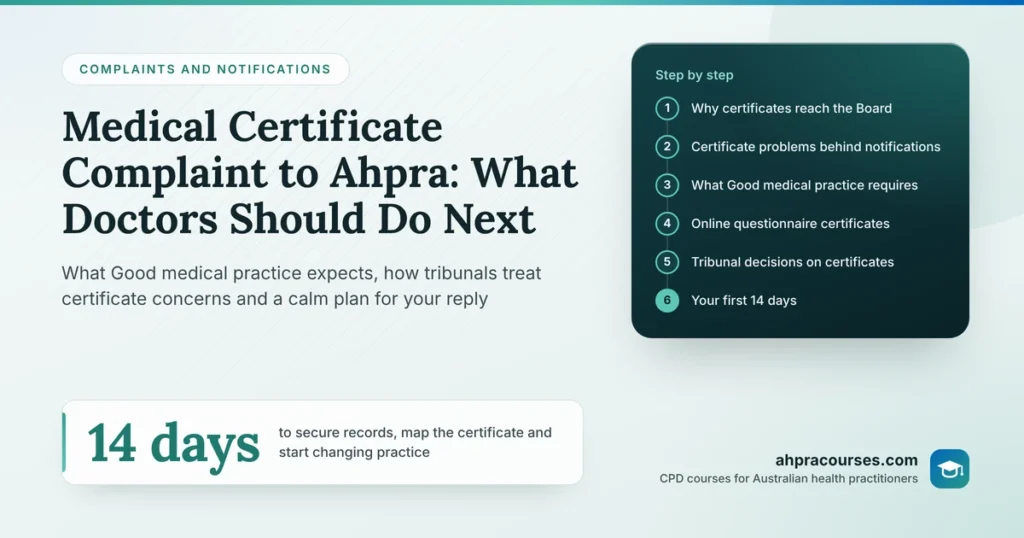
What should you do in the first 14 days?
The goal of the first fortnight is a response that is accurate, complete and shows you have already started to change how you issue certificates.
- Call your indemnity insurer first. Medical defence organisations see certificate notifications regularly. Ask for advice before you send anything to Ahpra or speak to the notifier.
- Secure the records. Retrieve the certificate, the clinical note, appointment data and any messages with the patient. Do not add to or change a note now; if you must add information, make a new dated entry that says when it was written.
- Place the certificate on the flow. Use the four questions above to decide, honestly, whether this was an assessment, wording, relationship or honesty problem.
- Write the timeline. Date of consultation, method, what you assessed, what the patient reported, what you wrote and why. Keep opinion about the notifier out of it.
- Name the standard. Refer to section 10.9 of Good medical practice and, if relevant, section 4.15 or the telehealth guidelines. Explain in your own words why the standard exists.
- Change the system now. Write a one-page certificate policy for yourself or your clinic, fix your template so it separates observed findings from reported history, and stop any pathway that issues certificates without a real-time consultation.
- Start targeted learning. Choose education that matches the concern, keep notes on what you learned, and plan an audit of your next certificates.
Notified over certificates, records or honesty? The Probity & Professional Integrity program for doctors brings together ethics, documentation, financial integrity, insight and remediation courses written to Good medical practice, so your response shows a structured plan rather than a promise.
Start the probity program for doctorsThe Probity & Professional Integrity program page lists all seven courses in the doctors' version. If you prefer to start with one course, the documentation course in the course block below is the closest match to a certificate concern. You can also map your reply with our free notification response planner and use our step-by-step guide on how to respond to an Ahpra notification.
Hypothetical: the Monday certificate for last week's absence
This scenario is invented to show how a common request can go either way.
Hypothetical scenario
A patient books a Monday appointment and tells the GP she was unwell from Wednesday to Friday the week before, stayed home and did not see anyone. Her employer wants a certificate for those three days. She has no symptoms now.
The GP writes a certificate dated the previous Wednesday stating the patient "was unfit for work" from Wednesday to Friday. The note says only "cert given". The employer later learns the patient attended an event on the Thursday and complains. The certificate reads as if the GP assessed her on Wednesday.
The GP dates the certificate on the Monday, states the date of the consultation, and records that the patient reported being unwell from Wednesday to Friday and that the GP did not assess her during that period. The note records the history taken and the GP's view that the account was plausible. If the employer complains, the certificate was accurate about what the doctor knew.
The difference is not compassion or suspicion. It is honesty about the source of each statement and a record that shows the reasoning. If you issued a Version A certificate, your response should say so, explain why the wording was misleading even if you believed the patient, and show the Version B template you now use.
What evidence shows the Board the risk has gone?
Boards and panels look for evidence that you understand the concern and that your practice has changed, not just that you completed a course. Build a short evidence bundle you could hand to a case officer.
What happened, which standard applied, why it matters to the people who rely on certificates, and what you would do differently. Our guide to demonstrating insight to Ahpra explains what decision-makers look for.
One page: real-time consultation only, date on the day of signing, reported history labelled, no certificates for people close to you, and how you handle pressure to change dates.
A certificate template with separate fields for date of consultation, observed findings and the period reported by the patient.
A review of your next run of certificates against the policy, ideally checked by a colleague or practice manager, with results dated and signed.
Courses matched to the concern, with your own notes on what you changed. If a Board later imposes an education condition, Ahpra usually needs to approve the course first.
If health, stress or workload played a part, a letter from your treating practitioner shows the Board the cause is being managed.
Keep each item dated. A bundle that shows change starting before the Board asks for it is far more persuasive than a list of promises. If you are unsure which learning fits, our course finder matches courses to the concern raised, and you can browse every course on ahpracourses.com.
Learning matched to a certificate concern
Courses for doctors whose certificates have been questioned
Each course is about 2 hours of self-paced CPD with a dated certificate. The learning supports the evidence you give Ahpra; it does not determine any regulatory outcome.
- Certificates and reports based on what you assessed
- Honest dating and labelling of reported history
- Correcting records without looking like concealment
Ethics and Ethical Standards for Doctors in Australia
- Honesty and trust under Good medical practice
- Care for people close to you
- Writing a reflection on a certificate decision
- Why regulators treat dishonesty as character
- Declarations and documents others rely on
- Changing systems after a probity concern
- Showing you understand why the certificate mattered
- Personal and system factors behind the decision
- An insight statement a case officer can rely on
Questions doctors ask about medical certificate notifications
Can a doctor be reported to Ahpra over one medical certificate?
Yes. Anyone can notify Ahpra, and a single certificate can be enough if it suggests there was no real assessment, the content was inaccurate or the person was not really your patient. Many single-certificate concerns close at assessment when the doctor can show a consultation, honest wording and a clinical record.
Is it ever acceptable to backdate a medical certificate?
The Board expects you to be honest and not misleading and to sign only documents you believe to be accurate. Date the certificate on the day you sign it. If the patient reports being unwell on earlier days, you can record that as the patient's report, making clear you did not assess them during that period.
Can I write a medical certificate for a family member or colleague?
Good medical practice section 4.15 says to avoid, whenever possible, providing medical care to anyone with whom you have a close personal relationship. A certificate is medical care, so it should come from the person's own doctor. In [2024] QCAT 431 a certificate for a colleague after a brief look and no record led to a reprimand.
Are certificates from online questionnaires allowed?
The Medical Board has said a certificate requires a real-time doctor patient consultation, and that doctors working for services issuing certificates after an online questionnaire without a consultation may be breaching professional standards. Phone or video consultations can be real-time; a form alone is not.
What outcome is likely for a medical certificate notification?
It depends on the facts. Many concerns close with no further action or a caution once records and changes are shown. Published tribunal cases involving certificates have ended in reprimands, and where dishonesty and health were involved, conditions covering education, treatment and mentoring.
Should I contact the patient or employer who complained?
Speak to your indemnity insurer first. Contacting a notifier about the complaint can be misread, and your response should go to Ahpra in writing. Keep any routine clinical contact with the patient professional and separate from the notification.
Will completing a course end the notification?
No course determines a regulatory outcome. Targeted education is one part of the evidence a Board weighs, alongside your insight, a changed certificate policy and template, and an audit showing your practice has changed.
Can I correct the clinical note now that a complaint has been made?
Do not alter an existing entry. If you need to add information, write a new entry dated the day you write it, saying it was added after the complaint and why. Changing records after a complaint can create a far more serious honesty concern.
Official sources
- Medical Board of Australia: Newsletter, July 2024 (Online medical certificates)
- Medical Board of Australia: Good medical practice, a code of conduct for doctors in Australia
- Medical Board of Australia: Guidelines, Telehealth consultations with patients
- Queensland Civil and Administrative Tribunal: [2024] QCAT 431
- Medical Board of Australia: Tribunal reprimands practitioner for providing a certificate and prescription ([2016] QCAT 35)
- Medical Board of Australia: Practitioner reprimanded for falsifying medical certificates ([2019] VCAT 1678)
- Fair Work Ombudsman: Notice and medical certificates
- Ahpra: What to expect when a concern is raised about you
- Ahpra: Immediate action
- Ahpra: Investigating practitioners
- Ahpra: How we manage concerns