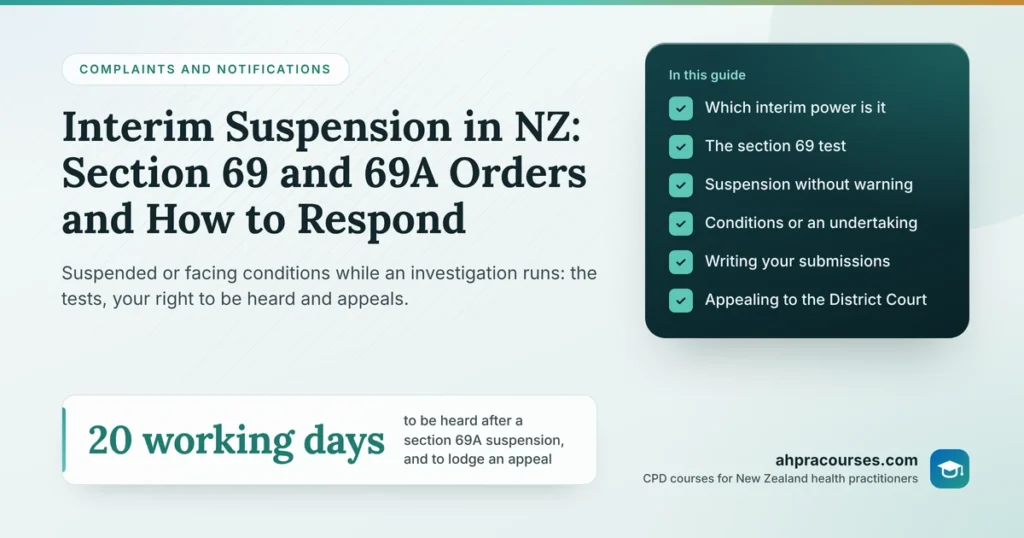
Interim Suspension in NZ: Section 69 and 69A Orders and How to Respond
A letter proposing interim suspension, or one telling you it has already happened, can arrive before anyone has decided whether you did anything wrong. Here is how the interim powers in the Health Practitioners Competence Assurance Act 2003 work, what the courts have said about them, and how to answer in a way your authority can act on.
Reviewed by the ahpracourses.com editorial team Updated
Short answer
Section 69 lets your responsible authority suspend your practising certificate, or add conditions, while a criminal case or an investigation by the Health and Disability Commissioner (HDC) or under the Act is pending, if it believes on reasonable grounds that the conduct casts doubt on the appropriateness of your professional conduct. It must tell you why and let you make written submissions and be heard first. Section 69A allows suspension without notice where the conduct poses a risk of serious harm to the public, but you must then be able to make submissions and be heard within 20 working days. Neither order has a fixed end date: each must be revoked as soon as practicable once the reason for it falls away. You can appeal to the District Court within 20 working days.
Proposal letter on your desk? Your written submissions are your best chance to shape what happens next.
"Interim suspension" is a phrase used for several different powers in the Act. Each has its own trigger, its own notice rule and its own end point, so the first step is to identify the section named in your letter.
Power
When it can be used
Notice before the order?
When it ends
Section 69
Conduct relevant to a pending criminal proceeding or a pending HDC or HPCA investigation that, on reasonable grounds, casts doubt on the appropriateness of your professional conduct
Yes: reasons, then a reasonable opportunity to make written submissions and be heard
Revoked as soon as practicable once one of four events in section 69(4) happens
Section 69A
Same pending matters, where the conduct poses a risk of serious harm to the public
No, but you must be able to make submissions and be heard within 20 working days of the order
Revoked when there is no longer a risk of serious harm, or the matter ends as in section 69
Section 39
You are, or will be, under a competence review and there are reasonable grounds to believe you pose a risk of serious harm by practising below the required standard
Yes
The later of the end of the review or passing any exam or assessment required
Section 48
Your authority considers you may be unable to perform the required functions because of a mental or physical condition
No
Up to 20 working days, extendable by up to 20 more for an examination
Section 93
After a notice of charge before the Health Practitioners Disciplinary Tribunal
No
When the charge is disposed of; you can apply to revoke at any time
This guide focuses on sections 69 and 69A, the conduct powers used while a complaint is being investigated. Section 70 of the Act stops your authority taking most disciplinary steps while the HDC is dealing with a complaint, but it is expressly subject to section 69, so an interim order can still be made during an HDC investigation. If the investigation is being run by a Professional Conduct Committee, our guide to the PCC investigation process in New Zealand explains what the committee itself can do.
Visual summary: Interim Suspension in NZ: Section 69 and 69A Orders and How to Respond
What does "casts doubt on the appropriateness" mean under section 69?
Section 69 has two gates. Both must be passed before your authority has any discretion to act.
Gate 1
The alleged conduct is relevant to a pending criminal proceeding, or a pending investigation under the Health and Disability Commissioner Act 1994 or the HPCA Act.
Gate 2
In your authority's opinion, held on reasonable grounds, the conduct casts doubt on the appropriateness of your conduct in your professional capacity.
Then
The authority may suspend your practising certificate or include one or more conditions in your scope of practice. It is a discretion, not a duty.
The District Court has described the factors that guide the discretion. In [2022] NZDC 4582 the court accepted that they include "the need for public protection", maintaining public confidence by upholding professional standards, and "the need for proportionality". The question on appeal was whether suspension was "the fair, reasonable and proportionate interim response". The same factors were applied in [2022] NZDC 4436, where the court also accepted the Medical Council's use of a precautionary approach.
So the realistic argument is rarely "nothing happened". An interim order is made before the facts are tested. The argument that matters is usually whether the order proposed is the least restrictive response that protects patients while the investigation runs.
When can a council suspend you without warning under section 69A?
Section 69A is the urgent version. The trigger is higher, a risk of serious harm to the public, but the authority does not have to tell you in advance.
The two conduct powers differ mainly in when you are heard: before the order under section 69, after it under section 69A.
Under section 69A(4), the authority must make sure you have the opportunity to make written submissions and be heard, personally or through a representative, within 20 working days of the order. Section 69A(6) also allows the authority, when it revokes a section 69A suspension, to impose conditions instead. The Medical Council's information sheet on its notifications process describes the same thing in plain terms: if a doctor is under investigation by a PCC or the HDC, or faces a criminal proceeding, and the Council considers the doctor poses a risk of serious harm, it "may immediately suspend" the practising certificate, and the doctor can comment after the suspension has been imposed.
If you have been suspended under section 69A, the 20 working day hearing is your first real chance to change the outcome. Treat it with the same seriousness as a hearing on the complaint itself.
Would conditions or a voluntary undertaking be enough?
Suspension is the most restrictive interim option, not the only one. The Medical Council's information sheet lists three: suspension of the practising certificate, conditions on scope of practice, or asking the doctor to sign a voluntary undertaking (VU).
Voluntary undertakingA promise you make about how you will practise. The Medical Council says a VU "will not be made public", although it may require you to tell employers.
Conditions on scopeFor example a chaperone, supervision, or not prescribing certain medicines. The Medical Council says conditions are, in most circumstances, publicly available.
SuspensionYou cannot practise. It can last for the full duration of the Council's other processes.
Your submissions should therefore address the next rung down. If suspension is proposed, explain why specific conditions would manage the risk. If conditions are proposed, check whether they are tied to the actual allegation or are wider than they need to be. The 2018 District Court decision discussed below shows a broad chaperone condition being replaced on appeal with a narrower undertaking.
Conditions that require a chaperone are common where the allegation concerns examinations. If that is your situation, the Chaperones and Intimate Examinations in New Zealand course covers the practical arrangements an authority will expect you to have thought through.
What should you put in your written submissions?
Section 69(3) gives you the right to make written submissions and be heard before a section 69 order is made. Use the right, and use it well. Your submissions are not the place to argue the whole complaint; they are the place to show that patients are safe while it is investigated.
1. Respond to the threshold
Say whether you accept that an investigation is pending and whether the conduct alleged is relevant to it. If the authority has the facts wrong, say so briefly with documents.
2. Address the risk, not the allegation
Identify exactly what risk the authority is worried about and describe what already controls it: changes to your role, supervision, a chaperone, or not doing certain work.
3. Offer a less restrictive alternative
Propose specific, practical conditions or an undertaking, with names of supervisors or arrangements already in place, and say how compliance will be checked.
4. Show insight without admitting what you dispute
You can recognise why the concern was raised, and its effect on patients and whānau, while still disputing the facts. Avoid attacking the complainant.
5. Attach evidence
Employer or supervisor letters, references from people who know about the concern, audits of your current practice, and certificates for learning already completed.
6. Explain the effect of suspension
Your income, your patients' continuity of care and the expected length of the investigation are relevant to proportionality. Courts have taken length into account.
Two documents are worth having to hand: your authority's letter, which should set out its reasons, and any material from the HDC or PCC that shows the scope of the investigation. Section 69 only applies to conduct relevant to a pending matter, so a clear account of what is actually being investigated helps you argue for terms that fit that concern and no more. The Responding to a Complaint for Health Practitioners in New Zealand course walks through structuring written responses like these.
An interim order usually sits alongside an HDC or PCC investigation, then sometimes a hearing. The NZ Complaint and Investigation Response Programme puts the courses for each stage together.
How long does an interim suspension last, and what ends it?
There is no fixed maximum for a section 69 or 69A order. Instead, the Act lists the events that require the authority to revoke it as soon as practicable.
(a)The authority is satisfied the appropriateness of your conduct is no longer in doubt (or, for 69A, there is no longer a risk of serious harm)
(b)The criminal proceeding is disposed of other than by conviction
(c)After a conviction, no disciplinary action is to be taken or continued
(d)The investigation is complete and you will not be charged
Revocation under section 69 takes effect immediately. The Medical Council's information sheet notes that interim suspension "may be in place for the full duration of any other Council process". The District Court in [2022] NZDC 4582 observed that a suspension in that case might exceed two years if charges followed, which put "into sharp focus" the need to check that such a long suspension was fair, reasonable and proportionate. In [2022] NZDC 4436 the court proceeded on the basis that suspension could last at least 8 to 12 months before any hearing.
Because events can change the picture, you can ask your authority to revoke or vary an order when circumstances change, for example when the police decide not to prosecute, when the HDC narrows its investigation, or when you have completed remediation and supervision is in place. Put the request in writing with the new evidence.
Can you appeal an interim suspension to the District Court?
Yes. Section 106(1) gives a right of appeal to the District Court against a decision of an authority to suspend your practising certificate or registration, to include conditions in your scope of practice, or to vary conditions. The reported interim order appeals discussed here were brought under section 106(1)(d) and (f).
20 working daysto lodge the appeal after notice of the decision is communicated, or longer if a judge allows (section 106(4))
Stays in forcethe order continues while the appeal is pending unless the court orders otherwise (section 108)
Rehearingthe court can confirm, reverse or modify the decision (section 109), or refer it back for reconsideration (section 111)
The court gives weight to the authority's assessment. In [2022] NZDC 4582 the judge said "significant respect" would be given to the Council's view on whether the conduct cast doubt on the doctor's professional conduct and whether suspension was a justifiable interim measure. An appeal is therefore strongest where you can show the order was not proportionate, or that relevant material was not considered, rather than simply disagreeing with the authority's concern.
What did the District Court decide in three interim order appeals?
These decisions were all appeals against the Medical Council under section 106. Practitioners are not named here; each case is cited by its neutral citation.
Section 69 condition: chaperone for all female patients
A doctor faced a single patient allegation of inappropriate touching. The police declined to prosecute, and the Council imposed a condition requiring a chaperone for all female consultations. The court held that the police decision was "a compelling factor", that the Council had not considered reports and references in the doctor's favour, and that the condition was "not fair, reasonable or proportionate". The condition was discharged and replaced with a narrower personal undertaking.
A doctor was suspended pending an HDC investigation into conduct relating to Covid-19. The court asked whether suspension was the fair, reasonable and proportionate interim response, noting that it might last more than two years. The court's published summary records that the appeal was allowed and the interim suspension was overturned.
Another doctor suspended under section 69 in the same period appealed. The court applied the same three factors, accepted the Council's precautionary approach, and assessed the appropriate interim measure as at the date of its own judgment. The Council had considered that a voluntary undertaking "did not provide assurance" of managing the risk, which shows why the content of an undertaking matters.
What these cases teach: courts look closely at proportionality, at whether a narrower measure would do, and at whether the authority considered the material the practitioner offered. That is exactly what your written submissions can supply.
What happens to your job, your income and the register while suspended?
A suspended practising certificate means you cannot practise in your profession for as long as the order lasts. Practical consequences follow quickly.
The register: the Medical Council says members of the public can search its register to see whether a doctor has been suspended. Conditions are usually publicly available too. Other authorities have their own publication policies; the Nursing Council, for example, publishes a policy on naming nurses subject to an order.
Your employer: section 35 of the Act allows an authority to tell an employer, the HDC, ACC and the Director-General of Health when it believes a practitioner's practice may pose a risk of harm. A voluntary undertaking may also require you to inform employers.
Your patients: plan handover of care with your practice or employer. Continuity of care is a legitimate point to raise in submissions, but patients must be looked after whatever the outcome.
Your skills: if the order runs for a long time, keep up learning that does not involve practice, and record it. If you are away from practice for years, return rules may apply; for doctors, see our guide to returning to practice after three years away.
The Nursing Council's concerns page puts it simply: "In serious cases where there is a public safety risk, the nurse may be suspended from practice." Nurses facing a proposal can find courses written for their scope on the nurses CPD courses for New Zealand page.
Law reform to watch: the Health Practitioners Competence Assurance Amendment Bill, introduced on 18 May 2026, does not rewrite sections 69 and 69A. As introduced, it would allow interim orders under section 39 (competence) to be made without notice where the risk of serious harm cannot otherwise be managed, and would allow section 48 (health) orders without notice, with the practitioner heard as soon as practicable afterwards. A bill is not law until it passes and comes into force; check its progress on legislation.govt.nz.
What should you do in your first 10 working days?
Whether you have a proposal letter or a section 69A order, the first fortnight sets the direction.
Day 1: read the section number and the deadline. Note whether the order is proposed (section 69) or already in force (section 69A), and the date for your submissions or hearing.
Day 1 to 2: get advice. Contact your indemnity insurer, professional body or a health lawyer. Ask for a copy of everything the authority relied on.
Day 2 to 4: talk to your employer. Agree what interim arrangements could be put in place now, such as a change of duties, supervision or a chaperone, and ask for that in writing.
Day 3 to 6: draft an alternative. Write the exact conditions or undertaking you would accept, with names, frequency of reports and how compliance will be checked.
Day 4 to 8: begin targeted learning and reflection. Start on the area the concern touches and keep certificates and notes; they support your submissions and any later process.
Day 6 to 9: collect third-party material. References and supervisor letters from people who know what the concern is about carry the most weight.
Day 9 to 10: file and prepare to be heard. Submit your written submissions on time and prepare a short, calm oral summary for the hearing.
Hypothetical scenario
A registered nurse working in a rest home is told the HDC is investigating a complaint that she gave a resident medication that had been withheld. The Nursing Council writes proposing interim suspension under section 69. In her submissions she accepts the investigation is pending, does not argue the facts at length, and focuses on risk: her manager confirms she has been moved off medication rounds, a senior nurse will check her medication competence fortnightly, and she has completed medication safety learning with a dated certificate. She proposes conditions that she not administer medicines unsupervised until the investigation ends, with monthly reports to the Council. Whether the Council accepts that is its decision, but it now has a concrete, checkable alternative to suspension.
Which moves keep an interim order in place?
Helps
Meeting every deadline and asking early if you need more time
Specific alternatives with named supervisors and reporting dates
Evidence of changes already made, not promises
Asking for revocation in writing when circumstances change
Complying fully with any conditions while you challenge them
Hurts
Ignoring the proposal letter or missing the hearing
Using submissions to attack the complainant or the investigator
Offering vague undertakings that cannot be checked
Practising, even informally, while suspended
Public comment about the case that adds to the authority's concern
Quick self-check before you file
Have I named the exact section and answered both parts of its test?
Have I identified the specific risk and shown what controls it today?
Have I proposed a less restrictive option in words the authority could adopt?
Is every claim about my practice supported by a document or a named person?
Does my tone show I understand why the concern was raised?
For practitioners under an interim order or a proposal
Courses to support your submissions
Each course is online and self-paced, written for practice in New Zealand, ends with a 20-question assessment and gives a dated, verifiable certificate. The learning supports the evidence you choose to provide; it does not determine any authority, court or Tribunal decision.
Can I be suspended in NZ before an investigation is finished?
Yes. Section 69 of the HPCA Act allows your authority to suspend your practising certificate or impose conditions while a criminal proceeding or an HDC or HPCA investigation is pending, if it believes on reasonable grounds that the conduct casts doubt on the appropriateness of your professional conduct.
Do I have the right to be heard before an interim suspension?
Under section 69, yes: the authority must tell you why and give you a reasonable opportunity to make written submissions and be heard. Under section 69A, where there is a risk of serious harm, the order can be made first, but you must be able to make submissions and be heard within 20 working days.
How long does an interim suspension last?
There is no fixed maximum. The authority must revoke the order as soon as practicable when the doubt or risk no longer exists, a criminal case ends without conviction, no disciplinary action follows a conviction, or the investigation ends without a charge. The Medical Council says it may last for the full duration of its other processes.
Can I appeal an interim suspension?
Yes, to the District Court under section 106 of the HPCA Act, within 20 working days after notice of the decision is communicated. The order stays in force during the appeal unless the court orders otherwise.
Can I offer conditions instead of being suspended?
You can propose them in your submissions. The Medical Council lists suspension, conditions on scope and a voluntary undertaking as interim options. Specific, checkable alternatives give your authority something it can adopt instead of suspension.
Will an interim suspension appear on the public register?
The Medical Council says the public can search its register to see whether a doctor has been suspended, and conditions are usually publicly available. It says a voluntary undertaking is not made public. Other authorities publish their own policies.
Does an HDC investigation stop my council acting against me?
Section 70 stops most authority action while the HDC is dealing with a complaint, but it is subject to section 69. Interim suspension or conditions can still be ordered during an HDC investigation.
Will a course get my interim suspension lifted?
No course can decide that. Targeted learning, with reflection and evidence of changed practice, can support submissions or a later request for revocation, but the decision rests with your authority or the court.
This article is general information. For advice on your own situation, speak to a lawyer, your indemnity insurer or your professional body.
Editorial review
ahpracourses.com editorial team
Interim powers, tests, notice rules, revocation events and appeal rights checked against the HPCA Act 2003 as currently published on legislation.govt.nz
Interim options and register information checked against Medical Council and Nursing Council publications
Court tests and outcomes taken from three published District Court decisions, cited by neutral citation only
Amendment Bill details checked against the Ministry of Health page and the introduced bill text
Notified over missing S8 stock or drug register discrepancies? How Ahpra and the NMBA assess diversion, when immediate action applies and 6 real outcomes.
Tell me your profession and what's happening at work or with Ahpra. I'll ask a few questions, show you the course that fits on screen, and enrol you on the call if you wish. Enrolled learners can study their course with me, one-to-one.
Dr AI Alma is an AI tutor, not a person or a registered health practitioner, and does not give legal or clinical advice. The call uses your microphone.
Dr AI AlmaReady
You are talking to Dr AI Alma, an AI tutor, not a person. Brief notes are kept to help you. Please don't name patients or colleagues. Privacy