Bundle & save Studying more than one course? Save 15% on 3, 22% on 5 and 30% on 10 or more, taken off in your cart.
Free Course AdvisorQuestions about which course fits your case?
Ahpra Courses

What insight means, and how to show it, for practitioners under the HPCA Act 2003

Insight for Health Practitioners in New Zealand: Understanding, Developing and Demonstrating It

Last updated

Almost every decision about a New Zealand practitioner after a concern turns, at some point, on insight: does this person grasp what went wrong, why it mattered and what has to change now? Yet no statute or regulator defines it. This course gives you a usable account of insight, explains how the Health and Disability Commissioner, responsible authorities, Professional Conduct Committees and the Tribunal each weigh it, and shows you how to build and evidence it honestly.

  • 3 hours, CPD-aligned
  • Written to your responsible authority's code
  • 8 sections with graded checks
  • 20-question final assessment
  • Dated, verifiable certificate
  • Self-paced on any device
  • 1-to-1 AI tutor, Dr AI Alma
Enrol now, NZ$120Bulk buy from NZ$85 a course

Dated certificate with a number anyone can verify

61CPD courses for New Zealand practitioners
16Professions covered
24/7Self-paced, online, any device
NZ$120Per course, no subscription

What brings you to this course?

At a glance

Who it is for
Practitioners registered under the HPCA Act 2003 who are answering a complaint, notification, review or charge, and anyone who wants to reflect more deeply in ordinary practice.
Regulators covered
The Health and Disability Commissioner, every responsible authority including the Medical, Nursing, Midwifery, Dental and Pharmacy Councils, Professional Conduct Committees and the Health Practitioners Disciplinary Tribunal.
Format
Self-paced online learning in eight sections (seven teaching sections and a conclusion) and 26 lessons, with weak and strong insight examples from several professions.
Assessment
Five-question insight quizzes after Sections 1 to 7, then a final assessment of 20 scenario questions; the pass mark is 80%.
Certificate
Available to download once you pass, with your name, the course, the date and the estimated learning time, ready to keep with your reflection.
Learning time
About 3 hours
Best taken with
Your adviser's input on any written response, and a trusted colleague, supervisor or cultural adviser who will read your reflection and challenge it.
Learning time
About 3 hours, self-paced, online on any device. Progress is saved to your account.
Price
NZ$120 for one course. Bundles: 5 courses for NZ$545, 10 courses for NZ$850.

In short

Insight: Understanding, Developing and Demonstrating It is a three-hour online course for health practitioners in Aotearoa New Zealand. It starts from a point many practitioners find surprising: no New Zealand statute, responsible authority, the HDC or the Tribunal publishes a formal test for insight. It is a factor weighed in protective, risk-based decisions. The course splits insight into the four things decision makers look for (acknowledgement, understanding of harm, apology and lower risk of repetition) and explains how each body, from the HDC to a Professional Conduct Committee and the Tribunal, looks at them. It covers the patterns that read as limited insight, the barriers that make insight hard, a structured seven-question method for reflection, the role of recertification tools and cultural safety, and how to show insight in writing and in person without making inaccurate admissions.

The certificate you receive

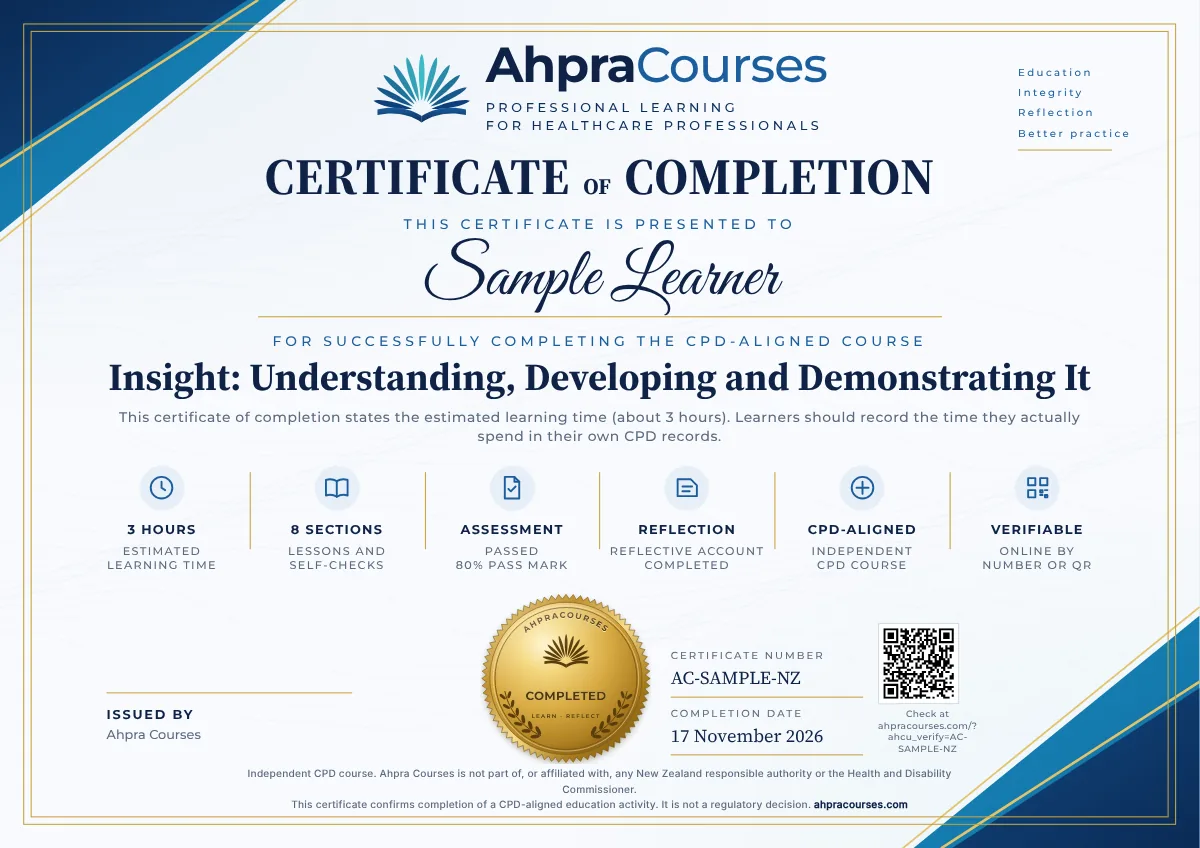
Sample certificate of completion for Insight for Health Practitioners in New Zealand: Understanding, Developing and Demonstrating It from Ahpra Courses, showing the learner's name, the course title, an estimated learning time of about 3 hours, the completion date and a certificate number that can be checked online
Sample. Your certificate shows your name, the course title, the completion date and its own certificate number.

Pass the final assessment to download an insight course certificate with your name, the course, the completion date and the estimated learning time. Anyone you share it with can check it on the site's verification page. The certificate shows you studied insight; the reflection you write with the course's prompts is what shows you have it.

How practitioners use it

  • Attach it behind your reflective statement, so the reader sees the learning and your own account together.
  • Refer to it in your reply to the HDC or your authority together with the specific change it produced, never as an item on its own.
  • Share it with a supervisor or mentor as the starting point for a discussion about the four elements in your own case.
  • Log it in your recertification record as learning linked to a reflection or learning goal.

Who this course is for

Practitioners writing to the HDC

Your first response to the Commissioner often shapes how a complaint is resolved. The course shows how to acknowledge the consumer's experience, explain your reasoning and describe changes without defensiveness or overstatement.

Practitioners whose authority is assessing a notification

Triage teams and case managers look for evidence that you understand the concern and that the risk has reduced. Section 3 explains what they are deciding and how insight informs it.

Practitioners before a PCC or the Tribunal

Insight is relevant to what a committee recommends and to penalty if a charge is established. Section 7 covers written statements, meetings, conciliation and hearings.

Practitioners told they lack insight

This feedback is common and often confusing. Section 5 sets out the patterns that produce it, such as minimisation, deflection and scripted language, and how to replace them with something more accurate.

Supervisors, mentors and educators

If you help colleagues reflect, the course gives you a shared framework for the four elements and a scale for judging whether an account is limited, developing or established.

Practitioners who want deeper reflection

Insight is not only for crises. The same methods strengthen everyday reflection, recertification records and cultural safety practice.

The concerns this course addresses

A response that reads as defensive

Starting with your experience, your workload or the patient's behaviour, or attacking the complainant, tells the reader you see the problem elsewhere. The course shows how to lead with an accurate account and an acknowledgement of the consumer's experience, then explain your reasoning, so your perspective is heard rather than dismissed.

HDC: What if a complaint is made about me?; Code of Rights, Right 10

Disputing facts without appearing to lack insight

Insight mainly affects what should happen next, not whether the facts are proved. You can honestly dispute what you believe is wrong while showing understanding of what you accept. The course shows how to separate the two clearly and how to recognise the consumer's experience even when your recollection differs.

HPCA Act s 100; responsible authority process guidance

An apology that is conditional or vague

An apology that says sorry you feel that way, or sorry if anything went wrong, usually makes things worse. There is no statutory duty of candour in New Zealand, but Right 6 and the HDC's 2019 open disclosure guidance ground the expectation of openness after harm. The course explains what a genuine apology names and why you should take advice on wording rather than withhold it.

Code of Rights, Right 6; HDC Guidance on open disclosure policies (2019); MCNZ Disclosure of harm (2024)

A PCC interview or request for information

A committee can require information under section 77 and will often want to hear from you. Practitioners sometimes over-prepare a script or say too little. The course covers answering questions directly, describing the consumer's perspective and showing how your understanding has developed.

HPCA Act ss 71, 77 and 80

Insight at the penalty stage

When the Tribunal considers penalty, it weighs protection of the public, rehabilitation and the least restrictive appropriate outcome. Late or newly discovered insight is given less weight than insight shown consistently and backed by change over time. The course shows how to build that record well before a hearing.

HPCA Act s 101; Tribunal penalty principles

Insight in boundary and honesty matters

For boundary concerns, insight centres on the power imbalance and the practitioner's responsibility for the relationship. For dishonesty, it centres on trust and on never repeating the dishonesty in the process itself. Insight alone will not lead to a light outcome in serious matters, but its absence makes every outcome harder.

MCNZ Professional boundaries and Sexual boundaries (2018); responsible authority codes of conduct

Cultural safety and how care was experienced

A cultural safety complaint is about how your care was experienced, not about accepting a label. Insight here means understanding your own assumptions and their effect on the person and whānau. The course draws on Te Tiriti o Waitangi and authority cultural safety standards to show how to reflect on this honestly.

MCNZ Cultural safety (2019); Code of Rights, Rights 1 and 3

Insight when health is involved

In the health pathway, insight means recognising how a condition may affect your practice and engaging with treatment and monitoring. Minimising symptoms or avoiding the authority's processes is the pattern most likely to cause concern. The course explains how to show insight while protecting your privacy appropriately.

HPCA Act s 45; responsible authority health processes

What the course covers

Eight sections and 26 lessons move from what insight is, through how New Zealand decision makers weigh it, to developing and demonstrating it. Sections 1 to 7 each close with five questions on recognising and showing insight.

1What insight means in practice3 lessons

Defines insight as an accurate understanding of what went wrong, why, the impact, your part and what has changed. Separates it from reflection (the process), remorse (a feeling) and apology (an act), and explains why it matters in a protective system. Lessons: defining insight; insight, reflection, remorse and apology; why insight matters in New Zealand.

  • 1.1 Defining insight
  • 1.2 Insight, reflection, remorse and apology: not the same thing
  • 1.3 Why insight matters in New Zealand practice
2Where insight sits in the New Zealand framework3 lessons

Places insight in the framework of the HPCA Act and the HDC Act, sets out what each decision maker is deciding, and shows how to link a concern accurately to the Code of Rights and your own profession's code. Explains why insight is a weighed factor, not a statutory test. Lessons: the legal framework; the decision makers; codes and standards as your yardstick.

  • 2.1 The legal and regulatory framework
  • 2.2 The decision makers and what they are deciding
  • 2.3 The codes and standards as your yardstick
3How New Zealand decision makers weigh insight4 lessons

Shows how the HDC uses early responses and apologies, how authorities and PCCs prefer the least restrictive adequate option, and how the Tribunal links insight to rehabilitation and penalty. Covers late insight, serious conduct and the health pathway. Lessons: the HDC; authorities and PCCs; the HPDT; insight across different kinds of concern.

  • 3.1 The HDC: responses, resolution and recommendations
  • 3.2 Responsible authorities and Professional Conduct Committees
  • 3.3 The HPDT: insight, rehabilitation and penalty
  • 3.4 Insight across different kinds of concern
4The four elements in depth4 lessons

Works through acknowledgement (accurate facts and active language), understanding of harm (physical, emotional, whānau, team and public trust), apology and open disclosure, and reducing the risk of repetition through personal and system change. Lessons: acknowledgement; understanding of harm; apology and open disclosure; risk of repetition.

  • 4.1 Acknowledgement: owning what happened
  • 4.2 Understanding of harm
  • 4.3 Apology and open disclosure
  • 4.4 Risk of repetition: understanding why and changing what you do
5Barriers to insight and red flags3 lessons

Describes the patterns that read as limited insight, including denial, minimisation, deflection, changing accounts and compliance without understanding, the normal barriers of fear and shame, and insight in boundary, probity, behaviour and cultural safety concerns. Lessons: recognising limited insight; why insight is hard; specific types of concern.

  • 5.1 Recognising limited insight
  • 5.2 Why insight is hard, and how to make it easier
  • 5.3 Insight in specific types of concern
6Developing genuine insight4 lessons

Teaches a seven-question structured reflection, how to use feedback and recertification tools, how to match learning to causes and record sustained change, and how cultural safety and Te Tiriti o Waitangi shape reflective insight. Notes the narrow protection in section 44(4). Lessons: structured reflection; feedback and recertification; targeted learning; cultural safety and Te Tiriti.

  • 6.1 A structured approach to reflecting for insight
  • 6.2 Using feedback and your recertification programme
  • 6.3 Targeted learning and sustained change
  • 6.4 Cultural safety, Te Tiriti and reflective insight
7Demonstrating insight to decision makers4 lessons

Gives a structure for a written response or reflective statement, the kinds of evidence that persuade, how to show insight in meetings, conciliation and hearings, and weak and strong examples across professions. Lessons: writing a response; building evidence; showing insight in person; weak and strong insight.

  • 7.1 Writing a response or reflective statement
  • 7.2 Building evidence of insight and change
  • 7.3 Showing insight in person: meetings, conciliation and hearings
  • 7.4 Weak and strong insight across professions
8Conclusion and key points1 lesson

Brings the course together in key points and leads into the reflective prompts, including a self-rating of your own account on each element, and the final assessment. Lesson: conclusion and key points.

  • Conclusion and key points
✓Reflection, final assessment and certificate3 steps
  • Your reflective account, which you can download for your records
  • Final assessment: 20 questions, 80% to pass
  • Certificate of completion, dated and numbered

Insight in New Zealand: a weighed factor, not a statutory test

Practitioners often assume there is a published checklist for insight that a committee scores. There is not. The Health Practitioners Competence Assurance Act 2003 does not use the word in its disciplinary provisions, and the HDC, the responsible authorities and the Health Practitioners Disciplinary Tribunal do not publish a formal definition or scoring system. Insight is something decision makers infer from what you say, what you do and what has changed, and they weigh it as part of a judgement about future risk.

Why it carries so much weight

The HPCA Act is protective. The Act exists to protect public health and safety by making sure practitioners are competent and fit to practise. Decisions after a concern therefore look forward: is this practitioner likely to repeat it, and what is the least restrictive step that will keep people safe? Insight is the most direct evidence on that question. A practitioner who accurately understands what happened and why, and who has changed the conditions that produced it, presents a different risk from one who does not.

Four elements decision makers look for

Acknowledgement means an accurate account of what happened and of your part in it, using active language and naming the standard involved. It does not mean accepting facts you genuinely dispute. Understanding of harm means seeing the actual and possible effect on the consumer, their whānau, colleagues and public trust, including how the care felt in cultural terms. Apology means a sincere, specific and unconditional expression of regret for what you did, grounded in the openness the Code of Rights and the HDC's open disclosure guidance expect. Reduced risk of repetition means identifying the personal and system causes and making specific, verifiable changes that address them.

How different bodies use it

The HDC considers your early response, any apology and the steps already taken when it decides how to resolve a complaint and what to recommend. Responsible authorities and Professional Conduct Committees use it in choosing between options such as an educational letter, a competence review, counselling or a charge. The Tribunal applies penalty principles recognised by the High Court, including protecting the public, rehabilitation and choosing the least restrictive appropriate penalty, and insight bears on each of them. In every setting, insight shown early and consistently, and backed by evidence of change, carries more weight than insight that appears for the first time at a hearing.

How to respond to a complaint or notification about this kind of concern

A written response is usually the first and most influential place insight is judged. These steps use the response structure from Section 7.

  1. Pause and get advice before you write

    Read the letter twice, then get in touch with your indemnity provider, union, professional association or lawyer. A first draft written in the hours after receiving a complaint often reads as defensive. Write it, then put it away.

    In the course: Lesson 5.2 explains the fear and shame that drive defensive first drafts and how to work through them.

  2. Give an accurate account in the first person

    Describe what happened using the records, in plain language. Say what you did and decided, using I rather than the passive voice. Separate clearly what you accept from what you dispute.

    In the course: Lesson 4.1 covers acknowledgement, active language and how to dispute facts honestly.

  3. Name the standard and the impact

    Identify the Code right and your own authority's standard the concern engages. Describe the effect on the consumer and their whānau, including how they experienced the care, even if you recall it differently.

    In the course: Lessons 2.3 and 4.2 show how to link the concern to the right standard and describe harm fully.

  4. Explain why, without shifting responsibility

    Set out the personal and system factors that contributed. Name the system issues honestly but own the decisions that were yours.

    In the course: Lesson 4.4 and Lesson 6.1 teach the causal analysis at the centre of the seven-question method.

  5. Apologise specifically

    Say what you are sorry for, without conditions. If you have already apologised, say when and how. Take advice on the wording, but do not let caution remove the apology.

    In the course: Lesson 4.3 covers apology and open disclosure in New Zealand.

  6. Show what has changed and how it will be checked

    List specific, dated changes and attach evidence from people other than you. Say how and when the change will be checked again.

    In the course: Lesson 7.2 describes the evidence that persuades and how to present it.

Do not overstate your insight with phrases such as I have learned so much from this, and do not make admissions you believe are inaccurate. Both undermine credibility. Precision is more persuasive than length.

Get advice from your professional indemnity insurer, union or professional association, or a lawyer before you respond.

How this course helps with a complaint or notification

It replaces guesswork with a clear framework

Because nobody publishes a definition, practitioners are often told they lack insight without being told what insight is. The four elements give you something specific to work on, and the self-rating scale in Section 5 lets you judge your own account as absent, limited, developing or established on each element.

It helps you hear how your words land

Section 5 shows the patterns that read as limited insight, with examples of each. Seeing denial, minimisation, deflection and scripted phrases written down makes it far easier to notice them in your own drafts and remove them.

It connects insight to evidence

A decision maker cannot see inside your head. They can see an audit, a supervisor's report and a changed process. Sections 6 and 7 show how to link what you understand to changes someone else can verify, which is what turns stated insight into demonstrated insight.

It treats cultural safety as part of insight

Understanding how your care was experienced by Māori and other patients and whānau is part of understanding harm. Lesson 6.4 shows how to reflect on your own assumptions and position in a way that is honest rather than performative.

Remediation evidence that carries weight

Carries weight

  • A written account that separates accepted facts from disputed ones and uses first-person, active language
  • A description of harm that includes the consumer's and whānau perspective, not only clinical outcomes
  • A record of a specific apology, when and how it was given, and the response
  • A causal analysis naming both personal and system factors, with your part clearly owned
  • Dated changes to practice with audit or observation evidence from someone else
  • Supervisor or mentor reports from people who know the full concern and describe how your understanding developed
  • Learning chosen because of the identified cause, followed by a described change
  • Consistent accounts across your response, interviews and reflective statement

Carries little weight

  • Generic lessons-learned phrases with no specific change attached
  • Expressions of distress about the complaint process rather than about the consumer
  • An apology that is conditional or focused on the complainant's feelings
  • References from people unaware of the concern
  • Insight that appears for the first time shortly before a hearing
  • Accounts that change as new evidence emerges
  • Compliance with conditions without any explanation of why they mattered

A remediation plan, phase by phase

  1. Week 1

    Steady yourself and get support

    • Contact your adviser and diarise deadlines
    • Arrange personal support through your GP, employee assistance or professional body
    • Write a private first account to get the immediate reaction out of the way
    • Gather the records without changing anything
  2. Weeks 1 to 3

    Work through the four elements

    • Write an accurate account and mark accepted and disputed facts
    • Describe the harm from the consumer's and whānau perspective
    • Identify personal and system causes using the seven questions
    • Consider whether and how to apologise, with advice
  3. Weeks 3 to 8

    Change something specific

    • Choose learning matched to the cause you identified
    • Make one or two practice changes someone else can see
    • Ask a supervisor, mentor or cultural adviser to read your account and challenge it
    • Rate your account against the four elements and strengthen the weakest
  4. Months 2 to 6

    Gather evidence of change

    • Run an audit or collect feedback on the changed practice
    • Ask for a written report from your supervisor or mentor
    • Update your reflective statement with what the evidence shows
  5. Ongoing

    Keep it consistent

    • Keep your accounts consistent across every stage
    • Carry the learning into your recertification plan
    • Revisit your reflection if new information emerges

Writing your reflective statement

1What happened and what was my part

Give the facts in order and state your own decisions in active language.

Example only (Dr P, a fictional general practitioner): I told Mrs W her chest pain was muscular after a five-minute telephone consultation and did not arrange an ECG or advise her to call 111 if it worsened.

2The standard involved

Identify the Code right and your authority's standard, and explain why the standard is there.

Example only: Right 4 required care of an appropriate standard, and the Council's telehealth standard expected me to consider whether an in-person assessment was needed.

3Who was harmed and how

Include physical, emotional, whānau and trust effects, and how the person experienced the care.

Example only: Mrs W had a heart attack two days later. Her daughter told the HDC that the family felt dismissed, and that her mother had been reluctant to call back because I had sounded certain.

4Why it happened

Identify personal and system factors without shifting responsibility.

Example only: I anchored on her age and a recent gym injury, I was running 40 minutes late, and our clinic had no rule for when chest pain calls must be seen in person.

5My apology

Say what you apologised for, when and how.

Example only: I met Mrs W and her daughter in March with our practice manager, said I was sorry that I had not arranged an ECG or given her clear advice, and explained what we had changed.

6What I have changed

List dated changes and the evidence for each.

Example only: Since February all chest pain calls are booked in person or referred, I use a safety-netting script, and a colleague reviewed 30 of my telephone notes in May.

7How I will know it holds

Say how the change will be checked and who will challenge you.

Example only: The audit is repeated in six months as part of my Inpractice audit, and my collegial relationship provider will review it with me.

The example sentences are fictional and show structure only. Your statement has to be your own honest account of what happened.

A weak and a strong response, side by side

Fictional example. The HDC writes to Mr D, a physiotherapist, after a patient says he brushed off her pain during exercises following knee surgery and laughed when she cried. He disputes that he laughed.

Weak

I strongly reject this complaint. I have treated hundreds of knee replacements and this patient was clearly anxious and not motivated. Pain is expected after surgery and she was told this. I never laughed at her; I may have smiled to encourage her. I am sorry she feels upset, but I followed the protocol. I have since attended a communication workshop and I have learned a great deal.

Strong

I do not recall laughing and I do not believe I did, but I accept that Ms R left the session feeling dismissed and humiliated, and that this matters whatever I intended. I pushed the exercises after she said the pain was 8 out of 10 and I did not stop to ask what she was worried about. Right 5 and our Board's standards required me to communicate in a way that let her raise concerns. I wrote to apologise for continuing when she was in distress. I now stop and check when a patient reports pain above 6, and record the discussion. A senior colleague observed four of my sessions in June and her notes are attached.

Why the second one works: The strong response keeps an honest dispute about one fact while acknowledging the patient's experience, names the right and standard, owns the decision, apologises without conditions and shows observed change. The weak response attacks the patient, relies on experience, offers a conditional apology and claims learning without describing any change.

Mistakes practitioners make when responding

Treating insight as a feeling to express

Remorse alone is not insight. Decision makers look for understanding and change, not distress.

Accepting everything to look insightful

Inaccurate admissions damage credibility and can affect findings. Accept what you accept, dispute what you dispute, and say why.

Using borrowed phrases

Language copied from templates, such as I have reflected deeply on this, is easy to spot and adds nothing. Use your own words about your own events.

Blaming the system for everything

System factors are real and should be named, but an account in which you made no decisions reads as deflection.

Leaving the apology out on cautious advice alone

Ask your adviser how to word an apology, not whether to give one. A sincere apology is usually expected.

Developing insight only for the hearing

Insight that appears late is given less weight. Start early and keep a dated record of how your understanding developed.

Changing your account

Inconsistency between your first response, an interview and a later statement is one of the strongest signals of limited insight.

The code provisions this course works through

Insight is judged against standards. These are the rights and provisions that most often frame how a New Zealand decision maker reads a practitioner's account.

Code of Rights, Right 5Effective communication

Right 5 gives every consumer effective communication in a form, language and manner they can understand, in a setting that allows open and honest communication.

In the course: Lessons 4.1 and 7.1 use this right to show what an open, honest account looks like.

Code of Rights, Right 6Right to be fully informed

Under Right 6 consumers are entitled to the information a reasonable consumer in their circumstances would expect. It underpins the expectation of openness after harm.

In the course: Lesson 4.3 links this right to apology and open disclosure.

Code of Rights, Right 10Right to complain

Providers must help resolve complaints fairly, simply, speedily and efficiently, acknowledge them in writing within 5 working days and respond within the set timeframes.

In the course: Lesson 3.1 shows how the way you handle a complaint becomes evidence of insight.

HPCA Act s 44Confidentiality of information

Restricts how certain statements and information from competence reviews and competence or recertification programmes can be used. It does not create a general privilege for personal reflections.

In the course: Lesson 6.1 explains why you should write reflections expecting that someone else may read them.

HPCA Act s 77PCC power to require information

A Professional Conduct Committee can require a practitioner or others to provide information or documents relevant to its investigation.

In the course: Lesson 7.3 prepares you for questions from a committee.

HPCA Act s 101Penalties

Sets the Tribunal's penalties: cancellation, suspension up to three years, conditions up to three years, censure, fines up to $30,000 and costs.

In the course: Lesson 3.3 explains how insight bears on penalty principles such as rehabilitation.

Also relevant: Code of Rights, Right 4 Services of an appropriate standard, including compliance with professional and ethical standards; HPCA Act s 100 Grounds on which a practitioner may be disciplined; HPCA Act s 45 Notification of a mental or physical condition affecting practice; HDC Guidance on open disclosure policies (2019) Elements of open communication after harm

How this applies in each profession

Doctors

Medical Council of New Zealand (Te Kaunihera Rata o Aotearoa)

The Council's Disclosure of harm standard, updated in January 2024, sets out what doctors should tell patients after harm, which is directly relevant to the apology element of insight.

Nurses

Nursing Council of New Zealand (Te Kaunihera Tapuhi o Aotearoa)

The Council consulted in early 2026 on a new Code of Conduct to replace the 2012 Code. Check which version applied at the time of the events when you name the standard in your account.

Midwives

Midwifery Council (Te Tatau o te Whare Kahu)

Midwives working in continuity of care often have long relationships with whānau, so understanding of harm frequently includes the effect on trust across a whole pregnancy.

Pharmacists

Pharmacy Council (Te Pou Whakamana Kaimatū o Aotearoa)

The annual critical reflection in MyRecert is a natural place to record how your understanding of a concern has developed, discussed with your verifier.

Physiotherapists

Physiotherapy Board of New Zealand

One of the three required reflections each cycle must address Māori culture and practice, which supports the cultural safety side of understanding harm.

Psychologists

New Zealand Psychologists Board

The Continuing Competence Programme begins with a self-reflective review against core competencies, a useful structure for examining how a concern relates to your practice.

Paramedics

Paramedic Council (Te Kaunihera Manapou)

Paramedics work in brief, high-pressure encounters, so insight often centres on communication and decision making under time pressure rather than on long relationships.

What happens after a complaint or notification in New Zealand

Insight is weighed at each step of a New Zealand matter, though each body asks a slightly different question. This is the usual sequence.

  1. The complaint arrives

    Many complaints start with you or your employer. How you handle them under Right 10, including acknowledgement within 5 working days, is often the first evidence of insight anyone sees.

  2. HDC assessment

    The HDC asks for your account and records. Your response, any apology and steps taken affect whether the complaint is resolved by referral, closed with recommendations or investigated.

  3. Responsible authority triage

    Your authority considers notifications and HDC outcomes. Insight informs the choice between no further action, an educational letter, a competence review or a PCC referral.

  4. Competence review or health process

    Reviewers look at whether you understand the gap and engage with fixing it. In the health pathway, they look at engagement with treatment and monitoring.

  5. Professional Conduct Committee

    A committee investigates, may interview you, and decides what to recommend or whether to lay a charge. Insight bears on what response is enough to protect the public.

  6. Tribunal hearing and penalty

    The Tribunal first decides whether the charge is established, then considers penalty, where insight is relevant to protection, rehabilitation and the least restrictive outcome.

Who handles your matter: the HDC, your responsible authority and the Tribunal

The Health and Disability Commissioner assesses complaints about care against the Code of Rights and decides how to resolve them. It looks at your early response and apology, and its recommendations often ask for reflection or learning. It cannot remove your registration.

Your responsible authority sets the standards for your profession and decides what regulatory response a concern needs. It usually waits while the HDC has a matter, except where interim protection is needed.

Professional Conduct Committees investigate conduct for the authority and can recommend steps or lay a charge. The Director of Proceedings may also lay a charge after the HDC refers a matter.

The Health Practitioners Disciplinary Tribunal hears charges and imposes penalties. Across all four, insight is judged by consistency: the same accurate account, from your first letter to any hearing, backed by changes that hold.

Possible outcomes and what they mean for you

OutcomeWhat it isWhat it means for you
HDC: resolved with the provider or advocacyThe HDC sends the complaint to you or to an advocate to resolve directly, and you tell it the outcome.A prompt, respectful, insightful response is what makes this route work. Keep a record of what you said and changed.
HDC: no further action with educational commentThe complaint is closed, often with recommendations or an educational comment for the provider.Respond to the comment with a short reflection and evidence of any change. It may be read again if a later complaint arises.
HDC: breach findingFollowing an investigation the Commissioner finds the Code breached, makes recommendations and may send the report to your authority.Accepting the finding where you can, and acting on recommendations, is strong evidence of insight for the authority.
Authority: educational letter or no further actionNo regulatory action follows, though the authority may suggest more learning.Treat recommended learning seriously and record what changed.
Authority: competence review, counselling or conditionsThe authority reviews competence, refers you for counselling or assistance, or places conditions on your scope.Engagement and understanding during these processes are watched closely.
Tribunal: censure, conditions, fine or suspensionWhen a charge is proved, the Tribunal may censure, impose conditions or suspend for up to three years each, fine up to $30,000 and order costs.Consistent, evidenced insight is relevant to the least restrictive penalty that will protect the public.
Tribunal: cancellationThe Tribunal cancels registration and may set conditions on any future application.Where cancellation is considered, absence of insight is often a significant factor in the assessment of risk.

If a condition or undertaking requires education

Orders and Tribunal conditions sometimes require reflective work, counselling, mentoring or education aimed at a particular concern. The order defines what counts: who must agree the activity, how it is reported and by when. If you hope this course will count towards such a requirement, write to your authority with the outline, objectives, list of sections, assessment and learning time. Only the authority, or the Tribunal for conditions it set, can say whether it fits.

Remember that insight is judged by more than completion. A reflective report that names the standard, describes harm from the consumer's perspective, identifies causes and points to verifiable change will usually be expected alongside any certificate.

Using this course as CPD

Reflection sits inside every New Zealand recertification programme, and this course is designed to deepen it. Pharmacists, for instance, record a critical reflection in MyRecert every year. Physiotherapists complete three written reflections per three-year cycle, one of them on Māori culture and their practice, and insight work fits well there. Doctors in vocational scopes have an annual structured conversation, and those in the general scope meet regularly with a collegial relationship provider. Psychologists start their Continuing Competence Programme by reviewing themselves against the Board's core competencies.

You can record this course as an educational activity and use the reflection prompts to produce the written reflection your programme asks for. If you are using it in response to a complaint or order, keep that reflection in your remediation file as well, and remember that reflective material can sometimes be obtained by others, so write it accurately and without identifying patients.

  • Use the reflection prompts to meet a written reflection requirement
  • Link the course to a learning goal about reflective practice or communication
  • Discuss your self-rating with your peer, verifier or supervisor
  • De-identify any reflection you store in a recertification system
  • Check your own authority's current requirements each year

How this course is written and kept current

This page and the course draw on the HPCA Act 2003, the HDC Act 1994 and the Code of Rights, HDC guidance on complaints, providers and open disclosure, guidance on the Director of Proceedings, Medical Council statements on disclosure of harm, boundaries and cultural safety, other authorities' codes and process documents, and the penalty principles the High Court has recognised. Our searches found no New Zealand statute or authority document that defines insight, and the page says so rather than inventing a test. Examples are fictional. The page is reviewed whenever the Act, the Code or a major standard changes.

Health Practitioners Competence Assurance Act 2003 (reprint as at 10 July 2026)Code of Health and Disability Services Consumers' RightsHDC: What if a complaint is made about me?HDC: Complaint processHDC: Referral to the Director of ProceedingsMedical Council: Current standards, including Disclosure of harm (2024) and Cultural safety (2019)Medical Council: Notifications Triage Team and Council options information sheetDental Council: Health Practitioners Disciplinary Tribunal summaryHealth Practitioners Competence Assurance Amendment Bill (Ministry of Health information, 2026)

Last reviewed: November 2026.

Key terms explained

Insight
A true understanding of what went wrong, why, how it affected people, what your part was and what you have changed. A factor decision makers weigh, not a statutory test.
Acknowledgement
Owning an accurate account of what happened and your decisions within it, using active language.
Understanding of harm
Recognising the actual and potential effects on the consumer, whānau, colleagues and public trust, including how care was experienced.
Apology
A sincere, specific and unconditional statement of regret for what you did, often given as part of open disclosure.
Risk of repetition
The likelihood the same problem will happen again, reduced by addressing personal and system causes.
Reflection
The structured process of examining an experience to learn from it. Insight is what good reflection produces.
Minimisation
Describing a concern as smaller or less serious than it was, a common pattern of limited insight.
Deflection
Placing the cause on others, systems or the consumer while leaving out your own part.
Open disclosure
Honest, timely communication with a consumer and whānau after harm, described in the HDC's 2019 guidance.
Cultural safety
Care the person receiving it experiences as safe, which depends on practitioners examining their own culture, assumptions and power.
Professional Conduct Committee
A committee a responsible authority appoints to investigate conduct and decide whether to lay a charge.
Least restrictive outcome
The principle that the response chosen should be the lightest that still protects the public.
Frequently asked questions

Can I disagree with the complaint and still show insight?

Yes. Insight is mainly about what should happen next, not about whether every fact is proved. You can honestly dispute what you believe is wrong while acknowledging what you accept and how the consumer experienced the care. What reads badly is disputing everything, attacking the complainant or changing your account as the matter progresses.

Will apologising be used against me?

We did not find a New Zealand statute that specifically protects apologies, so take advice from your indemnity provider or lawyer on the wording. In practice the HDC and authorities expect openness after harm, grounded in Right 6 of the Code and the HDC's open disclosure guidance, and an apology that is specific and sincere usually helps. Advice should shape how you apologise, not whether you do.

Are my reflective notes protected?

Generally not. Section 44 of the HPCA Act restricts the use of some material from competence reviews and competence or recertification programmes, and declared quality assurance activities have separate protection, but we found no general privilege covering personal reflections. A PCC, the HDC or a court may be able to require them. Write accurately, de-identify patients and focus on learning.

Will showing insight mean a lighter outcome?

No, and nothing on this page should be read as a promise. Insight is one factor among many. For serious matters such as sexual misconduct or serious dishonesty, insight alone will not lead to a light outcome. But its absence makes protective responses more likely, because decision makers have less reason to think the risk has reduced.

What does limited insight look like?

Common patterns include denying facts the records support, minimising the impact, deflecting responsibility to others or systems, blaming the patient, using scripted lessons-learned language, and complying with requirements without explaining why they matter. Section 5 gives examples of each and shows how to replace them with more accurate language that still reflects your genuine view.

How long does it take to develop insight?

The course takes about three hours, but genuine insight develops over weeks and months as you reflect, discuss the concern with others and test changes in practice. Decision makers give more weight to insight shown early and consistently than to insight that appears shortly before a hearing, so it is worth starting as soon as you have taken advice.

Should I take this course or the remediation course first?

Many practitioners start here, because a remediation plan only works if it is built on an accurate understanding of what went wrong and why. The remediation course then turns that understanding into objectives, activities and an evidence bundle. Both are part of the Insight, Reflection and Remediation Programme if you want to take them together.

Can I use this course for my recertification?

Yes. It can be recorded as an educational activity, and the reflection prompts help produce the written reflection most programmes require. Link it to a learning goal, discuss your reflection with your peer, verifier or supervisor, and keep the record de-identified. If you are also using it in response to a concern, keep a copy in that file too.

Does the course cover meetings and hearings, not just letters?

Yes. Lesson 7.3 covers showing insight in person at a PCC interview, an HDC or employer meeting, conciliation and a Tribunal hearing. It focuses on listening to the consumer before explaining, answering questions directly, describing their perspective and keeping your account consistent with what you have written. It also covers how to prepare thoroughly without memorising a script that sounds rehearsed.

How long does the course take, and how long do I have access?

The estimated learning time is about 3 hours (about 180 minutes), covering the lessons, the section checks, your reflective account and the final assessment. People work at different speeds, so record the time you actually spend in your own CPD records. Your progress is saved to your account and you can return to the course and your certificate at any time.

How is the course assessed?

Lessons open in order. Each section closes with a graded check that you answer before moving on. The course ends with a 20-question final assessment, marked on our server, with a pass mark of 80%. If you do not pass, review the sections it points you to and try again.

Does completing the course decide the outcome of my matter?

No course can decide or predict the outcome of a notification, investigation, panel or tribunal. Decision-makers weigh all of the evidence, including your insight, your reflection and the changes you have made and sustained. The course is designed to support that learning and to give you a dated record of it.

Start today, finish at your own pace

Instant access after checkout. Work through 8 sections in order, write your reflective account, pass the final assessment and download your dated certificate.

Primary sources

Always read the current version on the publisher's website. This page is general information, not legal advice.

On call with Dr AI Alma