Bundle & save Studying more than one course? Save 15% on 3, 22% on 5 and 30% on 10 or more, taken off in your cart.
Free Course AdvisorQuestions about which course fits your case?
Ahpra Courses

For New Zealand practitioners who need to get the conversation after harm right, or show they now can

Open Disclosure After Harm for Health Practitioners in New Zealand

Last updated

When care goes wrong, what you say next, and how soon, often matters more to the consumer, the Health and Disability Commissioner and your responsible authority than the original event. This course teaches open disclosure as New Zealand law and guidance actually frame it: grounded in the Code of Rights, shaped by HDC's guidance and the national adverse events policy, and carried out with whānau, culture and ACC in mind.

  • 3 hours, CPD-aligned
  • Written to your responsible authority's code
  • 8 sections with graded checks
  • 20-question final assessment
  • Dated, verifiable certificate
  • Self-paced on any device
  • 1-to-1 AI tutor, Dr AI Alma
Enrol now, NZ$120Bulk buy from NZ$85 a course

Dated certificate with a number anyone can verify

61CPD courses for New Zealand practitioners
16Professions covered
24/7Self-paced, online, any device
NZ$120Per course, no subscription

Which of these is your situation?

At a glance

Who it is for
Practitioners registered under the HPCA Act 2003, whatever their profession or setting: hospital, general practice, community, aged residential care, pharmacy, dental and allied health.
Regulators covered
the Health and Disability Commissioner and the Director of Proceedings; each responsible authority, including the Medical, Nursing, Midwifery, Dental and Pharmacy Councils, which expect open disclosure; professional conduct committees; the Health Practitioners Disciplinary Tribunal.
Format
Online and self-paced: seven teaching sections plus a conclusion, 26 lessons in total, with New Zealand disclosure examples and a quiz after each teaching section.
Assessment
A 20-question final assessment set around disclosure scenarios, passed at 80%, and a structured reflective account in four parts.
Certificate
Issued when you pass, with the open disclosure course title, your name, the date and the estimated learning time, and checkable online.
Learning time
About 3 hours
Best taken with
Advice from your indemnity insurer, union or professional body if a complaint is open, and written agreement from your responsible authority before you rely on the course for an order or condition.
Learning time
About 3 hours, self-paced, online on any device. Progress is saved to your account.
Price
NZ$120 for one course. Bundles: 5 courses for NZ$545, 10 courses for NZ$850.

In short

New Zealand has no statutory duty of candour. The duty to tell a consumer about harm comes from the Code of Health and Disability Services Consumers' Rights, especially Right 6, and HDC's Guidance on open disclosure policies (November 2019) explains it: disclosure should usually happen within 24 hours, be led by the provider with overall responsibility for the person's care, and include an acknowledgement, an explanation, a sincere apology and information on advocacy and complaints. The national adverse events policy that took effect on 1 July 2023 adds open communication and consumer and whānau participation as principles of how services learn from harm. ACC's no-fault treatment injury scheme removes most of the litigation risk practitioners fear, so the real exposure in New Zealand lies in silence, delay and poor records. This course teaches the full process.

The certificate you receive

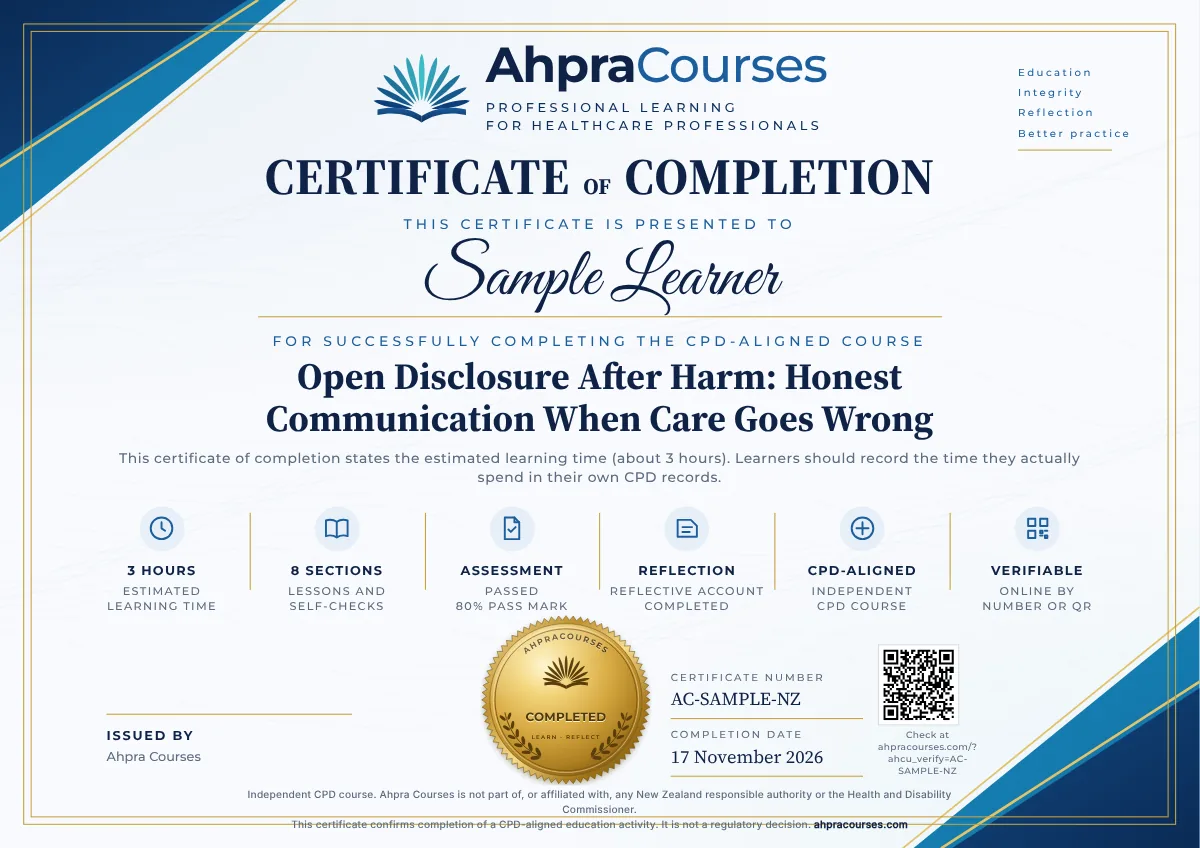
Sample certificate of completion for Open Disclosure After Harm for Health Practitioners in New Zealand from Ahpra Courses, showing the learner's name, the course title, an estimated learning time of about 3 hours, the completion date and a certificate number that can be checked online
Sample. Your certificate shows your name, the course title, the completion date and its own certificate number.

Pass the final assessment and send in your reflective account, and your certificate of completion is ready to download. It shows the course, the date, the estimated learning time and the sections completed, with a number and QR code so a reviewer can confirm it. For recertification, log the time you actually spent rather than the estimate.

How practitioners use it

  • File it in your recertification or professional development record against a goal about communication after adverse events.
  • Give it to your responsible authority, with the reflective account, if the authority has agreed this course can count toward an order or condition.
  • Share it with a supervisor or collegial contact who is helping you rebuild confidence after an event.
  • Add it to a reply to HDC or a professional conduct committee as one part of your evidence, together with the changes you have made in practice.
  • Use it to show a manager or credentialing committee that you have prepared for disclosure before taking on a lead role.

Who this course is for

Practitioners named in an HDC complaint about communication after harm

Complaints often say less about the original event than about what followed: a vague explanation, a closed door, a phone call that never came. The course shows what HDC expects and how to show you understand where your response fell short.

Practitioners whose responsible authority is reviewing their conduct or competence

A council may treat a failure to disclose as a conduct issue or a communication competence issue. The course helps you prepare a response that names the standard, the gap and the change.

Senior clinicians who lead disclosure meetings

HDC and the Medical Council expect the clinician with overall or lead responsibility to front the conversation. If that is you, the course gives a structure for preparing the team, leading the meeting and following through.

Nurses, midwives and allied practitioners on the front line

You are often the first to notice an error and the person the family asks. The course explains your part in escalation, initial acknowledgement and documentation, and when the conversation should move to someone else.

Pharmacists and dental practitioners in community settings

Dispensing errors and unexpected treatment outcomes often happen without a hospital system around you. The course covers disclosure, ACC and records where you are the provider with overall responsibility.

Quality, risk and clinical governance staff

If you write policy or coordinate learning reviews, the course maps the HQSC policy's principles, SAC ratings and reporting timeframes to the disclosure duties of individual practitioners.

Practitioners returning to practice after an adverse event

Second-victim distress is real and common. The course covers support for practitioners, and how to reflect honestly without self-blame or defensiveness.

The concerns this course addresses

Late or partial disclosure

The HDC guidance sets a usual expectation of disclosure within 24 hours of the event, or of the harm or error being recognised. Waiting for a review to finish, for a senior colleague to return or for the family to ask is the most common way a manageable event becomes a complaint.

HDC Guidance on open disclosure policies (2019); Code of Rights, Right 6(1)

Honesty treated as a professional standard

Every responsible authority's code expects honesty with consumers. A council can look at concealment or misleading explanations as a conduct matter, and a professional conduct committee can lay a charge before the Tribunal where it is serious.

HPCA Act ss 68, 80, 100; MCNZ Disclosure of harm (2024)

Fear of apologising

New Zealand has no general apology statute, but HDC's guidance expects a sincere apology as part of disclosure, and the Medical Council's statement encourages an expression of regret without accepting liability. Silence, not apology, is what HDC criticises.

HDC Guidance (2019); MCNZ Disclosure of harm, para 10

Misunderstanding ACC treatment injury

Treatment injury cover is no-fault. Helping a consumer lodge a claim is part of good care and is not an admission. ACC cover also limits damages claims, which is why the main consequences of poor disclosure here are complaints and regulatory action rather than lawsuits.

Accident Compensation Act 2001; HDC Act s 52(2)

Consumers and whānau left out of learning

The national adverse events policy names consumer and whānau participation, open communication and restorative practice among its eight principles. Reviews that ignore the family's account, or never report back, breed distrust and further complaints.

HQSC Healing, learning and improving from harm (2023)

Weak documentation of the conversation

Under clause 3 of the Code a provider must show that it took reasonable actions. If the record does not show who disclosed what, when, with which support people present, and what was promised, it is very hard to show the disclosure happened properly.

Code of Rights, clause 3; MCNZ Disclosure of harm, para 17

Education ordered after a concern

After a competence review an authority can order a competence programme or conditions, and the Tribunal can also set conditions. Education only counts if the body that set the requirement accepts it, so check before you enrol.

HPCA Act ss 38, 40, 101

Cultural safety after harm

For many Māori consumers harm touches mana and relationships, not just the body. A disclosure that ignores tikanga, whānau decision-making or the option of hohou te rongo can deepen the harm even when the facts are given accurately.

HQSC policy principles; Code of Rights, Right 1(3)

What the course covers

Eight sections and 26 lessons take you from what open disclosure means in Aotearoa, through the legal framework and the national adverse events system, to the conversation itself, culture, documentation and learning. Each teaching section, 1 to 7, ends with a short quiz on open disclosure.

1Open disclosure in Aotearoa New Zealand3 lessons

Lessons: What open disclosure means; Why open disclosure matters; Ethical foundations and Te Tiriti o Waitangi. Sets out the New Zealand vocabulary (open disclosure, open communication, disclosure of harm), separates adverse events, errors and near misses, and explains why the obligation should not be described as a statutory duty of candour.

  • 1.1 What open disclosure means
  • 1.2 Why open disclosure matters
  • 1.3 Ethical foundations and Te Tiriti o Waitangi
2The legal and professional framework4 lessons

Lessons: The Code of Rights and open disclosure; The HDC Guidance on open disclosure policies; What each responsible authority expects; When failure to disclose becomes a regulatory matter. Covers Rights 1, 4, 5, 6, 8 and 10, clause 3, the 2019 guidance on content, timing and leadership, and how HDC, councils, PCCs and the Tribunal respond to concealment.

  • 2.1 The Code of Rights and open disclosure
  • 2.2 The HDC Guidance on open disclosure policies
  • 2.3 What each responsible authority expects
  • 2.4 When failure to disclose becomes a regulatory matter
3The national adverse events system4 lessons

Lessons: The HQSC national adverse events policy 2023; Reporting and learning reviews; Engaging consumers and whānau in reviews; Restorative practice and hohou te rongo. Explains the eight principles, SAC ratings, Always Report and Review events and the Part A and Part B reporting timeframes, and how families take part in reviews.

  • 3.1 The HQSC national adverse events policy 2023
  • 3.2 Reporting and learning reviews
  • 3.3 Engaging consumers and whānau in reviews
  • 3.4 Restorative practice and hohou te rongo
4ACC treatment injury, apology and other obligations4 lessons

Lessons: ACC treatment injury and open disclosure; What ACC does and does not change; Apology in New Zealand; Other notifications after an adverse event. Shows how to support a treatment injury claim without implying fault, what ACC cover means for damages claims, the legal position of apology, and the other reports you may need to make.

  • 4.1 ACC treatment injury and open disclosure
  • 4.2 What ACC does and does not change
  • 4.3 Apology in New Zealand
  • 4.4 Other notifications after an adverse event
5The disclosure conversation in practice4 lessons

Lessons: Preparing for disclosure; Conducting the conversation; Disclosure as an ongoing process; Disclosure in particular circumstances. A step-by-step method from the first huddle to the final meeting, with adaptations for death, impaired competence, children, mental health care, disability, telehealth and events affecting many consumers.

  • 5.1 Preparing for disclosure
  • 5.2 Conducting the conversation
  • 5.3 Disclosure as an ongoing process
  • 5.4 Disclosure in particular circumstances
6Culture, equity and whānau3 lessons

Lessons: Culturally safe disclosure with Māori consumers and whānau; Pacific, migrant and disability perspectives; Equity and harm. Applies Te Tiriti principles and cultural safety to disclosure, plans meetings that respect tikanga and collective decision-making, and covers interpreters and accessible information under Right 5.

  • 6.1 Culturally safe disclosure with Māori consumers and whānau
  • 6.2 Pacific, migrant and disability perspectives
  • 6.3 Equity and harm
7Documentation, support and learning3 lessons

Lessons: Documenting open disclosure; Supporting practitioners after harm; Insight, reflection and remediation. Covers what to record and where, honest late entries and corrections, the effects of adverse events on staff, just culture, and how to reflect and plan change if your own disclosure is questioned.

  • 7.1 Documenting open disclosure
  • 7.2 Supporting practitioners after harm
  • 7.3 Insight, reflection and remediation
8Conclusion and key points1 lesson

Conclusion and key points. Brings the course together as a few habits for the first hour, the first day and the weeks after harm, then leads into the final assessment and your reflective account.

  • Conclusion and key points
✓Reflection, final assessment and certificate3 steps
  • Your reflective account, which you can download for your records
  • Final assessment: 20 questions, 80% to pass
  • Certificate of completion, dated and numbered

How New Zealand builds an obligation to disclose without a duty of candour statute

Practitioners trained overseas sometimes look for a statutory duty of candour in New Zealand law and do not find one. That does not mean disclosure is optional. The obligation is assembled from several sources, each binding in its own way, and together they set a standard that HDC and the responsible authorities apply firmly.

The Code of Rights is the foundation

Every provider of health or disability services, registered or not, is bound by the Code of Health and Disability Services Consumers' Rights. Under Right 6(1) consumers are entitled to the information a reasonable consumer in their situation would expect, and HDC regards an explanation of an adverse event as part of that. Right 6(3) gives a right to honest and accurate answers to questions, and Right 6(4) a right to a written summary on request. Right 5 calls for communication in a form and language the person understands, with a competent interpreter where needed and reasonably practicable. Right 1 requires respect, which HDC reads as including a truthful and sensitive discussion of harm. Right 8 allows a support person, and Right 10 requires that the consumer be told how to complain. Clause 3 then puts the provider in the position of having to show it took reasonable actions in the circumstances.

HDC's guidance turns the rights into a process

The Guidance on open disclosure policies, published on 19 November 2019, says disclosure should usually happen within 24 hours of the event, that the individual provider with overall responsibility for the consumer's care should usually lead it, and that it should include acknowledgement, an explanation of what happened, how and why, what is being done to prevent recurrence, a sincere apology, and details of the advocacy service and the complaints process. Disclosures left to administrators alone are, in HDC's words, not well received.

The national policy adds a system view

The national adverse events policy of Te Tāhū Hauora Health Quality & Safety Commission Healing, learning and improving from harm took effect on 1 July 2023. Among its eight principles are consumer and whānau participation, culturally responsive practice, equity, open communication, and restorative practice and hohou te rongo. Services tell the Commission about SAC 1, SAC 2 and Always Report and Review events: Part A within 30 working days and Part B within 120 working days. Those timeframes govern reporting and review. They do not delay disclosure, which is measured in hours.

Your council's standards make it personal

Each responsible authority expects honesty with consumers in its code of conduct or ethics. The Medical Council's statement Disclosure of harm, published on 26 January 2024, says harm should be disclosed as soon as practicable, that a senior clinician, preferably the doctor with lead responsibility, should be present when significant harm is disclosed, and that the record should cover the harm, contributing factors, the disclosure and follow-up care. A council can treat a failure here as a competence or conduct issue.

Why ACC changes the stakes but not the duty

Because ACC provides no-fault cover for treatment injury and the HDC Act generally bars damages for personal injury that ACC covers, New Zealand practitioners face far less litigation risk from candour than colleagues in many other countries. The consequences of getting disclosure wrong here are mostly regulatory and relational: an HDC breach finding, a council process, a damaged therapeutic relationship and a family that no longer trusts the service.
How to respond to a complaint or notification about this kind of concern

If a complaint or notification says you did not disclose harm properly, the response that tends to help most follows the same order a good disclosure should have followed. Each step links to a part of the course.

  1. Get advice and secure the facts

    Before you respond to a disclosure complaint, speak to your indemnity insurer, union or professional body. Gather the clinical record, incident report, any disclosure notes and the timeline of who knew what and when.

    In the course: Section 7 explains how the clinical record and incident report differ and how to add an honest late entry without altering the original.

  2. Measure what happened against the standard

    Compare your actual disclosure, its timing, content and who led it, with the Code rights, the HDC guidance and your own council's expectations. Identify exactly where it fell short.

    In the course: Section 2 sets out the Code rights, the 2019 guidance and each authority's expectations as a checklist you can measure against.

  3. Acknowledge the consumer's experience

    Explain in plain words what the delay or omission meant for the consumer and whānau: uncertainty, lost trust, the sense of something hidden. Avoid explaining it away.

    In the course: Section 6 helps you understand harm from a consumer and whānau perspective, including the cultural and relational harm of silence.

  4. Describe what you have changed

    Set out specific changes: how you now escalate, who you involve, the structure you use for the conversation, and how you record it. Changes in systems you influence count too.

    In the course: Section 5 gives the preparation and conversation structure you can adopt and describe as your new practice.

  5. Show the change is working

    Offer evidence: an audit of disclosure notes, peer feedback on a disclosure you led, supervision records or a policy you helped revise.

    In the course: Section 7 shows how to write a reflection and gather evidence that demonstrates insight rather than just stating it.

Do not contact the consumer or whānau about the complaint itself, or alter any record, without advice. A further apology may be appropriate, but it should not look like an attempt to influence the complaint.

Nothing on this page is legal advice; it explains the general position. Before replying to HDC, a professional conduct committee or your authority about a harm event, talk to your indemnity insurer or medical defence organisation, your union or professional association, or a lawyer.

How this course helps with a complaint or notification

It gives you a structure that holds under pressure

The first conversation after harm is often unplanned and emotional. The course gives a short, memorable sequence (acknowledge, apologise, explain what is known, plan, support, next steps) and the preparation that makes it possible inside the 24-hour window HDC describes.

It separates the overlapping systems clearly

Disclosure, incident reporting, SAC rating, learning reviews, ACC claims, HDC complaints and council processes all run at once and on different clocks. The course shows which belongs to whom, so you neither wait for one before doing another nor confuse them in front of the family.

It treats culture as part of the disclosure, not an add-on

Section 6 shows how tikanga, whānau decision-making, Pacific family structures and disability access change the way a disclosure meeting should be planned, and why asking, rather than assuming, is what cultural safety requires.

It helps you show insight if questioned

The reflective account follows the elements reviewers look for: what happened, how the consumer experienced it, the standard, what changed and how you know. It is written to support a response to HDC or a council, not to sit in a drawer.

Remediation evidence that carries weight

Carries weight

  • A clinical record entry, made at the time, showing who disclosed, when, who was present, what was said, the apology, questions asked and the plan agreed
  • A dated timeline showing disclosure began within hours of the harm being recognised and continued as findings emerged
  • Notes showing an interpreter, support person or cultural support was offered and what the consumer chose
  • Records that ACC treatment injury information was given and a claim lodged with consent where appropriate
  • Evidence the consumer and whānau were invited to contribute to the learning review and received its findings
  • A personal reflection that names the specific shortfall and the standard, without self-justification
  • Feedback from a peer or senior colleague who observed a later disclosure you led
  • A practice change you led, such as a disclosure checklist or record template, with an audit of its use

Carries little weight

  • An incident report alone, with nothing in the clinical record about telling the consumer
  • A statement that the family "were informed", with no detail of who, when or what
  • An apology letter sent weeks later by an administrator without clinical involvement
  • Certificates from courses unrelated to communication after harm
  • Testimonials about your general manner from unrelated patients
  • A reflection that focuses on how stressful the event was for you rather than for the consumer
  • A promise to "communicate better" with no description of what will change
  • Edits to the original note made after the complaint arrived

A remediation plan, phase by phase

  1. Days 1-7

    Stabilise and seek advice

    • Contact your insurer or professional body and diary every deadline in the letter
    • Secure the records and write an honest, dated late entry if the original is incomplete
    • Make sure any outstanding promise to the consumer, such as a follow-up call, is met
    • Arrange support for yourself through your employer, a colleague or your GP
  2. Weeks 1-3

    Understand the gap

    • Compare your disclosure with the Code rights, HDC guidance and your council's standard
    • Identify the specific failure: timing, leadership, content, apology, culture or record
    • Discuss it with a trusted senior colleague or supervisor
    • Complete Sections 1 to 4 of the course
  3. Weeks 3-6

    Build the new practice

    • Complete Sections 5 to 7 and draft your reflective account
    • Adopt a personal disclosure checklist and record template
    • Agree with your team who leads, who supports and how cultural support is arranged
    • Ask your service for its open disclosure policy and read it against the HDC guidance
  4. Months 2-4

    Apply and gather evidence

    • Use the structure in real conversations and ask a colleague for feedback
    • Audit your own disclosure entries over a set period
    • Take part in, or observe, a learning review that includes whānau
    • Update your reflection with what worked and what did not
  5. Ongoing

    Keep it current

    • Link the change to a goal in your recertification or professional development plan
    • Revisit the HDC guidance and your council's standard when they are updated
    • Share what you learned through peer review or team teaching
    • Keep the evidence together in case a reviewer asks for it

Writing your reflective statement

1What happened, and when people were told

Describe the event and the timeline of disclosure in factual, de-identified terms.

Example only (Mr T, a fictional registered nurse): A patient received a second dose of enoxaparin on a Tuesday evening because the morning dose was not signed. I noticed on Wednesday at 10 am. The patient and her son were told on Friday by the charge nurse.

2How the consumer and whānau experienced it

Write about the event from their side: what they needed, asked and felt.

Example only: Her son told the charge nurse he had noticed staff checking her more often on Wednesday and felt something was being kept from them. For two days they did not know why.

3The standard that applied

Name the rights, guidance and code provisions that set what should have happened.

Example only: Right 6(1) and HDC's 2019 guidance expected disclosure usually within 24 hours of the error being recognised, so by Thursday morning, with an apology and an explanation.

4Why it fell short

Explain honestly what led to the gap, including your own part and any system factors.

Example only: I reported the error and assumed the charge nurse would tell the family. I did not check, and the ward had no rule about who leads disclosure for medication errors.

5What I have changed

Describe specific, observable changes in your practice and any system you influence.

Example only: I now confirm who will disclose before the end of my shift and note it. I helped draft a ward checklist naming the lead and the 24-hour expectation.

6How I know it is working

Describe the evidence you have or will gather, and who can confirm it.

Example only: The nurse educator audited ten medication incident records over three months; all showed disclosure on the same or next day, with the discloser named.

7What I would do tomorrow

Describe how you would handle a similar event now, step by step.

Example only: Make the patient safe, tell the charge nurse and agree who discloses, check the family has been told that day, offer an apology and record it all in the notes.

The example sentences are fictional and show structure only. Your statement has to be your own honest account of what happened.

A weak and a strong response, side by side

Fictional: Dr R, a general practitioner, did not tell a patient for three weeks that an abnormal blood result had been filed without action. The patient learned of it at a later appointment and complained to HDC. Dr R has been asked for a response.

Weak

I have a heavy workload and our inbox system is not ideal. The result was only mildly abnormal and the patient has suffered no lasting harm. I did mention it to her at her next visit, which I believe was reasonable in the circumstances. I have always been open with my patients and have never had a complaint about honesty before. I am happy to apologise if she feels upset.

Strong

I accept that the result was filed without action and that I did not tell Mrs K when I found the error. I should have contacted her that day, explained what had happened and apologised. Learning of it weeks later left her unsure what else had been missed, and I understand why she lost confidence in me. Since then I have changed how I handle results: abnormal results cannot be filed without a recorded action, and if I find a missed result I phone the patient the same day and note the call. I have completed education on open disclosure, discussed the event with my peer group, and our practice now audits filed results monthly. If Mrs K would like it, I would be glad to apologise to her in person.

Why the second one works: The strong response accepts the specific failures (the missed result and the silence afterwards) without excuses, describes the effect on the consumer, names the standard implicitly met by same-day contact and apology, and gives concrete system and personal changes with ongoing evidence. The weak response minimises, blames workload, makes the apology conditional on the patient's feelings and offers nothing a reviewer could check.

Mistakes practitioners make when responding

Waiting for the review before saying anything

A learning review can take months. Disclosure should start with what is known now and continue as the review proceeds.

Letting someone without clinical involvement do it alone

HDC says disclosures by administrative staff or managers alone are not well received. The clinician responsible should lead or be present.

Speculating about blame

Explaining what happened is expected; guessing about who is at fault before the facts are known is not, and often has to be withdrawn later.

Treating an ACC claim as an admission

Treatment injury cover is no-fault. Supporting a claim is part of care, and avoiding it can leave a consumer without entitlements.

Assuming the family is the right audience

A competent consumer decides who is told. Ask before involving whānau, and respect their choice either way.

Using a family member to interpret

Right 5 points to a competent interpreter where necessary and reasonably practicable, and with bad news that matters even more.

Disclosing once and never returning

Disclosure is a process. Name a contact person, give updates and share the review findings.

Tidying the notes after a complaint

Altering a record turns a communication problem into an honesty problem. Add a dated late entry instead.

The code provisions this course works through

Open disclosure in New Zealand rests on consumer rights, then on the statutes that decide what happens when they are not met. These are the provisions this course is built around.

Code of Rights, Right 6(1) and 6(3)Right to be fully informed and to honest answers

Consumers are entitled to the information a reasonable consumer in their situation would expect, and to honest and accurate answers when they ask.

In the course: The core legal basis for disclosure, taught in Section 2 and applied to the conversation in Section 5.

Code of Rights, Right 5Effective communication

Information must come in a form, language and manner the consumer understands, with a competent interpreter where necessary and reasonably practicable, in a setting that allows open and honest communication.

In the course: Shapes where, how and with whom a disclosure meeting is held, covered in Sections 5 and 6.

Code of Rights, Rights 8 and 10Support persons and complaints

Consumers may have support persons present, and must be told about their right to complain and how to do so.

In the course: Section 5 builds both into the disclosure structure; Section 6 covers whānau and cultural support.

Code of Rights, clause 3Reasonable actions

Under clause 3, a provider who acted reasonably in the circumstances is not in breach, but the onus is on the provider to show it.

In the course: Explains why documentation matters so much, the focus of Section 7.

HPCA Act ss 100 and 101Discipline and penalties

The Tribunal can discipline for professional misconduct and other grounds, and can cancel or suspend registration (suspension up to 3 years), set conditions for up to 3 years, censure, fine up to $30,000 and order costs.

In the course: Section 2 explains how concealment can reach this point and why honest early disclosure rarely does.

Also relevant: HDC Act s 33 The Commissioner's preliminary assessment and options, from no action to investigation; HDC Act s 45(2)(f) Referral of a provider to the Director of Proceedings after a breach finding; HDC Act s 52(2) Damages generally barred for personal injury covered by ACC; HPCA Act s 64 An authority must pass to HDC any complaint it receives; HPCA Act s 38 Orders after a competence review, including a competence programme or conditions

How this applies in each profession

Doctors

Medical Council of New Zealand

The Council's Disclosure of harm statement (January 2024) expects a senior clinician, preferably the doctor with lead responsibility, to be present when significant harm is disclosed, and asks doctors to tell the patient's GP when harm occurs in a hospital.

Nurses

Nursing Council of New Zealand

Nurses are often first to see an error. The Code of Conduct expects honesty with health consumers; a draft replacement code released for consultation in January 2026 also addresses action after harm, so check which version is in force.

Midwives

Midwifery Council of New Zealand

Lead maternity carers are named individually in HDC complaints. When an outcome is unexpected, disclosure to the woman and her whānau, and timely consultation records, are central to how a complaint is assessed.

Pharmacists

Pharmacy Council of New Zealand

Dispensing errors are a leading category in HDC's medication error analysis. The pharmacist in charge is usually the provider with overall responsibility, so disclosure falls to you rather than to the prescriber.

Dentists and oral health practitioners

Dental Council of New Zealand

Unexpected outcomes and costs dominate dental complaints. A clear explanation, an apology and a plan for remedial treatment, recorded in the notes, prevent many disputes from reaching HDC.

Physiotherapists

Physiotherapy Board of New Zealand

Falls, burns and exacerbations during treatment need disclosure even without error. Recertification includes written reflections, one of them on Māori culture and practice, and a reflection on disclosure fits well alongside it.

Paramedics

Te Kaunihera Manapou Paramedic Council

Disclosure after pre-hospital events often happens later and by phone. Agree with your service who will contact the patient or whānau and make sure it is recorded in the patient report.

What happens after a complaint or notification in New Zealand

A disclosure concern usually reaches the regulators through a consumer complaint. This is the path in New Zealand, from the event to the most serious outcome, seen from the practitioner's side.

  1. The event and the first conversation

    The service manages the consumer's safety, records the incident and should begin disclosure, usually within 24 hours. Many complaints never happen because this step is done well.

  2. A complaint to HDC or the provider

    Consumers can complain to the provider, to an advocate or to HDC. Under Right 10 the provider must handle complaints fairly and quickly. Section 64 of the HPCA Act requires a responsible authority to forward such a complaint to HDC.

  3. HDC's preliminary assessment

    Under s 33 of the HDC Act the Commissioner assesses the complaint and can take no action, refer it to an advocate, refer it to the provider or another agency (your responsible authority under s 34, for example), or investigate. In 2024/25 around 68% of the complaints HDC closed went through early resolution pathways.

  4. Investigation and opinion

    Formal investigation is reserved for a small number of complaints and often takes about two years. HDC closed 190 investigations in 2024/25, 145 of them with a breach finding. Recommendations commonly include an apology, education and audits.

  5. Referral to your responsible authority

    HDC can refer competence or fitness concerns to the authority, which may review your competence under s 36 and make orders under s 38. While HDC investigates, the authority usually takes no action of its own on the same matter (s 70).

  6. Professional conduct committee

    An authority can refer conduct questions to a PCC under s 68. The PCC investigates and can recommend a competence review or counselling, decide on no further steps, refer a complaint to conciliation, or lay a charge (s 80).

  7. The Tribunal

    The Health Practitioners Disciplinary Tribunal hears charges brought by a PCC or by HDC's Director of Proceedings. HDC referred 12 providers to the Director in 2024/25. If a ground in s 100 is proved, the Tribunal chooses a penalty under s 101.

Who handles your matter: the HDC, your responsible authority and the Tribunal

The Health and Disability Commissioner deals with the consumer's complaint. HDC decides whether your care, and your communication after harm, met the Code of Rights. It has no power to cancel or restrict registration, but it can find a breach, make recommendations, refer you to your responsible authority and send serious matters to the Director of Proceedings.

Your responsible authority (the Medical, Nursing, Midwifery, Dental or Pharmacy Council, or the board or council for your profession) looks after your registration, competence and conduct. It can review your competence, set a competence programme or conditions, and send conduct questions to a professional conduct committee.

The Health Practitioners Disciplinary Tribunal hears disclosure-related charges laid by a PCC or by the Director of Proceedings. Only the Tribunal can impose disciplinary penalties such as censure, fines and cancellation.

The same disclosure failure can move through all three, but most stop at the first. Early, honest communication and a well documented response are what keep a matter at the HDC early resolution stage.

Possible outcomes and what they mean for you

OutcomeWhat it isWhat it means for you
HDC: no further actionHDC closes the complaint because further action is unnecessary or inappropriate, often where care was mainly reasonable.HDC frequently still suggests learning when closing. Act on it and keep evidence that you did.
HDC: resolution with the provider or through advocacyThe complaint goes back to the provider, or to an advocate, to be settled directly with the consumer.This is where a good late disclosure and a sincere apology can still repair the relationship.
HDC: educational comment or recommendationsHDC closes the file with advice or particular recommendations, such as an apology, training or an audit.HDC follows up on recommendations, so complete them on time and report back.
HDC: breach findingAfter investigation, HDC finds the Code was breached and issues an opinion, usually with recommendations, and may refer you to your authority.Opinions are often published in de-identified form. Your response and remediation will be noted.
Responsible authority: competence programme or conditionsFollowing a competence review, the authority orders a competence programme, conditions, an examination or counselling under s 38.Agree any education with the authority before starting it, and keep a record of how you used it.
PCC determinationA PCC recommends further steps, refers the complaint to conciliation, decides no further steps are needed, or lays a charge.What the committee recommends is shaped by evidence of insight and change.
Tribunal penaltyIf a charge is proved, the Tribunal may censure, fine up to $30,000, impose conditions or suspend for up to 3 years, cancel registration and award costs.Hiding harm or being dishonest about it is treated much more seriously than the original error.

If a condition or undertaking requires education

In New Zealand, required education usually arises in one of three ways. If, after a competence review under s 36 of the HPCA Act, the responsible authority believes you do not meet the required standard, it must make at least one order under s 38: a competence programme, conditions on scope, an examination or assessment, or counselling and support from people the authority nominates. A PCC can recommend a review or counselling, and the Tribunal can set conditions of up to three years that may include education.

Each body decides what will satisfy its own requirement. Before you rely on this course, send the authority or your case officer its outline, list of sections, learning objectives, assessment method and estimated learning time, and ask in writing whether they will accept it. Completing it first and asking later risks repeating the work. When you finish, the certificate and reflective account are usually supplied together, and the authority may ask for evidence that you have applied the learning, such as audited disclosure notes. If a competence programme ends unsatisfactorily, further orders can follow under s 43.

Using this course as CPD

Outside any regulatory process, this course is ordinary professional development for most New Zealand practitioners. How you count it depends on your authority. Nurses declare at renewal at least 60 hours of professional development over three years, and this disclosure course gives about 3 of them. General scope doctors log continuing medical education through the Medical Council's Inpractice programme, and vocationally registered doctors through their college. Physiotherapists work towards 100 hours over three practising years with written reflections, and pharmacists record learning goals and a critical reflection in MyRecert. Dental practitioners link activities to their professional development plan, as there is no minimum hour quota.

Whatever your profession, the strongest CPD record links the course to a goal (for example, "lead disclosure conversations within the HDC timeframe and record them fully"), records the time you actually spent and adds a short note on what you changed. If the course is for an order, condition or competence programme, ask the responsible authority whether the hours can also count towards recertification for that period, and keep the records apart unless it agrees.

  • Log the time you really spent, not the estimate printed on the certificate.
  • Link the course to a written goal in your professional development plan.
  • Then audit a few of your own disclosure notes so the learning becomes a review of your practice.
  • Keep the reflective account with the certificate for audit.
  • Check with your authority before counting hours used for an order or condition as recertification.

How this course is written and kept current

The disclosure duties on this page and in the course come from New Zealand primary sources: the Code of Rights, the Health and Disability Commissioner Act 1994 and the Health Practitioners Competence Assurance Act 2003 as currently in force, HDC's 2019 open disclosure guidance and its 2024/25 annual report, the Health Quality & Safety Commission's 2023 national adverse events policy and user guide, and the Medical Council's 2024 statement on disclosure of harm, along with the codes and standards of the other responsible authorities.

In November 2026 we checked section numbers, dates and reporting timeframes against those documents. Case examples are fictional composites. We review the page whenever HDC, the Commission or a responsible authority changes its guidance, and at least yearly. A Bill amending the HPCA Act was before Parliament during 2026; if it is enacted, the regulatory process sections will be updated.

Code of Health and Disability Services Consumers' Rights, in particular Rights 1, 4, 5, 6, 8 and 10; clause 3)Health and Disability Commissioner Act 1994, including ss 33, 34, 38, 45, 49, 52 and 57Health Practitioners Competence Assurance Act 2003, in particular ss 34 to 43, 64 to 82, 100 and 101HDC Guidance on open disclosure policies (19 November 2019)HDC annual report for 2024/25HQSC Healing, learning and improving from harm: National adverse events policy 2023 and policy user guideMedical Council of New Zealand, Disclosure of harm (published 26 January 2024)Accident Compensation Act 2001 (treatment injury)Health Practitioners Competence Assurance Amendment Bill (Government Bill 287-1, 2026)

Last reviewed: November 2026.

Key terms explained

Open disclosure
The honest, timely and continuing communication with a consumer, and usually whānau, after an adverse event or error in their care.
Adverse event
An event with negative consequences for a consumer that resulted from care rather than from the underlying condition.
Near miss
Something that could have hurt the consumer but did not reach them or was caught in time.
Code of Rights
The Code of Health and Disability Services Consumers' Rights, a regulation that binds every provider and that HDC enforces.
Clause 3
The part of the Code that requires the provider to show it took reasonable actions in the circumstances.
SAC rating
Severity Assessment Code: the scale services use to rate the consequence of an adverse event, from SAC 1 (most severe) down.
Always Report and Review
A national list of events that must be reported and reviewed regardless of their SAC rating.
Learning review
A structured review of an adverse event that looks for system learning rather than individual blame.
Hohou te rongo
A Māori restorative process for restoring peace and relationships after harm, recognised in the national adverse events policy.
Treatment injury
A personal injury caused by treatment from a registered health professional that ACC can cover without proof of fault.
Director of Proceedings
The independent officer within HDC who decides whether to bring proceedings after a breach finding is referred.
Professional conduct committee (PCC)
A committee appointed by a responsible authority to investigate a practitioner's conduct or practice and decide whether to lay a charge.
Second victim
A term for the distress a practitioner may feel after being involved in an adverse event.

Frequently asked questions

Is there a legal duty of candour in New Zealand?

Not as a single statute. The obligation comes from the Code of Rights, especially Right 6, explained in HDC's 2019 guidance on open disclosure policies, and from each responsible authority's standards. In practice it is enforced as firmly as a statutory duty: HDC finds breaches for failure to disclose, and councils can treat concealment as a conduct issue.

How soon do I have to tell the patient?

HDC's guidance says disclosure should usually happen within 24 hours of the event, once the consumer is stable. If the error is found later, the clock effectively starts when it is recognised. Begin with what you know and say what you are still finding out; you do not need the review findings first.

Will saying sorry be used against me?

New Zealand has no general apology-protection law, but HDC expects a sincere apology as part of disclosure, and the Medical Council encourages an expression of regret without accepting liability. Because ACC covers treatment injury and damages for covered injury are generally barred, an apology rarely creates civil exposure here. Avoid speculating about fault before the facts are known.

Do I have to disclose a near miss or an error that caused no harm?

Often yes. HDC has stated that patients have a right to know about errors whether or not they were harmed. The test under Right 6(1) is what a reasonable consumer in that person's circumstances would expect to be told. A near miss that never reached the patient may not need disclosure, but an error that affected their care usually does.

Who should lead the disclosure conversation?

Usually the practitioner with overall responsibility for the consumer's care. If someone else made the error, both should normally attend. HDC notes that disclosures by administrators or managers alone are not well received, though senior managers may attend alongside clinicians when harm is significant.

Does lodging an ACC treatment injury claim admit fault?

No. Treatment injury cover is no-fault: it depends on whether the injury was caused by treatment and was not a necessary part or ordinary consequence of it. Helping the consumer lodge a claim with their consent is part of good care. It does not replace disclosure or an apology.

What if the patient lacks capacity or has died?

Disclose to the person legally entitled to make decisions or receive information for them, such as an activated attorney or welfare guardian, and involve whānau as appropriate. After a death, disclosure to the family remains expected, alongside any coronial process. The course covers both in Section 5.

Can this course help with an HDC complaint about my communication?

It can help you understand the standard, reflect honestly and describe concrete changes, which are the things a response should show. It has no say in the outcome, and you should get advice from your insurer or professional body before replying.

Will my responsible authority accept this course for an order or condition?

Only the authority can decide that. Send it the course outline, learning objectives, assessment method and learning time, and get written agreement before you enrol if the course is meant to meet a requirement.

How does the national adverse events policy affect me as an individual?

The policy applies to services, which tell the Health Quality & Safety Commission about SAC 1, SAC 2 and Always Report and Review events: Part A within 30 working days and Part B within 120. As a practitioner you report events internally, contribute to reviews and make sure disclosure is not delayed by those timeframes.

How do I disclose in a culturally safe way?

Ask the consumer who they want present and how they want the meeting run, offer cultural support through your service, allow time for whānau discussion, and consider restorative options such as hohou te rongo where the consumer wants them. Cultural safety is defined by the consumer's experience, not by your intentions.

How long does the course take, and how long do I have access?

The estimated learning time is about 3 hours (about 180 minutes), covering the lessons, the section checks, your reflective account and the final assessment. People work at different speeds, so record the time you actually spend in your own CPD records. Your progress is saved to your account and you can return to the course and your certificate at any time.

How is the course assessed?

Lessons open in order. Each section closes with a graded check that you answer before moving on. The course ends with a 20-question final assessment, marked on our server, with a pass mark of 80%. If you do not pass, review the sections it points you to and try again.

Does completing the course decide the outcome of my matter?

No course can decide or predict the outcome of a notification, investigation, panel or tribunal. Decision-makers weigh all of the evidence, including your insight, your reflection and the changes you have made and sustained. The course is designed to support that learning and to give you a dated record of it.

Start today, finish at your own pace

Instant access after checkout. Work through 8 sections in order, write your reflective account, pass the final assessment and download your dated certificate.

Primary sources

Always read the current version on the publisher's website. This page is general information, not legal advice.

On call with Dr AI Alma