Bundle & save Studying more than one course? Save 15% on 3, 22% on 5 and 30% on 10 or more, taken off in your cart.
Free Course AdvisorQuestions about which course fits your case?
Ahpra Courses

Harm event reporting CPD and remediation for New Zealand practitioners

Adverse Event Reporting and Learning in New Zealand

Last updated

For practitioners who want to report harm well, and for those whose reporting, or failure to report, is now part of a complaint, a review or a responsible authority inquiry. The course takes the national adverse events policy from the point of view of the person at the bedside: noticing the event, rating it, writing it up, telling the right people outside the service and taking part in what follows.

  • 3 hours, CPD-aligned
  • Written to your responsible authority's code
  • 8 sections with graded checks
  • 20-question final assessment
  • Dated, verifiable certificate
  • Self-paced on any device
  • 1-to-1 AI tutor, Dr AI Alma
Enrol now, NZ$120Bulk buy from NZ$85 a course

Dated certificate with a number anyone can verify

61CPD courses for New Zealand practitioners
16Professions covered
24/7Self-paced, online, any device
NZ$120Per course, no subscription

What brings you to this course?

At a glance

Who it is for
Registered practitioners under the HPCA Act 2003 in hospitals, primary care, community pharmacy, aged residential care, ambulance and private practice, and clinical leaders who support reporting
Regulators covered
All HPCA responsible authorities, the Health and Disability Commissioner, professional conduct committees and the Health Practitioners Disciplinary Tribunal, plus Te Tāhū Hauora, the coroner, Medsafe, the Privacy Commissioner and WorkSafe for outside reporting
Format
Online and self-paced: 7 teaching sections with 26 lessons, followed by a concluding summary, using events from New Zealand wards, practices and pharmacies
Assessment
Five reporting scenarios at the end of each of sections 1 to 7, 20 final questions on real-world events (80% to pass), and a four-part reflection on an event you were part of
Certificate
Downloadable certificate of completion naming you, the course, the completion date and the estimated learning time
Learning time
About 3 hours
Best taken with
Open Disclosure After Harm, so that what you report and what you tell the consumer and whānau line up
Learning time
About 3 hours, self-paced, online on any device. Progress is saved to your account.
Price
NZ$120 for one course. Bundles: 5 courses for NZ$545, 10 courses for NZ$850.

In short

Adverse Event Reporting and Learning is an online course for New Zealand health practitioners about the first and most often skipped step in learning from harm: reporting it. It explains the language of Te Tāhū Hauora Health Quality & Safety Commission's Healing, learning and improving from harm policy, the four types of harm, the Severity Assessment Code and the Always Report and Review list, and the Part A and Part B reports that providers send to the Commission. It shows how to write a report that a reviewer can use, what must go in the clinical record instead, and which events also need reporting to the coroner, Medsafe and CARM, the Privacy Commissioner, WorkSafe or a responsible authority. It then covers learning reviews, safe reporting, the real limits of legal protection for incident reports, equity, reporting in small practices and how to use an event as evidence of insight.

The certificate you receive

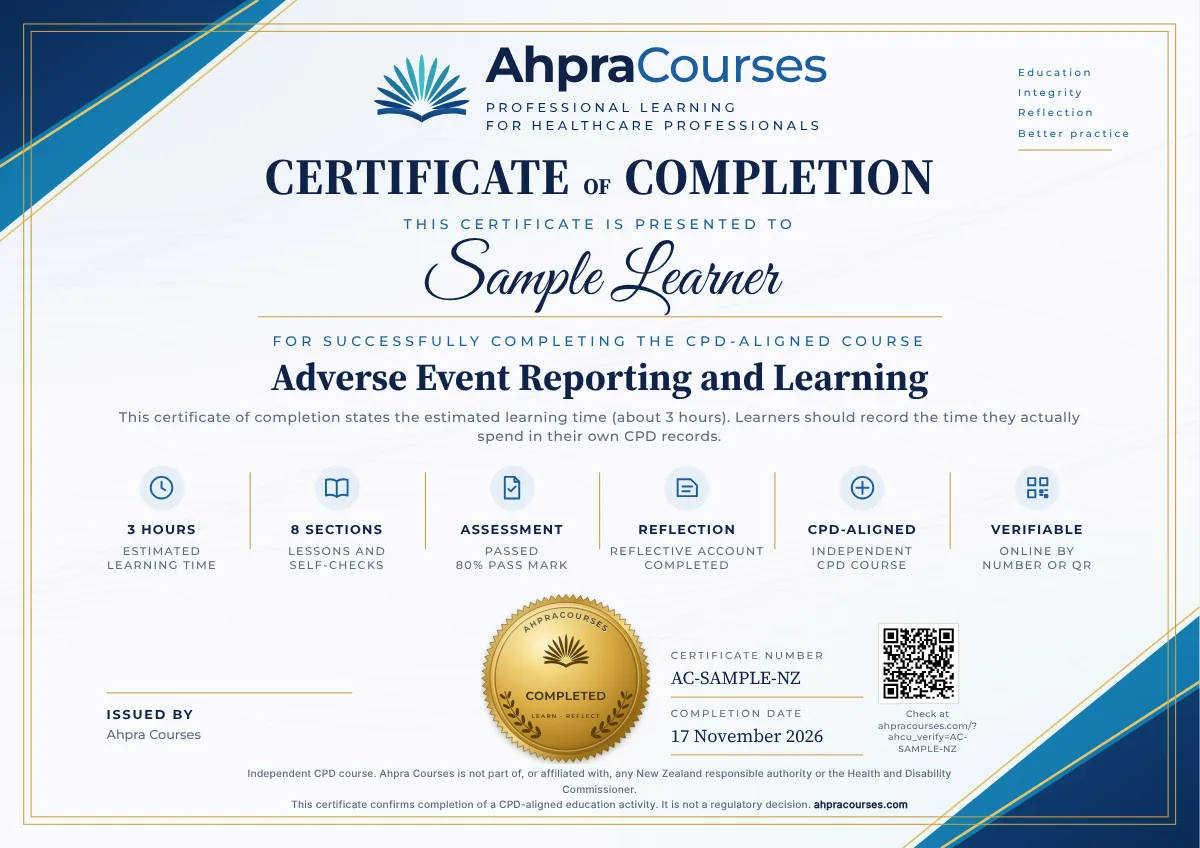
Sample certificate of completion for Adverse Event Reporting and Learning in New Zealand from Ahpra Courses, showing the learner's name, the course title, an estimated learning time of about 3 hours, the completion date and a certificate number that can be checked online
Sample. Your certificate shows your name, the course title, the completion date and its own certificate number.

Finish all eight sections and pass the final assessment, and your certificate is ready. It names you and the course, gives the completion date and records about 3 hours of learning. In your portfolio, record the time you really spent and the reporting habits you changed.

How practitioners use it

  • File it in your recertification portfolio against a goal about reporting, near miss capture or learning from harm.
  • Include it with a response to HDC or your authority where reporting or follow-up after an event has been questioned, together with your reflection.
  • Show it to your clinical lead or quality manager if you are setting up or improving reporting in a small practice.
  • Keep it alongside copies of reports you have lodged and the feedback received, to show the learning in use.
  • Use it as the starting point for a team session on what to report and how, recorded as a separate peer activity.

Who this course is for

Practitioners who were part of an event that was not reported

When an event comes to light through a complaint rather than the incident system, the absence of a report is itself examined. The course explains why that matters, what should have happened and how to show you now report as expected.

Practitioners asked to explain a report they wrote

Reports that speculate, blame a colleague or leave out the outcome can create problems later. The lessons on fact, opinion and structure show how to write reports that stand up to being read by anyone.

Senior clinicians and charge nurses

People with authority shape whether others report. The sections on psychological safety, just culture and feedback to reporters are written for those who receive reports as well as those who make them.

Doctors and nurse practitioners who certify deaths

An incident form does not discharge a duty to report a death to the coroner. The course explains which deaths after care must be reported and what not to do in the meantime.

Pharmacists and prescribers

Suspected adverse reactions and device problems have a national reporting route through CARM and Medsafe in addition to local systems. The course shows how the two fit together.

Practitioners in small or community settings

General practices, community pharmacies, dental clinics and aged care facilities need a proportionate system. Section 7 sets out what a small practice should have and how to run it without a quality department.

Anyone building recertification evidence

Every responsible authority expects practitioners to reflect on and learn from events. An event you reported, reviewed and changed practice after is strong evidence when written up well.

The concerns this course addresses

Deciding an event was not worth reporting

Near misses, events that "turned out fine" and harm that appears minor are the most commonly unreported. Yet a near miss differs from a harm event only in its outcome, and SAC 4 events reviewed together often reveal the most useful patterns. The course gives a low-threshold test you can apply in the moment and explains why the threshold is deliberately low.

National adverse events policy 2023; SAC definitions (SAC 4 includes near misses)

A report that helps nobody

Reports that are written days later, that guess at causes or that name and criticise a colleague are hard to rate and easy to misuse. A good report gives times, observable facts, the outcome, what was done, who was told and the conditions that contributed. The course shows a weak report rewritten into a strong one.

Responsible authority codes on documentation and collegial conduct; course Section 3

The clinical record left incomplete

The clinical record must contain the clinical facts of an event, what was done and what the consumer was told. The incident report sits elsewhere and serves a different purpose. Practitioners sometimes put everything in one and nothing in the other. The course explains what belongs where, and how to make a dated late entry without altering what was there.

Code of Rights, Right 4(2); responsible authority documentation standards

A death that should have gone to the coroner

Some deaths after care, including deaths during or after a medical procedure that were medically unexpected, must be reported to the coroner and must not be certified by the practitioner. Getting this wrong can cause distress for whānau and draw criticism later. The course explains the categories and the steps.

Coroners Act 2006; Coroners Court guidance for doctors and nurse practitioners

Product, device and privacy events

A suspected adverse drug reaction, a device that failed or a batch that looks wrong needs a report to CARM or Medsafe as well as to the service. Health information sent to the wrong person, where serious harm is likely, goes to the Privacy Commissioner and the people affected. The course sets out each route and the information to keep.

Medsafe and CARM reporting; Privacy Act 2020 notifiable privacy breaches

Holding back because of fear

Fear of blame is one of the strongest reasons practitioners do not report. The 2023 policy makes safe reporting one of its eight principles, and just culture separates honest error from at-risk and reckless behaviour. The course also explains plainly that incident reports are not generally protected from disclosure, so you can write reports you are comfortable for anyone to read.

National adverse events policy 2023, safe reporting principle; HPCA Act 2003, s 44 and Part 3

No reporting system in a small practice

Much of the national machinery was designed for hospitals. In a small practice the duty to learn from harm still applies under the Code of Rights and professional standards. The course describes a proportionate system: a log, a named lead, regular review, simple rating and a way to act on what is found.

Code of Rights, Right 4; RNZCGP Foundation Standard and responsible authority practice standards

Harm only the consumer recognised

Psychological, cultural and spiritual harm may be invisible to staff. The policy recognises all four types of harm and expects providers to enable consumers and whānau to report. The course explains how to listen to, record and report harm described by the person who experienced it.

National adverse events policy 2023, types of harm; Code of Rights, Rights 1 and 10

What the course covers

The course has seven teaching sections and a short conclusion. It starts with the vocabulary of harm, moves through rating, writing and outside reporting, and ends with what happens after a report and how to use an event in your own development.

1Harm, near misses and why reporting matters3 lessons

Harm, near misses and why reporting matters. Three lessons define harm events, adverse events and near misses as the national policy uses them, introduce physical, psychological, cultural and spiritual harm, explain why reporting is under-used and how to overcome each barrier, and trace the expectation to report through the Code of Rights, Ngā Paerewa and professional codes.

  • 1.1 The language of harm in Aotearoa
  • 1.2 Why reporting matters, and why it often does not happen
  • 1.3 Reporting as a professional and legal expectation
2Rating and classifying events under the national policy4 lessons

Rating and classifying events under the national policy. Four lessons set out what the policy covers and excludes, how complaints and employment issues relate to it, the four SAC levels and provisional versus final ratings, the Always Report and Review list with its documentation-dependent exclusions, and Part A and Part B reporting to the Commission.

  • 2.1 Scope of the policy and what sits outside it
  • 2.2 Applying the Severity Assessment Code
  • 2.3 The Always Report and Review list
  • 2.4 Reporting to the Commission: Part A, Part B and the portal
3Making a good report4 lessons

Making a good report. Four lessons cover the immediate priorities after an event, a low-threshold test for what to report, the structure of a report that supports rating and review, fact versus opinion and blame, the separate roles of the incident report and the clinical record, and the value of near misses, good catches and consumer-reported harm.

  • 3.1 What to report, and when
  • 3.2 Writing a report that helps
  • 3.3 The incident report and the clinical record
  • 3.4 Near misses, good catches and consumer-reported harm
4Reporting beyond your organisation4 lessons

Reporting beyond your organisation. Four lessons explain deaths that must go to the coroner, adverse reactions and device problems reported to CARM and Medsafe, notifiable privacy breaches and WorkSafe notifiable events, and notifications to a responsible authority under sections 34 and 45 of the HPCA Act.

  • 4.1 Deaths that must be reported to the coroner
  • 4.2 Medicines, vaccines and medical devices
  • 4.3 Privacy breaches and staff harm
  • 4.4 Notifying a responsible authority
5After the report: review and learning4 lessons

After the report: review and learning. Four lessons trace what a provider does with a report, the roles of terms of reference, facilitators and a consumer contact, why the Commission now prefers learning reviews to root cause analysis, how to take part in a review interview, and how SAC 3 and SAC 4 events are reviewed in clusters with stronger actions.

  • 5.1 From report to review: what happens next
  • 5.2 Learning reviews and the move away from root cause analysis
  • 5.3 Taking part in a review as a practitioner
  • 5.4 Clusters, themes and actions that last
6Safe reporting, accountability and protection4 lessons

Safe reporting, accountability and protection. Four lessons cover the safe reporting principle and psychological safety, just culture and matching the response to the behaviour, the limited statutory protections that apply to incident material, and support for health care workers after harm.

  • 6.1 The safe reporting principle
  • 6.2 Just culture: separating learning from blame and accountability
  • 6.3 Are incident reports protected?
  • 6.4 Supporting health care workers after harm
7Equity, settings and your own learning3 lessons

Equity, settings and your own learning. Three lessons apply the equity and culturally responsive practice principles to reporting, describe a proportionate incident process for general practice, pharmacy, dental and aged care settings, and show how to use an event as evidence of insight for recertification or a regulator.

  • 7.1 Culturally safe and equitable reporting
  • 7.2 Reporting in small, community and private settings
  • 7.3 Using an event as evidence of insight and learning
8Conclusion and key points1 lesson

Conclusion and key points. A brief recap of how reporting connects to open communication, review and national learning, before you move on to the final assessment.

  • Conclusion and key points
✓Reflection, final assessment and certificate3 steps
  • Your reflective account, which you can download for your records
  • Final assessment: 20 questions, 80% to pass
  • Certificate of completion, dated and numbered

Why the way you report an event matters to HDC, your authority and the system

Reporting is where New Zealand's response to harm begins. Te Tāhū Hauora Health Quality & Safety Commission's national adverse events policy, Healing, learning and improving from harm, asks providers to identify events, rate them, review them in proportion to their severity and share the learning. Its eight principles are consumer and whānau participation, culturally responsive practice, equity, open communication, restorative practice, safe reporting, system accountability and system learning. None of that machinery starts until a practitioner tells the system something has happened.

How events are rated

The Severity Assessment Code has four levels. SAC 1 covers death or harm causing severe loss of function or requiring lifesaving intervention. SAC 2 covers harm causing major loss of function or requiring significant intervention. SAC 3 covers short-term loss of function or minimal additional intervention, and SAC 4 covers events needing little or no intervention, including near misses. For SAC 1 and SAC 2 events, and anything on the Always Report and Review list, the provider reports to the Commission: Part A within 30 working days of the event being notified and Part B, the anonymised review findings, within 120 working days of the event being reported to the provider. The policy recognises physical, psychological, cultural and spiritual harm.

Why HDC and authorities look at reporting

The Code of Rights gives consumers the right to services that comply with professional standards (Right 4(2)), to information about what happened (Right 6) and to complain (Right 10). Every responsible authority's code expects practitioners to act when things go wrong and to support learning. When a complaint reaches HDC or a responsible authority, what a practitioner did after the event is often examined as closely as the event itself: whether it was reported, whether the record is accurate, whether the consumer was told and whether the practitioner took part in learning. A late or missing report, or a record changed after the fact, can turn a competence concern into a question of honesty.

What reporting does not protect

Practitioners often assume incident reports are confidential. In New Zealand that is only partly true. The HPCA Act protects information in some quality assurance activities that have been formally declared, and gives limited confidentiality to information in competence and recertification processes. An ordinary incident report has no general immunity and may be seen by HDC, a coroner, a responsible authority or a court. The safest approach is to write every report as if the consumer and the colleague named in it will read it: factual, timed, free of speculation and free of blame.

Reporting as evidence of insight

Responsible authorities, professional conduct committees and the Tribunal look for insight and the risk of repetition. A practitioner who reported promptly, told the consumer honestly, took part in the review and changed practice afterwards has a clear story to tell. The course is built to help you be that practitioner, and to describe it accurately if you are asked.
How to respond to a complaint or notification about this kind of concern

If a complaint or review has raised questions about how an event was reported or followed up, these steps help you respond in a way that is honest and useful.

  1. Take advice and read the concern closely

    Speak to your indemnity provider, professional association or union. Identify exactly what is said about reporting: that no report was made, that it was late, that it was inaccurate, or that the consumer was not told.

    In the course: Section 1 explains the professional and legal sources of the expectation to report, so you can see which standard is being applied.

  2. Check what was reported, where and when

    Find out whether an incident report exists, what it says and what the clinical record shows. Do not alter either. If something is missing from the record, ask your adviser about a clearly dated late entry.

    In the course: Lesson 3.3 explains the difference between the report and the record and how a late entry differs from a changed one.

  3. Work out whether outside reporting was required

    Consider whether the event should also have gone to the coroner, CARM or Medsafe, the Privacy Commissioner, WorkSafe or a responsible authority. If a duty was missed, tell your adviser now rather than letting it surface later.

    In the course: Section 4 sets out each outside route and when it applies.

  4. Acknowledge your part without speculation

    If you did not report, say so and explain honestly why, for example uncertainty about the threshold or fear of blame. Avoid guessing at other people's reasons.

    In the course: Section 6 helps you describe the barriers to reporting in a way that shows understanding rather than excuse.

  5. Show the reporting habits you now use

    Describe the specific changes: reporting near misses before you leave the shift, using a set structure, telling the consumer and recording that you did. Collect copies of reports lodged since and any feedback.

    In the course: Section 3 gives the report structure and Section 7 the frame for turning an event into evidence.

  6. Join in the learning, not just the paperwork

    Offer to take part in any review, attend debriefs and contribute to actions. Keep notes of what you did. A reviewer will look for engagement over time, not a single statement.

    In the course: Section 5 prepares you for a learning review and explains what stronger actions look like.

Do not edit an incident report or clinical note after you learn of a complaint. Electronic systems keep an audit trail, and an alteration can become a more serious matter than the original event.

This page gives general information about the course and the New Zealand system. If HDC, a responsible authority, a PCC or a coroner has contacted you, take advice from your indemnity provider, professional body, union or a lawyer before responding.

How this course helps with a complaint or notification

It settles the "should I report this?" question

Most reporting failures are not deliberate. They come from uncertainty about the threshold. The course gives a short, consistent test grounded in the national policy and the SAC levels, so you can decide quickly and defend your decision if asked.

It shows you what a reviewer needs from a report

The people who rate and review events need specific things: times, observations, outcome, actions taken, who was told and the conditions at the time. Reports that provide them are acted on. The course shows the structure and gives a worked rewrite of a weak report.

It maps every outside duty in one place

Coroners, CARM, Medsafe, the Privacy Commissioner, WorkSafe and responsible authorities each have their own rules. Practitioners usually learn them one by one after a mistake. Section 4 brings them together with the triggers and first steps for each.

It helps you show learning, not just compliance

Regulators can tell the difference between a practitioner who files forms and one who learns. The final section turns your involvement in an event into a structured reflection with evidence that fits recertification programmes and responses to a concern.

Remediation evidence that carries weight

Carries weight

  • De-identified copies of incident reports you have lodged since the event, showing a clear structure and timely submission
  • Feedback from your service on reports you made and the actions that followed
  • A reflection that names the reporting standard involved and explains specifically what you now do differently
  • Records of your participation in a learning review, debrief or cluster review
  • A near miss log or reporting tool you set up or improved in your practice, with evidence it is being used
  • A team education session you led on what to report and how, with attendance and follow-up
  • An audit of documentation after events in your area, repeated after an interval
  • A conversation with your peer, supervisor or verifier recorded in your recertification portfolio

Carries little weight

  • A statement that you now "always report everything" with no examples
  • Copies of reports that still speculate about causes or criticise colleagues
  • A description of the reporting system with no evidence of your use of it
  • Character references that do not mention the event or your reporting since
  • A completion certificate without any reflection or change in practice
  • Explanations that the incident system was too slow or too complicated to use
  • A newly written practice policy that no one has followed or audited
  • Retrospective reports filed only after the complaint arrived

A remediation plan, phase by phase

  1. Weeks 1 to 2

    Secure the facts and get support

    • Contact your adviser and diarise any deadlines
    • Obtain copies of any report and the relevant clinical record without changing them
    • Check whether any outside reporting duty was missed
    • Use your employee assistance programme or peer support if you need it
  2. Weeks 2 to 4

    Learn the standard

    • Complete this course and note the lessons that match your situation
    • Read the national policy summary and your service's incident procedure
    • Identify your own barriers to reporting honestly
    • Discuss the event with a senior colleague or supervisor
  3. Weeks 4 to 8

    Change how you report

    • Adopt a set structure for every report you make
    • Report near misses before you leave each shift
    • Record in the notes when you have told the consumer or whānau
    • Write up the event with the four prompts: facts, learning, change and evidence
  4. Months 2 to 4

    Contribute to learning

    • Take part in a learning review or cluster review if offered
    • Ask for feedback on the reports you have lodged
    • Lead or join a short team session on reporting
    • Update your reflection with what you have found
  5. Months 4 to 6

    Show it is sustained

    • Compile copies of reports, feedback and review notes
    • Audit documentation after events in your area
    • Discuss progress with your peer or verifier
    • Add a reporting goal to your next development plan

Writing your reflective statement

1The event and the report

State the bare facts, the harm or potential harm, and whether a report was made, when and through which system.

Example only (fictional): A resident in our aged care facility fell overnight and had a bruised hip. I documented the fall in her notes but did not complete an incident report because the X-ray was normal.

2The rating and the rules

Identify the SAC level that fits, whether the event is on the Always Report and Review list, and which standard required a report.

Example only: This was probably a SAC 3 event because she needed an X-ray and extra observation. Our facility procedure and Ngā Paerewa both required it to be reported.

3Why it was not reported well

Describe honestly the barriers you faced, separating system factors from your own decisions.

Example only: I believed a normal X-ray meant no harm. The form is long and I was finishing a double shift. I also did not want the night carer to feel blamed.

4Impact

Explain what the missing or poor report meant for the consumer, whānau and the service's learning.

Example only: Her daughter only learned of the fall when she visited. The facility missed the third fall in a month near the same bathroom door.

5What I now understand

Explain which idea from the course changed your view.

Example only: I now see reporting as information for the system, not an accusation, and that minor events reviewed together show patterns no single event does.

6What I do differently

Describe one or two reporting habits a colleague would see you doing, with a start date.

Example only: From June I complete a report for every fall before the end of the shift and tell the family the same day, recording that in the notes.

7How I will show it

Name the reports, feedback or audit results you will keep, and the date you will look at them again.

Example only: Copies of my reports for three months, the facility's falls cluster review and a discussion with my clinical manager in September.

The example sentences are fictional and show structure only. Your statement has to be your own honest account of what happened.

A weak and a strong response, side by side

Fictional: Ms R, a community pharmacist, receives a letter from the Pharmacy Council after a dispensing error that reached a child. The complaint notes that no incident report was made and the family were not told until they found the error themselves.

Weak

The error was caught by the parent before any harm was done and the child was fine. The pharmacy was extremely busy that day and our technician had called in sick. We do not have a formal incident system and I deal with errors informally with staff. I have since apologised to the family. I do not consider that this matter warrants the Council's involvement.

Strong

I accept that I dispensed the wrong strength of a paediatric liquid, that I did not make a written report, and that the family discovered the error before I told them. I understand now that a near miss of this kind should be recorded and reviewed, and that the family were entitled to hear from me promptly. I had no structured reporting system and treated errors as private matters, which meant we could not see patterns. Since then I have introduced an error and near miss log reviewed monthly with staff, I contact the person on the day an error is found, and I have changed how we check paediatric liquids. Copies of the log for the last four months and our review notes are attached.

Why the second one works: The strong response accepts both the error and the reporting failure, recognises the family's right to information and explains the cause without hiding behind workload. It describes a working system with evidence. The weak response minimises the event because no harm occurred, blames staffing and rejects the regulator's interest, which suggests the risk remains.

Mistakes practitioners make when responding

Waiting to see how the patient does

Reports are meant to be made promptly with a provisional rating. Holding back until the outcome is clear loses detail and looks like hesitation if the outcome is bad.

Writing opinions as facts

"The nurse was careless" is an opinion. "The 14:00 dose was not signed for" is a fact. Reports full of judgement are hard to use and may be read by the person you judged.

Putting the incident report in the notes

The clinical record needs the clinical facts, actions and disclosure. Commentary on systems and colleagues belongs in the incident system, not the consumer's record.

Certifying a death that should go to the coroner

If a death after care was medically unexpected, check the coroner reporting criteria before completing any certificate.

Assuming an incident report is confidential

Reports can be requested by HDC, authorities, coroners and courts. Write them so that you would be comfortable for anyone to read them.

Reporting only harm, never near misses

Near misses show which defences worked and which nearly failed. Leaving them out removes the most useful information from the system.

Treating the complaint as the report

A complaint that reveals harm should prompt a report in its own right. Responding to the complaint without reporting the event leaves the service unable to learn.

The code provisions this course works through

These provisions set out why reporting is expected and where its limits lie. Each note says what the provision requires and where the course applies it.

Code of Rights, Right 4(2)Compliance with standards

Right 4(2) expects care to meet legal, professional and ethical standards, and today those standards include reporting harm. Reporting and learning from harm are part of every profession's standards.

In the course: Lesson 1.3 traces reporting duties through professional codes.

Code of Rights, Right 6Right to be fully informed

Consumers are entitled to information that a reasonable consumer in their circumstances would expect, including the results of procedures. After harm, that includes an honest account of what happened.

In the course: Sections 3 and 5 connect reporting with open communication.

Code of Rights, Right 10(3)Resolving complaints

Right 10 requires providers to make complaints easy to raise and to resolve them fairly and quickly. A complaint that reveals harm should also enter the incident system.

In the course: Lesson 2.1 explains how complaints and harm events relate.

National adverse events policy 2023Reporting to the Commission

The policy sets the reporting clock for SAC 1, SAC 2 and Always Report and Review events: Part A within 30 working days of notification and Part B within 120 working days.

In the course: Lesson 2.4 explains what these timeframes mean for practitioners.

HPCA Act 2003, ss 34 and 45Notifying a responsible authority

Section 34 covers notification that a practitioner may pose a risk of harm because their practice may be below the required standard. Section 45 covers concerns that a condition may affect a practitioner's ability to perform their functions.

In the course: Lesson 4.4 explains when these apply and why an incident report is not a notification.

Also relevant: Privacy Act 2020 Notifiable privacy breaches to the Privacy Commissioner and affected people; HPCA Act 2003, s 44 and Part 3 Limited confidentiality for competence processes and declared quality assurance activities; Coroners Act 2006 Deaths that must be reported to the coroner

How this applies in each profession

Doctors

Medical Council of New Zealand (Te Kaunihera Rata o Aotearoa)

Doctors who certify deaths need to know which deaths after care must go to the coroner instead. The Inpractice audit requirement can be met by auditing post-event documentation in your own practice.

Nurses

Nursing Council of New Zealand (Te Kaunihera Tapuhi o Aotearoa)

Nurses make most incident reports in hospitals and aged care. A structured reporting habit and a reflection on an event you reported fit well within the 60 professional development hours over three years.

Midwives

Midwifery Council (Te Tatau o te Whare Kahu)

Lead maternity carers work across community and hospital settings. Knowing whose incident system receives a report, and making sure the event is reported in both where needed, avoids gaps.

Pharmacists

Pharmacy Council (Te Pou Whakamana Kaimatū o Aotearoa)

Community pharmacies need their own error and near miss log. Suspected adverse reactions should also be reported to CARM, which is a separate route from the pharmacy's internal record.

Dentists and oral health practitioners

Dental Council (Te Kaunihera Tiaki Niho)

Small dental practices rarely have a quality team. A simple log, a named lead and regular review meet the expectation to learn from events in a proportionate way.

Paramedics

Paramedic Council

Ambulance events often involve handover to another provider. Reporting in your own service and making sure the receiving team knows what happened are both needed.

Psychologists

New Zealand Psychologists Board

Psychological, cultural and spiritual harm are recognised in the national policy. Psychologists are often well placed to recognise and record harm that a consumer describes but staff did not observe.

What happens after a complaint or notification in New Zealand

This is how a harm event moves from the moment it happens to the possible regulatory outcomes, seen from the practitioner's side.

  1. Immediate response

    Make the person safe, get help, tell the right people, preserve equipment and information, and begin honest communication with the consumer and whānau.

  2. Incident report and provisional rating

    The event is reported in the provider's system and given a provisional SAC rating. Outside duties, such as to the coroner or CARM, are actioned separately.

  3. Review and reporting to the Commission

    SAC 1, SAC 2 and Always Report and Review events are notified to Te Tāhū Hauora and reviewed. SAC 3 and SAC 4 events are reviewed locally, often in clusters.

  4. Complaint to HDC

    Whatever the service does, the patient or their whānau can still take a complaint to HDC. HDC can refer the matter back to the provider, to Advocacy or to another agency, close it with comment, or investigate.

  5. Responsible authority involvement

    When HDC takes up a complaint about a registered practitioner, the authority is told. The authority may also receive notifications from employers or colleagues and may review competence under section 36.

  6. Professional conduct committee

    Where conduct is in question, including honesty about records or reporting, the authority may refer the matter to a PCC for investigation.

  7. Tribunal

    If a PCC or HDC's Director of Proceedings lays a charge, the Health Practitioners Disciplinary Tribunal decides whether it is proved and the penalty.

Who handles your matter: the HDC, your responsible authority and the Tribunal

Te Tāhū Hauora runs the national adverse events system. It receives reports from providers and publishes national learning. It does not investigate individual practitioners.

The Health and Disability Commissioner handles complaints about whether consumers' rights were respected. HDC may look at reporting and disclosure after an event as part of whether the Code was met.

Your responsible authority is concerned with your competence and conduct. It can review your practice, set a competence programme or conditions, and refer conduct to a professional conduct committee.

The Health Practitioners Disciplinary Tribunal rules on charges and sets any penalty. An incident report you wrote may become evidence at any of these stages, which is one more reason to write it carefully.

Possible outcomes and what they mean for you

OutcomeWhat it isWhat it means for you
HDC: referred to the provider or AdvocacyThe complaint is resolved directly between the consumer and the provider, with support from the Advocacy Service if needed. HDC reports that around 30% of complaints are resolved this way.Respond promptly, honestly and with evidence of changes, and report the outcome to HDC as required.
HDC: closed with educational commentHDC finds care was largely appropriate but comments on aspects that could be better, such as reporting or communication.Treat the comment as a learning goal and record what you did about it.
HDC: breach finding and recommendationsAfter investigation, HDC finds a breach of the Code and recommends actions such as an apology, a reflection, an audit or training.Complete each recommendation and keep the evidence. Reporting improvements are often part of them.
Director of ProceedingsIn the most serious breach cases HDC can refer the practitioner to the Director of Proceedings, who then decides whether proceedings should be brought.Rare, but serious. Take legal advice straight away.
Responsible authority: no further actionThe authority is satisfied the risk is managed, often because of what the practitioner has already done.Prompt reporting and genuine learning make this more likely. Keep going.
Competence programme or conditionsIf a review finds practice below the required standard, the authority can order education, supervision, an assessment or conditions.Confirm in writing whether this course can count before you rely on it.
Tribunal penaltiesAfter a charge is proved the Tribunal chooses from censure, conditions, suspension of up to three years, cancellation and a fine up to $30,000 and order costs.Altering records or concealing an event weighs heavily at this stage. Honesty after the event matters.

If a condition or undertaking requires education

If a responsible authority has ordered a competence programme or conditions after a review, the order may include education. Ask the authority before you enrol in any course to meet it, and send the outline, objectives and assessment details. Keep the written reply. Education completed before the authority agrees may not be counted.

Where reporting or documentation is part of the concern, the authority or your supervisor will usually want to see the change in your everyday work, not only the course. Plan from the start how you will show it: copies of reports, audits of records after events and supervisor observations over the period of the order.

Using this course as CPD

Learning from harm is part of every recertification programme in New Zealand, though each responsible authority records it differently. Nurses must show at least 60 hours of professional development within the previous three years at each practising certificate renewal. Doctors in the general scope using Inpractice complete annual minimums that include 20 hours of continuing medical education and a medical audit. Pharmacists set learning goals and complete a critical reflection in MyRecert. Other authorities use development plans, peer review and reflections.

This course provides about 3 hours of education. Record the time you actually spent and link it to a goal such as "report every near miss in my area within the shift". To turn it into stronger evidence, follow it with a small audit of reporting or post-event documentation in your area, or by presenting a de-identified event and its learning to colleagues.

If the course forms part of a competence programme, conditions or a recommendation from HDC or a PCC, keep that record separate from your ordinary recertification activity unless your authority tells you otherwise.

  • Log the real time spent and attach the certificate.
  • Tie the course to a reporting or learning goal in your plan.
  • Add an audit or team session to show the learning in practice.
  • Keep de-identified copies of reports and feedback for audit.
  • Keep required education records apart from ordinary recertification.

How this course is written and kept current

What you read here is drawn from New Zealand primary sources: Te Tāhū Hauora's national adverse events policy 2023, its user guide and SAC resources, the Code of Health and Disability Services Consumers' Rights, the HPCA Act 2003, the Privacy Commissioner's breach guidance and HDC's guidance for providers. Definitions, timeframes and SAC descriptors were checked against the published policy in November 2026. The examples on this page are fictional and do not describe real practitioners. The content is reviewed whenever the policy, its user guide or the relevant legislation changes, and at least annually.

Healing, learning and improving from harm: National adverse events policy 2023 (Te Tāhū Hauora)User guide to the national adverse events policy 2023 (Te Tāhū Hauora)Severity Assessment Code poster (Te Tāhū Hauora, March 2024)Harm (adverse) event submission portal (Te Tāhū Hauora)Code of Health and Disability Services Consumers' Rights (HDC)Health Practitioners Competence Assurance Act 2003 (version as at 10 July 2026)NotifyUs and privacy breach notification guidance (Office of the Privacy Commissioner)What if a complaint is made about me? (HDC)Continuing competence requirements (Nursing Council of New Zealand)

Last reviewed: November 2026.

Key terms explained

Harm event
An event that results in harm to a consumer receiving health or disability services; the Commission uses the term alongside "adverse event".
Near miss
Something that went wrong but was caught before it reached the patient, or reached them without harm; grouped with SAC 4 events and well worth reporting.
Types of harm
The four kinds the policy recognises: physical, psychological, cultural and spiritual.
SAC
Severity Assessment Code: SAC 1 severe, SAC 2 major, SAC 3 moderate, SAC 4 minor and near misses.
Always Report and Review list
Events in hospital specialist services that must be reported and reviewed whatever their outcome.
Part A and Part B
The initial notification (within 30 working days) and the anonymised review findings (within 120 working days) that providers send to the Commission.
Learning review
A review of a harm event built on human factors principles, preferred by the Commission over traditional root cause analysis.
Safe reporting
A policy principle: no one should be punished, marginalised or humiliated for reporting harm.
Just culture
An approach that matches the response to the behaviour: support for error, coaching for at-risk behaviour, accountability for recklessness.
CARM
The Centre for Adverse Reactions Monitoring, which receives reports of suspected adverse reactions to medicines, vaccines and natural health products.
Notifiable privacy breach
A breach of health information that has caused, or is likely to cause, serious harm; the Privacy Act 2020 requires the agency to tell the Privacy Commissioner and the people affected.
Section 34 notification
A notice under the HPCA Act to a responsible authority that a practitioner's practice may pose a risk of harm.

Frequently asked questions

Do I have to report a near miss if nobody was harmed?

Yes, in almost every service. The national policy treats near misses alongside SAC 4 events, and they are among the most useful reports because they show which safeguards worked. Your service's procedure will say how to report them. If you are unsure, report it and let the rating process decide. A report that turns out to be minor costs little; an unreported pattern can cost a great deal.

Who decides the SAC rating, me or my manager?

Usually the service gives the provisional and final ratings, not the person reporting. But your report should contain the facts needed to rate it: what happened, the actual harm, what intervention was needed and the outcome as the consumer experienced it. Ratings can change as the outcome becomes clearer, which is why the policy distinguishes a provisional rating from a final one. Report what you know now and update it if the person's condition changes.

Can my incident report be used against me?

It can be seen by others. Ordinary incident reports have no general legal protection in New Zealand, and may be requested by HDC, a coroner, a responsible authority or a court. The HPCA Act gives protection only to declared quality assurance activities and limited confidentiality in competence and recertification processes. Write factually and you have little to fear. Avoid speculation, opinions about colleagues and defensive commentary, and keep to times, observations, actions and outcomes.

Is an incident report the same as notifying my responsible authority?

No. An incident report goes to your service. A notification to a responsible authority under section 34 or 45 of the HPCA Act is a separate step taken when a practitioner's competence or health may pose a risk. Most events never need one. If you think a colleague's competence or health may put people at risk, talk to your manager or clinical lead first and take advice about whether a notification is needed. Section 4 explains both routes.

What must I report to the Privacy Commissioner?

Yes, if it has caused serious harm or is likely to: the agency must tell both the Privacy Commissioner and the people affected as soon as practicable. The Commissioner asks agencies to notify through NotifyUs, ideally within three days of becoming aware of a notifiable breach. Usually your organisation's privacy officer makes the notification, so tell them at once. Keep a record of what you knew and when, because the Commissioner may ask how the breach was handled.

Will this course help if HDC says I failed to tell the family?

Partly. It explains how reporting and open communication fit together and how to record disclosure. For a full treatment of how to have the conversation, the Open Disclosure After Harm course is the better companion. Reporting and disclosure are linked: the incident record should note when the consumer and whānau were told, by whom and what they were told. Where that note is missing, it is hard to show disclosure happened at all.

Can I use this course for an education condition?

Only with your responsible authority's written agreement. Send the outline and assessment details and wait for a reply before you start. If your order names a specific provider, use that one. Remember that education conditions are usually reviewed against what has changed in practice, so plan to keep copies of reports and audits from the start.

Does the course count for recertification?

It is about 3 hours of education that fits most programmes. Log the hours you really spent against a reporting or patient safety goal. Adding a reporting audit or team session makes it stronger evidence. If you hold a role in which you receive reports, such as charge nurse or practice lead, a reflection on how you respond to reporters can count as well.

I work alone in a small practice. Does any of this apply?

Yes. The duty to learn from harm comes from the Code of Rights and your professional standards, not from having a quality department. Section 7 describes a simple system that works for one or two practitioners. Even a simple paper log reviewed once a month with a colleague meets the spirit of the policy, and it gives you something concrete to show an auditor or your authority.

What happened to root cause analysis?

Te Tāhū Hauora's guidance now favours learning reviews that use human factors principles over traditional root cause analysis. The aim is to understand how work was really done and why actions made sense at the time, rather than to find a single cause. For practitioners, the change means review interviews focus on what you knew and why your actions made sense, not on finding someone to blame. Section 5 prepares you for that kind of conversation.

How much does the course cost?

NZ$120. Five New Zealand courses together cost NZ$545 and ten cost NZ$850, which suits practitioners building a wider learning plan. Discounts for several courses are applied automatically at checkout. Practitioners responding to a harm event often pair this course with Open Disclosure After Harm and Clinical Documentation and Record Keeping, which works out cheaper than buying them one at a time.

How long does the course take, and how long do I have access?

The estimated learning time is about 3 hours (about 180 minutes), covering the lessons, the section checks, your reflective account and the final assessment. People work at different speeds, so record the time you actually spend in your own CPD records. Your progress is saved to your account and you can return to the course and your certificate at any time.

How is the course assessed?

Lessons open in order. Each section closes with a graded check that you answer before moving on. The course ends with a 20-question final assessment, marked on our server, with a pass mark of 80%. If you do not pass, review the sections it points you to and try again.

Does completing the course decide the outcome of my matter?

No course can decide or predict the outcome of a notification, investigation, panel or tribunal. Decision-makers weigh all of the evidence, including your insight, your reflection and the changes you have made and sustained. The course is designed to support that learning and to give you a dated record of it.

Start today, finish at your own pace

Instant access after checkout. Work through 8 sections in order, write your reflective account, pass the final assessment and download your dated certificate.

Primary sources

Always read the current version on the publisher's website. This page is general information, not legal advice.

On call with Dr AI Alma