Bundle & save Studying more than one course? Save 15% on 3, 22% on 5 and 30% on 10 or more, taken off in your cart.
Free Course AdvisorQuestions about which course fits your case?
Ahpra Courses

The relational work that complaint, remediation and regulatory processes leave for you to finish

Rebuilding Trust After a Complaint in New Zealand

Last updated

A complaint can close while relationships stay broken: a patient who no longer trusts you, a team unsure what happened, an employer watching closely, an authority waiting for evidence and your own confidence shaken. This course treats trust as something with parts that can be repaired, and works through each relationship in turn, using the Code of Rights, your responsible authority's standards and a culturally safe, Te Tiriti-consistent approach.

  • 3 hours, CPD-aligned
  • Written to your responsible authority's code
  • 8 sections with graded checks
  • 20-question final assessment
  • Dated, verifiable certificate
  • Self-paced on any device
  • 1-to-1 AI tutor, Dr AI Alma
Enrol now, NZ$120Bulk buy from NZ$85 a course

Dated certificate with a number anyone can verify

61CPD courses for New Zealand practitioners
16Professions covered
24/7Self-paced, online, any device
NZ$120Per course, no subscription

Where does trust feel most damaged?

At a glance

Who it is for
Practitioners registered under the HPCA Act 2003 who are dealing with, or have come through, an HDC complaint, a notification, a competence review, a PCC investigation or a Tribunal charge, and the supervisors and leaders who support them
Regulators covered
All responsible authorities under the HPCA Act; the Health and Disability Commissioner; professional conduct committees; the Health Practitioners Disciplinary Tribunal
Format
Online and self-paced: 8 sections and 22 lessons, including the conclusion, with fictional cases from general practice, hospital teams, midwifery, community pharmacy, dental practice and allied health clinics
Assessment
Four trust-repair questions after each of sections 1 to 7, a 20-question final on patients, teams, employers and regulators (80% to pass), and a four-question reflection
Certificate
A dated certificate you can show a supervisor, employer or authority as one step in rebuilding trust, checkable by number or QR code
Learning time
About 3 hours
Best taken with
Responding to a Complaint while the matter is open, and Insight: Understanding, Developing and Demonstrating It when you need to show what you have learned
Learning time
About 3 hours, self-paced, online on any device. Progress is saved to your account.
Price
NZ$120 for one course. Bundles: 5 courses for NZ$545, 10 courses for NZ$850.

In short

A complaint damages trust in specific ways: confidence in your competence, belief in your honesty, a sense that you care, or confidence that you will do what you say. Each relationship affected, with the patient and whānau, colleagues, your employer, your responsible authority, the community and yourself, may have lost different parts. Repair follows a sequence: acknowledge, account, amend, assure and sustain. Competence lapses are repaired mainly through learning and evidence of current performance; integrity lapses need full admission, invited scrutiny and a long, consistent record. In New Zealand the Code of Rights continues to protect a patient who complains, the HPCA Act's processes are designed to return practitioners to safe practice, and repair with Māori and Pacific patients and whānau must be culturally safe. This course works through each relationship with practical steps and fictional cases.

The certificate you receive

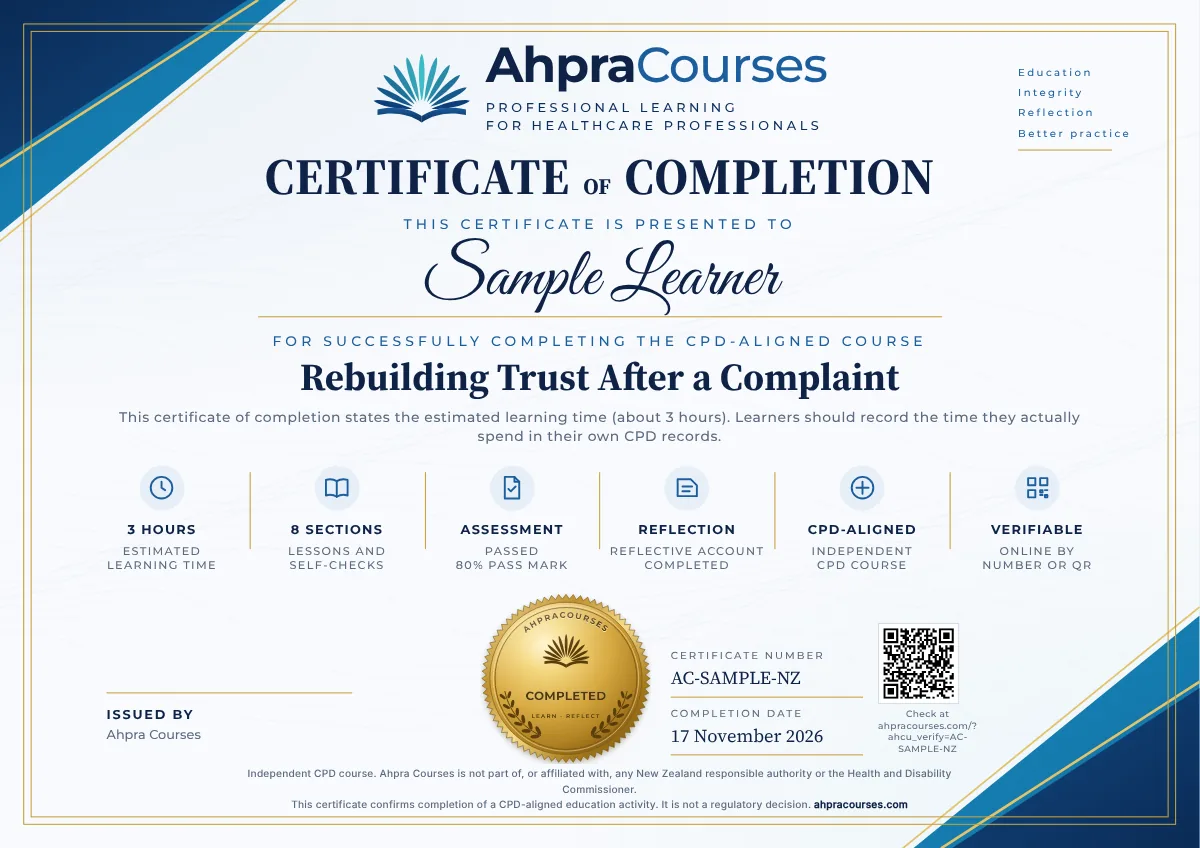
Sample certificate of completion for Rebuilding Trust After a Complaint in New Zealand from Ahpra Courses, showing the learner's name, the course title, an estimated learning time of about 3 hours, the completion date and a certificate number that can be checked online
Sample. Your certificate shows your name, the course title, the completion date and its own certificate number.

When you have passed the final assessment and completed the reflection, your certificate of completion is available to download. Course title, completion date and the learning time of about three hours, and it can be verified online by its number or QR code. Record your real study hours, not the estimate, in your own CPD log.

How practitioners use it

  • Add it to your recertification record against a goal about communication, professional relationships or professionalism.
  • Provide it, with your reflection, to your responsible authority or programme manager if relationships and trust are part of what a competence programme or conditions require.
  • Share it with your clinical leader or employer as part of a return-to-full-duties plan.
  • Discuss it with your supervisor or collegial relationship provider when planning a conversation with a patient, whānau or colleague.
  • Keep it in your file so that, if you move jobs, you can show the work you did after the complaint.

Who this course is for

Practitioners with an open complaint or notification

While a process is running, there is still a patient to care for, a team to work with and an employer to keep informed. The course shows what you can safely do to protect relationships without interfering with the process.

Practitioners whose matter has closed

An HDC opinion, a decision of no further action or a completed competence programme ends the formal process but not the relational one. The course covers what remains to be repaired and how.

Practitioners under conditions or a programme

Conditions, supervision and competence programmes can feel like punishment. The course shows how to comply in a way that builds a documented track record toward fewer restrictions.

Practitioners after a Tribunal decision

A published decision and its penalty affect public trust and your own sense of professional identity. The course covers responding to publicity, living with restrictions and rebuilding over years.

Supervisors, mentors and clinical leaders

If you support a colleague after a complaint, the course explains what trust repair involves and how you can help without colluding or overstepping.

Practitioners whose confidence has gone

Defensive practice, avoidance and thoughts of leaving the profession are common after a complaint. The course treats your own trust in yourself as a relationship worth repairing too.

The concerns this course addresses

Continuing care for a patient who complained

A complaint does not suspend the patient's rights. Care must not deteriorate, and ending the relationship because the patient complained is likely to be seen as retaliatory. Ask the patient what they want: to continue, share care or transfer, and make any change easy and safe.

Code of Rights Rights 1, 4 and 10; MCNZ statement on ending a doctor-patient relationship

Restorative conversations with patients and whānau

Meetings after a complaint can heal or harm. They must be voluntary for the patient and whānau, prepared, facilitated by someone suitable and culturally responsive, often kanohi ki te kanohi. Never use them to pressure a complainant to withdraw.

Healing, learning and improving from harm (2023), restorative practice and hohou te rongo; Code of Rights Right 5

Returning to your team

Complaints ripple through teams as rumour, side-taking and avoidance. Agree a short, accurate message about what you can say, never discuss the matter with colleagues who may give evidence, and treat any colleague who notified your authority as someone using a legitimate route.

HPCA Act 2003 ss 34 and 45; Protected Disclosures Act 2022

Keeping your employer's confidence

Your employer has its own duties: to protect patients, review its systems, notify the authority in some circumstances and treat you fairly. Restricted duties are a safety step, not a verdict. Offer a written plan with milestones and exit criteria that aligns with any regulatory conditions.

HPCA Act 2003 s 34(3); Employment Relations Act 2000

Honesty when moving on

Disclosing conditions to a new employer, answering annual practising certificate questions truthfully and keeping references accurate are integrity tests. A concealed history discovered later damages trust far more than one disclosed openly.

HPCA Act 2003; responsible authority APC declarations

Making conditions count

Practising in breach of conditions is a ground for discipline under section 100(1)(f), and not meeting a competence programme can lead to action under section 43. Compliance done well, with honest supervision and prompt self-reporting of slips, is the evidence that persuades an authority to reduce restrictions.

HPCA Act 2003 ss 38, 43 and 100

Published decisions and public comment

HDC opinions and Tribunal decisions are published, and media or online comment may follow. Respond briefly, never discuss patient information, and do not argue the case online. Name suppression is a matter for the Tribunal and needs to be sought through the proper process.

HPCA Act 2003 Part 4; Health Information Privacy Code 2020

Trusting yourself again

Loss of confidence creates its own risks: over-investigation, avoidance of complex patients, reluctance to make decisions. Rebuild confidence through evidence of your current performance, supervision and support, not reassurance alone.

Responsible authority codes on practitioner wellbeing

What the course covers

Eight sections and 22 lessons move from what trust is to repairing it with each group affected by a complaint. Sections 1 to 7 each end with a knowledge check.

1Understanding trust and how a complaint damages it3 lessons

Understanding trust and how a complaint damages it. Trust as competence, integrity, care and reliability; how New Zealand codes and the Code of Rights build trust into professional duties; the six rings of affected trust; and why repair is possible but cannot be demanded.

  • 1.1 What trust is made of
  • 1.2 How a complaint damages trust, and whose
  • 1.3 Why repair is possible, and what it is not
2Principles of trust repair3 lessons

Principles of trust repair. Why competence and integrity breaches need different repair, scoring the damage to each element, the five stages of acknowledge, account, amend, assure and sustain, and behaviours that undo repair.

  • 2.1 Competence breaches and integrity breaches need different repair
  • 2.2 A five-stage repair sequence
  • 2.3 Behaviours that undo repair
3Rebuilding trust with patients and whānau3 lessons

Rebuilding trust with patients and whānau. Continuing to care for a patient who complained without retaliation or neglect, safe and culturally responsive restorative conversations and hui, following through on commitments and HDC recommendations, and respecting a choice of no further contact.

  • 3.1 Continuing to care for a patient who complained
  • 3.2 Restorative conversations and hui
  • 3.3 Following through and respecting the patient's choice
4Rebuilding trust with colleagues and the team3 lessons

Rebuilding trust with colleagues and the team. How a complaint ripples through a team, what you can and cannot say, returning to work with open oversight, and working well with a colleague who raised the concern.

  • 4.1 How a complaint ripples through a team
  • 4.2 Returning to your team
  • 4.3 When the concern came from a colleague
5Rebuilding trust with your employer3 lessons

Rebuilding trust with your employer. The employer's position and duties, separating employment, HDC and regulatory processes, a written return-to-full-duties plan, and honest disclosure in job applications, references and APC declarations.

  • 5.1 Your employer's position after a complaint
  • 5.2 A return-to-full-duties plan
  • 5.3 Moving jobs, references and declarations
6Rebuilding trust with your responsible authority and the Tribunal3 lessons

Rebuilding trust with your responsible authority and the Tribunal. What a regulator's trust rests on, the least restrictive principle, living with conditions, programmes and supervision, and building a track record toward fewer restrictions.

  • 6.1 What a regulator's trust rests on
  • 6.2 Living with conditions, programmes and supervision
  • 6.3 Building a track record toward fewer restrictions
7Public trust, community and culture3 lessons

Public trust, community and culture. Published decisions, media and online comment, culturally safe and mana-enhancing repair with Māori and Pacific patients and whānau, and rebuilding your own professional confidence over the long term.

  • 7.1 Published decisions, media and online comment
  • 7.2 Te Tiriti, cultural safety and mana-enhancing repair
  • 7.3 Trusting yourself again and sustaining trust over time
8Conclusion and key points1 lesson

Conclusion and key points. Brings together the repair sequence and the plan for each relationship: stabilise, repair, prove and sustain.

  • Conclusion and key points
✓Reflection, final assessment and certificate3 steps
  • Your reflective account, which you can download for your records
  • Final assessment: 20 questions, 80% to pass
  • Certificate of completion, dated and numbered

Why trust is repaired differently with each body and person after a New Zealand complaint

New Zealand's complaint and regulatory system is designed to protect consumers and to return practitioners to safe practice where that is possible. The Health and Disability Commissioner protects consumers' rights under the Code; it can resolve complaints through the provider or an advocate, investigate, form an opinion and make recommendations. Responsible authorities under the HPCA Act 2003 can review competence, manage health concerns, set conditions and competence programmes, and refer conduct to a professional conduct committee. Charges, where they are laid, go to the Health Practitioners Disciplinary Tribunal. None of these processes is designed to repair the relationships a complaint damages. That work belongs to you.

Trust has parts. People trust a practitioner when they believe in their competence, their integrity, their care for the person in front of them, and their reliability. A clinical error mainly damages trust in competence. A dishonest record or a boundary breach damages trust in integrity, which is harder to rebuild because the evidence offered for repair is itself in question. A dismissive response to a complaint damages trust in care, sometimes more than the original event. Working out which parts are damaged, and for whom, is the first step in deciding what to do.

The patient's rights continue

The Code of Rights continues to apply to a patient who complains. Right 10 protects the right to complain, and providers must facilitate the fair, simple, speedy and efficient resolution of complaints, acknowledging a complaint in writing within five working days. Ending care because someone complained, or allowing their care to deteriorate, risks a further complaint and a finding that the provider did not respect the consumer's rights. Asking the patient what they want, and making it easy to change practitioner if they prefer, is both respectful and protective.

Regulators trust evidence over time

A responsible authority's confidence rests on whether a practitioner is safe, truthful and reliable, and each of these is shown through behaviour over time. Orders under section 38 of the HPCA Act, such as a competence programme or conditions, set the framework. Section 43 allows an authority to alter a scope of practice or suspend registration if a practitioner does not meet a competence or recertification programme, and section 100 makes practising in breach of conditions a ground for discipline. The opposite is also true: consistent compliance, candid supervision reports and prompt self-reporting of any slip build the record that persuades an authority restrictions are no longer needed.

Changes on the horizon

Parliament received an HPCA Amendment Bill in 2026. As introduced, it proposes changes including the possibility of referring complaints to restorative processes where all parties agree. It is not law at the time of writing, so check the current position before relying on any proposed change. Responsible authorities' existing cultural safety standards continue to apply in the meantime.
How to respond to a complaint or notification about this kind of concern

Whether your complaint is still open or recently closed, these steps help you start repairing trust without making things worse. Each step links to the part of the course that covers it.

  1. Get advice and understand the processes

    Talk to your indemnity provider, union or lawyer about what is under way: an HDC complaint, a regulatory matter, an employment process or more than one. Each has its own rules about contact and confidentiality.

    In the course: Section 5 explains how employment, HDC and regulatory processes differ and why your account must be consistent across all of them.

  2. Map whose trust is damaged and how

    List the patient and whānau, colleagues, employer, authority, community and yourself, and for each, note which elements of trust are most affected.

    In the course: Sections 1 and 2 show how to map the six rings of affected trust and score the damage.

  3. Acknowledge without excess

    Recognise the effect on the person affected, without minimising and without over-apologising for things that are still being determined. Your adviser can help you word this.

    In the course: Section 2 covers the acknowledge and account stages and the behaviours that undo them.

  4. Make amends that matter to them

    Ask what would help the patient and whānau, and do it: a meeting, an explanation, a change in practice, a transfer of care. Deliver any HDC recommendations on time.

    In the course: Section 3 covers restorative conversations, follow-through and respecting a choice of no further contact.

  5. Build a record of reliability

    Comply with every condition, prepare for supervision, self-report slips promptly and document what you are doing differently.

    In the course: Section 6 shows how to turn compliance into a track record your authority can rely on.

Do not contact a complainant to ask them to withdraw or soften a complaint, and do not discuss the matter with colleagues who may be witnesses. Both can be seen as interfering with a process and can cause serious further damage to trust.

Nothing here is legal advice about a particular complaint or condition. Before contacting a complainant, speaking to the media, responding to your authority or changing jobs while a matter is open, get advice from your professional indemnity provider, union or professional association, or a lawyer.

How this course helps with a complaint or notification

It separates the relationships

The course does not treat trust as one thing. It works through each relationship separately, because what repairs trust with a patient is different from what repairs it with an employer or an authority, and you may be at different stages with each.

It distinguishes competence from integrity

Repairing a competence lapse is mainly about learning and evidence of current performance. Repairing an integrity lapse needs full admission, invited scrutiny and a longer record. The course helps you match your plan to the breach.

It is culturally grounded

Section 7 covers whanaungatanga, manaakitanga, respect for mana, collective decision-making and strict follow-through when repairing trust with Māori and Pacific patients and whānau, consistent with Te Tiriti o Waitangi and the authorities' cultural safety standards.

It includes you

Your own confidence is treated as part of the work. The course covers defensive practice, avoidance and long-term recovery, with a plan to stabilise, repair, prove and sustain.

Remediation evidence that carries weight

Carries weight

  • A record that the patient was asked how they wanted their care to continue, and that their choice was respected
  • Notes of a restorative meeting held at the patient's and whānau's request, with commitments made and later kept
  • Confirmation that HDC recommendations were completed and reported by the due date
  • A written return-to-full-duties plan with milestones agreed with the employer
  • Supervisor or mentor reports that describe observed practice and candour, including difficulties raised
  • A dated record of self-reported slips and how they were handled
  • Accurate disclosure of conditions or outcomes in job applications and APC declarations
  • Feedback from colleagues or patients gathered over time showing changed practice

Carries little weight

  • Statements that you were cleared, used to dismiss the complainant's experience
  • An apology letter that explains why you were not at fault
  • Character references that do not mention the complaint
  • A plan to avoid the complainant or similar patients
  • Supervision attendance with no content about practice
  • Online posts defending yourself
  • A reference that leaves out conditions the referee knew about
  • Assurances that it will never happen again with no evidence of change

A remediation plan, phase by phase

  1. First month

    Stabilise

    • Get advice and understand every process under way
    • Make sure the patient's care is safe and that they know their options
    • Agree with your employer what can be said to the team
    • Arrange personal support through your GP, an employee assistance programme or a peer support service
  2. Months 1 to 3

    Repair

    • Offer a restorative conversation where the patient and whānau want one, with suitable facilitation
    • Agree a return-to-full-duties plan with your employer
    • Start any conditions or programme exactly as set out
    • Re-establish working relationships in the team, including with any colleague who notified
  3. Months 3 to 12

    Prove

    • Comply consistently with conditions and supervision and keep records
    • Self-report any slip promptly
    • Complete and report on HDC recommendations
    • Collect evidence of current performance, such as audit or feedback
  4. Year 2 onward

    Sustain

    • Apply to change or remove conditions when the evidence supports it
    • Build the area of concern into each year's professional development plan
    • Keep a regular external check on the area of practice
    • Consider sharing what you learned with colleagues, without identifying anyone
  5. Throughout

    Stay honest

    • Keep your accounts consistent across every process
    • Answer APC and employment questions fully and accurately
    • Avoid public comment on the matter

Writing your reflective statement

1What happened and who was affected

Describe the complaint and identify everyone whose trust was affected.

Example only (Dr M, a fictional general practitioner): A patient complained to the HDC that I dismissed her concerns about a breast lump. The patient, her daughter, my practice nurse and the practice manager were all affected.

2Which parts of trust were damaged

For each person, say which element of trust (competence, integrity, care, reliability) was most damaged.

Example only: For the patient, care and competence: she felt unheard and was worried about my judgement. For my nurse, reliability: she had followed up the referral herself.

3How I first responded

Describe honestly how you reacted to the complaint and the effect of that reaction.

Example only: My first response letter explained the guidelines I had followed. Re-reading it, it said nothing about how she felt and probably made things worse.

4What I did to repair

Describe the steps you took with each person and why.

Example only: With advice, I wrote again acknowledging her experience, offered a meeting with her daughter present and asked whether she wanted to see another doctor. She chose to transfer, and I made sure the referral was completed.

5What changed in my practice

Describe concrete changes and the evidence for them.

Example only: I now use a safety-netting template for any breast symptom and audit my referrals each quarter. My first audit found all referrals were sent within two working days.

6What is still unrepaired

Say honestly what remains difficult and what you are doing about it.

Example only: I have been avoiding booking new patients with similar concerns. I have raised this with my collegial relationship provider and we review those consultations together monthly.

7How I will sustain trust

Describe how you will keep the changes going and keep checking.

Example only: The referral audit will continue for a year, and I have added communication after complaints to my professional development plan.

The example sentences are fictional and show structure only. Your statement has to be your own honest account of what happened.

A weak and a strong response, side by side

Fictional: Ms A, a physiotherapist in private practice, had a complaint upheld in part by the HDC about a treatment that aggravated a patient's injury. The patient is still booked in for further sessions.

Weak

I was surprised the HDC upheld part of the complaint, as I followed standard practice. Since the patient is still booked, I will keep treating her as normal but I will be more careful to document what I say. I have decided not to raise the complaint with her as it might make things awkward. I have told my receptionist to let me know if she seems unhappy.

Strong

Before her next appointment I phoned the patient, acknowledged the HDC's findings and asked whether she wanted to continue with me, see a colleague or be referred elsewhere, making clear any choice was fine. She chose to continue but asked for her husband to attend. At that session I explained what I had changed: a written explanation of exercise progression and a check-in after each new exercise. I completed the HDC's recommended training and sent confirmation by the due date. I have asked my professional peer to review my documentation for similar patients next month.

Why the second one works: The strong response puts the patient's choice first, acknowledges the finding without argument, involves whānau as requested, explains specific changes, completes the recommendations on time and invites outside scrutiny. The weak response disputes the outcome, avoids the conversation, treats documentation as self-protection and relies on a receptionist to monitor the patient.

Mistakes practitioners make when responding

Pressuring the complainant

Any contact that looks like an attempt to make a complaint go away damages trust and can become a matter in itself.

Saying 'I was cleared'

Even when a complaint is not upheld, the patient's experience was real. Leading with vindication undoes repair.

Ending care because of the complaint

Discharging a patient because they complained is likely to be seen as retaliatory. Offer choice and make transfer safe if they want it.

Talking about it in the tearoom

Discussing a live matter with colleagues who may be witnesses can look like influencing evidence and fuels rumour.

Over-promising

Promising that something will never happen again invites disappointment. Say instead what you have already changed and how you, or someone else, will check it.

Treating conditions as a box to tick

Minimal compliance builds no track record. Use supervision honestly and report slips promptly.

Leaving it out

Omitting conditions or outcomes from a job application or APC declaration turns a past problem into a current integrity issue.

Defending yourself online

Public argument about a complaint risks breaching privacy and looks like the opposite of insight.

The code provisions this course works through

Trust is written into the Code of Rights, the HPCA Act and every authority's standards. The course leans most heavily on the provisions below.

Code of Rights, Right 10Right to complain

Consumers have the right to complain, and providers must facilitate the fair, simple, speedy and efficient resolution of complaints, including acknowledging them in writing within five working days.

In the course: Section 3 uses Right 10 to explain why a complainant's care must not change for the worse.

Code of Rights, Rights 1 and 4Respect and appropriate standards

Consumers have the right to be treated with respect and to services of an appropriate standard, including co-operation among providers for continuity of care.

In the course: Section 3 applies these rights to continuing or transferring care after a complaint.

HPCA Act s 38Orders after competence review

After a s 36 review the authority's s 38 orders can include a competence programme, conditions, an examination or assessment, or counselling and assistance by nominated persons.

In the course: Section 6 shows how to approach these orders as a framework for building trust.

HPCA Act s 43Not meeting a programme

Where a practitioner does not complete a competence or recertification programme satisfactorily, s 43 lets the authority alter their scope of practice or suspend registration; this is not itself a ground for discipline.

In the course: Section 6 covers what this means for reliability and early engagement.

HPCA Act s 100(1)(b) and (f)Discredit and breach of conditions

Professional misconduct likely to bring discredit to the profession, and failing to observe conditions on a scope of practice, are grounds for discipline.

In the course: Sections 1 and 6 use these grounds to explain why public trust and compliance matter.

Also relevant: HPCA Act s 101 Tribunal penalties, from censure to cancellation; HDC Act s 45 Recommendations after a breach finding; Employment Relations Act 2000 Good faith in employment processes after a complaint

How this applies in each profession

Doctors

Medical Council of New Zealand

The Council's statement on ending a doctor-patient relationship is directly relevant when a patient who complained remains under your care: ending care because of a complaint is likely to be seen as inappropriate.

Nurses

Nursing Council of New Zealand

Nurses usually return to a team that knows something has happened. Agreeing with the nurse manager what can be said, and accepting open oversight, often does more for trust than any statement.

Midwives

Midwifery Council

Lead maternity carer relationships are intensely personal and often involve wider whānau. If a woman wants to change midwife after a complaint, a safe, quick handover is the most trust-building response.

Pharmacists

Pharmacy Council of New Zealand

Community pharmacists see complainants in a public setting, sometimes weekly. A brief, private acknowledgement and an offer to have a colleague serve them can prevent awkward or hostile encounters.

Dentists and oral health practitioners

Dental Council of New Zealand

The Standards Framework emphasises maintaining public trust and confidence. Offering a patient who complained the option of another practitioner within the practice respects their choice.

Physiotherapists

Physiotherapy Board of New Zealand

In private practice the physiotherapist is often also the employer. Asking a professional peer to review relevant cases gives patients and colleagues an outside check that the practitioner cannot provide alone.

Psychologists

New Zealand Psychologists Board

The therapeutic relationship is itself the treatment, so a complaint can make continuing care inappropriate. Supporting a well-planned transfer can be the most trust-respecting option.

What happens after a complaint or notification in New Zealand

Trust repair runs alongside the formal processes. This is the usual New Zealand path, with a note on who handles each part.

  1. Complaint

    The consumer complains to the provider or the HDC, or a notification is made to the responsible authority. Providers must acknowledge complaints within five working days under Right 10.

  2. HDC assessment

    Under section 33 of the HDC Act the Commissioner decides whether to take no action, refer to the provider or an advocate, refer to the authority or another agency, call a conference or investigate.

  3. HDC outcome

    After investigation, the Commissioner may find a breach and make recommendations, and may refer a provider to the Director of Proceedings.

  4. Authority assessment

    When a matter reaches the responsible authority, it assesses it and may make inquiries, review competence, start a health process or refer to a PCC.

  5. Interim steps

    Where there is a risk of serious harm, the authority may suspend or impose conditions pending a review or process, after giving the practitioner a chance to be heard.

  6. Competence programme or conditions

    Orders under section 38 set requirements that, done well, build the track record for later review.

  7. PCC and Tribunal

    A PCC may lay a charge, and the Tribunal decides whether it is established and what penalty applies under section 101.

Who handles your matter: the HDC, your responsible authority and the Tribunal

Several bodies may be involved after a complaint, and each relationship needs its own repair. The Health and Disability Commissioner focuses on the consumer's rights. Its recommendations, such as an apology or training, are part of how trust is restored with the consumer, and completing them on time matters.

Your responsible authority focuses on whether you are safe to practise. Its trust rests on evidence over time: compliance, candid supervision and accurate declarations. A professional conduct committee investigates conduct on the authority's behalf and can lay a charge.

The Health Practitioners Disciplinary Tribunal decides charges and penalties, and its decisions are published. Your employer runs any employment process, which is separate from the HDC and the authority, though all three may look at the same events. Keep your account accurate and consistent across them all.

Possible outcomes and what they mean for you

OutcomeWhat it isWhat it means for you
HDC: no further actionHDC closes the complaint, deciding that further action is not needed or not appropriate.Relationships may still need repair. Avoid presenting this outcome to the patient as proof they were wrong.
HDC: resolution through the provider or an advocateThe complaint is referred back to be resolved directly, sometimes with an advocate supporting the consumer.This is a real opportunity for restorative conversation and agreed changes.
HDC: breach opinion with recommendationsThe Commissioner finds a breach and recommends steps such as a written apology, training or a review of practice, with a date for reporting back.Complete every recommendation on time. A late or grudging apology damages trust further.
Referral to the Director of ProceedingsThe Director decides whether to bring proceedings in the Human Rights Review Tribunal, disciplinary proceedings, or both.Take legal advice and continue repair work where it does not interfere with proceedings.
Authority: competence programme, conditions or counsellingAfter review, the authority orders steps to bring practice to the required standard.Treat the order as a structure for building a track record toward fewer restrictions.
Tribunal: censure, fine or conditionsIf a charge is established, the Tribunal may censure, fine up to $30,000, or impose conditions for up to three years.Published decisions affect public trust; respond briefly and keep the focus on what has changed.
Tribunal: suspension, cancellation and costsThe Tribunal may suspend registration for up to three years or cancel it, and order payment of costs.Trust repair continues during and after suspension, and any return will look at what you did in that time.

If a condition or undertaking requires education

Conditions and competence programmes under section 38 of the HPCA Act can require education, supervision, audit, counselling or reflection. Practising in breach of conditions is a ground for discipline, so read every order carefully, ask about anything unclear and diary every deadline.

If you want this course to count toward a requirement, send the outline to your authority or programme manager and obtain their agreement before you start. When you finish, give them the certificate with a reflection that shows which relationships were damaged, what you did to repair them and what evidence you have that the change is holding.

Using this course as CPD

Rebuilding trust draws on communication, professionalism and cultural safety, all areas that New Zealand recertification programmes expect practitioners to keep developing. Doctors can log the course as continuing medical education and use the reflection in collegial relationship meetings. Nurses can link it to the pou of the standards of competence on professional responsibility and partnership, and include it within the 60 professional development hours declared over 36 months. Physiotherapists can use the reflection as one of the professional or ethical reflections recorded on the Board's template, and pharmacists can make trust repair the topic of a critical reflection in MyRecert.

If you are completing the course because a competence programme, conditions or an HDC recommendation require it, keep that activity identified separately and ask the person who set the requirement whether it may also be counted for recertification.

  • Link the course to a goal about communication or professional relationships
  • Use the reflection prompts to write about a real relationship, de-identified
  • Discuss the plan with your supervisor, peer or collegial relationship provider
  • Check your own authority's current requirements
  • Record the time you actually spent

How this course is written and kept current

This page and the course draw on the HPCA Act 2003 and the HDC Act 1994 as in force in 2026, the Code of Rights, the 2026 HPCA Amendment Bill as introduced, Te Tāhū Hauora's national adverse events policy with its restorative principles, the Protected Disclosures (Protection of Whistleblowers) Act 2022, and the codes, statements and processes of the responsible authorities, including the Medical Council's statements on ending a doctor-patient relationship and on disclosure of harm.

Statutory references were checked against legislation.govt.nz in November 2026. All cases are fictional and no real practitioner, consumer or decision is described. The page is reviewed at least once a year and whenever relevant law or guidance changes.

Health Practitioners Competence Assurance Act 2003 (version as at 6 June 2026), ss 34, 38, 39, 43, 100 and 101Health and Disability Commissioner Act 1994 (version as at 10 July 2026), ss 33, 38, 45 and 49Code of Health and Disability Services Consumers' Rights, including Right 10 and clause 3Health Practitioners Competence Assurance Amendment Bill 2026 (as introduced)Te Tāhū Hauora: Healing, learning and improving from harm (2023)HDC: guide to the HDC investigation processHDC: referral to the Director of ProceedingsProtected Disclosures (Protection of Whistleblowers) Act 2022Medical Council of New Zealand: Health Practitioners Disciplinary Tribunal decisions

Last reviewed: November 2026.

Key terms explained

Trust
The expectation that a practitioner is competent, honest, caring and reliable, which a complaint can damage in different proportions.
Competence breach
A lapse in knowledge or skill, repaired mainly through learning and evidence of current performance.
Integrity breach
A lapse in honesty or ethical conduct, which needs full admission, scrutiny and a long consistent record to repair.
Repair sequence
Acknowledge, account, amend, assure and sustain: the stages of rebuilding trust, taken in order.
Restorative conversation
A voluntary, prepared meeting in which the people affected by harm and the practitioner talk about what happened and what is needed.
Hui
A meeting or gathering, often used for restorative conversations involving whānau.
Kanohi ki te kanohi
Face to face, a way of meeting that many Māori whānau value for important conversations.
Mana-enhancing
Acting in a way that upholds the dignity and standing of the people involved.
Return-to-full-duties plan
A written plan agreed with an employer setting out milestones, measures and review dates for lifting restrictions.
Least restrictive principle
The approach that restrictions should go no further than needed to protect the public.
Track record
Documented, consistent evidence over time that a practitioner is practising safely and honestly.
Defensive practice
Clinical decisions driven by fear of complaint rather than the patient's needs, which can create new risks.

Frequently asked questions

Should I keep treating a patient who complained about me?

Ask the patient what they want. Some prefer to continue, some want to share care with a colleague and some want to transfer. Their rights under the Code continue, so their care must not deteriorate, and ending the relationship because they complained is likely to be seen as retaliatory. If they choose to move, make the transfer safe and complete. If you feel unable to continue professionally, take advice and follow your authority's guidance on ending a professional relationship.

Can I contact the patient while the HDC complaint is open?

Often you can and should continue clinical care, and a sincere acknowledgement can help. But any contact about the complaint itself needs care: it must never pressure the patient to withdraw or change their account. Talk to your indemnity provider or lawyer before discussing the complaint with the patient, and consider whether an advocate or another suitable person should be involved. Keep a note of every contact.

Is an apology an admission of liability?

An apology that acknowledges the patient's experience and expresses regret is part of good practice after harm, and the HDC commonly recommends written apologies. How you word an apology while a process is open matters, so get advice. In general, a sincere acknowledgement of how the patient feels is different from a statement about fault, and patients often value the first far more than any explanation of why the practitioner was not to blame.

What should I tell my colleagues?

Agree a short, accurate message with your manager or clinical lead: that a process is under way and you cannot discuss the details. Do not discuss the events with anyone who may give evidence, as it can look like influencing them. Accept offers of support, and if a colleague made the notification, recognise that they used a legitimate route. Section 4 of the course covers how to rebuild working relationships, including with that colleague.

Do I have to tell a new employer about a complaint or conditions?

If you have conditions on your scope of practice, a new employer needs to know, and many application forms and annual practising certificate applications ask direct questions about complaints, investigations and conditions. Answer them truthfully and completely. A history that is disclosed and explained can be managed. One that is concealed and later discovered becomes a question of honesty, which is much harder to recover from than the original concern.

How do I get conditions removed?

Read the order to see when and how a review can happen, then build evidence that the conditions are no longer needed: consistent compliance, supervision or mentor reports describing observed practice, audit results, and an honest account of any difficulties. Authorities apply the principle that restrictions should go no further than necessary, so clear evidence of safe practice is persuasive. Talk to your authority before the review date about what it will want to see.

My case has been published. How should I respond?

HDC opinions and Tribunal decisions are published, and media or online comment may follow. Keep any response brief, factual and focused on what you have learned and changed. Never discuss patient information. Do not argue the case on social media or in comments. If you are contacted by a journalist, take advice before replying. Questions about name suppression are for the Tribunal and need to be raised through the proper process with legal help.

How do I rebuild trust with Māori patients and whānau?

Repair needs to be culturally safe. That may mean meeting kanohi ki te kanohi with whānau present, taking time for whanaungatanga before discussing the complaint, recognising collective decision-making and showing manaakitanga throughout. Respect the mana of everyone present and follow through exactly on anything promised. Consider involving a cultural adviser or kaumātua if the whānau would welcome it. Section 7 of the course explores what mana-enhancing repair looks like in practice.

Is a restorative meeting the same as conciliation?

No. A restorative conversation is a voluntary, prepared meeting focused on what happened, its effects and what is needed to put things right, and it can happen at any stage if the patient and whānau want it. Conciliation is a formal option that a professional conduct committee can use for complaints under the HPCA Act. A bill introduced in 2026 proposes wider use of restorative processes, but it is not yet law.

I have lost confidence and keep second-guessing myself. Is that normal?

It is very common after a complaint, and it matters because defensive practice and avoidance create their own risks for patients. Talk to your GP, a peer support service or an employee assistance programme. Use supervision to look at real cases and build evidence of your current performance, such as audit or feedback. Confidence rebuilt on evidence is more durable than reassurance. If health is affecting your practice, seek help early.

Will this course help with my competence programme?

It may, if trust, communication or professional relationships are part of what your programme addresses, but only your authority or programme manager can decide whether it counts. Send them the outline and wait for their agreement before you enrol. Whatever they decide, the reflection and plan you produce in the course can form part of the evidence you give them of what you have done.

How long does the course take, and how long do I have access?

The estimated learning time is about 3 hours (about 180 minutes), covering the lessons, the section checks, your reflective account and the final assessment. People work at different speeds, so record the time you actually spend in your own CPD records. Your progress is saved to your account and you can return to the course and your certificate at any time.

How is the course assessed?

Lessons open in order. Each section closes with a graded check that you answer before moving on. The course ends with a 20-question final assessment, marked on our server, with a pass mark of 80%. If you do not pass, review the sections it points you to and try again.

Does completing the course decide the outcome of my matter?

No course can decide or predict the outcome of a notification, investigation, panel or tribunal. Decision-makers weigh all of the evidence, including your insight, your reflection and the changes you have made and sustained. The course is designed to support that learning and to give you a dated record of it.

Start today, finish at your own pace

Instant access after checkout. Work through 8 sections in order, write your reflective account, pass the final assessment and download your dated certificate.

Primary sources

Always read the current version on the publisher's website. This page is general information, not legal advice.

On call with Dr AI Alma