Bundle & save Studying more than one course? Save 15% on 3, 22% on 5 and 30% on 10 or more, taken off in your cart.
Free Course AdvisorQuestions about which course fits your case?
Ahpra Courses

A practical guide for New Zealand practitioners dealing with a complaint, an HDC assessment, a notification to their responsible authority or a PCC

Responding to a Complaint for Health Practitioners in New Zealand

Last updated

A complaint is the start of a process, not a finding. This course shows you where a complaint about you can go in Aotearoa New Zealand, what each body is allowed to decide, and how to respond at each point: acknowledging a consumer within the Right 10 timeframes, answering the Health and Disability Commissioner, engaging with your responsible authority's triage, preparing for a Professional Conduct Committee, and building insight and remediation that stand up to scrutiny.

  • 3 hours, CPD-aligned
  • Written to your responsible authority's code
  • 8 sections with graded checks
  • 20-question final assessment
  • Dated, verifiable certificate
  • Self-paced on any device
  • 1-to-1 AI tutor, Dr AI Alma
Enrol now, NZ$120Bulk buy from NZ$85 a course

Dated certificate with a number anyone can verify

61CPD courses for New Zealand practitioners
16Professions covered
24/7Self-paced, online, any device
NZ$120Per course, no subscription

Where are you in the complaint process?

At a glance

Who it is for
Practitioners registered under the HPCA Act 2003 who have had a complaint or notification, or who want to be prepared before one comes: doctors, nurses, midwives, oral health practitioners, pharmacists, psychologists, physiotherapists, paramedics and the other regulated professions
Regulators covered
Your responsible authority (such as the Medical, Nursing, Midwifery, Dental or Pharmacy Council), the Health and Disability Commissioner and the Advocacy Service, Professional Conduct Committees, the Director of Proceedings and the Health Practitioners Disciplinary Tribunal
Format
Online and self-paced: eight sections and 25 lessons, with fictional New Zealand cases set in general practice, hospital wards, community pharmacy, dental clinics and birthing units
Assessment
Five complaint-handling questions closing each of sections 1 to 7, a 20-question final assessment (80% to pass) and a structured reflection on a complaint
Certificate
A certificate of completion for this complaints course with its estimated learning time, a verification number and a QR code
Learning time
About 3 hours
Best taken with
Remediation After a Concern and Rebuilding Trust After a Complaint, which go further into the work that follows a response
Learning time
About 3 hours, self-paced, online on any device. Progress is saved to your account.
Price
NZ$120 for one course. Bundles: 5 courses for NZ$545, 10 courses for NZ$850.

In short

In New Zealand a complaint about a registered practitioner may be dealt with by the provider under Right 10 of the Code of Rights, assessed by the Health and Disability Commissioner, passed to the practitioner's responsible authority under the HPCA Act 2003, investigated by a Professional Conduct Committee and, at the serious end, heard as a charge before the Health Practitioners Disciplinary Tribunal. Each body has a different job and different powers. A good response is prompt, honest and structured: it answers every concern, separates what the record shows from what you remember and from your usual practice, apologises where that is warranted, and gives evidence of what has changed. This course teaches each of those steps with fictional New Zealand cases.

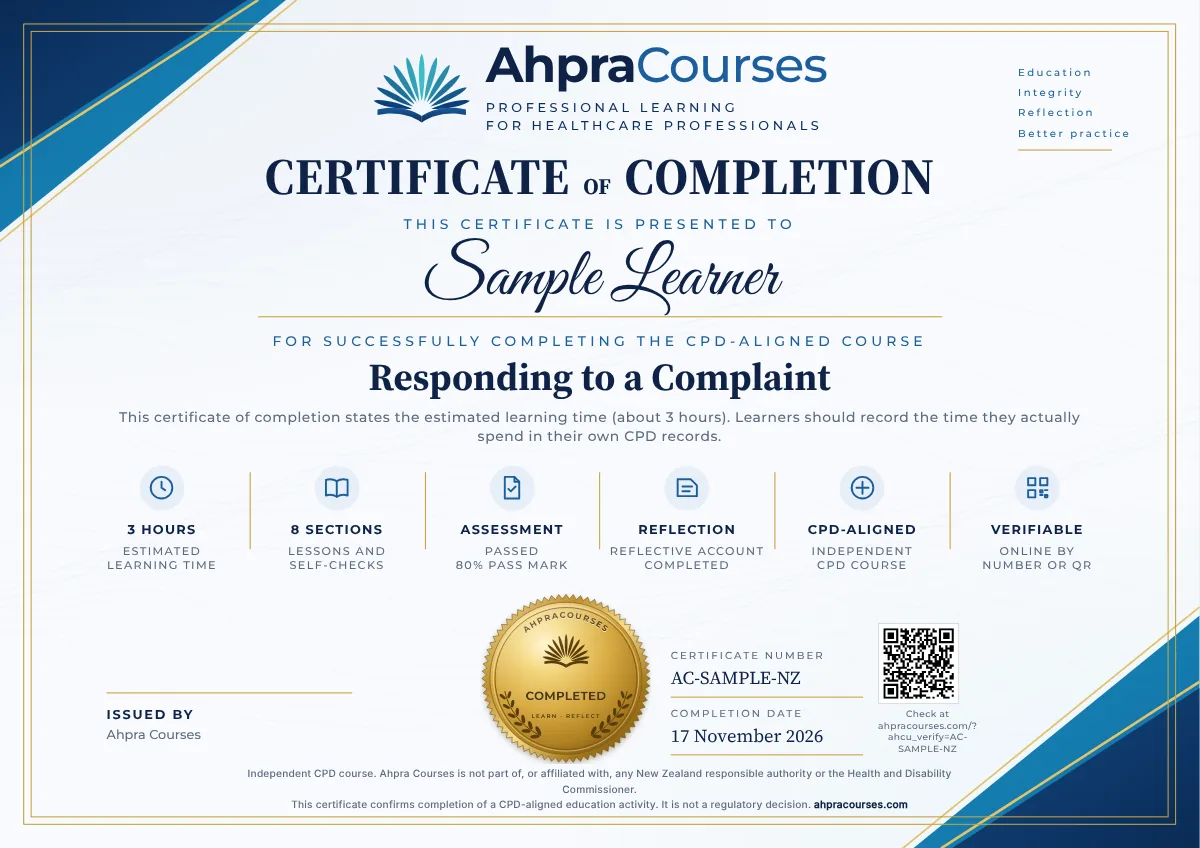
The certificate you receive

Sample certificate of completion for Responding to a Complaint for Health Practitioners in New Zealand from Ahpra Courses, showing the learner's name, the course title, an estimated learning time of about 3 hours, the completion date and a certificate number that can be checked online
Sample. Your certificate shows your name, the course title, the completion date and its own certificate number.

Pass the final assessment and finish the reflective account on your complaint response, and your certificate of completion is ready to download. It shows the course name, the estimated learning time and your result, and anyone you give it to can confirm it online with its number or QR code. In your own recertification records, log the time you actually spent.

How practitioners use it

  • Add it to the remediation part of your reply to the HDC or your responsible authority, with a short note on what you learned and what you changed.
  • File it in your recertification portfolio as professional development on complaints, communication and accountability.
  • Show it to your employer, clinical lead or practice manager when you agree changes to how complaints are handled in your service.
  • Give it to your indemnity adviser, union or lawyer so they know what preparation you have already done.
  • Keep it with your reflective account as part of the record you may later rely on at a PCC meeting or in a competence review.

Who this course is for

Practitioners who have just received a complaint

The first few days set the tone. The course shows how to pause, take advice, secure the record without changing it, meet the Right 10 acknowledgement duty and avoid the reactions that turn a manageable concern into a conduct issue.

Practitioners answering the Health and Disability Commissioner

HDC usually asks for a written account and the clinical notes. The course explains how the Commissioner assesses a complaint, the range of outcomes and how to write a response that answers each issue the consumer raised.

Practitioners notified to their responsible authority

Councils and Boards triage concerns into competence, conduct and health pathways. The course explains what triage looks for and why an early, reflective reply can shape what follows.

Practitioners facing a competence review or a PCC

A competence review looks at your current practice; a PCC investigates conduct and decides whether to lay a charge. The course explains both processes and what to bring to each.

Practice owners, managers and clinical leads

Providers, not just individuals, carry Right 10 duties. The course covers complaint registers, timeframes, updates to consumers and how to support a staff member who is the subject of a complaint.

Practitioners who want to be prepared

Most practitioners will receive a complaint at some point. Knowing the map and the method in advance reduces the shock and improves the quality of what you write when it happens.

Internationally qualified practitioners new to New Zealand

The Code of Rights, the HDC and the HPCA Act combine in a way that differs from complaint systems elsewhere. The course explains the New Zealand system from the beginning.

The concerns this course addresses

Handling a complaint at practice level

Right 10 says consumers may complain in any form appropriate to them and that providers must make resolution fair, simple, speedy and efficient. An informal comment at the front desk can be a complaint. Treating it seriously and promptly is often what stops it going further.

Code of Rights Right 10; HDC Fact sheet 3 on Right 10 timeframes

Answering an HDC request

The Commissioner will usually ask for your account and the records. Supplying requested information does not breach privacy. A late, defensive or incomplete answer makes a formal investigation more likely; a clear, complete one helps HDC decide the right outcome.

HDC: What if a complaint is made about me?; HDC: Possible outcomes of a complaint

Notification to your responsible authority

Concerns reach Councils and Boards from the HDC, from colleagues and employers, from convictions and through health notifications. Your authority's role is public protection, so it asks about current risk and what you have done about it, not only what happened.

HPCA Act ss 34, 45, 64 to 67A

A review of your competence

Under section 36 an authority may review a practitioner's competence. A review looks at how you practise now. If it finds a gap, section 38 lets the authority order a competence programme or set conditions on your scope of practice.

HPCA Act ss 36 to 40 and 43

Responding to a Professional Conduct Committee

A PCC can gather evidence, call for documents and hear from you. It then recommends steps to the authority and decides whether to take no further steps, send the matter to conciliation or lay a charge before the Tribunal.

HPCA Act ss 71 to 83, especially ss 77 and 80

Interim orders while a matter is open

If there is a risk of harm or doubt about whether conduct was appropriate, an authority can set interim conditions or suspend a practising certificate while a review, investigation or prosecution runs. You are entitled to be heard before most of these decisions.

HPCA Act ss 39, 48, 69 and 69A

Writing a response that works

Strong responses answer every concern in turn, show the source of each fact, acknowledge impact on the consumer and whānau, apologise where that is warranted and set out specific changes with evidence. Weak ones argue, generalise or blame.

Code of Rights clause 3 (reasonable actions, onus on provider)

Looking after yourself during the process

Complaints can take months, and formal HDC investigations can take years. Practitioners who use their GP, a peer supporter and their professional body cope better and write better responses. Distress is common and is not a sign of guilt.

HDC: What if a complaint is made about me? (support from professional bodies and colleagues)

What the course covers

Eight sections and 25 lessons follow a complaint from the moment it arrives to the remediation that follows. Sections 1 to 7 each finish with five questions on responding to complaints.

1Complaints in Aotearoa New Zealand: the landscape3 lessons

Lessons: What a complaint is, and what it is not; Where a complaint can go: the New Zealand map; The Code of Rights as the legal floor. Treats a complaint as information rather than a verdict, explains what most complainants want, and maps the separate roles of the provider, HDC, the Advocacy Service, the responsible authority, a PCC and the Tribunal.

  • 1.1 What a complaint is, and what it is not
  • 1.2 Where a complaint can go: the New Zealand map
  • 1.3 The Code of Rights as the legal minimum
2Responding at provider level: Right 10 in practice3 lessons

Lessons: Right 10: the provider's legal duties and timeframes; Resolving complaints well at the local level; Organisations, employees and records of complaints. The 5 and 10 working day rules, telling the consumer about advocacy and HDC, monthly updates, listening meetings, apology and keeping a complaints record.

  • 2.1 Right 10: the provider's legal duties and timeframes
  • 2.2 Resolving complaints well at the local level
  • 2.3 Organisations, employees and records of complaints
3The Health and Disability Commissioner process3 lessons

Lessons: How HDC assesses a complaint; Responding to an HDC request; Formal investigations, opinions and onward referral. How the Commissioner decides on outcomes, what to send and how to write it, the provisional opinion stage, breach findings and referral to the Director of Proceedings.

  • 3.1 How HDC assesses a complaint
  • 3.2 Responding to an HDC request
  • 3.3 Formal investigations, opinions and onward referral
4Responsible authority notifications and competence processes4 lessons

Lessons: How concerns reach your responsible authority; Triage outcomes and early resolution; Competence reviews and competence programmes; Health concerns and interim protective action. The competence, conduct and health pathways under the HPCA Act and how to engage with each from the first letter.

  • 4.1 How concerns reach your responsible authority
  • 4.2 Triage outcomes and early resolution
  • 4.3 Competence reviews and competence programmes
  • 4.4 Health concerns and interim protective action
5Professional Conduct Committees and the Tribunal3 lessons

Lessons: The Professional Conduct Committee investigation; PCC outcomes; The Health Practitioners Disciplinary Tribunal. Membership and powers of a PCC, what it can recommend and determine, how a charge is heard, the two-stage misconduct test and the penalties in section 101.

  • 5.1 The Professional Conduct Committee investigation
  • 5.2 PCC outcomes
  • 5.3 The Health Practitioners Disciplinary Tribunal
6Preparing and writing your response4 lessons

Lessons: The first seventy-two hours; Building an accurate chronology; Writing the response; Cultural safety, whānau and accessible complaint handling. The practical core of the course: securing records, the record-recollection-usual practice method, a response structure, and responding well to Māori and Pacific complainants and their whānau.

  • 6.1 The first 72 hours
  • 6.2 Building an accurate chronology
  • 6.3 Writing the response
  • 6.4 Cultural safety, whānau and accessible complaint handling
7Advice, insight, remediation and wellbeing4 lessons

Lessons: Using indemnity, union and legal advice; Demonstrating insight and remediation; Wellbeing and support during a complaint; Practising during and after a complaint. When to involve a lawyer, how insight is shown, building a remediation portfolio, and keeping yourself and your patients safe while a matter is open.

  • 7.1 Using indemnity, union and legal advice
  • 7.2 Demonstrating insight and remediation
  • 7.3 Wellbeing and support during a complaint
  • 7.4 Practising during and after a complaint
8Conclusion and key points1 lesson

Lesson: Conclusion and key points. A one-page summary of the map, the Right 10 duties, the response method and the link between remediation and your recertification programme.

  • Conclusion and key points
✓Reflection, final assessment and certificate3 steps
  • Your reflective account, which you can download for your records
  • Final assessment: 20 questions, 80% to pass
  • Certificate of completion, dated and numbered

How a complaint travels through the New Zealand system, and where your reply changes the outcome

New Zealand separates consumer rights from professional regulation. The Code of Health and Disability Services Consumers' Rights binds every provider, registered or not, and the Health and Disability Commissioner enforces it. The Health Practitioners Competence Assurance Act 2003 covers registered practitioners only, and it tasks 18 responsible authorities with protecting the public by making sure practitioners are competent and fit to practise. A single complaint can touch both systems, and understanding which one you are dealing with is the first step to responding well.

Provider level

Right 10 gives every consumer the right to complain in any appropriate form and requires providers to make resolution fair, simple, speedy and efficient. You must acknowledge a complaint in writing within 5 working days, decide within 10 working days of acknowledging it whether it is justified or needs more time, tell the consumer if you need more than 20 working days, and update them at least monthly. Most complaints that are handled well at this level go no further.

The Commissioner

HDC assesses every complaint it receives. It can refer the complaint back to you, pass it to the Advocacy Service, send it to a better placed agency such as your responsible authority, take no further action, make recommendations or comments, or open a formal investigation. HDC's published guidance says around 30% of complaints are resolved directly between provider and complainant, and that many formal investigations take around 12 months. Occasionally a breach finding leads to referral to the Director of Proceedings, who decides independently of the Commissioner whether to take proceedings in the Health Practitioners Disciplinary Tribunal or the Human Rights Review Tribunal. HDC has no power to remove a practitioner from the register or to award compensation.

Your responsible authority

Section 64 of the HPCA Act makes an authority refer to the Commissioner any complaint alleging that a practitioner affected a health consumer, and section 70 restricts what the authority can do while HDC investigates, although interim protective steps remain available. Authorities also hear of concerns through competence notifications under section 34, health notifications under section 45 and notice of convictions. Authorities can review competence, refer a matter to a Professional Conduct Committee, or manage a health concern through their health processes.

The PCC and the Tribunal

A PCC investigates, can demand information under section 77, and under section 80 makes recommendations to the authority and decides whether to lay a charge. Charges come to the Tribunal from a PCC or from the Director of Proceedings. It first decides whether, objectively, the conduct is a departure within a section 100 ground, and then whether it is serious enough to justify a disciplinary sanction. Penalties under section 101 range from censure to cancellation. At every stage, a response that is honest, complete and shows real change gives decision-makers what they need.
How to respond to a complaint or notification about this kind of concern

Whatever body has written to you, the same five steps produce a better response. Each step maps to a section of this course.

  1. Stop, read carefully and get advice

    Note who has written, what they are asking for and the deadline. Talk to your indemnity provider, union or professional association before replying, and ask early for more time if you need it.

    In the course: Section 6 sets out what to do, and what not to do, in the first three days after a complaint arrives.

  2. Secure the record without changing it

    Obtain the full clinical record, appointment logs, messages, rosters and relevant policies. Never alter an existing entry. Any addition must be dated when written and clearly labelled as a later note.

    In the course: Section 6 explains how to gather primary sources beyond the notes and why altering records is far more serious than most original errors.

  3. Build a chronology

    List events in order and mark the source of each fact: what the record shows, what you remember, and what your usual practice would have been. Decision-makers weigh these differently.

    In the course: Section 6 teaches the record, recollection and usual practice method used throughout the course's case studies.

  4. Answer every concern, in the consumer's words

    Take each issue the consumer raised and respond to it directly. Explain why you acted as you did, acknowledge how it affected the person and their whānau, and apologise sincerely where care fell short.

    In the course: Sections 3 and 6 give a response structure for HDC and for responsible authorities, with worked fictional examples.

  5. Show insight and change

    Set out what you have learned and changed, and how someone else could verify it: an audit, a revised process, supervisor feedback or completed education linked to the gap.

    In the course: Section 7 covers demonstrating insight and building a remediation portfolio that links to your recertification programme.

Do not contact the complainant about the complaint outside the formal process, do not ask colleagues to line up their accounts, and never alter or back-date a clinical record.

Nothing here is legal advice. Before you reply to the HDC, your responsible authority or a PCC about a complaint, get advice from your indemnity provider or medical defence organisation, your union or professional association, or a lawyer.

How this course helps with a complaint or notification

It gives you the whole map before you write

Many poor responses come from not knowing who will read them or what that body can do. The course sets out the roles and limits of the provider, HDC, advocacy, your authority, a PCC and the Tribunal, so you write for the right reader.

It turns facts into a credible account

The record, recollection and usual practice method keeps your account accurate and makes clear which statements rest on documents and which on memory. That honesty is persuasive, and it protects you if your memory is later shown to be wrong.

It treats apology as a skill

A good apology acknowledges what happened and its effect on the person without excuses. The course shows how to apologise meaningfully at provider level and in a response to HDC, and how this differs from accepting legal liability.

It links the response to real change

Decision-makers look for evidence that the problem is less likely to happen again. Section 7 helps you choose remediation that matches the concern and record it in a way your recertification programme can also use.

Remediation evidence that carries weight

Carries weight

  • A complete, unaltered copy of the clinical record, with any later notes clearly dated and labelled
  • A chronology that marks which facts come from the record, which from memory and which from usual practice
  • A direct answer to each concern the consumer raised, in the order they raised them
  • A sincere apology for what fell short, without excuses or conditions
  • A revised process, template or checklist, with the date it was introduced
  • A before-and-after audit of the area of concern, checked by someone other than you
  • Written feedback from a supervisor, peer or clinical lead describing what they observed
  • Completed education targeted at the gap, with a short reflection on how it changed your practice

Carries little weight

  • Long accounts of your experience and reputation that do not address the concern
  • Character references that do not mention the issue raised
  • Statements that the consumer misunderstood, was difficult or had unrealistic expectations
  • General promises to do better with no specific change or date
  • Certificates for courses unrelated to the issue
  • A record entry added after the complaint without a clear date and label
  • Accounts from colleagues that read as though they were coordinated
  • A response sent late, without asking for an extension

A remediation plan, phase by phase

  1. Days 1 to 3

    Stabilise

    • Read the letter twice and diary every deadline
    • Ring your indemnity provider, union or professional association as soon as the complaint arrives
    • Request the complete record and preserve all related documents unaltered
    • Tell your manager or practice owner if your employment agreement or policy requires it
  2. Week 1 to 2

    Understand

    • List each concern in the consumer's own words
    • Build a chronology with the source of each fact marked
    • Identify what went well, what fell short and against which standard
    • Book a GP appointment or a peer support conversation for yourself
  3. Weeks 2 to 4

    Respond

    • Draft the response using a clear structure and have your adviser review it
    • Include a genuine apology where care or communication fell short
    • Describe changes already made, with dates
    • Send the response on time, or ask for an extension before the deadline
  4. Months 1 to 3

    Remediate

    • Complete education targeted at the specific gap
    • Introduce and test practical changes such as templates or safety-netting scripts
    • Arrange observation or audit by a colleague and keep the results
    • Write a reflective account linking the learning to your practice
  5. After the outcome

    Sustain

    • Comply fully with any recommendations, conditions or programme
    • Repeat the audit after six months
    • Record the learning in your recertification portfolio
    • Share de-identified learning with your team where appropriate

Writing your reflective statement

1What the complaint said

Summarise the consumer's concerns in their words, not yours, and note how the complaint reached you.

Example only (Ms K, a fictional practice nurse): Mrs T's daughter wrote to the practice saying her mother left a wound clinic without being told the signs of infection and was admitted with cellulitis four days later.

2What the record shows

State what the clinical notes, messages and logs show, separately from what you remember.

Example only: My note records the dressing and a review date. It does not record any advice about warning signs or who to contact after hours.

3What I remember and my usual practice

Say what you recall and what you normally do, and be clear which is which.

Example only: I believe I mentioned redness and heat, but I cannot recall doing so. My usual practice is to give verbal advice; I do not routinely give written information.

4The impact on the consumer and whānau

Describe how the events affected the person and their family, from their point of view.

Example only: Mrs T and her daughter did not know what to watch for, so the infection was found late. Her daughter has had to take time off work to care for her.

5What fell short, and why

Name the standard, what fell short and the factors that contributed, without excusing your own part.

Example only: Under Right 6 Mrs T was entitled to the information a reasonable consumer in her situation would expect. My advice was not clear or recorded. The clinic was running late, but that does not change what she needed to know.

6What I have changed

List each change with its date and say how someone else could confirm it.

Example only: Since March I give every wound clinic patient a written sheet with warning signs and after-hours numbers, and record that I have done so. A colleague audited 20 records in May; all 20 showed it.

7What I will keep doing

Describe how the change will last, including any ongoing check.

Example only: The sheet is now part of the clinic template, and I have asked for the audit to be repeated every six months as part of my professional development plan.

The example sentences are fictional and show structure only. Your statement has to be your own honest account of what happened.

A weak and a strong response, side by side

Fictional: HDC asks Mr R, a community pharmacist, to respond to a complaint that he dispensed ten times the prescribed dose, then brushed off the patient's son and refused to check when the son rang about it.

Weak

I have been a pharmacist for 25 years with an unblemished record. We were very short-staffed that day with two people off sick, and the handwriting on the prescription was hard to read. The son was aggressive on the phone and I did not appreciate his tone. The patient did not suffer any lasting harm. Since then I have finished a few online courses and I am sure it will not happen again. I do not believe there has been any breach of the Code.

Strong

I accept that I dispensed the wrong strength and that the mistake was mine. The patient was exposed to a serious risk, and I understand from the complaint how frightening this was for him and his family. I also accept that when his son called, I did not listen properly or check the dispensing record, which I should have done straight away. I apologise to them both. The record shows the prescription was clear; I selected the wrong product from a similar-looking pack. Since then the pharmacy has separated those strengths on the shelf and added a second check for that medicine, and I have completed education on dispensing errors. An audit of 50 dispensings of that medicine in June found no errors. I would welcome any further recommendations from the Commissioner.

Why the second one works: The strong response accepts the error, describes the risk and the distress from the family's point of view, separates what the record shows from the explanation, apologises without excuse, and gives specific system changes with dated evidence. The weak response relies on reputation, blames workload and the complainant, minimises harm and offers only general reassurance.

Mistakes practitioners make when responding

Replying while angry or upset

A response written on the day the letter arrives often reads as defensive. Draft it, put it aside and have an adviser read it before it goes.

Changing the record

Altering or adding to notes without clear dating and labelling turns a clinical concern into a question of honesty, which is treated far more seriously.

Contacting the complainant directly

Approaching the consumer or their family to discuss the complaint outside the process can look like pressure, even when meant kindly.

Missing the deadline

Silence suggests indifference. If you need more time, ask before the deadline and explain why.

Answering a different question

Responses that describe your general practice but skip the consumer's actual concerns leave the decision-maker with nothing to weigh in your favour.

Blaming the patient or a colleague

Even where others contributed, pointing elsewhere before acknowledging your own part undermines insight.

Treating apology as an admission of liability

A sincere apology for what the person experienced is expected and helpful. It is not the same as conceding every allegation, and advisers can help you word it.

Saying nothing about change

A response that is accurate but shows no learning gives an authority little reason to think the risk has reduced.

The code provisions this course works through

Your response is judged against the Code of Rights and the HPCA Act. These are the provisions this course returns to most often.

Code of Rights, Right 10Right to complain

Consumers may complain in any appropriate form. Providers must make resolution fair, simple, speedy and efficient, acknowledge in writing within 5 working days, decide within 10 working days and update at least monthly.

In the course: Section 2 applies each duty to practice-level complaints, with model letters.

Code of Rights, clause 3Reasonable actions

A provider is not in breach of the Code if it acted reasonably in the circumstances, including the consumer's clinical situation and the provider's resources. The onus of proof is on the provider.

In the course: Sections 1 and 6 show how a clear chronology helps you show what you did and why.

Code of Rights, Rights 4, 5 and 6Standards, communication and information

Complaints most often engage the rights to services of an appropriate standard, effective communication and the information a reasonable consumer would expect.

In the course: Section 6 uses these rights to structure the issues in a response.

HPCA Act ss 36 to 40Competence reviews and orders

An authority may review competence, make orders including a competence programme or conditions, and in some cases act on an interim basis pending review.

In the course: Section 4 explains what a review involves and how to prepare.

HPCA Act ss 71, 77 and 80Professional Conduct Committees

PCCs are appointed to investigate, can require information and documents, and make recommendations and determinations, including whether to lay a charge.

In the course: Section 5 covers the PCC process and what to bring to it.

Also relevant: HPCA Act s 64 Complaints alleging a consumer was affected are referred to the HDC; HPCA Act ss 100 and 101 Grounds for discipline and the Tribunal's penalties; HPCA Act s 45 Notice that a practitioner may not be able to perform their functions because of a mental or physical condition

How this applies in each profession

Doctors

Medical Council of New Zealand

The Council's statements on Good medical practice (2021) and Disclosure of harm (updated January 2024) set expectations for honesty when things go wrong, which shape how a complaint response is read.

Nurses

Nursing Council of New Zealand

The Council put a draft replacement Code of Conduct out for consultation in January 2026. Until a new code takes effect, the current Code of Conduct remains the standard your response is measured against.

Midwives

Midwifery Council of New Zealand

Midwives' complaints often involve whānau as well as the woman. The Council's Code of Conduct expects honest information, clear notes and respectful professional relationships, all central to a response.

Dentists and oral health practitioners

Dental Council of New Zealand

The Council consulted in 2026 on a revised version of its standards framework of 28 professional standards. Confirm which version was in force when the events happened.

Pharmacists

Pharmacy Council of New Zealand

The Code of Ethics asks pharmacists to respond honestly, openly, courteously and promptly to complaints and criticism, a useful test for any draft response.

Psychologists

New Zealand Psychologists Board

Responses are read against the Board's 2002 Code of Ethics, still its principal guiding document. Implementation of a revised Code of Conduct was paused in 2026.

Physiotherapists

Physiotherapy Board of New Zealand

Recertification includes written reflections, one on Māori culture and practice, so reflecting on a complaint involving a Māori patient and whānau can meet both needs.

What happens after a complaint or notification in New Zealand

This is the usual sequence for a complaint involving a registered practitioner in New Zealand. Many matters stop at the first or second stage.

  1. Complaint to the provider

    The consumer raises the concern with you or your service. Right 10 duties apply immediately: acknowledge in writing within 5 working days, decide within 10, explain any longer timeframe and keep the consumer updated.

  2. Complaint to the HDC

    The consumer, or someone on their behalf, complains to the Commissioner, or an authority refers it there. HDC gathers information, often including your response and records, and may take clinical advice.

  3. HDC assessment outcome

    HDC may refer the matter back to you or to advocacy, refer it to another agency, take no further action, make comments or recommendations, or open a formal investigation. Formal investigations can end in a breach opinion.

  4. Responsible authority triage

    Your Council or Board considers referrals from HDC and concerns from other sources. It can close the matter, send an educational letter, review competence, use its health process or send the matter to a PCC.

  5. Competence review or health process

    A competence review looks at current practice and can lead to a competence programme or conditions. Health processes aim to protect the public while supporting the practitioner.

  6. Professional Conduct Committee

    A PCC investigates and hears from you, then decides whether to take no further steps, refer the matter to conciliation or lay a charge, and recommends other steps to the authority.

  7. Tribunal

    The HPDT hears any charge from a PCC or the Director of Proceedings, applies its two-stage test and, if a ground is proved, picks penalties under section 101.

Who handles your matter: the HDC, your responsible authority and the Tribunal

The Health and Disability Commissioner deals with complaints about how consumers were treated. It applies the Code of Rights to all providers, registered or not, and decides how to deal with each complaint. It does not register or discipline practitioners and cannot cancel registration or order compensation.

Your responsible authority registers you, sets standards for your profession and protects the public under the HPCA Act. It deals with your competence, conduct and health, can review your practice, impose conditions and refer conduct matters to a Professional Conduct Committee. It does not resolve complaints for consumers.

The Health Practitioners Disciplinary Tribunal hears formal complaint-related charges brought by a PCC or by HDC's Director of Proceedings. Only the Tribunal can find professional misconduct under section 100 and impose the section 101 penalties.

One set of events can involve all three, sometimes at different times. Your adviser can help you work out which body you are dealing with and what it needs from you.

Possible outcomes and what they mean for you

OutcomeWhat it isWhat it means for you
Resolved at provider levelThe consumer is satisfied with your explanation, apology or action, and the complaint ends there.Keep a record of the complaint, the response and any changes. This is the outcome good Right 10 practice makes most likely.
HDC: no further actionThe Commissioner closes the file, for example because the issues have been dealt with or clinical advice found the care appropriate.Read any comments carefully. A closed complaint is still an opportunity to reflect and record learning.
HDC: comments or recommendationsThe Commissioner closes the file with an educational comment or asks you to make changes, such as an apology, an audit or training, and checks they are done.Meet each HDC recommendation by its deadline and keep proof that you did. HDC checks that recommendations are carried out.
HDC: breach opinionAfter a formal investigation, the Commissioner finds you breached the Code and usually makes recommendations. The opinion may be shared with your authority.Engage fully with the provisional opinion stage, and treat the recommendations as the basis of your remediation plan.
Authority: educational outcome or competence programmeThe authority closes the matter with advice, or after a review orders a competence programme or conditions to bring your practice to the required standard.Follow the programme exactly as set, keep records and ask early if anything is unclear or a deadline is at risk.
PCC: conciliation, recommendations or no further stepsThe PCC finds no charge is warranted, refers the matter to conciliation, or recommends steps such as a competence review, counselling or conditions.Respond constructively. Insight and remediation shown to the PCC can influence what it recommends.
Tribunal penaltiesWhere a charge is proved, the Tribunal can cancel registration, suspend for up to 3 years, set conditions for up to 3 years, censure, fine up to $30,000 and order costs.Remediation is relevant to penalty. Decision-makers consider rehabilitation and the least restrictive appropriate outcome.

If a condition or undertaking requires education

After a competence review an authority can order a competence programme, add conditions to your scope of practice or require other steps under sections 38 and 40 of the HPCA Act. A programme is set by the authority and may include supervision, education, assessment and reporting. Section 43 deals with what happens if a programme is not completed satisfactorily, so it matters to raise problems early rather than let a deadline pass.

Where your authority, a PCC or the Tribunal requires education, the content is decided by that body. If you want to use this course towards a requirement, send the outline to the authority and ask in writing whether it will count before you enrol.

Using this course as CPD

Complaints work fits naturally into New Zealand recertification programmes, which all ask for reflection on practice. Nurses renewing an APC declare 450 practice hours and at least 60 hours of professional development over the previous three years; complaint-handling learning can count. Doctors must be enrolled and actively participating in a recertification programme at all times. Physiotherapists complete 100 hours over a rolling three years with written reflections, one focused on Māori culture and their practice. Pharmacists, oral health practitioners, psychologists and other professions record learning goals, plans and reflections in their own programmes.

This course can count as professional development on accountability, communication and complaint handling, and the reflective account it asks for is written so you can adapt it for your own portfolio. If your authority has ordered education or a competence programme, the authority sets its content, so check with it before relying on this course for that purpose.

  • Record the time this course really took, not the estimate
  • Turn the reflective account into a de-identified portfolio reflection
  • Tie the course to a development goal on communication or handling complaints
  • Keep evidence of practice changes alongside the certificate
  • Check your own authority's current recertification requirements, as they differ between professions

How this course is written and kept current

The complaint process described here and in the course is drawn from New Zealand primary sources: the Health Practitioners Competence Assurance Act 2003, the Health and Disability Commissioner Act 1994 and the Code of Health and Disability Services Consumers' Rights, HDC's guidance for providers on complaints, outcomes, investigations and the Director of Proceedings, HDC's fact sheet on Right 10 timeframes, the codes and standards of the responsible authorities, and the Tribunal's published material.

In November 2026 we checked section numbers, timeframes and penalties against the legislation and HDC's published guidance. Fictional cases are illustrative only. The Health Practitioners Competence Assurance Amendment Bill, introduced on 18 May 2026, could change parts of this process; check its status before relying on the current provisions.

Health Practitioners Competence Assurance Act 2003 (reprint as at 10 July 2026)Code of Health and Disability Services Consumers' Rights (1996)Health and Disability Commissioner Act 1994HDC Fact sheet 3: Timeframes for responding to complaints under Right 10HDC: Possible outcomes of a complaintHDC: What if a complaint is made about me?HDC: Referral to the Director of ProceedingsManatū Hauora: Responsible authorities under the HPCA ActMedical Council of New Zealand: current standardsDental Council: Health Practitioners Disciplinary Tribunal information

Last reviewed: November 2026.

Key terms explained

Complaint
An expression of dissatisfaction about a service, made in any form. Under Right 10 it need not be in writing.
Code of Rights
The Code of Health and Disability Services Consumers' Rights: ten consumer rights and the matching duties of every provider.
HDC
The Health and Disability Commissioner, who promotes and protects consumer rights and assesses and investigates complaints.
Advocacy Service
The free Nationwide Health and Disability Advocacy Service, which supports consumers to raise and resolve complaints.
Clause 3
The clause that protects a provider who took reasonable actions in the circumstances, with the provider carrying the burden of proving it.
Responsible authority
The Council or Board that registers and regulates a profession under the HPCA Act, for example the Nursing or Medical Council.
Competence review
A section 36 review of whether the practitioner's current practice meets the required standard.
Competence programme
A programme ordered by the authority under the HPCA Act to help a practitioner reach the required standard.
PCC
A Professional Conduct Committee, normally two practitioners and a layperson, appointed to investigate a conduct matter.
Director of Proceedings
A lawyer in HDC's office who makes a separate decision on whether to take proceedings after the Commissioner refers a provider.
HPDT
The Health Practitioners Disciplinary Tribunal, which hears charges against registered practitioners and decides penalties.
Interim suspension
A temporary suspension of a practising certificate during a review, investigation or prosecution, where the thresholds in the Act are met.
Chronology
An ordered account of events in which the source of each fact is clear: record, recollection or usual practice.

Frequently asked questions

Do I have to respond to a complaint made directly to me?

Yes. Right 10 of the Code of Rights applies to every provider. Acknowledge the complaint in writing within 5 working days, decide within 10 working days of that whether it is justified or needs more time, and keep the consumer updated at least monthly. You must also tell the consumer about the complaints procedures available to them, including advocacy and the Health and Disability Commissioner. Many services have a complaints policy that names who responds, so check yours and involve your manager where appropriate.

Will I breach privacy by sending records to the HDC?

No. HDC's guidance for providers says you will not breach patient confidentiality or privacy by supplying the information the Commissioner requests. Send the complete record exactly as it stands. If you notice an error or gap, explain it in your response rather than changing the notes. Keep a copy of everything you send and note the date it went out.

Should I say sorry if I do not believe I did anything wrong?

You can sincerely acknowledge the person's experience and distress without accepting every allegation. Where care or communication did fall short, a clear apology without excuses is usually the most helpful thing you can offer, and complainants often say an apology is part of what they wanted. Your indemnity adviser can help you word it so it is honest and fits the facts. Avoid conditional wording such as "I am sorry if you felt", which tends to read as defensive.

How long does an HDC complaint take?

It varies widely. Many complaints are resolved through referral to the provider or advocacy, and HDC says about 30% are resolved directly between provider and complainant. HDC's own guidance notes that many formal investigations take around 12 months, although simpler ones may be quicker and complex ones longer. Delays are stressful, so plan for support over a long period and keep practising safely in the meantime. Ask HDC for an update if you have heard nothing for some time.

Can the HDC take away my registration?

No. HDC cannot cancel or suspend registration, order compensation or have a practitioner struck off. It can make recommendations, find a breach of the Code and, occasionally, refer a provider to the Director of Proceedings, who may lay a charge before the Health Practitioners Disciplinary Tribunal. Only the Tribunal can cancel registration as a disciplinary penalty, although your responsible authority has its own powers to impose conditions or interim suspension in specific circumstances.

What is the difference between HDC and my Council or Board?

HDC protects consumers' rights and deals with complaints about how a consumer was treated, by any provider. Your responsible authority regulates your profession under the HPCA Act and looks at your competence, conduct and fitness to practise. A complaint to an authority that alleges a consumer was affected must be referred to HDC first. Both may become involved in one set of events, for different purposes.

What happens at a Professional Conduct Committee?

A PCC is usually two practitioners from your profession and a layperson. It investigates, can require information and documents, and gives you the opportunity to make submissions and be heard. It then recommends steps to your authority, such as a competence review or conditions, and decides whether to take no further steps, send the matter to conciliation or lay a charge before the Tribunal. Get legal or indemnity advice before you engage.

What penalties can the Tribunal impose?

If a charge is proved, section 101 of the HPCA Act lets the Tribunal cancel registration, suspend it for up to 3 years, set conditions on practice for up to 3 years, censure, fine up to $30,000 and order some or all of the costs. It applies a two-stage test before reaching penalty, and penalty principles include public protection, rehabilitation and the least restrictive appropriate outcome.

Can I keep working while a complaint is open?

Usually yes, unless your authority has imposed interim conditions or suspension, or your employer has made other arrangements. Practise as carefully as you normally would, document well, and take extra care with the area of concern. If the stress is affecting your concentration or sleep, speak to your GP and consider whether you need adjustments. Tell your adviser about any new incident promptly.

Should I get a lawyer?

Many practitioners respond to HDC without a lawyer, and HDC's guidance says the decision is yours. Indemnity providers, unions and professional associations can advise and often review your draft. Legal advice is especially important if the matter involves honesty, boundaries, possible criminal conduct, a PCC, a Tribunal charge or interim suspension. Give any adviser the complete picture and your chronology early.

Will this course satisfy a requirement my authority has set?

Only your authority can decide that. Programmes and conditions ordered under the HPCA Act are set by the authority, a PCC or the Tribunal. If you hope the course will count, send its outline and ask in writing before enrolling. Even where it is not required, completing it and showing what you changed can be relevant evidence of insight.

How long does the course take, and how long do I have access?

The estimated learning time is about 3 hours (about 180 minutes), covering the lessons, the section checks, your reflective account and the final assessment. People work at different speeds, so record the time you actually spend in your own CPD records. Your progress is saved to your account and you can return to the course and your certificate at any time.

How is the course assessed?

Lessons open in order. Each section closes with a graded check that you answer before moving on. The course ends with a 20-question final assessment, marked on our server, with a pass mark of 80%. If you do not pass, review the sections it points you to and try again.

Does completing the course decide the outcome of my matter?

No course can decide or predict the outcome of a notification, investigation, panel or tribunal. Decision-makers weigh all of the evidence, including your insight, your reflection and the changes you have made and sustained. The course is designed to support that learning and to give you a dated record of it.

Start today, finish at your own pace

Instant access after checkout. Work through 8 sections in order, write your reflective account, pass the final assessment and download your dated certificate.

Primary sources

Always read the current version on the publisher's website. This page is general information, not legal advice.

On call with Dr AI Alma