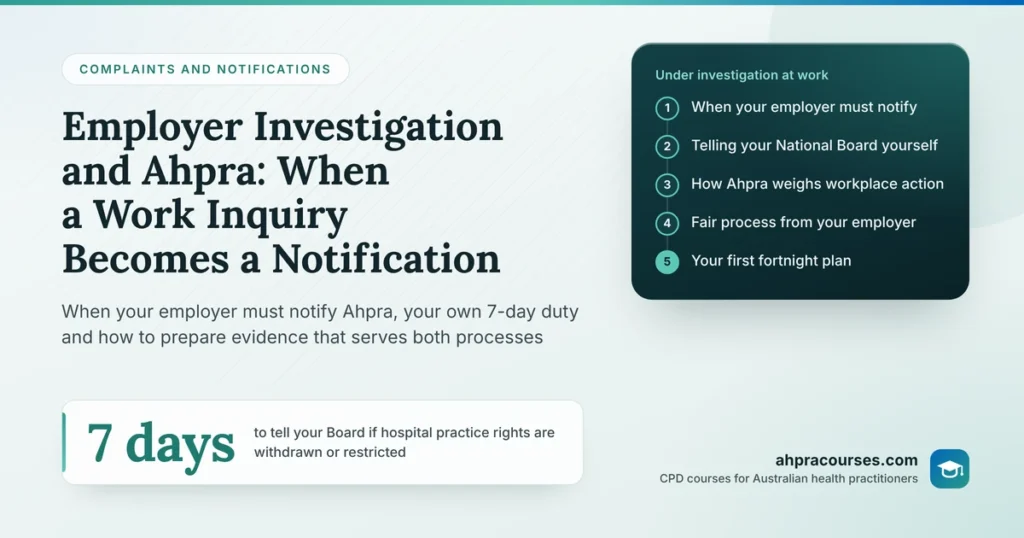
Employer Investigation and Ahpra: When a Work Inquiry Becomes a Notification
A show-cause letter, a stand-down or a credentialing review does not automatically mean Ahpra is involved. Here is when your employer must notify, when you must tell the Board yourself, how Ahpra weighs what your workplace has already done, and how to build evidence now so you are ready either way.
Reviewed by the ahpracourses.com editorial team Updated
4types of notifiable conduct that oblige an employer to notify
7 daysto tell your Board if hospital practice rights are withdrawn or restricted
60 daysAhpra's target for finishing most assessments
1,542mandatory notifications Ahpra received in 2024/25
In short
An employer investigation is a workplace process, not an Ahpra process. Your employer must notify Ahpra only if it reasonably believes you have engaged in one of four types of notifiable conduct, and Ahpra's own guidance says many concerns can be managed through the workplace without involving it. You must tell your National Board yourself within 7 days if your right to practise at a hospital or health facility is withdrawn or restricted because of your conduct, performance or health. If a notification is made, Ahpra looks at the actions your workplace has already taken, so the reflection, learning and practice changes you start now count twice: once with your employer and again with the Board.
Under investigation at work and worried it will reach Ahpra? Prepare one honest, evidence-based response that serves both processes.
Does an employer investigation mean Ahpra already knows about you?
Not necessarily. A hospital, practice, aged care provider or health service runs its investigation under its own policies, your contract and any enterprise agreement. Ahpra and the National Boards run a separate process under the Health Practitioner Regulation National Law. The two can run in parallel, one after the other, or only one of them may ever happen.
Ahpra's page for employers on mandatory reporting and managing concerns says employers "have a responsibility to decide whether the issue is best addressed through your internal procedures", and that "Many concerns can be managed within your own procedures, without the need to engage with us." The same page tells employers to "Complete a local investigation" and to "Contextualise the concern." In other words, the regulator expects the workplace to do its own fact-finding first in most cases.
That does not mean you can treat the workplace process lightly. What you say in an investigation interview, the documents your employer collects and any outcome it reaches can all become part of an Ahpra file later, either because the employer notifies or because Ahpra asks for information. The safest approach is to answer the workplace process as if a Board member might one day read every word.
Workplace investigation and Ahpra notification compared
Question
Employer investigation
Ahpra and the National Board
Rules it runs under
Employer policy, your contract, any enterprise agreement, the Fair Work Act 2009
Health Practitioner Regulation National Law and the Board's codes and standards
The question it asks
Should your employment, role or clinical privileges change?
Is there a risk to the public, and does your registration need regulatory action?
Possible outcomes
No action, counselling, a warning, a performance plan, restricted duties, dismissal
No further action, a caution, conditions, undertakings, referral to a panel or tribunal; immediate action if the risk is serious
Who decides
Your manager, an investigator, a credentialing committee
A National Board or its delegate, a panel or a tribunal
Where it can be reviewed
Internal review, the Fair Work Commission (for example an unfair dismissal claim)
Appealable decisions go to the responsible tribunal; process complaints go to the National Health Practitioner Ombudsman
If you work in Queensland or New South Wales, the co-regulatory arrangements change who receives the concern first. Our guide to how notifications work with the HCCC and the Health Ombudsman explains those differences; the employer duties below come from the National Law and apply in every state and territory.
Visual summary: Employer Investigation and Ahpra: When a Work Inquiry Becomes a Notification
When must your employer notify Ahpra?
Section 142 of the National Law says that if an employer "reasonably believes the health practitioner has behaved in a way that constitutes notifiable conduct, the employer must notify the National Agency of the notifiable conduct." Notifiable conduct is defined in section 140, and there are only four kinds.
1. Intoxication
"practising the practitioner's profession while intoxicated by alcohol or drugs"
2. Sexual misconduct
"engaging in sexual misconduct in connection with the practice of the practitioner's profession"
3. Impairment
"placing the public at risk of substantial harm in the practitioner's practice" because the practitioner has an impairment
4. Standards
"placing the public at risk of harm by practising the profession in a way that constitutes" a significant departure from accepted professional standards
Ahpra's Guidelines: Mandatory notifications about registered health practitioners, in effect from 1 March 2020, explain how these tests work. A reasonable belief is "a state of mind based on reasonable grounds", and "Speculation, rumours, gossip or innuendo are not enough to form a reasonable belief." The guidelines also note that "While employers have to report the same types of concern as practitioners, the requirement to notify us is based on a specific level of risk."
Two lines in the guidelines matter most to a practitioner under investigation. First, "Performance management alone does not meet the threshold for mandatory notifications." Second, mandatory notifications "should not be used as a performance or risk management measure." So a performance plan, a rostering dispute or a communication complaint is not, by itself, a reason your employer has to notify. A concern about intoxication at work, sexual misconduct or harm from a significant departure from standards is different.
There is no deadline in the guidelines for an employer to notify, and a worked example in them shows an employer notifying even though it had "not yet been able to investigate the claims". Ahpra's employer page adds that some notifications are required "regardless of any workplace action or resolution", and that resigning does not necessarily stop a notification. If the employer fails to notify when it should, section 142(2) says Ahpra "must give a written report about the failure to the responsible Minister". You can read more on the threshold, and how it differs from a voluntary notification, in our explainer on mandatory versus voluntary notifications, or test a scenario with the free mandatory notification guide.
How an employer's notification duty and your own reporting duty fit together. Based on sections 130, 140 and 142 of the National Law and Ahpra's mandatory notification guidelines.
Do you have to tell your National Board yourself, and how fast?
Sometimes, yes. Section 130 of the National Law requires a registered practitioner to give written notice to their National Board "within 7 days after becoming aware that a relevant event has occurred". One of those events, in section 130(3)(d), is that "the practitioner's right to practise at a hospital or another facility at which health services are provided is withdrawn or restricted because of the practitioner's conduct, professional performance or health".
Read the trigger carefully
The event is the withdrawal or restriction of your right to practise at a facility, such as suspended or limited clinical privileges, for a reason linked to your conduct, performance or health. Neither the National Law nor Ahpra's self-reporting page says that an investigation, an interview request or a show-cause letter is itself a relevant event. If you are unsure whether what has happened counts as a restriction, get advice from your indemnity insurer or a health law solicitor before the 7 days run out rather than after.
Ahpra's self-reporting page lists the event as "your right to practise at a hospital or health service is restricted or withdrawn", confirms the notice is due "within seven days of becoming aware", and explains that you lodge it through the online Raise a concern form by choosing "Something I'm obliged to tell you." It also says "Receiving notice directly from you or your representative is relevant to our assessment." A late or missing self-notice is not a criminal offence under section 130(2), but it may be treated as behaviour for which health, conduct or performance action can be taken. That is an avoidable second problem on top of the first.
Section 130(3)(h) adds another event: a complaint made about you to one of the entities listed in section 219(1)(a) to (e). Your adviser can tell you whether anything your employer has done brings that provision into play.
The Shared Code of conduct also asks practitioners to meet their reporting obligations. Section 8.1 says "Practitioners also have professional obligations to report to the National Boards/Ahpra", and section 7.2(4) asks practitioners to "comply with statutory reporting requirements, including mandatory notifications requirements under the National Law". Doctors will find the equivalent in section 10.3 of Good medical practice: "Doctors have statutory obligations under the National Law to report".
If your employer notifies Ahpra, what happens next?
Ahpra must assess every notification, and most are dealt with at that first stage. Ahpra's page on how long it takes says: "In most cases, we try to finish the assessment process within 60 days and most notifications are closed within 90 days."
Employer notifications are not a fringe category. Ahpra's 2024/25 annual report records that it received 13,327 notifications, and that "A further 17% were from health practitioners and employers". Mandatory notifications "made up 11.6% of notifications received": 1,542 of them, 32% more than the year before. Of those, 617 (40%) were about nurses and 503 (32.6%) were about medical practitioners. In a February 2026 statement, Ahpra said it "treats all notifications equally seriously, regardless of whether they come from patients, clinicians or managers."
The usual path of a notification. Timeframes are Ahpra's stated targets for assessment and closure; no timeframe is published for investigations, panels or tribunals.
During an investigation, Ahpra's February 2026 statement says it "may also contact relevant parties, including employers and hospitals," for information to support the investigation. That is why the records and statements created in your workplace process matter. Our separate article on whether Ahpra tells your employer about a notification covers the opposite direction: what Ahpra shares with your workplace.
Immediate action is the outcome most practitioners fear when an employer has already stood them down. It is a high threshold: the Board must reasonably believe you pose "a 'serious risk to persons'". Ahpra's immediate action guide explains that "'Show cause' means that the National Board gives the practitioner notice that it proposes to take immediate action", and that "You will be given the opportunity to make written or verbal submissions." In 2024/25 Ahpra took immediate action in 554 cases relating to 315 practitioners. If you receive a show cause notice, our guide to responding to immediate action and keeping working sets out what to put in your submission.
How does Ahpra weigh what your workplace has already done?
This is where an employer investigation can work for you rather than against you. Ahpra's page on how it manages concerns says it considers "the actions taken by the practitioner's workplace" during assessment, and that it will "Validate any steps taken by the practitioner and/or their workplace to manage any risk to the public".
The same page says Ahpra takes action when the risk "is not sufficiently managed by individual and/or organisation risk controls". Put simply, if your workplace has supervision, retraining, an audit or a changed role in place, and you can show your own reflection and learning, there may be less left for the Board to manage. If nothing has changed, the Board has to manage the whole risk itself.
What strengthens the picture
A supervision, mentoring or audit arrangement your employer has put in place
Your own written reflection on what happened and why
Targeted learning with dated certificates linked to the concern
Evidence that the practice change is working, such as audited notes
A prompt, accurate self-notice where section 130 applied
What leaves the Board to manage the risk
No change in practice since the incident
A response that blames colleagues or the system alone
Learning unrelated to the concern, done in bulk at the last minute
Inconsistent accounts between the workplace interview and Ahpra
What fair process should you expect from your employer?
Your employer's own policy and any enterprise agreement set the detailed steps. The Fair Work Ombudsman's guidance gives the baseline the Fair Work Commission looks at if a dismissal is later challenged.
The Fair Work Ombudsman's ending employment fact sheet lists what the Commission considers when deciding whether a dismissal was harsh, unjust or unreasonable, including:
whether there was a valid reason for the dismissal related to the employee's capacity or conduct
whether the employee was notified of that reason and given an opportunity to respond
whether the employer unreasonably refused to let the employee have a support person present at discussions about the dismissal
whether the employee had been previously warned that their performance was unsatisfactory
whether the size of the business, or a lack of dedicated human resources specialists, affected the procedures followed
The fact sheet also notes that employees "must apply to the Commission within 21 calendar days of the dismissal taking effect." On meetings, the Fair Work Ombudsman's page on managing performance and warnings says "The employer should tell the employee what the meeting is about and ask them if they want to bring a support person along."
Two cautions. First, the Fair Work Ombudsman's stand-down page covers stand-downs where an employee cannot do useful work because of things like equipment breakdown or industrial action; it does not deal with suspension during a disciplinary investigation. Whether you are paid while suspended depends on your contract, policy or agreement. Second, a fair workplace process and a favourable Ahpra outcome are different things. Winning an argument about procedure at work does not answer a patient safety question the Board may later ask.
What do published cases show when the workplace acted first?
Three published decisions show the range, from a caution that took workplace action into account to cancellation. Practitioners are not named here; each is identified by its official panel summary number or neutral citation.
Panel hearing summary 2020.0888
Workplace sanction and remedial learning considered
A nurse in a leadership role faced allegations of "aggressive and inappropriate communication towards work colleagues including in the presence of patients". She had been "suspended for a period of four months during a workplace investigation" that "culminated in a first and final warning". The panel found unprofessional conduct and cautioned her, taking into account the workplace outcome and that she had "undertaken remedial education to address the issues raised". Read the panel summary.
[2025] QCAT 46
Dismissal, then an employer notification, then immediate action
A nurse educator was suspended on full pay after his employer raised allegations of inappropriate conduct towards students, and "ultimately he was dismissed from his employment" in April 2021. The employer then notified the Office of the Health Ombudsman. The Board accepted his undertaking not to practise, which kept him from nursing "for almost 18 months". He admitted the conduct and showed insight; the tribunal found professional misconduct, imposed a reprimand and said further suspension "would be punitive". Read the decision.
[2021] QCAT 4
Prompt employer suspension in a serious clinical case
A nurse in a correctional facility failed to monitor a deteriorating patient or arrange his transfer to hospital, and wrote a progress note she knew was false. She "was suspended promptly by her employer", and the regulator "acted following a notification by the respondent's employer". The tribunal found professional misconduct, reprimanded her, cancelled her registration and set a 12-month disqualification. Read the decision.
The pattern is consistent with Ahpra's own guidance. Where the conduct was at the lower end and the practitioner had already engaged with workplace consequences and learning, the regulatory outcome was a caution. Where the facts involved dishonesty in clinical records and serious risk to a patient, workplace action did not prevent the most serious outcome. Honesty in the records and in every account you give is the thread that runs through all three.
Hypothetical: the show-cause letter that arrives on a Friday
Hypothetical scenario
Priya is a registered nurse on a surgical ward. After a patient's deterioration was escalated late on a night shift, her manager gives her a letter at the end of a Friday shift: she is required to attend an investigation interview in ten days, is moved to non-clinical duties in the meantime, and is invited to show cause why disciplinary action should not be taken. Her ward access is limited while the investigation runs.
What she does well: she calls her indemnity insurer and union that afternoon, writes a dated private timeline of the shift while it is fresh, asks HR whether the change to her duties is a restriction of her right to practise at the hospital and, on advice, lodges a short self-notice with the Nursing and Midwifery Board inside 7 days. She requests the observation charts and her notes through the proper channel, enrols in learning on escalation and documentation, and writes a reflection that names what she would do differently.
What would have hurt her: messaging colleagues on the shift to compare stories, editing or adding to the clinical record after the event, or telling the investigator nothing can be learnt because the ward was short-staffed.
Why it matters: if the hospital later notifies Ahpra, the Board sees a practitioner who reported on time, answered consistently and started changing her practice in week one.
Your first fortnight under an employer investigation: a step plan
Most of the damage in these cases comes from the first two weeks: rushed statements, late self-notices and silence that looks like a lack of insight. A steady plan prevents all three.
1
Get advice the same day. Contact your professional indemnity insurer or medical defence organisation, and your union if you have one. Ask them to review the letter before you reply to anything.
2
Work out whether section 130 applies. If your right to practise at a hospital or facility has been withdrawn or restricted because of your conduct, performance or health, notify your National Board in writing within 7 days.
3
Write a private, dated timeline. Record what happened, when and who was present while your memory is fresh. Keep it for your adviser; do not alter or add to clinical records.
4
Ask for the allegations and documents. Request the specific allegations in writing, the policy being applied and the records you need to respond. Confirm you may bring a support person to interviews.
5
Answer the safety question, not just the procedure. In your written response, address each concern with facts and records, acknowledge anything you could have done better, and say what you have already changed.
6
Start targeted learning and reflection now. Choose learning that matches the concern, complete it properly, keep the dated certificates and write a reflection on what you learnt and how your practice has changed.
7
Keep one consistent evidence file. Store your timeline, responses, certificates and reflections together so the same honest account can go to your employer and, if a notification follows, to Ahpra.
Facing both a workplace investigation and a possible notification? Work through all seven notification and remediation courses, 14 CPD hours with a dated certificate for each, before your interview. See the program outline.
Contacting the person who raised the concern, or colleagues who are witnesses, about the investigation
Changing, adding to or "tidying" clinical notes after the event
Resigning on the assumption that it ends the matter
Giving a different account to your employer and to Ahpra
Missing the 7-day self-notice because you were waiting for the investigation outcome
Do instead
Keep normal, courteous professional contact and route questions through HR or your adviser
Make any genuine late entry openly, dated and signed, only on advice
Take advice before resigning; a notification may still be needed after you leave
Use one timeline and one evidence file for both processes
Self-notify on time if section 130 applies, and keep a copy
The first point carries legal weight. Since 1 December 2025 (4 December 2025 in South Australia), the National Law has made it an offence to "threaten, intimidate, dismiss, refuse to employ or otherwise discriminate against someone" involved in a complaint, with a maximum penalty of $60,000 for an individual. People can also raise a concern with Ahpra despite any clause in a non-disclosure agreement. Even an innocent message to a colleague about the investigation can be misread, so keep that contact to normal work.
The codes also expect cooperation. Section 8.9 of the Shared Code of conduct asks practitioners to "cooperate with any legitimate inquiry into the treatment of a patient", and section 10.11.1 of the Medical Board's Good medical practice says the same of "Cooperating with any legitimate inquiry into the treatment of a patient." Cooperating does not mean answering without advice; it means engaging honestly and on time.
Self-check: is your evidence ready if Ahpra calls?
Tick each one you can honestly say yes to
I know exactly which allegations my employer is investigating.
I have checked, with advice, whether section 130 required me to notify my Board, and acted within 7 days if it did.
I have a dated private timeline written soon after the events.
My written response deals with patient safety first and procedure second.
I can name what I would do differently and why.
I have started learning linked to the specific concern and kept the certificates.
My clinical records are unchanged except for any open, dated late entry made on advice.
Everything I have told my employer is consistent with what I would tell Ahpra.
Learning that answers the workplace and the Board at once
Each course is 2 CPD hours with a dated certificate, written for Australian practitioners. Choose the course that matches the concern in your letter. The learning supports the evidence you present; it does not determine any employment or regulatory outcome.
Questions practitioners ask about employer investigations and Ahpra
Does my employer have to tell Ahpra it is investigating me?
No, not just because it is investigating. Under section 142 of the National Law an employer must notify Ahpra only if it reasonably believes you have engaged in notifiable conduct: practising while intoxicated, sexual misconduct in connection with practice, placing the public at risk of substantial harm because of an impairment, or placing the public at risk of harm through a significant departure from accepted professional standards.
Do I have to tell Ahpra about a workplace investigation?
The investigation itself is not listed as an event you must report. Section 130 requires you to notify your National Board in writing within 7 days if your right to practise at a hospital or another health facility is withdrawn or restricted because of your conduct, professional performance or health. Get advice if you are unsure whether a change to your duties counts.
Is a performance improvement plan enough for a mandatory notification?
No. Ahpra's mandatory notification guidelines say performance management alone does not meet the threshold for mandatory notifications, and that mandatory notifications should not be used as a performance or risk management measure.
If I resign, does the employer investigation stop a notification?
Not necessarily. Ahpra's guidance for employers says some notifications are required regardless of any workplace action or resolution, and that a notification may still be needed after a practitioner resigns. Take advice before resigning.
Will Ahpra look at what my employer has already done?
Yes. Ahpra says it considers the actions taken by the practitioner's workplace during assessment and validates steps taken by the practitioner or the workplace to manage risk. Regulatory action is taken where the risk is not sufficiently managed by individual or organisation risk controls.
Can Ahpra ask my employer for my records and the investigation file?
Ahpra has said that during an investigation it may contact relevant parties, including employers and hospitals, for information to support the investigation. Assume anything created in the workplace process could be seen by the Board.
Can I bring a support person to an investigation interview?
The Fair Work Ombudsman says the employer should tell the employee what the meeting is about and ask whether they want to bring a support person. An unreasonable refusal to allow a support person at discussions about dismissal is one of the factors the Fair Work Commission considers in an unfair dismissal claim.
How long does Ahpra take after an employer notification?
Ahpra says that in most cases it tries to finish the assessment within 60 days and that most notifications are closed within 90 days. Matters that go to investigation, a panel or a tribunal take longer, and Ahpra does not publish a timeframe for those stages.
This article is general information about the regulatory framework. For advice on your own situation, speak to your professional indemnity insurer, medical defence organisation, union or a health law solicitor.
Editorial review
ahpracourses.com editorial team
Employer and practitioner duties checked against sections 130, 140 and 142 of the National Law and Ahpra's mandatory notification guidelines
Figures checked against Ahpra's 2024/25 annual report and its published assessment timeframes
Reprisal and non-disclosure points checked against Ahpra's National Law amendments page and its 24 February 2026 statement
Fair process points checked against Fair Work Ombudsman guidance; cases taken from a published panel summary and two Queensland tribunal decisions, with practitioners not named
This article explains the framework; it is not legal advice.
Doctor notified over a medical certificate? What section 10.9 of Good medical practice requires, why questionnaire certificates fail and a 14-day reply plan.
Notified over missing S8 stock or drug register discrepancies? How Ahpra and the NMBA assess diversion, when immediate action applies and 6 real outcomes.
Tell me your profession and what's happening at work or with Ahpra. I'll ask a few questions, show you the course that fits on screen, and enrol you on the call if you wish. Enrolled learners can study their course with me, one-to-one.
Dr AI Alma is an AI tutor, not a person or a registered health practitioner, and does not give legal or clinical advice. The call uses your microphone.
Dr AI AlmaReady
You are talking to Dr AI Alma, an AI tutor, not a person. Brief notes are kept to help you. Please don't name patients or colleagues. Privacy