Bundle & save Studying more than one course? Save 15% on 3, 22% on 5 and 30% on 10 or more, taken off in your cart.
Free Course AdvisorQuestions about which course fits your case?
Ahpra Courses

Patient safety incidents, risk management and open disclosure for all registered professions

Clinical Competence and Patient Safety Course in Australia

Last updated

For practitioners involved in an adverse event, near miss or sentinel event who now face an incident review, a complaint or an Ahpra notification. The course explains how harm arises when individual gaps meet weak safeguards, what every Board expects of you before and after an incident, and how to turn a review's findings into a response that shows insight and lasting change.

  • 2 hours, CPD-aligned
  • Written to your Board's code
  • 9 sections with graded checks
  • 20-question final assessment
  • Dated, verifiable certificate
  • Self-paced on any device
  • 1-to-1 AI tutor, Dr AI Alma
Enrol now, A$99Bulk buy from A$70 a course

Free tools to use alongside this course: Response planner, Reflective statement builder, Evidence organiser

Dated certificate with a number anyone can verify

36CPD courses for Australian practitioners
16Professions covered
24/7Self-paced, online, any device
A$99Per course, no subscription

Which of these is your situation?

At a glance

Who it is for
Registered practitioners in every National Scheme profession who work where incidents happen, including those responding to a notification that followed an adverse event
Boards and codes
Good medical practice (2020) sections 4.11 and 8; NMBA Code of conduct for nurses and for midwives (2018); shared Code of conduct (2022) sections 4.5 and 7.1; Psychology Board Code of conduct (in force 1 December 2025)
Regulators covered
Ahpra and the National Boards; in NSW the Health Professional Councils and the HCCC; in Queensland the OHO; with the coroner, state health departments and the TGA where they apply
Format
Self-paced online learning in nine sections, built around incidents from pharmacy, dentistry, imaging, paramedicine, nursing, physiotherapy, Chinese medicine, podiatry, psychology and general practice
Assessment
Section knowledge checks, a 20-question scenario-based final assessment and five reflective prompts on your own incidents and risks
Certificate
Dated completion certificate showing the course title and estimated learning time; record your actual time in your CPD log
Best taken with
Open Disclosure in Healthcare Practice, and Ensuring a Mistake or Misconduct Isn't Repeated
Learning time
About 2 hours, self-paced, online on any device. Progress is saved to your account.
Price
A$99 for one course. Bundles: 5 courses for A$450, 10 courses for A$700.

In short

This remediation course looks at clinical competence through patient safety incidents. It explains how adverse events happen when an individual gap lines up with weak systems, and what each National Board's code requires before and after one: taking part in risk management, recognising and reporting adverse events, disclosing openly and changing practice. It covers the NSQHS Standards, the ten events on the Australian Sentinel Events List, mandatory reporting of serious medical device adverse events to the TGA from 21 March 2026, and the Australian Open Disclosure Framework revised in June 2026. Learners practise a five-step risk process, write an incident reflection that a Board would find credible, and leave with a safety-focused Personal Development Plan. It suits practitioners responding to an Ahpra notification, an OHO or HCCC complaint, or an internal review after harm.

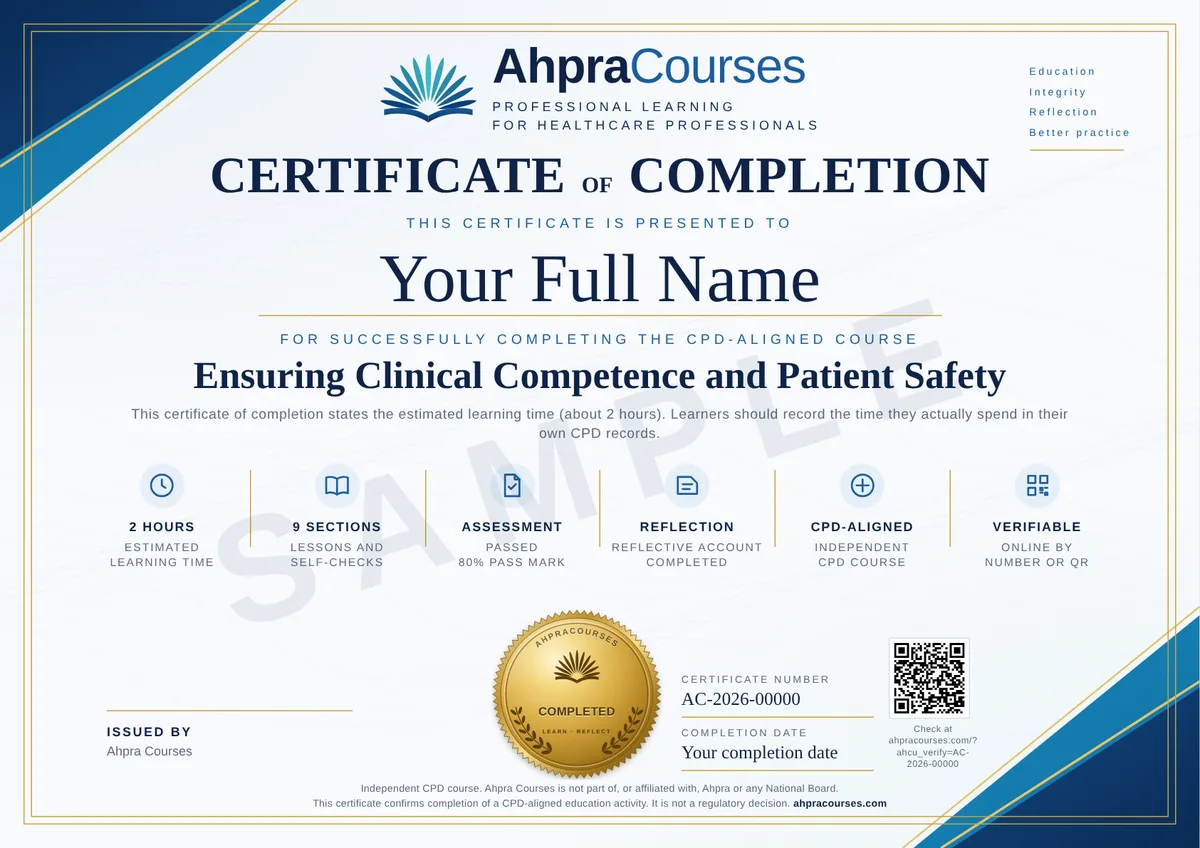
The certificate you receive

Sample certificate of completion for Clinical Competence Patient Safety Course from Ahpra Courses, showing the learner's name, the course title, an estimated learning time of about 2 hours, the completion date and a certificate number that can be checked online
Sample. Your certificate shows your name, the course title, the completion date and its own certificate number.

The certificate confirms the date you finished, the course title and its estimated learning time. It is evidence that you studied incident management, risk and open disclosure; what persuades a reviewer is the reflection and practice changes you build on it.

How practitioners use it

  • Include it with your response to Ahpra, the HCCC, a NSW Council or the OHO, alongside the incident review findings
  • Provide it with a reflective practice report where an accepted education condition requires one
  • Share it with your service's patient safety or clinical governance lead when you take part in implementing review recommendations
  • Keep it in your CPD portfolio with a note of the incident trend or near miss that prompted the learning
  • Use it with your indemnity insurer's adviser when preparing for an inquest or a complaint conciliation

Who this course is for

Practitioners named in an incident review

Your service is running a root cause analysis or similar review and wants your statement. The course helps you give an honest account of your own part.

Practitioners notified after an adverse event

A patient, family member or employer has raised the incident with Ahpra or a health complaints entity. Patients, families and other members of the public made 72.8% of notifications to Ahpra in 2024/25. The regulator's real question is whether the risk has been addressed.

Practitioners subject to an employer mandatory notification

Employers must notify Ahpra when they reasonably believe a practitioner has placed the public at risk through a significant departure from accepted professional standards. Departure from professional standards was the reason in 61% of mandatory notifications in 2024/25.

Sole and small-practice clinicians

Dentists, pharmacists, physiotherapists, podiatrists, optometrists and Chinese medicine practitioners in private practice often have no hospital governance behind them. The course shows how to build a workable risk register, incident log, emergency drill schedule and recall system.

Clinicians who reported their own near miss

You caught an error before it reached the patient, or it reached them without harm, and you want to learn from it properly and show that your reporting reflects good practice.

Practitioners affected by a serious outcome

An unexpected death or serious harm has left you shaken. The course covers the effect of adverse events on clinicians, debriefing and support services, so that your reflection is productive rather than self-punishing.

Safety leads and educators

Educators, practice managers and clinical leads can use it to build a shared approach to reporting and review.

The concerns this course addresses

Your part in an adverse event

An adverse event is an incident that results, or could have resulted, in harm to a patient. When one is reviewed, the question for you is not only what the system got wrong but which safeguard you were responsible for and whether it held. Every code expects you to recognise and report adverse events, act promptly to reduce harm and review your practice to prevent a repeat.

shared Code 4.5; Good medical practice 4.11 and 8.2; NMBA codes principle 2; Psychology Board Code of conduct 4.5

Sentinel events

The Australian Sentinel Events List (version 2) names ten events that are wholly preventable and cause serious harm or death, including wrong-site and wrong-patient procedures, retained objects, ABO-incompatible transfusion reactions, medication errors causing serious harm or death, and an incorrectly positioned oro- or nasogastric tube. The course explains the list and the protocols, such as time-outs and three-identifier checks, that exist to prevent them.

Australian Sentinel Events List v2; NSQHS Standards (second edition); shared Code 7.1; Good medical practice 8.2

Open disclosure that was late, partial or absent

The Australian Open Disclosure Framework, revised in June 2026, applies to all health service organisations and professionals in every setting. It expects initial disclosure as soon as possible after harm or potential harm is recognised, even before all the facts are known, and an apology that includes the words 'I am sorry' or 'we are sorry' where appropriate. The course explains what disclosure requires of you personally.

Australian Open Disclosure Framework (2026); shared Code 4.5; Good medical practice 4.11; NMBA codes principle 2

Medication and dispensing errors

Medication errors span prescribing, dispensing, packing, administration and monitoring, and are a sentinel event when they cause serious harm or death. The course covers controls that do not rely on memory: independent checks, barcode scanning, reconciliation and standard terminology.

NSQHS Medication Safety Standard; Pharmacy Board Guidelines on the safe provision of pharmacy services (from 1 October 2026); shared Code 7.1; Good medical practice 8.2

Results, referrals and handover that were not closed

Some of the most damaging delays happen when information exists but nobody acts on it: an abnormal report filed as seen, a referral never sent, an anticoagulant mentioned at handover but not written down. The course covers results tracking, closed-loop communication of critical results and structured handover such as ISBAR.

NSQHS Communicating for Safety Standard; Good medical practice 6.3 and 8.2; shared Code 5.4 and 7.1

Not recognising or escalating deterioration

Rising respiratory rate, falling blood pressure, new confusion or a family member saying something is wrong are signals that must trigger a response. Concerns arise when observations were recorded but not acted on, or a medical review was requested and not chased. The course covers escalation criteria, family escalation schemes such as Ryan's Rule in Queensland and Raise It in NSW (which replaced REACH in March 2026), and why you keep escalating when there is no response.

NSQHS Recognising and Responding to Acute Deterioration Standard; NMBA Registered nurse standards for practice (2016); Good medical practice 3.2

Concealment: unreported incidents and altered records

Regulators treat what happens after an incident as seriously as the incident itself. Failing to report an error, discouraging a colleague from reporting, or adding to or changing notes after the event can turn a performance matter into a conduct or probity matter. The course covers dated addenda, cooperation with reviews and the duty to report even when nobody else saw the error.

shared Code 4.5 and 8.3; Good medical practice 4.11, 10.5 and 10.11; NMBA codes principle 2

Medical device adverse events

Since 21 March 2026, health service organisations including public, private and day hospitals have had to report to the TGA adverse events involving high-risk medical devices that cause death, serious injury or serious deterioration. Under the Commission's advisory, medium-risk devices and near misses are scheduled to follow from 1 April 2028. The course explains your part in recognising, recording and escalating device-related events so your service can meet its duty.

Therapeutic Goods (Medical Devices) Regulations 2002 (as amended); ACSQHC Advisory AS25/01; NSQHS Action 1.11; shared Code 7.1

What the course covers

Each of the nine sections looks at competence from the point of view of the incidents it prevents, and at what practitioners must do when one occurs. The cases are fictional and drawn from many professions.

1Clinical Competence and Patient Safety3 lessons

Shows how harm arises when holes in several safeguards line up, using the Swiss cheese model and human factors science. Sets out each Board's code provisions on risk and adverse events.

  • 1.1 Importance of Clinical Competence
  • 1.2 Ensuring Patient Safety
  • 1.3 Guidance from AHPRA and the National Boards on Competence and Patient Safety
2Developing and Maintaining Clinical Competence3 lessons

Identifies high-consequence knowledge for each field, such as sepsis, red flags and dangerous interactions, and how skills decay when rarely used. Covers emergency drills, incident-driven CPD, debriefing and clinician support.

  • 2.1 Clinical Skills and Knowledge
  • 2.2 Continuing Professional Development
  • 2.3 Learning and Improving with Self-Reflection and Feedback
3Risk Management to Support Patient Safety3 lessons

Teaches a five-step risk process (identify, assess, control, monitor, review). Covers incident reporting, the Australian Sentinel Events List, TGA device reporting from March 2026, the NSQHS Standards and the danger of workarounds.

  • 3.1 Identifying and Minimising Risks in Clinical Settings
  • 3.2 Incident Reporting and Its Role in Patient Safety
  • 3.3 Patient Safety Guidelines and Protocols
4Ethical Obligations for Healthcare Professionals3 lessons

Covers the ethics of speaking up, commercial targets that erode safety, open disclosure under the June 2026 framework, apology, and accountability in records after an incident. Works through dilemmas such as a colleague's unsafe practice, unsafe staffing and an error nobody else saw.

  • 4.1 Ensuring Professional Ethics in Clinical Practice
  • 4.2 Integrity and Accountability
  • 4.3 Handling Ethical Dilemmas in Patient Care
5Effective Communication and Patient Safety2 lessons

Treats communication with patients and families as a safety control: warning signs, identity checks, teach-back, interpreters, family escalation schemes and consent covering material risks.

  • 5.1 Effective Communication with Patients and Families
  • 5.2 Involving Patients in Their Care Plans
6Regulatory Compliance and Fitness to Practise3 lessons

Explains how an incident can lead to regulatory scrutiny, how internal review, open disclosure, complaints entities, Ahpra and the coroner run in parallel, and how to use a review's findings in your response.

  • 6.1 Understanding Fitness to Practise Standards
  • 6.2 Responding to Notifications and Investigations
  • 6.3 Complying with Recommendations and Remediation Plans
7Reflection and Continuous Development3 lessons

Uses near misses and routine self-observation as material for reflection, sets out a reflective account a regulator would find credible, and builds a safety-focused Personal Development Plan.

  • 7.1 Reflective Practice for Skill Enhancement
  • 7.2 Creating a Personal Development Plan
  • 7.3 Adapting to Changing Clinical and Patient Safety Standards
8Learning from Case Studies and Practical Application2 lessons

Analyses incidents involving a physiotherapist, a Chinese medicine practitioner, an occupational therapist and a podiatrist, plus missed results, handover loss, a failed sterilisation cycle and a deteriorating patient, to draw out the lessons that recur.

  • 8.1 Case Studies on Clinical Competence
  • 8.2 Lessons from Patient Safety Incidents
9Conclusion and Commitment to Patient Safety2 lessons

Summarises the key lessons and asks you to choose one safety risk in your practice, set a measurable goal and fix a date to check progress.

  • Key Takeaways
  • Long-Term Commitment
✓Reflection, final assessment and certificate3 steps
  • Your reflective account, which you can download for your records
  • Final assessment: 20 questions, 80% to pass
  • Certificate of completion, dated and numbered

From adverse event to Ahpra notification: how incident review, open disclosure and regulation fit together

Most patient safety incidents never reach a regulator. They are reported in the service's incident management system, reviewed, disclosed to the patient and used to change a process. A small number go further, usually when harm was serious, practice departed significantly from accepted standards, there is a pattern, a health problem is involved, or the practitioner did not disclose or altered records. One event can run along several tracks at once.

The health service's review, whether a root cause analysis or another systems-focused method, looks for the conditions that allowed the error: confusing equipment, a missing check, an unsafe roster, a culture in which juniors did not speak up. Its aim is system learning. Open disclosure is the conversation with the patient and family: what happened, an apology, what is being done and how they will be supported. A health complaints entity, such as the HCCC in NSW or the OHO in Queensland, deals with the consumer's complaint. A coroner examines a reportable death. Ahpra and the Board, or a NSW Council, look at something narrower: whether this practitioner's performance, conduct or health poses a risk that needs a regulatory response.

That difference matters for how you respond. A system review that finds five contributing factors does not remove your responsibility for the one that was yours, and a regulator does not expect you to carry responsibility for the other four. What the regulator wants to see is that you understand both: the part you played, the safeguards that failed around you, and what has changed in your own practice as well as in the system.

Human factors science explains why careful people still make errors: attention, memory and fatigue have limits, and designs that rely on perfect performance will fail. That is not an excuse. The codes expect you to use the safeguards provided every time, to report incidents and near misses so weak layers can be fixed, to recognise when fatigue or distraction makes you a weaker layer than usual, and to take part honestly in review. Workarounds that become normal, sometimes called normalisation of deviance, are a common precursor to serious harm, and a practitioner who quietly bypasses a time-out or an identification check has removed a layer the system relies on.

A response to a notification after an incident is strongest when it draws on all of these tracks: the review's findings, the disclosure that took place, the changes the service made and the changes you made, each with evidence.

How to respond to an Ahpra notification about this kind of concern

When an incident you were involved in leads to a complaint or notification, the order in which you act matters. These steps follow the incident from the first hours to your written response.

  1. Make the patient safe and start disclosure

    Attend to the patient and limit further harm. Tell the patient or family promptly and honestly what is known, say sorry, and explain what happens next, in line with your service's open disclosure process. Do not speculate about causes you do not yet understand.

    In the course: Section 4 covers initial and formal disclosure under the 2026 framework and how to apologise without guessing at blame.

  2. Report it and keep the record straight

    Lodge an incident report that is factual, timely and free of opinion, describing roles rather than naming colleagues. Write your clinical notes contemporaneously. If something needs correcting later, add a dated addendum; never change an earlier entry.

    In the course: Section 3 sets out what a good incident report contains; section 4 covers integrity in records after an event.

  3. Get advice early

    Contact your indemnity insurer or medical defence organisation as soon as you know a complaint, inquest or notification may follow. Do not contact the notifier about a notification.

    In the course: Section 6 explains how internal review, complaints entities, Ahpra and the coroner interact.

  4. Take part in the review honestly

    Give the reviewers an accurate account of what you saw, did and thought at the time, including the parts that do not reflect well on you.

    In the course: Section 6 covers cooperating with reviews and investigations; section 2 covers debriefing.

  5. Write a response built on the review

    Acknowledge the harm to the patient, name the standards that applied, describe the system factors the review identified and your own part, and set out what you and the service have changed. Attach evidence: completed education, new protocols, audit results, supervisor or peer reports.

    In the course: Section 7 gives a structure for a reflective account a regulator would find credible.

  6. Look after yourself and your colleagues

    Serious incidents affect clinicians too. Use debriefing, your employee assistance program or a practitioner support service, and support colleagues who were involved.

    In the course: Section 2 discusses the effect of adverse events on clinicians and where to find help.

Blaming the system without naming your own part, or blaming yourself without understanding the system, both leave a regulator unsure whether the risk has been dealt with.

Before you make a statement to a review, a complaints entity, a coroner or Ahpra, get advice from your professional indemnity insurer or medical defence organisation, your union or professional association, or a lawyer.

How this course helps with an Ahpra notification

Insight that holds both the system and your own part

After an incident, insight means being able to explain how the harm happened, which safeguards failed, which one was yours, and what you now do differently. The two traps are blaming only the system, or taking all the blame without naming a change. The course uses the Swiss cheese model and human factors to help you hold both views at once, which is what regulators read for.

Ahpra's assessment process includes validating the steps the practitioner and the workplace have taken to manage risk. A response that links your changes to the review's findings makes that validation straightforward.

A reflection structure for incidents and near misses

The course applies the four-step structure Ahpra recommends for reflective practice reports to incidents: an objective description, your thoughts and feelings at the time and since, an analysis of what contributed and what you learned, and a conclusion setting out what you will do differently and the steps you have already taken. It adds near-miss questions: what nearly happened, what stopped it, and would that barrier always be there?

Honest, reflective and specific: the Medical Council of NSW's three words for good self-reflection make a useful test of any draft.

Remediation that changes the safeguard, not just your knowledge

After an incident, the most convincing remediation usually changes a process as well as a person. Education closes a knowledge gap; a checklist, a time-out, a tracking system or a reconciliation step makes the right action routine; an audit shows the new step is used every time. The course shows how to combine these and keep the evidence.

Limits of any course

A course does not determine the outcome of a notification, an inquest or a complaint. Decision-makers weigh the seriousness of the harm, your history and everything else before them. What good remediation can do is show that the risk has been understood and reduced.

Remediation evidence that carries weight

Carries weight

  • The incident review's findings and recommendations, with your account of which ones relate to your practice
  • Documentation that open disclosure occurred, including the apology and follow-up offered
  • A new or reinforced safeguard you introduced or now use, such as a time-out, three-identifier check or results tracking step, with its start date
  • Compliance audits showing the safeguard is used, for example ten consecutive observed medicine rounds or a month of results reconciliation
  • Education targeted to the gap the review identified, with evidence of completion and assessment
  • Peer review or supervision notes on the area of practice involved in the incident
  • Your incident reports from the months since, showing you continue to report near misses
  • Minutes or notes showing you shared the learning at a team meeting, huddle or morbidity and mortality meeting

Carries little weight

  • An account that blames the roster, the equipment or a colleague without naming your own part
  • A statement that the patient was not seriously harmed, offered as a reason the matter does not matter
  • Generic patient safety certificates unrelated to the incident
  • A promise to be more vigilant, with no change to the process
  • Records amended after the event, or explanations for why an addendum was not used
  • Evidence that the service changed its policy, with nothing about whether you follow it
  • References describing your character that do not mention safety practice
  • A reflective report that never acknowledges the patient or family

A remediation plan, phase by phase

  1. First 48 hours

    Patient, disclosure, report

    • Make sure the patient's care is safe and any further harm is prevented
    • Take part in initial disclosure with the patient or family as your service directs
    • Lodge a factual incident report and write contemporaneous notes
    • Tell your indemnity insurer or MDO if a complaint, inquest or notification is likely
  2. Weeks 1-2

    Understand the event

    • Write a private, dated account of what you saw, did and thought, for your own reflection and your adviser
    • Contribute honestly to the service's review and ask when findings will be available
    • Identify the safeguard that was yours and whether it held
    • Use debriefing or a support service if the event is affecting you
  3. Weeks 2-6

    Fix the gap and the process

    • Complete education aimed at the specific knowledge or skill the incident exposed
    • Adopt the review's recommendations that apply to your work, and add your own where needed
    • Introduce a checklist, template prompt or tracking step that does not rely on memory
    • Draft your incident reflection and Personal Development Plan goals
  4. Weeks 6-12

    Prove the change

    • Audit your use of the new safeguard and record the results
    • Share the lessons at a team meeting or morbidity and mortality review
    • Finalise your written response with your adviser, attaching evidence
  5. Ongoing

    Keep the layer strong

    • Re-audit at six months and after any change in equipment, system or role
    • Keep reporting near misses, including your own
    • Review your safety Personal Development Plan at least every six months
    • Treat new equipment and new workflows as a period of higher risk

Writing your reflective statement

1What happened

Give a factual, de-identified sequence of events.

Example only: During a night shift I gave a patient 10 units of rapid-acting insulin that had been charted for the morning, because I read the wrong column on a paper chart that had been rewritten that afternoon.

2Impact

Describe the effect on the patient, family and colleagues.

Example only: The patient became hypoglycaemic and needed intravenous glucose; she and her daughter were frightened and told me they no longer trusted the night medication round.

3What the review found

Summarise the system factors and which safeguards failed or held.

Example only: The review found the rewritten chart had a confusing layout, there was no second-person check for insulin at night, and the glucometer reading taken an hour later caught the error.

4My part

State plainly the safeguard that was yours and why it did not hold, without shifting blame.

Example only: My part was that I did not check the dose against the time and the blood glucose before giving it, which our protocol and my code expect every time.

5Disclosure and reporting

Explain what you told the patient and family, when, and how you reported the incident.

Example only: I told the nurse in charge straight away, lodged an incident report before the end of the shift and was present when the patient was told what had happened and given an apology the next morning.

6What has changed, with evidence

Describe changes to your practice and the system, with evidence.

Example only: I now check dose, time and glucose aloud for every insulin dose; the ward introduced an independent second check for insulin in May, and my last 20 observed insulin administrations were fully compliant.

7Sharing the learning

Say how you have helped others learn from the event and how you will keep the change in place.

Example only: I presented the case at our ward safety huddle and the insulin check is now in my Personal Development Plan with a re-audit in November.

The example sentences are fictional and show structure only. Your statement has to be your own honest account of what happened.

A weak and a strong response, side by side

Fictional example. Mr N, a community pharmacist in Geelong, dispensed oral methotrexate with a label directing a daily rather than weekly dose. The patient took it daily for five days and was admitted with toxicity. The patient's son made a complaint and a notification was made to Ahpra.

Weak

This was a dispensing software problem. The default directions in our system populated as daily and the label was printed during a very busy afternoon with only one pharmacist on duty. I have worked as a pharmacist for twenty-two years without a serious error. I have reminded staff to take more care with labels. I am sorry the patient became unwell, but I do not believe the error was mine alone and I ask that this be taken into account.

Strong

I dispensed methotrexate with daily directions when the prescription was weekly. I did not check the label against the prescription and the patient's history, which the Board's guidelines and my own practice require for a high-risk medicine. The patient was seriously harmed, and I apologised to him and his son in person. Our review found the software defaulted to daily directions; we have since locked those directions, introduced a second check and counselling script for every methotrexate supply, and I audit each one monthly. I completed medication safety education on high-risk medicines and attach the audit for May to July.

Why the second one works: The strong response names the safeguard that was the pharmacist's own, recognises the harm and the disclosure, and still uses the system finding, but as one cause rather than the excuse. It shows controls that do not rely on memory and an audit proving they are used. The weak response leans on experience and workload and offers only a reminder to staff.

Mistakes practitioners make when responding

Waiting for the review before saying sorry

Initial disclosure should happen as soon as harm or potential harm is recognised, even before all the facts are known. Every Australian jurisdiction has laws that stop an apology being used as an admission of liability in certain proceedings.

Editing the notes

Adding to or changing an entry after an incident, rather than writing a dated addendum, is one of the fastest ways to turn a clinical concern into a probity concern.

Using the review as a shield

Quoting the system findings without acknowledging your own part suggests limited insight. Regulators read for both.

Not reporting the near miss

Errors caught before harm are still reportable, and the ones nobody else saw are the clearest test of integrity. Reporting them is evidence of good practice, not a risk to your registration.

Remediating knowledge when the gap was a check

If the incident happened because a step was skipped, more education alone will not fix it. Show the safeguard you now use and an audit proving you use it.

Responding before getting advice

Statements to a review, a coroner and a regulator may be read together. Speak to your insurer or MDO first so your accounts are accurate and consistent.

Forgetting the family

A response that never mentions the patient or family's experience reads as self-focused, however good the clinical analysis.

The code provisions this course works through

These provisions decide most incident-related matters. A Board will apply the version of the code that was in force when the incident happened.

Shared Code 4.5Adverse events and open disclosure

Requires practitioners in the twelve shared-Code professions to document adverse events, recognise and report them, act promptly to reduce harm, follow open disclosure and non-punitive incident management, explain promptly and fully what happened, support the patient, and review practice to reduce recurrence.

In the course: Sections 3 and 4 work through each obligation with dental, imaging and pharmacy incidents.

Good medical practice 4.11Adverse events

Sets out doctors' duties when an adverse event occurs: recognise what has happened, act to minimise harm, explain to the patient, acknowledge distress and apologise, support the patient, and report the event in line with the service's requirements.

In the course: Section 4 compares this provision with the 2026 open disclosure stages.

Good medical practice 8.2 and shared Code 7.1Risk management

Both ask practitioners to take part in quality assurance and in monitoring adverse events and near misses, and to act when patient safety may be compromised.

In the course: Section 3's five-step risk process is built to meet these expectations in hospitals and in sole practice.

Psychology Board Code of conduct 4.5Your response when your service harmed clients

The Psychology Board's Code, in force since 1 December 2025, has a dedicated provision on responding when a psychologist's service has harmed a client, alongside section 7 on minimising risk to and by clients.

In the course: Section 2 includes a psychologist's reflection after a client's suicide.

NMBA codes, principle 2Person-centred practice, including adverse events

The Code of conduct for nurses and the Code of conduct for midwives include expectations on recognising and responding to adverse events and open disclosure within the principle on person-centred practice.

In the course: Section 3 uses a nasogastric tube near miss and section 7 an identification drift to apply them.

Also relevant: Shared Code 8.3 and Good medical practice 10.5 Health and medical records: accurate, contemporaneous, never altered after the event; Good medical practice 10.11 Cooperating with investigations; Shared Code 4.6 and Good medical practice 4.12 Responding when a complaint is made; Shared Code 5.4 Delegation, referral and handover; NSQHS Action 1.11 Organisation-wide incident management and investigation systems, now including TGA device reporting

How this applies in each profession

Pharmacists

Pharmacy Board of Australia

Incidents centre on dispensing, dose administration aids, high-risk medicines and reconciliation. The shared Code applies, and conduct from 1 October 2026 is measured against the Guidelines on the safe provision of pharmacy services including medicines and advice, which replaced the separate dispensing and dose administration aid guidelines.

Dental practitioners

Dental Board of Australia

Wrong-tooth extraction, medical emergencies in the chair and infection control failures are common incident types. The Board no longer prescribes its own infection control guideline and expects practitioners to follow evidence-based guidance relevant to their setting, so a failed sterilisation cycle is judged against that guidance and shared Code 4.5 and 7.1.

Medical radiation practitioners

Medical Radiation Practice Board of Australia

Wrong-patient imaging, missed pregnancy checks and contrast reactions are the typical incidents. The shared Code applies.

Paramedics

Paramedicine Board of Australia

Handover loss, destination decisions for time-critical conditions and manual handling feature in incident reviews. The shared Code and the Professional capabilities for registered paramedics apply.

Nurses and midwives

Nursing and Midwifery Board of Australia

Medication administration, deterioration escalation, falls and tube placement are common incident themes, and nurses were the subject of 40% of mandatory notifications in 2024/25. The NMBA codes and standards for practice apply, with the Decision-making framework relevant where delegation contributed.

Doctors

Medical Board of Australia

Missed or unactioned results, delayed referral, prescribing errors and procedural complications are common. Good medical practice 4.11 and 8.2 apply. Taking part in morbidity and mortality review and audit after an incident also counts towards the reviewing performance and measuring outcomes hours in the CPD standard.

Chinese medicine practitioners

Chinese Medicine Board of Australia

Herb-drug interactions, adverse reactions and acupuncture infection control are typical. The shared Code applies with the Board's Guidelines for safe Chinese herbal medicine practice and its acupuncture infection prevention and control guidelines, both revised from 1 December 2023.

Psychologists

Psychology Board of Australia

Incidents often involve suicide risk assessment, safety planning and confidentiality decisions when someone is at risk. The Code of conduct in force since 1 December 2025 includes a provision on responding when a service has harmed a client.

What happens after a notification reaches Ahpra

After an incident, several bodies may become involved, each with its own process.

  1. Local incident management

    The incident is reported and triaged by the service. Serious events, including sentinel events, are reported through the state or territory's incident reporting arrangements and reviewed in depth. Open disclosure begins. Most incidents end here.

  2. A complaint or notification is made

    A patient or family may complain to a health complaints entity or notify Ahpra; an employer may make a mandatory notification where it believes there was a significant departure from accepted professional standards that placed the public at risk. Ahpra received 13,327 notifications in 2024/25, and 22,658 were made nationally once NSW and Queensland are included.

  3. Assessment

    Ahpra and the Board consult the complaints entity about who should handle the matter, then assess it. Expect to be asked what has changed since the incident and what you and your workplace have done to reduce the risk. A review report, disclosure records and evidence of new safeguards are directly relevant at this point.

  4. Immediate action, if the risk is serious

    If a Board reasonably believes there is a serious risk needing urgent protection of the public, it can suspend registration, impose conditions, or accept an undertaking or surrender, after inviting a response. Ahpra took immediate action in 554 cases relating to 315 practitioners in 2024/25.

  5. Investigation or assessment

    Serious incidents, or patterns, may be investigated, and the Board can also require a performance or health assessment.

  6. Decision, panel or tribunal

    Options range from closing the matter to a caution, conditions or an undertaking. Matters that may involve unsatisfactory performance can go to a panel, and possible professional misconduct must go to the responsible tribunal. In 2024/25, 81.1% of notifications closed within six months of receipt.

  7. The coroner, in parallel

    If a death is reportable, the coroner investigates separately and may hold an inquest with public findings and recommendations. Keep your accounts to the coroner, the review and the regulator consistent.

Who handles your matter in New South Wales and Queensland

NSW. An incident that leads to a complaint about a practitioner is managed by the relevant Health Professional Council and the Health Care Complaints Commission, which consult on the right pathway. NSW public health services conduct serious adverse event reviews of the most serious incidents. Councils look at whether the practitioner has reflected on what happened and taken steps to prevent it happening again, and can take interim action when public safety requires it. An employer's mandatory notification is still lodged with Ahpra.

Queensland. Every complaint starts with the Office of the Health Ombudsman, which considers them jointly with Ahpra and keeps the more serious matters. In 2024/25 the OHO retained 714 notifications for further action after joint consideration. Queensland's Ryan's Rule lets patients and families escalate concerns about deterioration directly, so staff should tell families how to use it.

Possible outcomes and what they mean for you

OutcomeWhat it isWhat it means for you
No further actionThe Board is satisfied there is no ongoing risk needing a regulatory response, often because the practitioner or workplace has already dealt with it. The record is kept.Most likely when disclosure happened and the review's lessons are visibly in your practice.
CautionA formal warning in writing about your future conduct or performance, which the Board does not normally publish.Common where a single incident exposed a lapse that has since been corrected. A second similar incident will be read against it.
UndertakingA binding promise you agree to, such as completing education or a practice audit; published while it stands, with no appeal.Incident-related undertakings often require education on the area of the error and an audit of the safeguard involved.
ConditionsRequirements placed on your registration by the Board, a panel or a tribunal, which are published while in force.Typical conditions after an incident include accepted education, mentoring, a practice audit or supervised practice in the relevant area.
ReprimandA formal rebuke from a performance and professional standards panel or a tribunal, published on the register.More likely where an incident was combined with concealment, poor disclosure or a pattern, rather than a single honest error.
SuspensionA period during which you may not practise, imposed by a tribunal or by a Board as immediate action.Reserved for serious ongoing risk. If it follows an incident, a detailed plan for safe return, with supervision, is essential.
CancellationRemoval of registration by a tribunal or court, often with a disqualification period; since April 2026 a tribunal reinstatement order is needed before reapplying.Rare after a clinical incident alone. It usually reflects very serious harm combined with dishonesty, repeated failures or refusal to engage.

If a condition or undertaking requires education

Where a condition or undertaking requires education after an incident, Ahpra's monitoring rules apply. You nominate the education, give enough detail about the curriculum for the Board or its delegate to judge whether it addresses the issue, and wait for acceptance before you begin. Ahpra states that education completed before acceptance may not count, and that online programs are generally accepted only when they include interactive content or an assessment.

If you want to use this course, send its outline to your case officer, or the monitoring team of the NSW Council handling your matter, and explain which part of the decision it responds to: for example incident reporting, risk management, open disclosure or medication safety. Keep the written acceptance.

When you finish, you will normally need to provide the certificate and a reflective practice report. Hours used to meet the condition cannot be counted towards CPD for the same period.

Using this course as CPD

Incident review is some of the most useful CPD a practitioner can do, because it starts from a real gap. How it counts depends on your Board. Doctors must complete 50 hours a year through their CPD home, at least 25 of them reviewing performance and measuring outcomes, so taking part in morbidity and mortality meetings, incident review panels and audits after an event fits the standard well; this course itself counts as an educational activity. Nurses and midwives meeting the NMBA's 20-hour annual minimum need to show the learning need, plan and reflection behind each activity, which an incident naturally supplies. Dental practitioners work to 60 hours over the cycle ending 30 November 2028, and physiotherapists to at least 20 hours a year. Other Boards publish their own requirements.

A team approach often works best after an incident that crossed professions. A joint session for nurses, doctors and pharmacists on a medication error, or a deterioration simulation with paramedics and emergency staff, addresses the handover and communication gaps that single-profession learning tends to miss.

  • Log the time you really spent on the course; the certificate shows only the estimated learning time
  • Name the incident, near miss or trend that prompted the learning, without identifying anyone
  • Pair the course with an audit of the safeguard involved so it counts as outcome measurement too
  • Revisit the entry at your next Personal Development Plan review and record whether the change held
  • Hours used to meet a Board condition or undertaking should not be claimed again as CPD for that period

How this course is written and kept current

The course and this page were written from primary documents: the Board codes, the NSQHS Standards, the Australian Open Disclosure Framework (June 2026), the Australian Sentinel Events List (version 2), the Commission's advisory and TGA guidance on mandatory medical device reporting, and Ahpra's published material on how notifications are assessed and decided. Clause numbers and dates were checked against those documents in October 2026. Figures are drawn only from the Ahpra annual report 2024/25, and the people in the examples are invented.

We revise the page when a Board code, the open disclosure framework, the NSQHS Standards or national reporting rules change. The third edition of the NSQHS Standards was still a consultation draft at the date of review.

Good medical practice: a code of conduct for doctors in Australia (2020)Code of conduct for nurses and Code of conduct for midwives (NMBA, 2018)Shared Code of conduct (2022)Psychology Board of Australia Code of conduct (2025)Australian Open Disclosure Framework (ACSQHC, June 2026)National Safety and Quality Health Service Standards (second edition)Australian Sentinel Events List (version 2) specificationsACSQHC advisory on mandatory reporting of medical device adverse events; TGA reporting obligationsAhpra annual report 2024/25

Last reviewed: October 2026.

Key terms explained

Adverse event
In the 2026 open disclosure framework, an incident that results, or could have resulted, in harm to a patient or consumer. Harm can be physical, social or psychological.
Near miss
An incident caught before it reached the patient, or before it caused harm. Near misses show where safeguards are weak without the cost of injury.
Sentinel event
One of ten wholly preventable events, listed nationally, that result in serious harm to or death of a patient, such as surgery on the wrong site or a retained foreign object.
Open disclosure
Honest, empathetic and timely discussion with a patient, family or carer about an adverse event, including an apology, an explanation and what will be done.
Expression of regret
Words of sorrow and sympathy without an acknowledgement of fault. The 2026 framework notes it may be preferred where harm was not preventable; an apology including 'I am sorry' is used where it was.
Root cause analysis
A structured, systems-focused review of a serious incident that looks for the underlying conditions that allowed it rather than the last person involved.
Normalisation of deviance
The gradual acceptance of a workaround or skipped step as normal because nothing has gone wrong yet.
ISBAR
Identify, Situation, Background, Assessment, Recommendation: a structured format for clinical handover and escalation.
Serious adverse patient safety event
In Victoria, an event that triggers the statutory duty of candour placed on health service entities, including an apology and a written account.
TGA adverse event reports
Reports to the TGA about adverse events involving medicines, vaccines or devices. Anyone can report; hospitals under mandatory device reporting must report electronically.
Second victim
A term for the distress, guilt and loss of confidence clinicians may experience after being involved in an adverse event.
Clinical governance
The system by which a health service is accountable for the safety and quality of care. It is the first NSQHS Standard and includes incident management (Action 1.11).

Frequently asked questions

If I apologise to the patient, am I admitting liability?

The open disclosure framework expects an apology, including the words 'I am sorry' or 'we are sorry', and every Australian jurisdiction has laws, often called sorry laws or apology laws, that protect apologies or expressions of regret from being used as admissions of liability in certain proceedings. Check with your insurer, but do not let fear delay an honest conversation.

Do I have to report an error that caused no harm?

Yes. The codes expect adverse events to be recognised and reported, and the 2026 framework defines an adverse event to include incidents that could have resulted in harm.

Will Ahpra see the hospital's incident review?

It depends on the jurisdiction and the review, as some review documents are protected. Investigators can require documents, and you can choose to rely on findings that are available to you. Ask your insurer or MDO what can be shared before you include review material in a response.

What is a sentinel event and why does it matter for me?

It is one of ten wholly preventable events on the national list that cause serious harm or death, such as surgery on the wrong patient. Sentinel events are reported through state or territory incident reporting arrangements and reviewed in depth.

What changed for medical device incidents in 2026?

From 21 March 2026, public, private and day hospitals must report adverse events involving high-risk medical devices that cause death, serious injury or serious deterioration to the TGA, with medium-risk devices and near misses scheduled from 1 April 2028. The duty sits with the service but depends on clinicians recording device involvement. Individual practitioners can also report voluntarily.

My employer made a mandatory notification about me after an incident. What now?

Get advice first. Mandatory notifications are assessed like other notifications: Ahpra will want to understand what happened, the setting and what has changed. Your employer's review findings and the steps you have taken since are central to your response.

I was involved but the review found it was a system failure. Do I still need to reflect?

Yes. A reflection that shows you understand the system factors, and that identifies anything you would do differently, is evidence of insight even where your own contribution was small.

There is an inquest as well as a notification. How do the two fit?

They run separately. The coroner makes findings about a death and may make recommendations; the Board decides whether you pose a risk. Your statements should be accurate and consistent across both.

Does the Victorian duty of candour apply to me personally?

The statutory duty of candour in Victoria is placed on health service entities when a serious adverse patient safety event occurs. Individual practitioners take part through their service's process, and the open disclosure expectations in their own code apply in every state.

Will a Board accept this course for an education condition?

Only with the Board's written acceptance before you start. Send the outline, explain which part of the decision it addresses, and keep the confirmation.

How is this course different from the other clinical competence and patient safety course?

This course is about incidents: how harm arises, risk management, reporting, sentinel events, open disclosure and learning from adverse events. The companion course concentrates on maintaining your own competence through scope, CPD, recency and supervised practice.

How long does the course take, and how long do I have access?

The estimated learning time is about 2 hours (about 120 minutes), covering the lessons, the section checks, your reflective account and the final assessment. People work at different speeds, so record the time you actually spend in your own CPD records. Your progress is saved to your account and you can return to the course and your certificate at any time.

How is the course assessed?

Lessons open in order. Each section closes with a graded check that you answer before moving on. The course ends with a 20-question final assessment, marked on our server, with a pass mark of 80%. If you do not pass, review the sections it points you to and try again.

Does completing the course decide the outcome of my matter?

No course can decide or predict the outcome of a notification, investigation, panel or tribunal. Decision-makers weigh all of the evidence, including your insight, your reflection and the changes you have made and sustained. The course is designed to support that learning and to give you a dated record of it.

Start today, finish at your own pace

Instant access after checkout. Work through 9 sections in order, write your reflective account, pass the final assessment and download your dated certificate.

Primary sources

Always read the current version on the publisher's website. This page is general information, not legal advice.

Course Content

1

Course Content

  • 1.1 Importance of Clinical Competence

  • 1.2 Ensuring Patient Safety

  • 1.3 Guidance from AHPRA and the National Boards on Competence and Patient Safety

  • 1.4 Section 1 Self-Check

  • 2.1 Clinical Skills and Knowledge

  • 2.2 Continuing Professional Development

  • 2.3 Learning and Improving with Self-Reflection and Feedback

  • 2.4 Section 2 Self-Check

  • 3.1 Identifying and Minimising Risks in Clinical Settings

  • 3.2 Incident Reporting and Its Role in Patient Safety

  • 3.3 Patient Safety Guidelines and Protocols

  • 3.4 Section 3 Self-Check

  • 4.1 Ensuring Professional Ethics in Clinical Practice

  • 4.2 Integrity and Accountability

  • 4.3 Handling Ethical Dilemmas in Patient Care

  • 4.4 Section 4 Self-Check

  • 5.1 Effective Communication with Patients and Families

  • 5.2 Involving Patients in Their Care Plans

  • 5.3 Section 5 Self-Check

  • 6.1 Understanding Fitness to Practise Standards

  • 6.2 Responding to Notifications and Investigations

  • 6.3 Complying with Recommendations and Remediation Plans

  • 6.4 Section 6 Self-Check

  • 7.1 Reflective Practice for Skill Enhancement

  • 7.2 Creating a Personal Development Plan

  • 7.3 Adapting to Changing Clinical and Patient Safety Standards

  • 7.4 Section 7 Self-Check

  • 8.1 Case Studies on Clinical Competence

  • 8.2 Lessons from Patient Safety Incidents

  • 8.3 Section 8 Self-Check

On call with Dr AI Alma