Ahpra Practice Audit Condition: How to Prepare for a Records Audit
An audit condition puts your notes, prescribing and billing in front of an independent reviewer, on a timetable Ahpra sets. Here is what the restriction requires, who can audit you, what auditors look at and how to get your records into shape without making things worse.
At a glance
A practice audit condition, called Complete audit in Ahpra's National Restrictions Library, requires an auditor approved by Ahpra to review your practice and supporting records against the concerns that led to the condition. You nominate the auditor, the auditor writes a plan, Ahpra approves both, and the auditor reports back after each audit. Most steps carry a 30 calendar day deadline, you pay every cost, and the findings shape whether the condition can later be removed. If the concern is about your notes, start improving how you document today. Our course Documentation Professionalism for Health Practitioners in Australia was written for exactly this point.
What is an Ahpra practice audit condition?
It is a restriction on your registration that requires an approved auditor to audit your practice, including supporting records. Ahpra's restriction page says the audit focuses on the Board's concerns, and those concerns decide how often audits happen and what form they take. Ahpra must approve both the auditor you nominate and the audit plan, and it then checks that you met each timeframe, that the auditor and plan were capable of assessing the concerns, and what the audit found.
Your notice will set one of two patterns:
Completed within a stated timeframe after the restriction starts.
The first within a stated timeframe, then at a set frequency or as directed. Some conditions also require a minimum number of audits over a period.
This is not the same thing as being selected for an audit of registration standards. That process checks whether your declarations at renewal, such as CPD or recency, are backed by evidence. A practice audit condition comes from a concern about how you actually practise, usually after a notification, a performance assessment or a panel or tribunal outcome, and it sits on your registration until it is removed. If you are unsure which type of audit you face, the heading on your letter will tell you, and our guide to how conditions and undertakings work explains where restrictions come from.
Why do National Boards order an audit of your practice?
An audit lets a Board see whether practice has actually changed, rather than relying on your description of it. Published outcomes show audits being used where the concern involves records, prescribing, billing, boundaries or compliance with other limits on practice.
Notes that are thin, late, copied forward or hard to follow for the next clinician.
Patterns such as drugs of dependence prescribed without a clear documented rationale.
Whether item numbers, appointment times and the clinical record line up.
Whether limits on hours, patients or settings are being followed, checked against appointment data.
Ahpra's own guidance on managing health records sets the baseline an auditor will have in mind. It describes good records as accurate, up to date, factual and legible, including all relevant clinical history, diagnostic, treatment and services information, with each entry identifying the date and time of the service, who provided it and, where relevant, where it was provided. Informed consent should be documented, and written consent may be needed for higher risk procedures. Profession-specific expectations sit in each Board's code, and our articles on documentation concerns for doctors and record keeping for nurses and midwives go into those in more depth.
How does the audit timetable run?
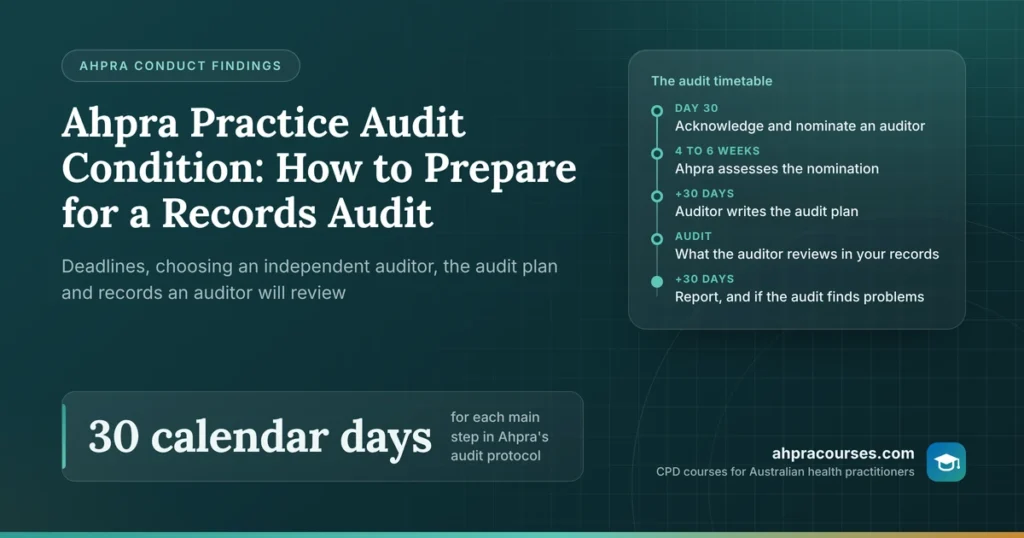
The Ahpra Protocol: Complete audit applies to restrictions imposed or accepted from 16 September 2024. It turns the restriction into a sequence of steps, most with a 30 calendar day limit. The protocol forms are numbered HPA.2.10 for your acknowledgement, HPN.2.10 for the nomination and NMA.2.10 for the auditor's acknowledgement.
Two practical points follow from this timetable. First, Ahpra recommends waiting for approval before any audit starts, because audits done earlier may not count and you could pay for them twice. Second, the 30 day nomination window is short when good auditors are busy. Start making calls on the day the notice arrives.
Who can be your auditor, and who should you avoid?
Under the protocol the auditor must hold registration as a health practitioner, and their CV must show the skills, training, experience or qualifications for the areas the audit has to examine. Ahpra also looks at the nominee's own regulatory history. Above all, the auditor must be able to give an independent report and be willing to tell Ahpra about concerns with your conduct, performance or compliance.
Look for
- Experience in your profession and type of practice, so the review is credible
- Familiarity with the specific concern, such as prescribing or billing
- Availability to audit within your timeframe, including follow-up audits
- Comfort working with your record system, especially if a remote audit is proposed
Avoid
- Anyone you employ who you could direct
- People with shared financial interests, or whose relatives or friends share yours
- Anyone who has accepted a gift or benefit from you
- A friend or relative, or someone whose beliefs could affect impartiality
These examples come from the conflicts appendix to the protocol. You and the nominee must declare any actual, potential or perceived conflict before the audit begins and whenever a new one arises. Once approved, give the auditor a copy of your restrictions, the protocol and your case officer's details, and explain the reasons for the audit. A nomination that does not meet the requirements can be refused, and repeatedly failing to nominate a suitable auditor may itself be treated as non-compliance.
What must the audit plan contain?
The auditor writes the plan, not you, and it is due within 30 calendar days of the auditor's approval. Ahpra must approve it before the audit begins. You sign it to show you commit to it. The protocol and its appendix list what it should cover.
Dates and format of each audit, including whether it is in person, online or both, and where it happens.
Selection method for patients or records, where relevant.
Sample size, as a number or a percentage of your total patient load.
Activities, such as discussion, demonstration of tasks, observation and review of case notes or reports.
Assessment criteria and the benchmark standards used.
The minimum outcome that shows the required standard has been met.
A schedule that meets any minimum number of audits in your condition.
Your signature committing to the plan.
If you hope to be audited by video, the plan needs to explain how reliable internet, equipment, secure record sharing and technical problems will be handled. Ahpra's guidance says audio-only audits are unlikely to be approved, pre-recorded material alone is generally not enough, and a virtual audit is unlikely to be approved where records are on paper.
What will the auditor look at in your records?
When asked, you must give the auditor access to your practice locations, patient lists, appointment or billing data, patient records including prescribing and clinical notes, and your electronic record systems. The plan decides which records are drawn. Tribunal conditions show how specific this can be. In one Queensland decision, [2024] QCAT 68, the conditions required an audit within 3 months of returning to practice and every three months after that, focused on professional boundaries, record-keeping and compliance with practice limits, and including at a minimum a random selection of 15 patient clinical records together with pathology results, prescribing records, billing and appointment records.
Self-check: pick five recent records and ask
- Could a colleague continue care from this note alone?
- Does the note show what you assessed, what you concluded and why?
- Is every medicine you prescribed explained, with dose, quantity and review plan?
- Does the item number billed match the time and content recorded?
- Is consent recorded where the treatment needed it?
- Are results and letters acknowledged and acted on, with a date?
- Can you tell who wrote each entry and when?
If you answered no to two or more for most records, the audit will probably find what you found. That is your starting list.
How should you prepare your records before the first audit?
Preparation means changing how you document from now on. It never means going back to improve old notes. Altering or adding to past entries without a clear, dated and attributed late entry can turn a performance concern into an honesty concern, which is far more serious. If an existing note is genuinely wrong, follow your organisation's process for a marked correction, keep the original visible and record why.
- Re-read the reasons for your condition. List the specific record problems the Board or panel described.
- Audit yourself first. Use the self-check above on a sample of your own recent records and keep the results.
- Fix the template, not just the habit. Build prompts into your note structure for history, examination, reasoning, plan, consent and follow-up.
- Time your notes. Write the entry during or straight after the consultation and protect time in your session for it.
- Check prescribing against the record. Every script should be traceable to an assessment and a plan in the note.
- Reconcile billing. Make sure the time and complexity recorded support the item claimed.
- Do focused learning and keep the certificates. Link each piece of learning to a change you can point to in your records.
Our free remediation evidence organiser helps you map each change to the concern it answers, so you can show the auditor and later Ahpra a clear line from problem to fix.
Make your next 15 records ones you would be glad to have audited
- Learn what every Board's code expects of clinical notes, consent and certificates
- Fix habits such as brief notes, copied entries and late additions the right way
- Self-paced, about 2 hours, with a dated certificate you can show your auditor
The Probity and Professional Integrity Program groups courses on records that withstand review, correct amendment of records, billing and declarations. Learning supports your evidence and does not decide any regulatory outcome.
What happens if the audit finds problems?
The auditor's report goes to your compliance case officer within 30 calendar days of each audit. The protocol says it should confirm the audit followed the approved plan and comment on your performance or conduct in the areas audited, your compliance with the restrictions, areas needing improvement, education or training, and improvements you plan to make or have made. Reports are not routinely released to you, but they will be if Ahpra relies on them for further regulatory action or the law requires it.
Auditors are registered practitioners, so they also carry the mandatory notification duties that apply to every registered health practitioner. The protocol reminds them of this and requires them to tell Ahpra immediately if your practice or conduct places the public at risk. That is another reason to prepare honestly rather than hope a sample misses the weak records.
What do published decisions show about audit conditions?
Panel hearing summary 2020.0886, medical practitioner, Queensland
The practitioner did not submit to an audit or provide a written audit plan within the required timeframes. He said he had struggled to find an auditor with the right experience. Ahpra then located auditors whose fees the panel viewed as excessive and unreasonable, and his financial position meant he could not pay them. The panel still found unprofessional conduct and reprimanded him, strongly encouraging strict compliance from then on.
Panel hearing summary 2020.0887, medical practitioner, Western Australia
Allegations about poor patient care, inappropriate prescribing of drugs of dependence and inaccurate or unclear records were substantiated as unsatisfactory professional performance. The panel imposed conditions requiring indirect supervision and audits of the practitioner's practice.
[2024] QCAT 68, psychiatrist, Queensland
After findings involving boundaries, certificates and records the tribunal described as wholly inadequate for understanding treatment or enabling handover, conditions required a Board-approved auditor to attend all places of practice every three months and review a random selection of at least 15 patient records, with the practitioner meeting the cost.
The lesson from the first summary is uncomfortable but clear. Cost and difficulty finding an auditor did not excuse missed deadlines. If you are struggling, ask for an extension in writing before the due date, explain why and propose a new date. The protocol allows extensions case by case for third-party delays or circumstances such as serious ill health. Our article on breaches of Ahpra conditions sets out what usually follows when deadlines are missed.
Which assumptions about audit conditions cause trouble?
"I can start the audit now to save time."
Ahpra recommends waiting for approval. Audits done before approval may not count and may have to be repeated at your cost.
"Ahpra will pay or help with the auditor's fees."
The protocol makes you responsible for all costs of complying, including the audit and the reports.
"If my auditor pulls out, the clock stops."
You must tell your case officer promptly and nominate a new auditor within 30 calendar days. The new auditor then has 30 days to write or endorse a plan.
"I will see the report before Ahpra does."
Reports go to Ahpra and are not routinely released to you, though they will be if Ahpra relies on them for further action.
"Not enough patients means I am off the hook."
If you cannot reach the numbers or deadlines, apply for an extension. Missed audits may be treated as non-compliance.
How do you use the audit to have the condition removed?
For audit restrictions, Ahpra's review guidance asks for evidence that you have addressed the audit findings and changed your practice. That is narrower than many people expect. A run of clean audits helps, but the strongest application also shows what you changed after each report, with examples. Applications to change or remove a condition are made under section 125(1) of the National Law using form ARCD-00, either after the review period or earlier if your circumstances have materially changed. The steps, timing and appeal rights are covered in our guide to lifting conditions on your registration.
An audit evidence file worth building from day one
- The approved plan and every auditor report you have been given or summarised
- Your own self-audit results before and after changes
- Old and new note templates, with the date the new one started
- Learning certificates, each linked to a change in your records
- A short reflection on why the original record problems happened
Learning for practitioners facing a records audit
Courses that change what the auditor will find
Each is self-paced, about 2 hours, with a dated certificate. Choose the course that matches the concern named in your condition. Completing a course supports your evidence and does not determine any regulatory outcome.
- Notes that show assessment, reasoning and plan
- Correct ways to amend or add a late entry
- Consent, certificates and AI scribe output
- Linking every script to a documented assessment
- Drugs of dependence and monitoring
- Scope and authority to prescribe
- Turning audit findings into a remediation plan
- Evidence a review application can rely on
- Reflection on why record problems happened
Financial Integrity and Probity for Health Practitioners in Australia
- Matching billing to the clinical record
- Honest claiming and declarations
- Spotting patterns an audit will question
Audit condition questions, answered briefly
How long do I have to nominate an auditor?
Under the Ahpra Protocol: Complete audit, you must acknowledge the restriction and nominate an auditor within 30 calendar days of the restriction start date, using the approved forms and attaching the nominee's CV.
Does the auditor have to be from my profession?
The protocol requires the auditor to be a registered health practitioner whose CV shows the skills and experience for the areas the audit must cover. In practice that usually means someone experienced in your field, and Ahpra also checks their regulatory history.
Who chooses which patient records are audited?
The approved audit plan sets how patients or records will be selected and how many, as a number or a percentage of your patient load. Some tribunal conditions specify a random selection, so check the wording of your own condition.
Can an Ahpra audit be done by video?
A videoconference audit may be considered if the plan covers reliable internet, equipment, secure sharing of records and technical problems. Audio-only audits are unlikely to be approved, and paper records make a virtual audit unlikely.
Who pays for an audit required by my conditions?
You do. The protocol makes the practitioner responsible for all costs of complying with the restriction, including the audit and the auditor's reports.
Will I get a copy of the audit report?
Not routinely. The report goes to your compliance case officer. It will be released to you if Ahpra relies on it for further regulatory action or if the law requires disclosure.
Can I fix my old notes before the auditor arrives?
No. Improve how you document from now on. Changing past entries without a clear, dated and attributed late entry or correction can raise honesty concerns that are more serious than the original record problem. You can browse every course and guide on the Ahpra Courses home page.
Official sources (13)
- Ahpra: Restriction, Complete audit
- Ahpra Protocol: Complete audit (PDF)
- Ahpra: Complete audit forms HPA.2.10, HPN.2.10, NMA.2.10 (PDF)
- Ahpra: National Restrictions Library 2.0
- Ahpra: Review of restrictions
- Ahpra: Managing health records
- Ahpra: Audit of registration standards
- Ahpra: Panel hearing summary 2020.0886
- Ahpra: Panel hearing summary 2020.0887
- Queensland Judgments: [2024] QCAT 68
- Ahpra: Common forms, including ARCD-00
- Ahpra: Protocols for restrictions
- OAIC: Guide to health privacy