Ahpra Drug Screening Condition: Living With It and Getting It Lifted
A screening restriction changes your whole week: a phone call every weekday morning, observed collections, hair tests, nominated practitioners and a rule about every tablet you take. This guide sets out what Ahpra's current protocol requires, where practitioners slip, and how to build the record that supports a step down and, later, removal.
In short
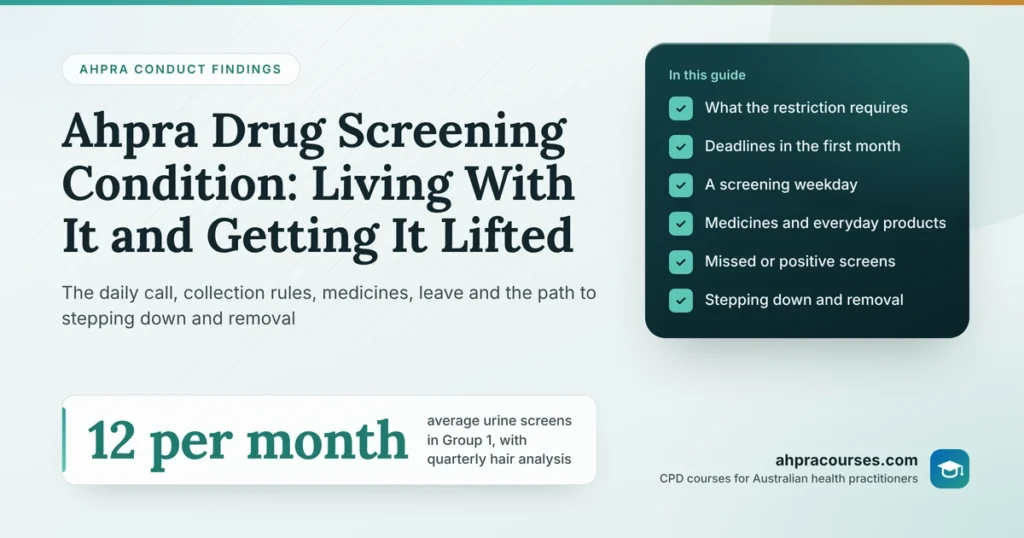
Ahpra's restriction "Screen for drugs" applies to restrictions imposed or accepted from 16 September 2024. You cannot practise until Ahpra publishes approved practice locations, you may take substances only when a nominated prescribing practitioner prescribes, approves or administers them, and you test at a frequency set by screening group, from an average of 12 urine screens a month in Group 1 to annual hair testing in Group 5. You pay for the testing. Most problems come from missed calls, late collections, dilute samples and unchecked over-the-counter products. Compliance, treatment reports and visible insight are what a National Board looks at when you ask to change or remove the restriction under section 125 of the National Law.
A health restriction is not the end of your career. A weak record of compliance and insight can be.
The Fitness to Practise: Health, Conduct and Performance in Australia course explains how the National Law treats health concerns, what a Board weighs, and how to show you are managing your health safely.
- About 2 hours, online and self-paced
- Dated certificate with a number anyone can verify
- Learning supports your evidence; it does not decide any Board outcome
What does an Ahpra "Screen for drugs" restriction actually require?
It requires four things at once: approved places of practice with a senior person at each, a treating practitioner for your health condition, a strict rule on what substances you take, and urine or hair drug screening at a frequency Ahpra sets. Ahpra's restriction page says the restriction is usually applied because of concerns about a practitioner's health, and that some of its details are kept off the public register to protect privacy.
The restriction sits in Ahpra's National Restrictions Library 2.0. If yours was imposed or accepted from 16 September 2024, the document that governs your daily life is the Ahpra Protocol: Screen for drugs. Older restrictions may still refer to the earlier drug and alcohol screening arrangements in Library 1.0, so check the wording on your own notice before relying on any summary, including this one.
The core wording is short. A practitioner with the restriction "must not practise until we publish approved practice locations", must nominate a senior person at each practice location, and must "not take substances unless prescribed, approved or administered by a nominated prescribing practitioner". The protocol then fills in the detail: forms, deadlines, the screening hotline, collection rules, leave and reporting.
Three people end up in your monitoring arrangements, and each has a defined job under the protocol:
| Role | Who it can be | What they do under the protocol |
|---|---|---|
| Senior person | Someone senior to you by role and/or experience at each published practice location, with a unique email address | Is Ahpra's main contact for safe practice at that site, gives information about the location, supervision and return to work arrangements, and reports concerns about your practice or compliance |
| Treating practitioner | A practitioner treating your health condition, such as a GP, psychiatrist, addiction specialist, nurse practitioner, psychologist or alcohol and other drugs counsellor | Acknowledges the nomination, reports if concerned, when treatment is complete or if you stop attending, and answers Ahpra's requests about your condition and engagement |
| Prescribing practitioner | A nominated registered practitioner with no actual or perceived conflict of interest | Prescribes, approves or administers any substance you take, and confirms substances, doses, frequency and repeats |
Where your restriction requires approved locations, the protocol adds that you must not be the only practitioner of your profession at that location, that the senior person and staff must not have a direct personal relationship with you, and that there must be enough oversight. Sole practice and family businesses are therefore hard to fit inside a screening restriction, which is worth knowing before you nominate a location that Ahpra will not publish.
If your restriction came from a NSW Council rather than a National Board, the Health Professional Councils Authority runs its own participant procedure for drug screening, so the forms and contacts differ. For the wider picture of how restrictions are imposed and recorded, see our explainer on conditions and undertakings on registration.
Which deadlines fall in the first month?
The first weeks carry most of the paperwork, and missing a deadline is itself non-compliance. These are the time limits written into the protocol, counted in calendar days unless stated.
Two related rules catch people out. If your treating practitioner changes, you must advise Ahpra within 3 calendar days and send a new nomination within 30. And you must give your treating practitioner a full copy of the restrictions and the protocol, plus your case officer's contact details, so they know what they are reporting against.
Practice location nominations go on Form HPN.2.29 with a health monitor acknowledgement and senior person details for each site, and each senior person signs Form SPA.2.29. Until Ahpra publishes a location, practising there breaches your registration requirements, even if your employer is ready for you to start. If you need an extension for any deadline, the protocol asks for a written request before the due date with a proposed timeframe, reasons and evidence.
How often will you be tested, and how do the screening groups work?
Frequency depends on your screening group. Appendix C of the protocol sets five groups, and most practitioners start in Group 1 unless Ahpra advises otherwise. Urine screens are averages because the dates are random.
| Group | Urine screens (average) | Hair analysis | What it usually means for your week |
|---|---|---|---|
| Group 1 | 12 per month | Quarterly | Frequent random collections; plan every working day around the 6.00pm cut-off |
| Group 2 | 4 per month | Quarterly | About one collection a week, still called at random |
| Group 3 | 1 per month | Quarterly | Monthly urine screen plus the hair test each quarter |
| Group 4 | 5 to 10 times per year | Quarterly | Occasional urine screens; hair testing carries more of the monitoring |
| Group 5 | Nil | Annually, based on risk assessment | Hair only, with the need for testing assessed from medical reports, compliance and scope of practice |
You continue at your current frequency until Ahpra advises otherwise. Moving down is described as progressive and decided case by case; you can make a written request to step down through the levels in Appendix C. The protocol does not promise a set number of clear results before a step down, so treat any figure you hear from colleagues as anecdote, not rule.
Frequency can also go up. Ahpra may increase it, for example after a breach, and the protocol gives you the chance to make a written or verbal submission first. That submission matters: it is your opportunity to explain context, show what you have done since, and argue for the least restrictive frequency that still protects the public.
What does a screening weekday look like?
For urine screening, the day starts with a phone call. You call the screening hotline on 1800 027 624 every weekday after 6.00am local time, listen to the full message for your group, and if your group is called you provide a sample no later than 6.00pm that day, or at another time Ahpra advises.
At the centre the sample is collected under direct observation, which the protocol calls Level 1 supervision, and you sign a chain of custody form. Collection follows the Australian and New Zealand standard AS/NZS 4308:2008. You also complete a Drug Information Sheet covering the last 14 calendar days or the period since your previous sample, whichever is longer. List everything honestly, because the sheet is what links a detected substance to a valid prescription.
The protocol warns against dilute samples. A sample is dilute when creatinine is below 1.76 mmol/L, and drinking large amounts of water before a collection can produce one. A dilute or unsuitable sample can trigger an additional screen. Testing is generally not required on public holidays.
Hair testing works differently. You book an appointment in advance at an approved collection centre. Head hair must be no less than 3 cm long, including at the nape of the neck, and the collector cuts a section about the thickness of a pencil close to the scalp, noting any chemical treatment. If you have been thinking about a very short haircut, check with your case officer first, because a sample that cannot be collected creates a problem you did not need.
Ahpra has engaged a single national collection and pathology service for this work. You must use the Ahpra-issued pathology request form, write that day's date, not alter it, present photo ID and attend a collection centre on Ahpra's published list. If you live or work somewhere without access to a listed centre, the protocol lets you put a written proposal for alternative arrangements, with samples couriered to the approved pathology provider.
Which medicines and everyday products can put you in breach?
Anything that contains a listed substance and was not prescribed, approved or administered by your nominated prescriber. The protocol's list reaches well beyond illicit drugs: it includes prescription-only and Schedule 8 medicines and named pharmaceuticals such as codeine, tramadol, gabapentin, pregabalin and zolpidem.
Do
- Route every new medicine through your nominated prescriber, including short courses after dental work or minor surgery.
- Keep copies of prescriptions and administration records; a positive screen needs valid evidence for each substance detected.
- Check ingredient lists of cold and flu products, Schedule 3 medicines, vitamins and supplements against the protocol's appendices.
- Tell any new doctor, dentist or emergency team about your restriction so they can involve your prescriber.
- Record any medicine on your Drug Information Sheet at the next collection.
Do not
- Eat food containing poppy seeds; the protocol says poppy seed consumption is not accepted as an explanation for a positive opiate result.
- Take a family member's leftover tablets, even once, even for pain.
- Use weight loss or body building supplements whose ingredients you cannot confirm; if unknown, avoid the product.
- Self-prescribe or ask a colleague for an informal script.
- Assume a pharmacist's over-the-counter advice covers your restriction; they may not know about it.
The prescriber rule is also a conflict rule. Your nominated prescriber must have no actual or perceived conflict of interest, and both you and the nominee must declare any. A colleague you work beside, a relative or a friend is unlikely to meet that test. Ahpra can also ask you for product details and ingredients, so keep packaging or a photo of the label for anything you take.
Doctors with a health restriction should read this alongside our article on how the Medical Board responds to health impairment notifications, which explains self-prescribing expectations in the Medical Board's code. Nurses and midwives will find the NMBA angle in our guide to nurse health impairment, drug and alcohol notifications.
Can you take leave, get sick or travel while being screened?
Yes, but only with the right paperwork, and some leave is simply not available. Section 12 of the protocol allows requests for urine screening leave only. Hair leave is not granted, verbal requests are not accepted, and leave will not be approved if it limits monitoring or simply to avoid screening on regular work days.
| Situation | What the protocol asks | Watch for |
|---|---|---|
| Overseas travel | A written request at least five business days before you go, with a confirmed itinerary, rosters or leave approvals and your contact details | Extra urine screens may be needed on return: after 2 or more days away in Group 1, or 5 or more days in other groups |
| Illness | Evidence of the medical condition within 3 calendar days of the absence, including a medical certificate | Being too unwell to work is not the same as being unable to attend a collection; ask your case officer |
| Public health direction | Evidence of the direction and employer confirmation within 3 calendar days | Screening is not required during ordered quarantine or isolation; otherwise it continues |
| Extended absence | An application for exemption, for example for parental leave or inpatient treatment | Published practice locations are removed and screening may restart when you return to practice |
| Interstate work | Not addressed separately; use alternative collection arrangements if you cannot reach an approved centre | Put any proposal in writing before you go, not after a missed call |
Two points follow from these rules. First, plan holidays early, because a late request is easy to refuse. Second, a period of non-practice does not quietly pause your restriction: if you stop working at a published location you must tell your case officer in writing within 14 days, and if you want testing to stop you need an approved exemption.
A hospital pharmacist in Group 1 is invited to a family wedding in Bali in five weeks. She lodges a written request three weeks ahead with her flight itinerary, approved annual leave and contact details abroad. Her case officer approves urine screening leave for the days away, reminds her that her quarterly hair test still falls due, and tells her additional urine screens may be required when she returns because the trip is longer than 2 days.
Before she flies, she asks her nominated prescriber about travel sickness tablets and a sleep aid for the long flight. The prescriber approves one and declines the other, and she records both conversations. She keeps the boarding passes and the case officer's email in her compliance folder. On return she calls the hotline the first weekday morning and attends when called.
Nothing about this trip is dramatic, and that is the point: when she later applies to step down, her file shows a practitioner who plans ahead and keeps Ahpra informed.
What happens after a missed, dilute or positive screen?
Each is treated as a compliance issue. The protocol lists triggers for additional screens, including using an unapproved centre, an incomplete chain of custody, a non-Ahpra form, collection without Level 1 supervision, a dilute or inadequate sample, unprescribed substances and a return from leave. Failing to attend by the cut-off is a breach in itself.
If you miss a required screen, tell your case officer within 24 hours. Do it even if you think the reason is obvious, and give evidence: a hospital roster showing an emergency theatre case, a GP certificate, a dated photo of a closed collection centre. Silence turns an explainable miss into a pattern.
A positive result needs a valid prescription, approval or evidence of administration for each substance detected. Confirmatory testing is at your cost. If you cannot account for a result, get advice before you respond, from your professional indemnity insurer or defence organisation or a health law solicitor, and be truthful. In the 2017 decision described below, the tribunal found the explanation offered "implausible", and that weighed against the practitioner.
What follows a breach depends on the facts. Outcomes seen in published decisions include a caution, an increase in screening frequency, suspension, a referral to a tribunal for professional misconduct and, in serious and repeated cases, cancellation. Our article on breaching Ahpra conditions walks through the regulatory steps after a breach in more detail.
Screening restriction in place? Start the reflection and insight work now, so your review application has more than test results behind it.
See the Insight, Reflection and Remediation programWhat do tribunal decisions show about screening breaches?
Published decisions show both ends of the spectrum: tribunals that reduce screening when the practitioner's record supports it, and tribunals that cancel registration after sustained non-compliance and dishonesty. The practitioners are not named here.
A registered nurse had conditions imposed because of alcohol dependence. Between July and November 2014 she failed to provide urine samples on 26 occasions; between May 2014 and March 2015 she failed to attend urine testing on 80 occasions; she also missed 26 blood tests and deadlines for reports from her GP and psychiatrist. Statutory declarations she submitted carried a forged witness signature, and she did not notify the Board of criminal charges and convictions.
The tribunal found the breaches of conditions and the forged declarations were professional misconduct, reprimanded her and cancelled her registration, without setting a disqualification period.
Lesson: missed screens stacked up over months, combined with dishonesty, ended registration. Each missed screen was a separate, provable event.
An enrolled nurse with drug screening, prescribing and supervision conditions returned a urine screen positive for cocaine metabolites, confirmed on retest. The NMBA cautioned her and increased her screening frequency. On appeal the tribunal upheld the breach and found her explanation implausible, but reduced screening to the frequency in place before the breach.
The tribunal noted the aim of regulation is "not to punish the practitioner but to manage the risk posed by the practitioner to the public". It weighed her many clear tests, the absence of evidence she had practised while impaired, her standing with colleagues and the burden of the conditions.
Lesson: a strong compliance history still counts after a breach, and frequency should be no greater than needed to protect the public.
A nurse whose registration had been suspended after admitted methamphetamine use, and who had not been frank with a Board-appointed health assessor, returned to practice with conditions including drug screening. She breached those conditions on several occasions between November 2018 and June 2019.
By the hearing she had undergone extensive treatment and complied with screening, and the NMBA accepted she was fit to practise. The tribunal still found professional misconduct, reprimanded her and imposed conditions with a 6-month review period.
Lesson: later recovery helps, but it does not erase earlier breaches. Honesty with health assessors is weighed heavily.
How do you step down and eventually have the restriction removed?
There are two separate steps. Stepping down changes your screening group under the protocol, by written request. Removing or changing the restriction itself is an application to the National Board under section 125(1) of the National Law, made once the review period on your notice has ended or earlier if there has been a material change in your circumstances.
Ahpra's review guidance sets out what the application needs: which restrictions you want changed or removed and how, when they were imposed or accepted, the review date and the basis for the request. For drug and alcohol screening, the suggested evidence is reports from treating practitioners on your current health status and pathology results. You do not need to send copies of compliant urine or hair screens; Ahpra already holds those.
Two details make a real difference. Reports should be dated within the preceding four weeks, so time your requests to your treating practitioner carefully. And Ahpra says it will not seek additional reports on your behalf, so a thin application stays thin. Applications that stop you starting or resuming practice are prioritised; others may take four to twelve weeks.
If the restriction was imposed by a NSW Council or tribunal, or a Queensland tribunal, the Board can consider your application only if that body decided the Board is the appropriate review body; otherwise you apply to the body that imposed it. Requests about restrictions from Queensland's Office of the Health Ombudsman go to that Office. A decision to refuse your application is appealable, and our guide on getting Ahpra conditions removed covers the review application step by step.
Beyond test results, a Board reading a review application is asking whether the risk that led to the restriction has reduced and will stay reduced. That is where insight and reflection carry weight: a clear account of what led to the health concern, what you have learned about your triggers and supports, what has changed in how you work, and what you would do if things became difficult again. Our article on demonstrating insight to Ahpra explains what that looks like in writing.
What should your compliance plan look like this month?
Treat the restriction as a project with a paper trail. These steps follow the protocol's requirements in the order they usually arise.
- Read your notice and the protocol in full. Note your screening group, review period and each form you must lodge, and put every deadline in your calendar the day the restriction starts.
- Lodge the acknowledgements on time. Form HPA.2.29 within 3 calendar days, then treating practitioner and location nominations, then your substance declaration within 7 days of locations being published.
- Set a daily call routine. A fixed alarm after 6.00am on weekdays, a log of each call, and a plan for reaching your collection centre before 6.00pm on working days.
- Audit your medicine cabinet. Remove anything not approved by your prescriber, check supplements and Schedule 3 products, and keep labels for what you keep.
- Brief your senior person. Make sure they have a copy of the restrictions and know when to contact Ahpra, so reports arrive without surprises.
- Stay engaged with treatment. Attend every appointment; your treating practitioner must report if you stop, and their reports are the main evidence for review.
- Plan leave in writing. Overseas requests at least five business days ahead, illness evidence within 3 days, exemptions for long absences.
- Build reflection alongside compliance. Keep dated reflective notes on what supports your recovery and safe practice, and complete targeted learning such as the Fitness to Practise: Health, Conduct and Performance in Australia course, then map each piece of evidence in the free remediation evidence organiser.
Quick self-check: are you protocol-ready?
- Do you know your screening group and the date your review period ends?
- Is every substance you take on your declaration and approved by your nominated prescriber?
- Could you reach your collection centre before 6.00pm on your longest shift day?
- Does your senior person hold a current copy of the restrictions?
- Have you told your case officer about every change of location, prescriber or treating practitioner?
- Is there a dated record of your reflection and learning, not only your test results?
Any "no" is the task for this week. A run of "yes" answers, kept up for months, is what a review application is built on.
Costs deserve a line in the plan too. Under section 11 of the protocol you pay all drug screening costs, including confirmatory testing. If that causes financial hardship, the protocol says to contact Ahpra. Ahpra also lists practitioner support services on its website, and seeking support early is a sign of insight, not weakness.
Show the Board more than clean results
- Understand how health, performance and conduct pathways are assessed under the National Law
- Write reflection that shows insight into the risk behind your restriction
- Keep a dated certificate in the folder you will send with your review application
Learning for practitioners under a health restriction
Courses that support your review evidence
Each course is about two hours of structured CPD with a dated certificate. Pick learning that matches what your Board will want to see at review.
Fitness to Practise: Health, Conduct and Performance in Australia
- How health concerns are assessed under the National Law
- Managing your health so practice stays safe
- What a Board weighs before easing restrictions
- Insight into the risk behind a restriction
- Explaining triggers, supports and safeguards
- Avoiding statements that read as minimising
- Structuring reflection for a review application
- Linking reflection to practice changes
- Keeping a dated reflective record
- Turning compliance into evidence of change
- Matching evidence to the Board's concern
- Planning for the end of the review period
Prefer a structured pathway? The Insight, Reflection and Remediation program brings the three elements together in about 8 hours, and you can browse every course at ahpracourses.com.
Questions practitioners ask about drug screening restrictions
Can I keep working while I have a drug screening restriction?
Usually yes, but only at practice locations Ahpra has published. The restriction says you must not practise until approved locations are published, and you need a nominated senior person at each one.
How often will I be tested?
It depends on your screening group. Under Appendix C of the Ahpra protocol, Group 1 averages 12 urine screens a month with quarterly hair tests, and frequency falls through the groups to Group 5, which is hair testing annually based on risk.
What time do I need to call and attend?
You call the screening hotline every weekday after 6.00am local time and listen to the full message. If your group is called, you must provide the sample by 6.00pm that day or by the time Ahpra advises; attending later counts as failure to attend.
Who pays for drug screening?
You do. The protocol says practitioners pay all drug screening costs, including confirmatory testing, and asks anyone facing financial hardship to contact Ahpra.
Can I take over-the-counter cold medicine or supplements?
Only if they do not contain a listed substance, or your nominated prescriber has approved them. The protocol covers Schedule 3 medicines, complementary medicines, vitamins and weight loss or body building supplements, and says to avoid a product if you do not know its ingredients.
Is my drug screening restriction shown on the public register?
Ahpra says some details of this restriction are not public, to protect the practitioner's privacy. Check how your own entry reads on the register and ask your case officer if anything is unclear.
What should I do if I miss a screen?
Tell your case officer within 24 hours, explain why and send any evidence. Failing to attend is a breach and may lead to an additional screen, so prompt and honest contact matters.
When can I apply to have the restriction removed?
Once the review period on your notice has ended, or earlier if there has been a material change in your circumstances. You apply to the National Board under section 125 of the National Law on form ARCD-00, with treating practitioner reports dated within the preceding four weeks.
How can a course help when my restriction is reviewed?
Structured learning on fitness to practise, insight and reflection can add dated evidence of understanding to an application, alongside your compliance record and treatment reports.
Official sources
- Ahpra: Restriction, Screen for drugs (National Restrictions Library 2.0)
- Ahpra Protocol: Screen for drugs (PDF)
- Ahpra: Review of restrictions
- Ahpra: Frequently asked questions about monitoring and compliance
- Ahpra: Collection centres
- Ahpra: Drug and alcohol screening (National Restrictions Library 1.0)
- Ahpra: Practitioner support services
- Health Professional Councils Authority (NSW): Participant procedure, drug screening
- Health Professional Councils Authority (NSW): Possible outcomes
- Queensland Civil and Administrative Tribunal: [2020] QCAT 224
- NMBA: Tribunal finds nurse in breach of conditions but orders reduced drug testing
- NMBA: Tribunal reprimands nurse who breached conditions of her registration