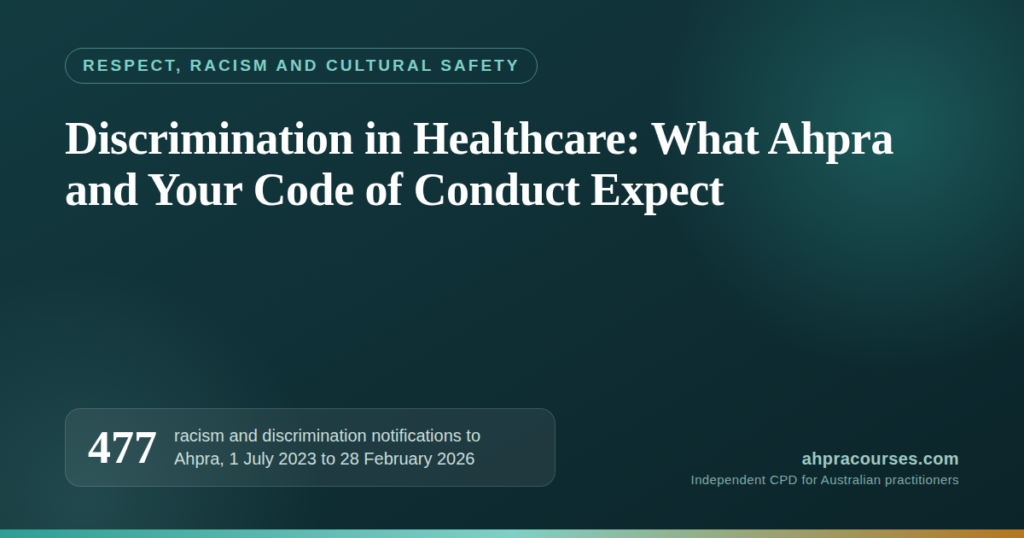
Discrimination in Healthcare: What Ahpra and Your Code of Conduct Expect
Every National Board code now addresses discrimination, racism, bullying and harassment. Here is what the codes and the National Law say, what Ahpra's 2026 review found, what tribunals have decided and how to respond if you are notified.
In short
All registered health practitioners in Australia must provide care free of bias, discrimination and racism, and treat colleagues and students with respect. The Shared Code of conduct (section 5.3), Good medical practice (section 5.4), the NMBA codes and the Psychology Board code all cover this, and the National Law names the elimination of racism as a guiding principle. Ahpra's 2026 review found 477 racism and discrimination notifications in under three years; most closed without action, but tribunals have reprimanded and disqualified practitioners for discriminatory conduct and harassment.
Discrimination, racism, bullying and harassment are not only workplace issues in Australian health regulation. Every National Board code addresses them, the National Law names the elimination of racism as a guiding principle, and in 2026 Ahpra published a detailed review of these notifications. This guide covers every registered profession. If you are a nurse or midwife, our separate guide to dignity and non-discrimination concerns for nurses covers your code in more depth.
- 29 June 2022The Shared Code of conduct took effect for 12 National Boards. Section 5.3 deals with discrimination, bullying and harassment.
- 1 October 2020The Medical Board's Good medical practice took effect. Section 5.4 asks doctors to have zero tolerance for discrimination, bullying and sexual harassment.
- s3A(2)(aa)A National Law guiding principle: a culturally safe and respectful workforce that contributes to the elimination of racism in health services.
- 1 December 2025The Psychology Board's own Code of conduct took effect, replacing the APS Code of Ethics.
- 477Racism and discrimination notifications received from 1 July 2023 to 28 February 2026, 1.5% of all notifications.
- 92%Of the 439 finalised in that review, 406 closed with no regulatory action; 5 were referred to a tribunal.
- 2025-1Ministerial Policy Direction issued by Health Ministers in September 2025 on racism and discrimination, including antisemitism.
What do the codes of conduct say about discrimination in healthcare?
Every National Board code of conduct in Australia says healthcare must be free of discrimination and racism, and that practitioners must treat patients and colleagues with respect. The Shared Code of conduct, Good medical practice, the NMBA codes and the Psychology Board code all cover this, and Ahpra says breaches may affect registration.
The wording differs by profession, but the expectations line up closely.
| Code | In effect | Where it deals with discrimination and respect |
|---|---|---|
| Shared Code of conduct (12 Boards, including dental, pharmacy, physiotherapy, paramedicine, optometry and chiropractic) | 29 June 2022 | Section 1.3 says: "Your decisions about access to care must be free from bias and discrimination." Section 2 covers Aboriginal and Torres Strait Islander health and cultural safety; section 3.1 covers cultural safety for all communities; section 5.3 covers discrimination, bullying and harassment. |
| Good medical practice (Medical Board of Australia) | 1 October 2020 | Section 4.7 covers Aboriginal and Torres Strait Islander health and cultural safety; 4.8 covers all communities; 5.4 is headed Discrimination, bullying and sexual harassment and includes "Having zero tolerance for discrimination, bullying and sexual harassment." |
| Code of conduct for nurses and Code of conduct for midwives (NMBA) | 1 March 2018 | The NMBA fact sheet says the codes state that "bullying and harassment is not acceptable and should not be tolerated", and that culturally safe practice requires challenging bias and assumption. |
| Code of conduct for psychologists (Psychology Board) | 1 December 2025 | The Board's own Code of conduct, replacing the APS Code of Ethics. The Board's FAQ says: "Cultural safety and responsiveness are universal expectations across all psychology practice." |
On 21 February 2025, Ahpra and the National Boards issued a joint statement, Discrimination and racism will not be tolerated. It reminded practitioners that "Breaches of the code may have consequences for a practitioner's registration", and that a breach may be considered unsatisfactory professional performance, unprofessional conduct or professional misconduct. Our pillar guide explains the difference between unprofessional conduct and professional misconduct.
What does cultural safety mean under the National Scheme?
Cultural safety, as defined by the National Scheme, is determined by Aboriginal and Torres Strait Islander individuals, families and communities, not by the practitioner. Culturally safe practice means ongoing critical reflection on your own knowledge, skills, attitudes, behaviours and power differences so that care is safe, accessible, responsive and free of racism.
National Scheme definition, as set out in the codes
"Cultural safety is determined by Aboriginal and Torres Strait Islander individuals, families and communities."
The definition was agreed across the National Scheme and appears in the Shared Code (section 2.2) and Good medical practice (section 4.7).
This is now part of the law itself. The National Law includes an objective in section 3(2)(ca), to build the capacity of the health workforce to provide culturally safe health services to Aboriginal and Torres Strait Islander Peoples, and a guiding principle in section 3A(2)(aa): a culturally safe and respectful workforce that "contributes to the elimination of racism in the provision of health services". Ahpra said cultural safety was adopted through National Law amendments in October 2022. Under its Aboriginal and Torres Strait Islander Health and Cultural Safety Strategy 2020-2025, Ahpra is working toward a healthcare system free from racism and culturally safe by 2032.
Section 2.2 of the Shared Code sets out four things practitioners must do to ensure culturally safe and respectful practice:
"acknowledge colonisation and systemic racism", along with the social, cultural, behavioural and economic factors that affect health.
"acknowledge and address individual racism, your own biases, assumptions, stereotypes and prejudices" and provide holistic, unbiased care.
Recognise the importance of self-determined decision-making, partnership and collaboration, driven by the individual, family and community.
Foster a safe working environment that supports the rights and dignity of Aboriginal and Torres Strait Islander people and colleagues.
Cultural safety extends to all communities. Section 3.1 of the Shared Code asks practitioners to "understand that only the patient and/or their family can determine whether or not care is culturally safe and respectful".
What is the difference between direct and indirect discrimination?
The Australian Human Rights Commission explains that direct discrimination is treating a person less favourably because of their background or a personal characteristic, while indirect discrimination is an unreasonable rule or policy that applies to everyone but unfairly disadvantages people who share a particular attribute. Both ideas help practitioners recognise conduct that codes prohibit.
Direct
Less favourable treatmentThe Commission describes a person being "treated less favourably than another person or group because of their background or certain personal characteristics."
Illustrative example, not a real caseA practitioner shortens consultations and skips an examination for patients who need an interpreter, assuming they will not follow advice.
Indirect
A same-for-everyone rule with an unfair effectThe Commission says "Indirect discrimination occurs when there is an unreasonable rule or policy that is the same for everyone" but has an unfair effect on people who share an attribute.
Illustrative example, not a real caseA clinic books new patients only through an online form in English, with no other option, making it harder for some older patients and people with disability or limited English to get care.
Under the Commission's guidance, an indirect rule is not unlawful if it is reasonable in the circumstances. Federal laws include the Racial Discrimination Act 1975, Sex Discrimination Act 1984, Disability Discrimination Act 1992 and Age Discrimination Act 2004, and states and territories have their own anti-discrimination laws. Since 12 December 2022, the Sex Discrimination Act has included a positive duty on employers to take reasonable and proportionate measures to eliminate workplace sex discrimination and sexual harassment, as far as possible.
Does the code cover how you treat colleagues, students and staff, not only patients?
Yes. The Shared Code of conduct and Good medical practice both apply respect and non-discrimination duties to colleagues, students, trainees and healthcare teams as well as patients. In a 2023 decision, the ACT Civil and Administrative Tribunal held that the Medical Board code's discrimination section is not confined to the workplace.
Access to care free from bias; treatment based on clinical need; no lesser care because you believe a patient's behaviour or other attributes contributed to their condition.
Professional, courteous behaviour at all times; no discrimination, bullying or harassment; constructive feedback.
Good medical practice names students, trainees and international medical graduates in its feedback and referral duties.
The Shared Code warns social media can be used to bully or harass. Ahpra found 44% of racism and discrimination notifications came from online conduct.
Section 5.3 of the Shared Code asks practitioners to "never engage in, ignore or excuse discrimination, bullying and harassment", and states that "Respect is a cornerstone of good practice and of patient safety." It also expects you to speak up when you see it, take action if you are a leader or manager, and support colleagues who report. If you are worried about the consequences of reporting a colleague, read about protections for people who make a notification. For conduct online, see our guide to social media conduct and Ahpra.
When does workplace bullying or sexual harassment become an Ahpra matter?
Workplace bullying and harassment usually start as employer matters, but they can become regulatory matters. Good medical practice says concerns should be referred to the Medical Board when there is ongoing or serious risk to patients, students, trainees, colleagues or healthcare teams, and the NMBA says notification is needed only where bullying and harassment directly affect public safety.
Good medical practice section 5.4.10 expects doctors to refer concerns "to the Medical Board when there is ongoing and/or serious risk to patients, students, trainees, colleagues or healthcare teams (in addition to mandatory reporting obligations)." The NMBA fact sheet says that in most cases employers should manage bullying and harassment as a performance issue, with notification needed only where "bullying and harassment directly affect public safety." The Shared Code says a Board may impose conditions or accept an undertaking where these behaviours affect public safety. Ahpra's Shared Code case studies include a chiropractor who feels repeatedly undermined by a senior colleague and resolves it through workplace policies.
In a June 2021 joint statement on sexism, sexual harassment and violence, Ahpra and the National Boards said: "Concerns about disrespectful behaviour can often be handled locally." They added that serious concerns about unprofessional conduct, including sexual harassment, can be reported to Ahpra, that "Unprofessional conduct may result in regulatory action including suspending registration", and that possible criminal conduct such as sexual assault should go to police first.
How many racism and discrimination notifications does Ahpra receive?
Ahpra's 2026 notifications review found 477 notifications about racism and discrimination were received between 1 July 2023 and 28 February 2026, which was 1.5% of all notifications. Ahpra says these concerns are likely under-reported, and 44% related to practitioners' conduct on social media.
The review was part of Ahpra's response to Ministerial Policy Direction 2025-1, which asked Ahpra and the National Boards to ensure practitioners undertake education and training to promote a culture of antiracism and non-discrimination, and to review how these concerns are assessed and managed. Doctors were named in most notifications, as the bars below show.
Notifications by profession (n=477)
Source: Ahpra, Notifications review: findings and actions, published 23 July 2026. Bar widths are relative to the medical total.
What outcomes can follow a discrimination or racism notification?
Most racism and discrimination notifications close without regulatory action. In Ahpra's 2026 review, 406 of 439 finalised notifications (92%) had no regulatory action, 28 resulted in conditions, a caution or other action, and 5 notifications involving 4 practitioners were referred to a tribunal.
Closed after assessment. Ahpra found case management was sometimes inconsistent and outcome letters sometimes brief or templated.
Outcomes such as a caution or conditions on registration, which can include education or mentoring.
The most serious matters, where professional misconduct may be found and suspension or cancellation is possible.
The review concluded: "Overall, Ahpra and the National Boards have applied appropriate and proportionate regulatory thresholds with these notifications." Where risk is higher, a Board can take immediate action, or refer a matter to a performance and professional standards panel or a responsible tribunal. Our guide to notification outcomes explains each outcome.
In 2023, Ahpra announced a culturally safe process for notifications involving Aboriginal and Torres Strait Islander Peoples, with at least two Aboriginal and Torres Strait Islander representatives. Ahpra said they would take part in decisions with practitioner and community members, including, in the most serious matters, whether to refer a practitioner to a tribunal.
A discrimination, bullying or harassment concern is a conduct matter. Build structured learning on respectful practice, boundaries and professional conduct.
Get the Professional Boundaries & Conduct ProgramWhat have panels and tribunals decided in real discrimination and harassment cases?
Published decisions show outcomes ranging from a caution for disrespectful communication with colleagues to a reprimand and 12-month disqualification for racially discriminatory comments. Insight, remediation and whether the conduct targeted a person repeatedly have shaped the orders. Practitioners are not named in this article.
A doctor forwarded another doctor an email with offensive comments about a medicines policy designed to benefit Indigenous people, then made culturally insensitive comments about that doctor and Indigenous Australians in communications with Ahpra. The tribunal found the colleague was treated less favourably because of his racial background, and said "it is abundantly clear that clause 5.4 of the Code does not merely apply to a medical practitioner's workplace." It found the conduct "has the potential to bring the medical profession into disrepute" and was not satisfied the doctor had gained good insight.
Outcome: professional misconduct; reprimand; disqualified from applying for registration for 12 months; prohibited from providing any health service for 12 months; costs.
After a colleague did not return his romantic feelings, a doctor sent her harassing messages and posted about her on social media over about eight months. The tribunal called it "targeted and planned harassment" and said its role was "not to punish but rather to protect the public". He was also convicted of using a carriage service to harass.
Outcome: professional misconduct; reprimand; disqualified from practising for 12 months.
A nurse in a senior role spoke to colleagues aggressively and inappropriately, sometimes in front of patients, and did not escalate a workplace report. She had already been suspended for four months during a workplace investigation and had completed remedial education.
Outcome: unprofessional conduct; caution.
A paramedicine lecturer made inappropriate comments to a student, contacted her through Facebook and behaved inappropriately at an awards ceremony. The panel found he showed limited capacity for self-reflection and insight.
Outcome: unprofessional conduct; reprimand; conditions requiring education and mentoring on boundaries, power imbalances and ethics.
A pharmacist gave patients health management suggestions based on personal religious beliefs and advice inconsistent with COVID-19 public health orders. The panel found breaches of the 2014 code and the 2022 Shared Code, principally about unprofessional communication. This was a communication finding, not a discrimination finding.
Outcome: unprofessional conduct; caution; conditions requiring 12 hours of mentoring over 12 months.
Two patterns stand out. Emails, messages and posts outside the clinic were treated as professional conduct. And the response to the regulator mattered: in the ACAT case, comments made to Ahpra formed part of the conduct, and the tribunal found no genuine contrition. Our guide to demonstrating insight explains what Boards look for. You can browse every course and guide on the Ahpra Courses home page.
What does respectful, non-discriminatory practice look like day to day?
Respectful, non-discriminatory practice means basing care on clinical need, letting patients judge whether care is culturally safe, treating colleagues and students with courtesy, and speaking up about discrimination you see. The checklist below turns the Shared Code and Good medical practice expectations into everyday habits for any registered profession.
With patients
- Decide investigations and treatment on clinical need, not assumptions about a person
- Offer an interpreter and culturally appropriate support when needed
- Ask, do not assume: invite feedback on whether care felt safe and respectful
- If you conscientiously object, tell the patient respectfully and make sure they have other care options
With colleagues and students
- Give feedback privately, specifically and respectfully
- Never comment on a person's race, religion, sex, sexuality, disability or age as a criticism
- Check your own power as a senior, supervisor or lecturer
- Do or say something when you see discrimination, bullying or harassment
Online and in writing
- Assume emails, messages and posts may be read by a Board
- Do not post, share or forward content that demeans a group
- Write about patients and colleagues professionally in records and letters
- Stay professional in every communication with Ahpra, even when you disagree
What should you do if you are notified about discrimination or racism?
If you receive a notification about discrimination, racism, bullying or harassment, get advice early from your professional indemnity insurer or a health law solicitor, read the concern carefully, and respond respectfully and on time. Focus on the impact on the other person, show insight, and evidence any change you have made.
- Pause before you reply. Do not contact the notifier, and do not post about the matter. In the ACAT case, comments made to Ahpra became part of the conduct.
- Check who is handling it. In NSW, complaints are managed by the Health Care Complaints Commission and the health professional Councils; in Queensland, the Office of the Health Ombudsman is the single point of entry for health service complaints. See how notifications work in NSW and Queensland.
- Get advice. Contact your professional indemnity insurer, a medical defence organisation or a health law solicitor before you make a detailed written response.
- Understand the allegation. Identify which code sections are in issue, such as Shared Code 5.3 or Good medical practice 5.4, and what the other person experienced.
- Respond to impact, not only intent. The codes say the patient, family or community determines cultural safety. Acknowledge how your conduct was received, even if you meant no harm.
- Show insight and change. Reflect on bias, power and communication, and describe what you now do differently. Our guide on how to respond to an Ahpra notification explains structure and timing.
- Evidence remediation. Where education is required you usually nominate a course and the Board decides whether it is suitable. Keep certificates, reflections and any mentoring records.
Want structured evidence that you understand respect, ethics and professionalism across your whole practice?
Get the Ethics & Professionalism Complete ProgramLearning matched to discrimination and respect concerns
Relevant courses
Two hours of structured CPD each, with a dated certificate. Choose learning that matches the concern you are addressing.
Ensuring Dignity and Non-Discrimination as Healthcare Professionals
- Direct and indirect discrimination in care
- Cultural safety and respectful practice
- Reflecting on bias and assumptions
Ensuring Effective Communication as Healthcare Professionals
- Respectful communication with patients
- Constructive feedback to colleagues
- Communicating across language and culture
Professionalism for Healthcare Professionals
- Standards peers and the public expect
- Professional behaviour online and offline
- Respect in teams and workplaces
Rebuilding Trust of Patients, Public, and the National Boards
- Understanding the impact of your conduct
- Showing insight after a concern
- Documenting the changes you make
Frequently asked questions
Can Ahpra act on discrimination against a patient?
Yes. Every National Board code requires care free of bias and discrimination. A notification about discriminatory treatment is assessed against your code, and a breach may be unsatisfactory professional performance, unprofessional conduct or professional misconduct.
Can I be reported to Ahpra for bullying a colleague?
Yes, although employers usually manage bullying first. Good medical practice says concerns should go to the Medical Board where there is ongoing or serious risk, and the NMBA says notification is needed where bullying directly affects public safety.
What is the difference between direct and indirect discrimination?
Direct discrimination is treating someone less favourably because of a personal characteristic. Indirect discrimination is an unreasonable rule applied to everyone that unfairly disadvantages people sharing an attribute, as the Australian Human Rights Commission explains.
Who decides whether care is culturally safe?
The person receiving care. The National Scheme definition says cultural safety is determined by Aboriginal and Torres Strait Islander individuals, families and communities, and the Shared Code says only the patient or their family can decide.
Do social media posts count as professional conduct?
They can. In Ahpra's 2026 review, 44% of racism and discrimination notifications related to social media. A tribunal also found the Medical Board code's discrimination section is not limited to the workplace.
How many racism and discrimination notifications lead to action?
Ahpra's review of 439 finalised notifications found 92% closed with no regulatory action. Twenty eight led to a caution, conditions or other action, and five notifications involving four practitioners were referred to a tribunal.
Is sexual harassment of a colleague a conduct matter?
Yes. Good medical practice asks doctors not to sexually harass others, and the Shared Code lists sexual harassment as a form of harassment. Tribunals have reprimanded and disqualified practitioners for harassing colleagues.
What should I do first if I am notified about racism?
Contact your indemnity insurer or a health law solicitor, do not contact the notifier or post about it, and respond respectfully. Acknowledge the impact on the other person and evidence insight and any changes made.
Official sources
- Ahpra: Shared Code of conduct (in effect 29 June 2022)
- Dental Board of Australia: Code of conduct in effect today (29 June 2022)
- Medical Board of Australia: Good medical practice, a code of conduct for doctors in Australia
- Medical Board of Australia: Updated code of conduct to guide doctors from October (2020)
- NMBA: Fact sheet, Code of conduct for nurses and Code of conduct for midwives
- NMBA: New codes of conduct take effect (1 March 2018)
- Psychology Board of Australia: Code of conduct FAQ
- Psychology Board of Australia: Psychologists to maintain high standards under new requirements (1 December 2025)
- Health Practitioner Regulation National Law (Queensland), sections 3 and 3A
- Ahpra: Aboriginal and Torres Strait Islander Health Strategy
- Ahpra: Major milestone towards eliminating racism in healthcare (24 March 2023)
- Ahpra: Discrimination and racism will not be tolerated (21 February 2025)
- Ahpra: Standing firm against racism and discrimination (15 October 2025)
- Ahpra: Eliminating racism and discrimination
- Ahpra: Notifications review, findings and actions (2026)
- Physiotherapy Board of Australia: No place for sexism, sexual harassment or violence in healthcare (30 June 2021)
- Australian Human Rights Commission: Direct discrimination
- Australian Human Rights Commission: Indirect discrimination
- Australian Human Rights Commission: Respect@Work changes to the Sex Discrimination Act (December 2022)
- Australian Human Rights Commission: A quick guide to Australian discrimination laws
- Ahpra: Case studies, Shared Code of conduct
- Ahpra: Reporting concerns in New South Wales or Queensland
- Office of the Health Ombudsman (Qld): Who we work with
- ACAT: Medical Board of Australia v CDA [2023] ACAT 64
- Medical Board of Australia: Doctor disqualified for 12 months for harassment (VCAT, 2020)
- Ahpra panel decision summary 2020.0888 (Nursing, SA)
- Ahpra panel decision summary 2020.0898 (Paramedicine, Vic)
- Ahpra panel decision summary 2023.0920 (Pharmacy, Vic)