
In short
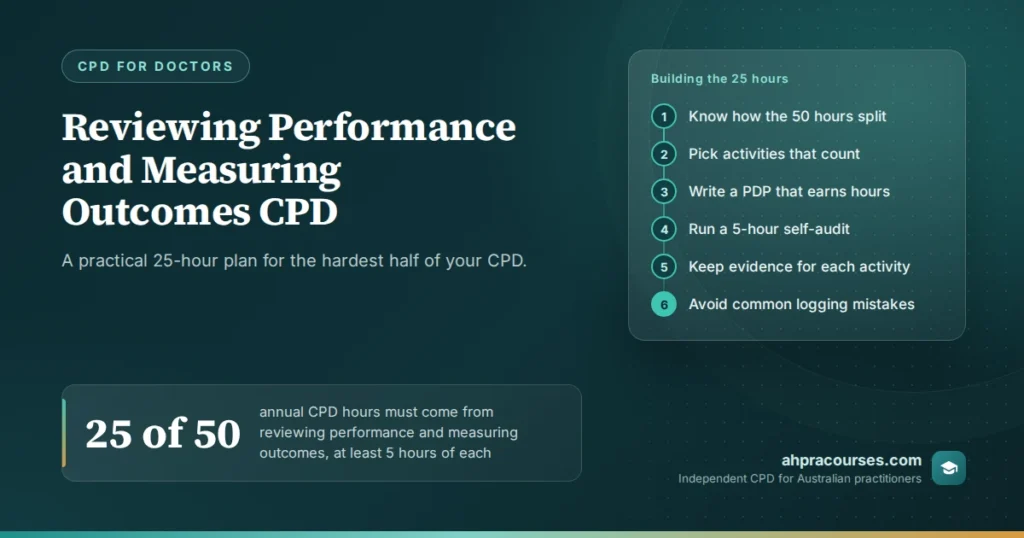
Doctors with practising registration need at least 50 CPD hours each calendar year through an accredited CPD home. At least 25 of those hours must be reviewing performance and measuring outcomes, with a minimum of five hours of each, plus 12.5 educational hours and 12.5 hours of any type. Reviewing performance includes your PDP, reflection, feedback and peer review. Measuring outcomes includes audits, incident analysis and M&M meetings. Plan these hours early, because they need data from your own practice.
How are the 50 CPD hours split?
For doctors who must do CPD, half of the annual 50 hours must come from reviewing performance and measuring outcomes, with at least five hours of each.
Under the Medical Board of Australia's CPD registration standard, doctors with practising registration complete at least 50 hours of CPD each calendar year that is relevant to their scope of practice, through an AMC-accredited CPD home that suits that scope, guided by a professional development plan (PDP). The Board breaks the 50 hours down like this:
So the 25-hour block is not two separate 12.5-hour quotas. You need at least 5 hours of each type, and you decide how to split the other 15. A GP who does a lot of peer review could log 20 hours of reviewing performance and 5 of measuring outcomes and still comply.
Specialty-specific high-level requirements, which your CPD home includes in its program, and the CAPE requirements sit inside the 50 hours, not on top of them. CAPE stands for culturally safe practice, addressing health inequities, professionalism and ethical practice, and the Board says doctors must complete activities aligned with Good medical practice that cover each aspect.
Why are these 25 hours the hardest to fill?
Because you cannot buy them off the shelf. They have to come from your own practice.
Educational hours are easy to find: a webinar, a course, a conference. Reviewing performance and measuring outcomes require you to look at what you actually do and what happens to your patients as a result. That takes data, time and a little discomfort. It is also why these categories are the most useful: they are where real improvement happens, and they make useful evidence if a concern is ever raised about your practice.
- Reviewing performance asks: how do I practise, and how do others see it?
- Measuring outcomes asks: what results does my practice produce, and how do they compare with a standard?
Which activities count in each category?
The Board's examples are grouped into individual activities, group activities, and activities not directly focused on your own practice. Your CPD home may publish further guidance and has the final say on how an activity is logged.
Your PDP, self-evaluation and reflection, colleague observation, multi-source feedback, patient experience surveys, workplace appraisals
Team-based observation, multi-source feedback, patient experience surveys, medical service reviews, multidisciplinary team meetings, peer review groups
Clinical governance or quality committees, accrediting or auditing sites, medico-legal work
Audits of your own practice, root cause analysis, incident reports, individual quality improvement projects
Practice, national or international audits, M&M and case conferences, quality improvement projects, multidisciplinary team meetings
Reviewing incident reports, analysing or writing about healthcare outcomes
How do you write a PDP that also earns reviewing performance hours?
Keep it short and practical. The Board says a PDP is not a complicated document, and the time you spend on it counts.
Write your PDP before you start CPD each year. Many CPD homes provide a template. A useful plan answers four questions:
A simple PDP structure
- Where is my practice now? Your scope, setting and any changes planned this year.
- What did last year show? A brief self-evaluation of last year's goals and what you achieved.
- What do I want to improve? Two to four learning goals, ideally including one that needs an audit or feedback.
- How will I get there? The activities you will use, split across educational, reviewing performance and measuring outcomes hours.
The Board also notes that work you already do for your employer, such as appraisals, audits or quality meetings, may count if your CPD home recognises it. Check before you plan extra activities you may not need.
What does a compliant 25-hour plan look like?
Three sample plans for different kinds of practice. Adjust the hours to your own work and your CPD home's rules.
Solo or small-practice GP
Limited access to hospital meetings
| RPWrite and review PDP | 2 |
| RPPeer review group, monthly | 10 |
| RPPatient experience survey and reflection | 3 |
| MOSelf-audit of S8 prescribing notes | 6 |
| MORoot cause analysis of an incident | 4 |
| Total | 25 |
Hospital specialist
Regular departmental meetings
| RPWrite and review PDP | 2 |
| RPMulti-source feedback and reflection | 4 |
| RPWorkplace appraisal | 2 |
| MOM&M meetings | 10 |
| MODepartmental clinical audit | 7 |
| Total | 25 |
Non-clinical or part-time doctor
Medico-legal, academic or reduced hours
| RPWrite and review PDP | 2 |
| RPMedico-legal report review | 8 |
| RPQuality committee | 6 |
| MOReviewing incident reports | 5 |
| MOWriting on healthcare outcomes | 4 |
| Total | 25 |
RP = reviewing performance, MO = measuring outcomes. Hours are illustrative. Log the actual time spent.
Turn self-evaluation into structured, dated reflection you can log and evidence. Two hours of CPD with a certificate.
Start the Module on ReflectionHow do you run a 5-hour self-audit that counts as measuring outcomes?
A simple clinical audit compares what you actually do against a standard, then checks whether a change worked.
Good first audit topics include documentation of consent for procedures, review dates on repeat prescriptions, follow-up of abnormal results, and safety-netting advice in acute presentations. Keep the audit tool, the results, the change you made and a short reflection. That bundle is your evidence.
If you are facing prescribing and record keeping conditions, an audit of your own notes is also one of the most persuasive things you can show. The same applies before a performance assessment.
What evidence should you keep for each activity?
| Activity | Evidence to keep |
|---|---|
| PDP | The plan, your review of last year's goals and the time spent |
| Peer review group | Attendance record, cases discussed and your reflection |
| Multi-source feedback | The summary report and what you will change |
| Patient survey | Results summary and your action plan |
| Clinical audit | Audit tool, results, change made and re-audit plan |
| M&M or case conference | Attendance record and learning points |
| Incident analysis | De-identified summary, contributing factors and actions |
Log activities with your CPD home as you go. The CPD standard requires you to keep records of your annual CPD activity for three years after the end of each one-year cycle, for audit by your CPD home and the Board. Your CPD home reports your compliance to the Board, and the Board may audit compliance from time to time.
Who is exempt, and what if you fall short?
A few groups do not need to do CPD. For everyone else, falling short has registration consequences.
- Not required to do CPD: medical students, doctors with non-practising registration, doctors registered for less than four weeks, and interns and PGY2 doctors in a structured program leading to a certificate of completion.
- Extended leave: if you take leave of between six and 12 months, for reasons such as illness or parental leave, you may be eligible for an exemption. You apply through your CPD home, not the Board.
- Part-year registration: the Board does not publish a general pro rata rule, so check with your CPD home how hours apply to your situation.
- If you do not meet the standard: the Board can impose conditions on your registration or refuse to renew it. Not completing CPD is not an offence in itself, but it may lead to health, conduct or performance action.
Which logging mistakes trip doctors up?
- Leaving it to December. Audits and surveys need time to collect data. Start them early in the year.
- Missing the 5-hour minimum. Doctors heavy on meetings often have plenty of one type and none of the other.
- Double counting. A multidisciplinary meeting appears in both categories, but logging the same time twice overstates your hours.
- Logging education as review. A course is usually an educational activity. The reflection you write afterwards about your own practice is what may count as self-evaluation.
- No PDP, or no year-end review. Write your PDP before starting CPD each year, link activities to its goals, and evaluate your CPD at the end of the year as you prepare the next plan.
- No reflection. Activities without a note on what you learnt and changed are weak evidence if you are ever asked.
Where do online courses fit in the 50 hours?
Mostly in the educational and free-choice hours. The reflection that follows is what connects them to reviewing performance.
Structured online courses, including ours, are educational activities. They help fill the 12.5 educational hours and the 12.5 free-choice hours, and courses on ethics and professionalism CPD help meet the professionalism and ethical practice aspects of CAPE. Self-evaluation and reflection on your own practice is listed as a reviewing performance activity, so a structured reflection written after a course, about your own cases, may be logged that way if your CPD home agrees.
For doctors with a concern raised, these same activities also show a Board that you have looked hard at your own practice. Our guides on how to demonstrate remediation and on writing a reflective statement for the Medical Board show how to present them.
Doctor with a concern to address? Build insight, reflection and remediation evidence that also strengthens your CPD year. You can browse every course and guide on the Ahpra Courses home page.
Get the Insight, Reflection & Remediation Program for DoctorsCPD for doctors
Courses that support your reviewing and outcomes hours
Two hours of structured CPD each, with a dated certificate to log with your CPD home.
Module on Reflection
- Structured self-evaluation of your practice
- Reflection you can log and evidence
- Dated certificate
Module on Remediation
- Turn audit findings into change
- Plan measurable improvement
- Show the loop is closed
Professionalism in Documentation for Healthcare Professionals
- Audit-ready clinical notes
- Supports a records self-audit
- What good records show
Ensuring Clinical Competence and Patient Safety
- Safety-netting and clinical reasoning
- Patient safety principles
- Supports clinical outcome audits
Frequently asked questions
How many hours of reviewing performance and measuring outcomes do doctors need?
At least 25 hours a year combined, with a minimum of five hours of each type. You choose how to split the remaining 15 hours between the two categories, within your 50 total CPD hours.
What counts as reviewing performance for CPD?
The Medical Board's examples include your professional development plan, self-evaluation and reflection, colleague observation, multi-source feedback, patient experience surveys, workplace appraisals, peer review groups and multidisciplinary team meetings, among others.
What counts as measuring outcomes for CPD?
The Medical Board's examples include audits of your own practice, root cause analysis, incident reports, quality improvement projects, M&M meetings, case conferences, practice or national audits, and multidisciplinary team meetings.
Does writing my professional development plan count as CPD?
Yes. The Medical Board says time spent writing and reviewing your PDP counts towards the 50 CPD hours each year, and lists the PDP among reviewing performance activities. It need not be long or complicated.
Can a multidisciplinary team meeting count in both categories?
It appears in both the reviewing performance and measuring outcomes examples, so log each meeting under the category that fits best. Logging the same time twice would overstate your total CPD hours.
Do online courses count as reviewing performance?
Usually not. Courses are generally educational activities. A structured reflection you write afterwards about your own practice may be logged as self-evaluation and reflection, depending on your CPD home's rules.
Is the CPD year a calendar year for doctors?
Yes. Doctors meet the CPD requirements each calendar year and log activities with their CPD home. At renewal they declare their CPD home for the previous year and whether they met the standard.
How long do I need to keep CPD records?
The Medical Board's CPD standard requires you to keep records of your annual CPD activity for three years after the end of each one-year cycle, for audit by your CPD home and the Board.