
In short
Probity concerns are about honesty and integrity. At every renewal you declare that you meet five registration standards: PII, recency, CPD, criminal history and health. Boards audit these, and a false or misleading declaration can lead to refused renewal, conditions or disciplinary action. Tribunals have found repeated false PII and recency declarations to be professional misconduct, with reprimands, suspension and disqualification, even where the cause was inattention. If you realise a declaration was wrong, stop practising if uninsured, take advice and correct the record promptly.
What counts as a probity concern?
Any concern about a practitioner's honesty or integrity. The common thread is that someone relied on information that was not true.
Probity is about being truthful with patients, colleagues, employers, insurers, funders and the regulator. Codes of conduct for every registered profession expect honesty in what you say, write, sign and declare. Probity concerns are taken seriously because registration itself depends on trust: the public register only works if what practitioners declare is accurate.
This article focuses on the declarations practitioners make to Ahpra, because they are where many probity matters begin. For profession-specific guidance, see our articles on dishonesty and integrity concerns for doctors and dishonesty and financial integrity concerns for nurses.
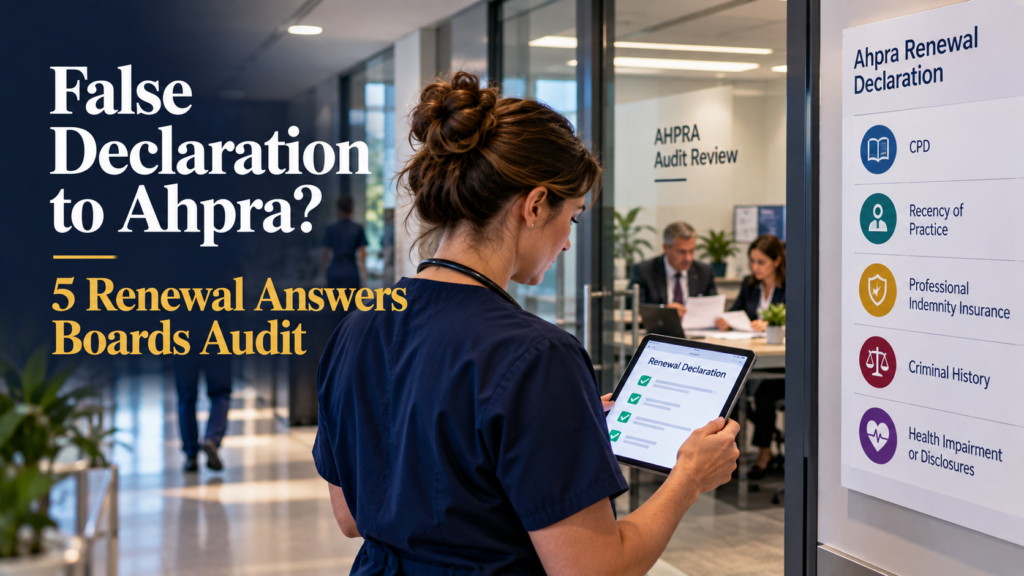
Which declarations do you make every time you renew?
Five, and each one can be audited.
At renewal, every registered practitioner declares that they meet their Board's registration standards. Ahpra says Boards randomly audit a selection of practitioners each year, and you must be able to substantiate what you declared.
| Declaration | What you are confirming | Audit evidence | Where it goes wrong |
|---|---|---|---|
| Professional indemnity insurance | You held appropriate cover in the last period and will not practise without it | Proof of cover for the whole period | Assuming an employer's policy covers private or locum work |
| Recency of practice | You have practised the minimum hours required | Payslips, rosters or employer letters | Ticking "yes" after a long career break |
| CPD | You met your Board's CPD requirements | Records, certificates or a portfolio | Declaring hours you planned to complete but had not |
| Criminal history | You have disclosed any new charges or convictions | A criminal history check | Not disclosing a charge because it was minor or unresolved |
| Health impairment | You have declared impairments likely to affect safe practice | Treatment plan or treating practitioner statement | Not declaring a condition that does affect practice |
Ahpra warns that making a false or misleading declaration can be grounds for a Board to refuse renewal, and can also lead to conditions or disciplinary action. Notice that most problems in the right-hand column are not deliberate lies. They are assumptions and inattention. That is exactly what the cases below show.
Case: five false PII declarations and a three-month suspension
A Victorian medical radiation practitioner practised without professional indemnity insurance for about five years. At each of five renewals she answered "yes" to holding PII. A random audit in 2022 prompted her to realise she had no cover. She completed the audit checklist, informed the Board, obtained retroactive cover and has held PII since.
The tribunal found:
- Professional misconduct for practising without PII, and for making false declarations at five renewals.
- Unprofessional conduct for failing to notify the Board within seven days that her PII had lapsed, as section 130 of the National Law requires.
- That she had obtained her registration improperly at each renewal, having "paid little to no attention to the questions".
Case: recency declarations after years out of practice
A nurse declared at two renewals that she met the recency of practice standard, despite not having practised since January 2012. The Board said she "ought to have known" this was false. She later applied for non-practising registration and declared she had never been subject to conditions, undertakings or conduct, performance or health proceedings, which the Board said she "should have known" was false.
The State Administrative Tribunal of Western Australia found professional misconduct, reprimanded her and disqualified her from applying for registration for six months.
Why does the false declaration often matter more than the original problem?
Because the original problem is usually fixable, while dishonesty goes to whether you can be trusted to self-report.
A lapse in insurance or a shortfall in CPD hours can be corrected. A false declaration is different: the regulatory system relies on practitioners telling the truth so that Boards do not need to verify every answer. The cases show how matters escalate:
If a matter reaches this stage, our guide to panel and tribunal hearings explains how those hearings work.
Probity concerns call for integrity-focused learning. The program covers honesty, declarations, billing and conflicts of interest together.
Get the Probity & Professional Integrity ProgramRealised a declaration was wrong? What to do now
Act quickly, take advice, and correct the record yourself before someone else does.
- Stop practising if you are uninsured. Do not see patients until appropriate PII is in place.
- Arrange cover. Speak to an insurer about current cover and whether retroactive cover is available for the gap.
- Get advice before you write to Ahpra. Your indemnity insurer, defence organisation or a health law solicitor can help you frame the disclosure accurately.
- Notify the Board. Explain what happened, when you realised, and what you have done. Do not minimise or embellish.
- Gather your evidence. Current cover, CPD records, employment history and anything that substantiates what you now say.
- Start targeted learning. Integrity-focused education shows you understand why accurate declarations matter, not just that you fixed the gap.
- Put controls in place. Show the Board the practical systems that will stop it happening again.
If you receive a notification, our guide to responding to an Ahpra notification covers the written response in detail. Self-disclosure does not guarantee a particular outcome, but candour is directly relevant to how a Board assesses insight and future risk.
Where else can misleading information cause a probity concern?
- Advertising. The National Law prohibits advertising a regulated health service in a way that is false, misleading or deceptive, and Ahpra publishes guidelines on advertising.
- Titles and qualifications. Using a protected title you are not entitled to, or implying a specialty or qualification you do not hold.
- Job applications and CVs. Overstating experience, roles or reasons for leaving previous positions.
- Billing and claims. Inaccurate item numbers, claims for services not provided, or claiming under another practitioner's details.
- Records. Altering or backdating notes after a complaint. Clearly labelled, dated addenda are acceptable; changing originals is not.
Which simple controls prevent declaration problems?
Probity controls checklist
- Confirm your PII in writing, especially if you do private, locum or volunteer work outside your main employer.
- Set reminders for PII renewal dates and your registration renewal date.
- Read every renewal question in full. Do not rely on last year's answers.
- Keep CPD and recency evidence as you go, and keep records for at least five years.
- Disclose new charges promptly and check what your Board requires.
- When unsure, ask your insurer or Ahpra before you declare, not after.
Want to evidence integrity learning for a renewal, billing or declaration concern?
Enrol in Financial IntegrityIf a probity matter has already led to regulatory action, rebuilding trust takes time and consistent evidence. Our guide to removing a reprimand from the register explains when and how a reprimand can be removed, and our ethics and professionalism courses guide helps you choose the right learning. You can browse every course and guide on the Ahpra Courses home page.
Probity & integrity
Courses for a probity or declaration concern
Structured CPD with a dated certificate, so you can show the Board what you have learnt and changed.
Financial Integrity for Healthcare Professionals
- Honest declarations, claims and billing
- Managing conflicts of interest
- Building practical integrity controls
Professional Ethics
- Why honesty underpins registration
- Ethical decision-making under pressure
- Applying your Board code
Rebuilding Trust of Patients, Public, and the National Boards
- Repair trust with patients and the Board
- Show sustained change
- Plan your return to good standing
How to Ensure a Mistake or Misconduct is Not Repeated
- Identify what led to the lapse
- Put safeguards in place
- Evidence reduced risk
Frequently asked questions
What is a probity concern in health regulation?
A probity concern is a concern about a practitioner's honesty or integrity, such as false renewal declarations, practising without PII, misleading advertising, inaccurate billing or altering records. Boards treat these seriously because registration relies on trust.
What happens if I make a false declaration to Ahpra?
Ahpra says a false or misleading declaration can be grounds to refuse renewal, and may lead to conditions or disciplinary action. Tribunals have found repeated false declarations to be professional misconduct, with reprimands and suspensions.
What if I did not realise my declaration was wrong?
Tribunals look at whether you knew or ought to have known it was false. Inattention is not an excuse, but promptly correcting the record and showing insight is relevant to how a Board assesses risk.
Do I have to tell Ahpra if my PII lapses?
Yes. Section 130 of the National Law requires you to notify your Board of certain events within seven days, including when your professional indemnity insurance arrangements stop meeting the Board's requirements.
Does my employer's insurance cover all my work?
Not necessarily. Employer cover often applies only to work within that employment. Private practice, locum and volunteer work may need separate cover, so confirm your arrangements in writing before declaring at renewal.
How does Ahpra check renewal declarations?
Boards randomly audit a selection of practitioners each year. If audited, you must provide evidence such as proof of PII, CPD records, practice hours, and a criminal history check to substantiate your declarations.
Should I self-report a false declaration?
Take advice first, then correct the record. Self-disclosure does not guarantee any outcome, but candour, prompt action and evidence of change are directly relevant to how a Board assesses your insight and future risk.
Which course helps with a probity concern?
Integrity-focused learning such as Financial Integrity for Healthcare Professionals, ideally alongside Professional Ethics, or the Probity and Professional Integrity Program for broader concerns. Pair any course with genuine reflection on what went wrong.