
In short
An ethics and professionalism course helps Ahpra-registered practitioners understand and apply the standards in their Board's code, and gives dated evidence of learning. Choose a course that matches your situation: general ethics for judgement concerns, professionalism for conduct, integrity courses for probity, and targeted courses for boundaries or discrimination. Profession-specific versions exist for doctors, nurses, pharmacists, dentists, allied health and social workers. Use it as evidence alongside genuine reflection.
Who actually needs an ethics and professionalism course?
Most practitioners look for one in one of five situations. Knowing which one you are in decides which course fits.
Whatever the reason, the purpose is the same: to understand the professional standards that apply to you well enough to apply them under pressure, and to have dated evidence that you did the learning.
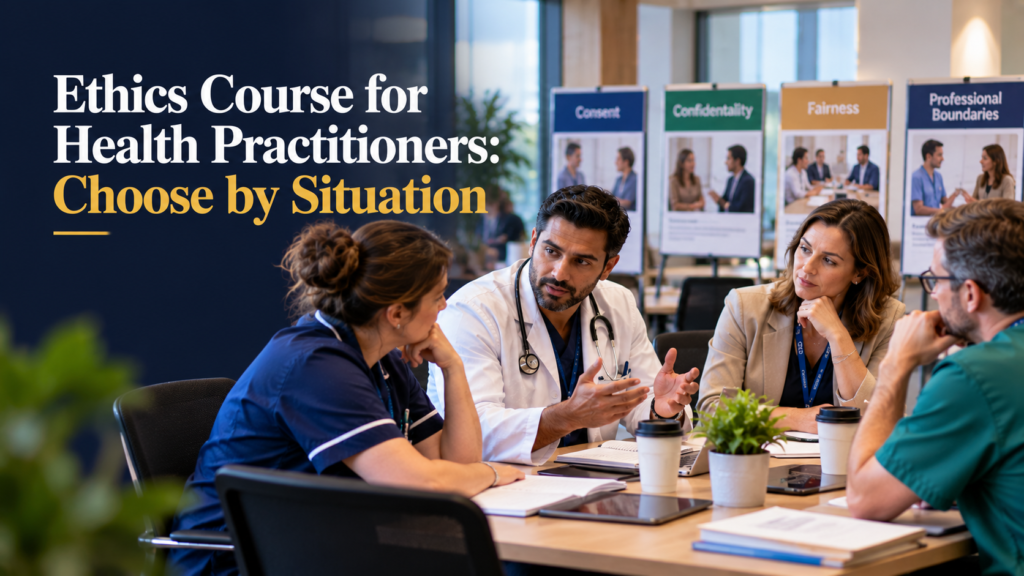
Which course fits your situation?
Match the course to the concern, not to the broadest title.
Boards and panels look for learning that addresses the specific issue. A general ethics course is the right choice when the concern is about ethical decision-making itself. When the concern is narrower, such as billing, boundaries or communication, choose the course that names it.
| Your situation | Start with | Why |
|---|---|---|
| General ethics or judgement concern | Professional EthicsEthics for Healthcare Professionals | Covers ethical principles, decision-making and the codes you practise under. |
| Conduct, attitude or behaviour at work | Professionalism for HCPs | Focuses on professional behaviour, accountability and public trust. |
| Honesty, declarations, billing or records | Financial IntegrityProfessional Ethics | Probity concerns turn on honesty, so integrity-focused learning is most relevant. |
| Boundaries or relationships with patients | Ethical BoundariesProfessional Boundaries | Targets power imbalance, dual relationships and safeguards. |
| Respect, discrimination or cultural safety | Dignity & Non-Discrimination | Addresses respectful, non-discriminatory and culturally safe care. |
| Doctor wanting medical ethics specifically | Medical EthicsEthics for Doctors | Framed around medical practice and the Medical Board's code. |
If more than one row applies, pair a general course with a targeted one. If a probity concern is behind your search, read our guide to probity concerns and false declarations first.
Should you choose a profession-specific course?
Usually yes, if one exists for your profession. It speaks to your Board's code and the situations you actually face.
Doctors practise under the Medical Board's code, Good medical practice. Nurses and midwives have their own NMBA codes of conduct. Most other National Boards, including those for pharmacy, dental, physiotherapy and psychology, use the shared Code of conduct for registered health practitioners. A course framed around your profession makes it easier to show you understand the standards that apply to you.
Which everyday dilemmas does ethics training help with?
Most ethics concerns do not start with a dramatic decision. They start with an ordinary situation handled without enough thought.
These are the kinds of situations that commonly lead to concerns, and the questions a good course trains you to ask before acting.
Each of these has a clear answer in the codes and guidelines once you know where to look. Ethics training builds the habit of pausing, checking the standard and documenting your reasoning.
What should a credible ethics course give you?
Whether you choose ours or another provider's, check for these markers. They are what makes a course useful as evidence, not just as reading.
Our courses are structured CPD of two hours each, CPD-aligned, with a curriculum and a dated certificate. They are designed so you can record them as CPD and refer to them as evidence of learning.
Need a general ethics course with a certificate you can use today?
Enrol in Professional EthicsHow does the course work from enrolment to certificate?
Keep the certificate with a short note of what you learnt and what you changed as a result. That note turns a certificate into evidence. If you are responding to a concern, it can be woven into your reflective statement.
Will a National Board accept an ethics course?
A Board judges whether the learning addresses the concern.
Where a condition requires education, the usual process is that you nominate a course and the Board decides whether it meets the requirement. Our guide on what to do when you are ordered to complete a course explains that process step by step.
Outside formal conditions, a course is supporting evidence. It shows initiative and learning, and it is most persuasive when it matches the concern and is paired with genuine reflection. Our article on whether CPD courses help with a notification explains what makes CPD carry weight, and the wider framework of insight, reflection and remediation shows where a course fits.
One course or the complete program?
Single course
Best for a specific, narrow need
- Two hours of structured CPD
- Targets one topic directly
- Quick to complete before a deadline
Ethics & Professionalism Program
Best for broader concerns or conditions
- Several courses in one structured pathway
- Covers ethics and professionalism together
- Stronger evidence of sustained learning
Doctors can choose the version written for medical practice instead.
Doctor facing an ethics or professionalism concern? Take the program built around the Medical Board code.
Get the Program for DoctorsEthics & professionalism courses
Choose your ethics course
Two hours of structured CPD each, with a dated certificate you can record and submit.
Professional Ethics
- Ethical principles and decision-making
- Applying your Board code in practice
- Dated certificate for your CPD record
Ethics for Healthcare Professionals
- Core ethics for every registered profession
- Real-world dilemmas and judgement
- Reflection prompts for your practice
Professionalism for Healthcare Professionals
- Professional behaviour and accountability
- Maintaining public trust
- Responding to concerns about conduct
Financial Integrity for Healthcare Professionals
- Honesty in declarations and billing
- Managing conflicts of interest
- Building integrity controls
Frequently asked questions
How do I use an ethics course for a condition?
Where a condition requires education, you usually nominate a course and the Board decides whether it meets the requirement.
How long is the ethics course?
Each of our courses is two hours of structured CPD, completed online at your own pace, with a dated certificate. The complete program combines several courses for broader learning needs.
Does an ethics course count towards CPD?
It can count towards your CPD requirements where it meets your Board's standard. Some CPD standards exclude education ordered by a Board or tribunal, so check your conditions and your CPD home rules first.
Which ethics course should a doctor choose?
Doctors can choose Ethics and Ethical Standards for Doctors or Medical Ethics, both framed around Good medical practice, or the Ethics and Professionalism Program for Doctors when the concern is broader or more serious.
Will an ethics course help with an Ahpra notification?
It can support your response as evidence of learning, especially when it matches the concern and is paired with reflection.
What is the difference between ethics and professionalism courses?
Ethics courses focus on principles and decision-making in difficult situations. Professionalism courses focus on behaviour, accountability and maintaining public trust. Many concerns benefit from both, which the complete program covers.
Can I use the certificate in my response to Ahpra?
Yes. Attach the certificate and explain in your response or reflective statement what you learnt and what you changed in practice. That explanation gives the certificate its real value as evidence.
Is the course suitable for nurses and allied health practitioners?
Yes. There are profession-specific versions for nurses and midwives, pharmacists, dentists, allied health practitioners and social workers, plus general ethics and professionalism courses written to suit every Ahpra-registered profession in Australia.