
In short
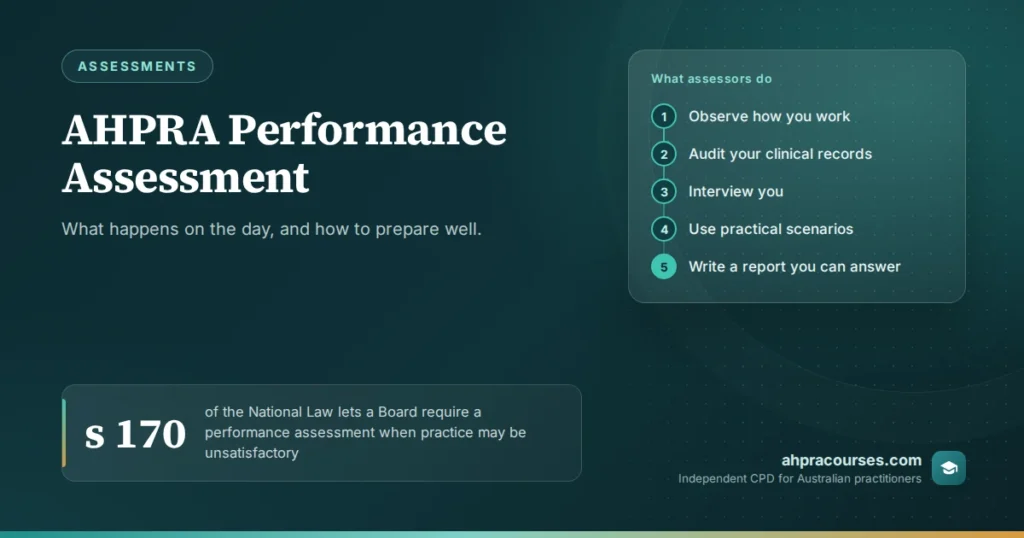
Under section 170 of the National Law, a National Board can require you to undergo a performance assessment if it believes the way you practise is, or may be, unsatisfactory. One or more independent practitioners from your own profession, with a similar scope of practice, observe how you work, audit your clinical records, interview you and may use practical scenarios. You receive a copy of their report and can respond, usually at a meeting with a Board member. The assessment is protective, not punitive, and targeted learning in any area of weakness, before and after, is one of the best things you can do.
What is an AHPRA performance assessment?
A performance assessment is used when a Board has a concern about the way a practitioner practises, rather than about a single piece of conduct or about their health. It might arise from a notification about clinical care, from a pattern of concerns, from information gathered during an investigation, or from difficulties in meeting the standard expected of someone at your level. The purpose is to find out, objectively, whether your knowledge, skill and judgement meet the expected standard, and if not, where the gaps are. Our Ahpra Notification Response page brings the related guidance together.
It is important to hold on to what a performance assessment is not. It is not a finding that you are incompetent, and it is not a punishment. It is a fact-finding tool, and many practitioners come through it with no further action, or with targeted education that improves their practice.
How is it different from a health assessment or an investigation?
Each pathway answers a different question about a practitioner.
A matter can involve more than one pathway. For example, an investigation might lead to a performance assessment if the evidence suggests a broader issue with clinical practice, and a performance assessment can, in turn, lead to further action if serious concerns emerge.
What does the National Law say about performance assessments?
They sit in Part 8, Division 9 of the Health Practitioner Regulation National Law.
Key sections
| s 170 | Requirement for a performance assessment |
| s 171 | Appointment of an assessor to carry out the assessment |
| s 172 | Notice to be given to the practitioner |
| s 173 | Assessor may require information or attendance |
| s 174 | Inspection of documents |
| s 175 | Report from the assessor |
| s 176 | A copy of the report to be given to the practitioner |
| s 178 | Action the Board may take afterwards |
In plain terms: the Board must have a reasonable basis for the requirement, you must be told, the assessor can ask for information and look at documents, and you are entitled to see the report the Board relies on.
Who carries out the assessment?
One or more independent practitioners from your profession, chosen to match your scope of practice.
The Board appoints the assessor or assessors, selecting people whose scope of practice is similar to yours, so that you are judged by peers who understand the kind of work you actually do. A general practitioner is assessed by general practitioners; a midwife by midwives; a community pharmacist by community pharmacists. Before the assessment, assessors must confirm they have no conflict of interest and no prior relationship with you. If you believe there is a genuine conflict, raise it early, in writing, through your adviser.
You will receive written notice of the assessment, including the date, time, the plan for the day and the names of the assessors, so you know exactly what to expect.
What happens during a performance assessment?
Assessors look at your real work from several angles, so that no single moment decides the result.
The detail varies by profession and concern, but an assessment typically draws on several of the following:
- Observation of practiceAssessors watch how you work with patients, from history-taking and examination to explanation and consent.
- Audit of clinical recordsA sample of your notes is reviewed for accuracy, reasoning, plans, safety-netting and legibility.
- Structured interviewYou discuss your cases, decisions and approach, and how you keep your knowledge current.
- Scenarios or role playYou may work through simulated cases that test judgement in situations that might not arise on the day.
- Information from othersAssessors may consider feedback from colleagues or supervisors who know your practice.
How should you prepare for a performance assessment?
Prepare the way you would for a careful clinical audit: honestly, specifically, and focused on the areas of concern.
A preparation checklist
- Take advice early from your indemnity insurer or medical defence organisation about the process and your rights.
- Understand the concern that led to the assessment, so you know which areas will be looked at most closely.
- Refresh the standards that apply to you: your Board's code of conduct, practice standards and relevant clinical guidelines.
- Close known gaps now with targeted, structured CPD in the areas of concern, rather than general reading.
- Tidy your systems so your records, templates, recall and referral processes reflect good practice.
- Organise your CPD record and any evidence of recent learning so you can speak to it confidently.
- Be honest about your scope, including what you refer on, rather than overstating what you do.
Strengthen the clinical areas an assessor will look at, before the day.
Start Clinical Competence & Patient Safety →Which areas do assessors look at most closely?
Wherever the concern arose, and the everyday habits that underpin safe practice.
Assessors measure your practice against the standard expected of a practitioner in your role. Beyond the specific concern, the areas that commonly come under close scrutiny are the foundations of safe practice:
If you know one of these is a weakness, the best time to address it is before the assessment, with learning you can point to and changes you have already made. For how clinical care concerns are judged, see our guide to clinical care and performance concerns.
A structured program covering clinical competence, records and safe practice, in one place.
Get the Clinical Competence & Patient Safety Program →What happens after the performance assessment?
The assessor reports to the Board, you receive a copy, and you get the chance to respond before any decision.
The assessor's report sets out who was assessed and by whom, the methods used, relevant professional history, the findings and any recommendations. Under the National Law, you are entitled to a copy. Where the report might harm your wellbeing, it may be given to a treating practitioner you nominate, who can go through it with you; otherwise it comes to you or your representative.
You are then usually invited to meet a member of the National Board to discuss the findings and respond to them. The meeting generally lasts no more than an hour, although time is allowed for up to 90 minutes so everything can be covered, and you can also provide a written submission. This is your opportunity to show that you understand any gaps identified and have already started addressing them.
The Board then decides what, if anything, is needed. The options include:
- No further action, where your practice meets the expected standard.
- A caution, or accepting undertakings, such as agreeing to targeted education.
- Conditions on your registration, such as education, supervision or practice restrictions. Our guide to conditions and undertakings explains these.
- Referral to a health assessment, an investigation, a panel or a tribunal, where serious concerns emerge.
Is it different in New South Wales?
Yes. NSW runs its own performance pathway through the professional councils.
In New South Wales, performance concerns are managed by the relevant professional council, supported by the Health Professional Councils Authority, which runs its own performance pathway and workplace performance assessments. The aims and methods are similar, but the process and terminology differ. Our guide to notifications in NSW and Queensland explains the co-regulatory system.
How can CPD help before and after a performance assessment?
It closes gaps before the assessment and evidences remediation after it.
A performance assessment is ultimately about whether your practice meets the standard, and structured learning is the most direct way to strengthen it. Targeted CPD aligned with your Board's CPD registration standard, focused on the areas of concern, helps you go into the assessment stronger and, if gaps are identified, gives you dated evidence of remediation to put before the Board. It never guarantees a result, but it shows you are taking the concern seriously. Browse the full range of CPD for healthcare professionals. You can browse every course and guide on the Ahpra Courses home page.
For a performance assessment
Courses for a performance assessment
Structured CPD in the areas assessors look at most closely, plus evidence of remediation.
Ensuring Clinical Competence and Patient Safety
- Strengthen clinical reasoning and safety-netting
- Refresh the standard expected of you
- Evidence competence for the Board
Professionalism in Documentation for Healthcare Professionals
- Prepare for a clinical record audit
- Show reasoning, plans and follow-up clearly
- Build a reliable documentation habit
Ensuring Effective Communication as Healthcare Professionals
- Strengthen consent and explanation
- Perform well under direct observation
- Evidence safer communication practice
Module on Remediation
- Respond to gaps in the assessor's report
- Plan and evidence targeted change
- Prepare for your meeting with the Board
Official sources
Frequently asked questions
Why would AHPRA require a performance assessment?
Under section 170 of the National Law, a Board can require one if it believes the way you practise is, or may be, unsatisfactory. It often follows clinical care concerns, a pattern of notifications, or investigation findings.
Does a performance assessment mean I am incompetent?
No. It is a fact-finding tool, not a finding. It tells the Board objectively whether your practice meets the expected standard and where any gaps are, and many practitioners come through it with no further action.
Who will assess me?
One or more independent practitioners from your own profession, chosen for a similar scope of practice. They must confirm they have no conflict of interest or prior relationship with you before the assessment goes ahead.
What happens during the assessment?
Assessors typically observe your practice, audit a sample of your clinical records, interview you about your cases and decisions, and may use scenarios or role play. They may also consider feedback from colleagues or supervisors.
Will I see the assessor's report?
Yes. The National Law entitles you to a copy. If it might harm your wellbeing, it may go first to a treating practitioner you nominate. You can then respond, usually at a meeting with a Board member and in writing.
How should I prepare for a performance assessment?
Take advice, understand the concern, refresh your Board's standards and relevant guidelines, close known gaps with targeted CPD, tidy your records and systems, organise your CPD record, and be honest about your scope of practice.
What can the Board decide after the assessment?
It can take no further action, caution you, accept undertakings, impose conditions such as education or supervision, or refer the matter to a health assessment, investigation, panel or tribunal where serious concerns emerge.
Does CPD help with a performance assessment?
Yes. Targeted CPD in the areas of concern strengthens your practice before the assessment and, if gaps are found, gives dated evidence of remediation for the Board. It never guarantees an outcome, but it shows real commitment.