Bundle & save Studying more than one course? Save 15% on 3, 22% on 5 and 30% on 10 or more, taken off in your cart.
Free Course AdvisorQuestions about which course fits your case?
Ahpra Courses

Social media CPD and remediation: privacy, online boundaries, advertising and public comment

Social Media Professionalism and Boundaries for Health Practitioners in Australia

Last updated

For practitioners whose post, review reply, clinic page, group chat or direct message has drawn a complaint, an Ahpra letter or an advertising notice, and for anyone who wants their online presence to stay inside the rules. The course applies your Board's code, Ahpra's social media guidance, section 133 of the National Law and privacy law to what you actually do online, and helps you show a regulator what has changed.

  • 2 hours, CPD-aligned
  • Written to your Board's code
  • 6 sections with graded checks
  • 20-question final assessment
  • Dated, verifiable certificate
  • Self-paced on any device
  • 1-to-1 AI tutor, Dr AI Alma
Enrol now, A$99Bulk buy from A$70 a course

Free tools to use alongside this course: Response planner, Reflective statement builder, Evidence organiser

Dated certificate with a number anyone can verify

36CPD courses for Australian practitioners
16Professions covered
24/7Self-paced, online, any device
A$99Per course, no subscription

Which of these is your situation?

At a glance

Who it is for
Registered practitioners and students in all National Board professions who use social media, messaging, review platforms or online advertising, personally or for a practice.
Boards and codes
Shared Code of conduct (2022); Good medical practice (2020); NMBA Codes of conduct (2018); Psychology Board Code of conduct (2025); Ahpra's social media guidance; Guidelines for advertising a regulated health service (2020); cosmetic advertising guidelines (2023 and 2025).
Regulators covered
Ahpra and the National Boards, including Ahpra's advertising compliance work; in NSW the Health Professional Councils and the HCCC; in Queensland the OHO; the Office of the Australian Information Commissioner for privacy.
Format
Online and self-paced in six sections, with cases drawn from TikTok, Instagram, Google reviews, WhatsApp groups and clinic websites.
Assessment
Short self-checks in each teaching section, a 20-question final assessment, and reflection prompts that lead into a personal social media code.
Certificate
Downloadable when you finish; records course title, completion date and estimated learning time. Record your real time separately.
Best taken with
Confidentiality and Privacy in Healthcare if a privacy breach is central; Maintaining Professional Boundaries for Clinicians if online contact became a personal relationship.
Learning time
About 2 hours, self-paced, online on any device. Progress is saved to your account.
Price
A$99 for one course. Bundles: 5 courses for A$450, 10 courses for A$700.

In short

Social Media Professionalism and Boundaries is an online, course for Australian registered health practitioners. It explains how the National Law, each Board's code of conduct, Ahpra's guidance Social media: How to meet your obligations under the National Law (reviewed March 2025) and the Guidelines for advertising a regulated health service apply to posts, comments, review replies, direct messages, group chats and clinic pages. It covers accidental identification of patients, clinical photographs on personal devices, online boundary drift, conflicts of interest and influencer arrangements, the section 133 ban on testimonials and misleading advertising, cosmetic advertising rules, public comment and misinformation. It ends with handling an Ahpra notification about online conduct and writing a personal social media code that doubles as evidence of insight.

The certificate you receive

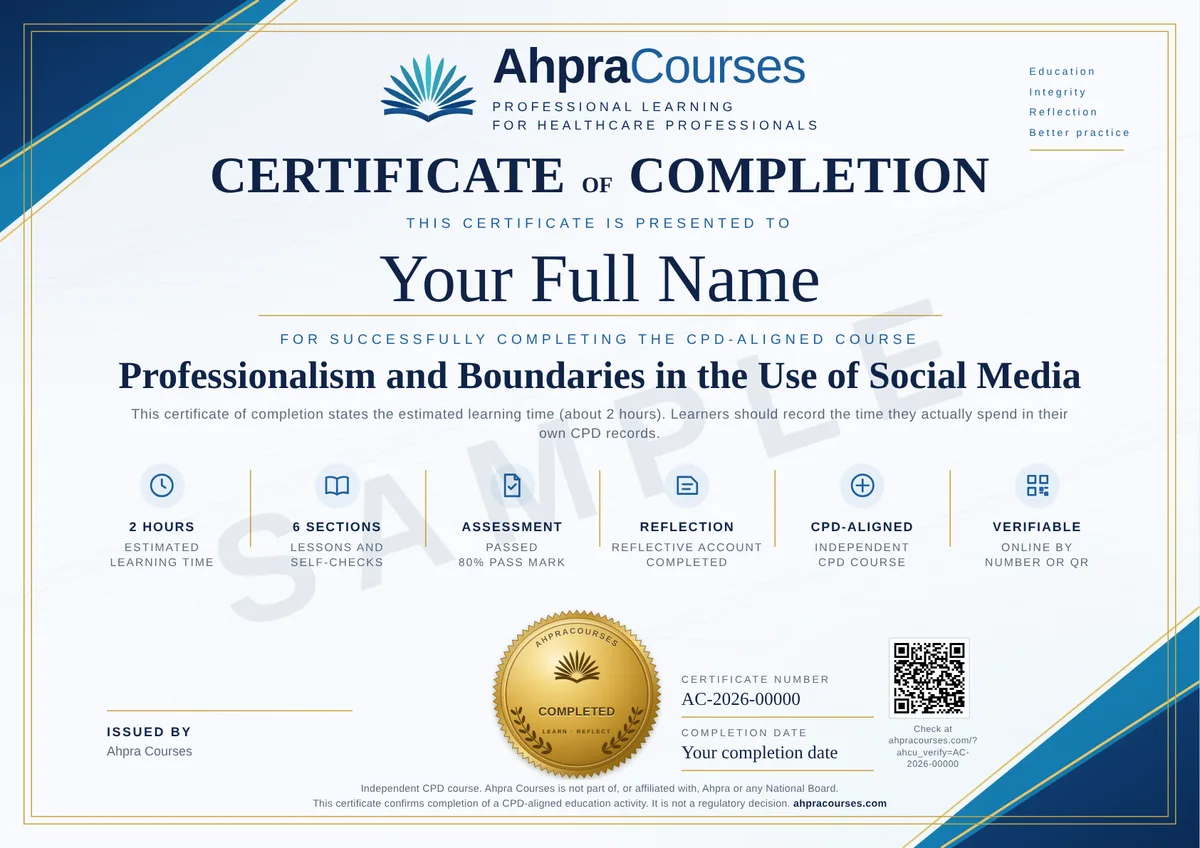
Sample certificate of completion for Social Media Professionalism & Boundaries | AHPRA from Ahpra Courses, showing the learner's name, the course title, an estimated learning time of about 2 hours, the completion date and a certificate number that can be checked online
Sample. Your certificate shows your name, the course title, the completion date and its own certificate number.

Your certificate is issued after you complete all six sections and pass the final assessment. It names you and the course, gives the completion date and states the estimated learning time; keep your own note of the hours you spent. For an online conduct concern it is most persuasive when it sits next to your written personal social media code and a record of the content you reviewed and corrected.

How practitioners use it

  • Attach it to a response about a post, review reply or advertisement, together with screenshots of corrected content and your new approval process.
  • Provide it where a condition or undertaking required education on social media or advertising and Ahpra approved the course before you started.
  • Show it to an employer applying its social media policy after a workplace complaint.
  • File it as CPD under a learning need such as 'advertising compliance for my clinic's social media'.
  • Give a copy to the marketing agency or staff who run your accounts, with your rules, so everyone works to the same standard.

Who this course is for

Practitioners notified about a post or comment

Whether the content was a video, a photo, a joke about a patient or a heated reply in a community group, the course explains how Ahpra assesses it and what a response should contain.

Clinic owners and anyone who advertises

If you run a practice page, website, booking profile or paid campaign, section 133 applies. The course walks through testimonials, offers, claims and images using the same tests Ahpra applies.

Practitioners working in cosmetic procedures

Medical practitioners, nurses, dentists and others performing injectables or cosmetic surgery face specific advertising guidelines from 2023 and 2025, including rules on influencers and on content aimed at people under 18.

Health communicators and advocates

If you post health education, comment on public health or campaign on workforce issues, the course separates protected expression from content likely to warrant investigation.

Clinicians using messaging for clinical work

Ward and registrar group chats, wound photos sent for advice and texts to patients carry privacy and record-keeping obligations that many services have not thought through.

Students and early-career practitioners

Registered students are covered by the same guidance. The course helps you set up your accounts properly before a problem arises.

The concerns this course addresses

A patient identified without a name

Age, town, condition, a tattoo, a ward whiteboard or a window view can identify a patient to anyone who knows them, and the patient may recognise themselves. Sharing any person's information or images, even unnamed, needs their written informed consent.

Shared Code 3.3; Good medical practice 4.4; Psychology Board Code 3.3; Privacy Act 1988 (Cth) APP 6

Answering a review with clinical details

Saying that a reviewer missed appointments, signed a consent form or has anxiety discloses health information without consent. Even confirming they were a patient is a disclosure. Move the conversation to your complaints process.

Shared Code 3.3 and 4.6; Good medical practice 4.4 and 4.12; Privacy Act APP 6

Testimonials on pages you control

A testimonial is a positive statement about the clinical aspects of a service, such as the symptom, the treatment, the outcome or the practitioner's skill, used in advertising. If you control a page with reviews, you are responsible for them; disabling reviews is one way to comply.

National Law s133(1)(c); Guidelines for advertising a regulated health service (2020); Ahpra testimonial guidance

Misleading claims, offers and images

Claims that a treatment cures or is pain-free, edited before-and-after photos, offers without terms and conditions, and posts urging unnecessary services each breach section 133. The maximum fine is 60,000 dollars for an individual and 120,000 dollars for a body corporate.

National Law s133(1)(a), (b), (d) and (e); Guidelines for advertising a regulated health service (2020); Good medical practice 10.7

Cosmetic advertising and influencers

Cosmetic procedures carry extra rules. The 2025 guidelines for higher risk non-surgical procedures ban advertising aimed at under-18s, require the treating practitioner to be identified, strengthen the ban on influencer testimonials and target content that trivialises or sexualises procedures.

Guidelines for registered medical practitioners who advertise cosmetic surgery (2023); Guidelines for advertising higher risk non-surgical cosmetic procedures (2025)

Personal contact with patients online

Accepting a current patient's friend request, chatting by direct message or pursuing a dating-app match moves the relationship out of the clinic. Ahpra's guidance treats overly personal or suggestive online contact as a breach; doctors must politely decline and redirect.

Ahpra social media guidance; Sexual boundaries guidelines section 8; shared Code 4.9; Psychology Board Code 4.8

Public comment, misinformation and discriminatory content

Ahpra says practitioners will not be investigated purely for holding or expressing views, but content that is discriminatory, false or misleading, or contrary to the best available evidence and public health campaigns can lead to action.

Good medical practice 2.2; Psychology Board Code 8.4; shared Code 5.3; Ahpra social media guidance

Clinical images and chats on personal devices

Wound photos in a personal camera roll, a WhatsApp group of registrars or a phone with no passcode synced to a personal cloud put health information at risk and outside the record. A lost device can become a notifiable data breach.

Privacy Act APP 11 and APP 8; Notifiable Data Breaches scheme; shared Code 3.3 and 8.3

Sponsorship, gifts and affiliate links

Free products, paid posts, discount codes and promoting your own supplement range create conflicts of interest. Disclose them to each affected patient as part of consent and do not let them shape recommendations.

Good medical practice 10.12; shared Code 8.11 and 1.2; Psychology Board Code 8.12 to 8.14; Ahpra interim guidance on financial or commercial conflicts of interest (2026)

What the course covers

Six sections move from principles to risks, then to the specific standards, then to what happens when a complaint is made and how to prevent the next one. Most lessons end with a case from a real platform type.

1Overview of Professionalism and Boundaries on Social Media2 lessons

Explains that the National Law, codes and advertising guidelines apply online as offline, what counts as social media, why not naming your profession does not make you anonymous, and how private accounts can still engage professional obligations. Sets out the harms of unprofessional use to patients, the public, colleagues and the practitioner.

  • 1.1 Professionalism and Boundaries Online
  • 1.2 Impact of Unprofessional Use of Social Media
  • Section check (graded)
2Risks Associated with Social Media Use2 lessons

Lists the nine most common risks, from accidental identification and clinical messaging to advertising non-compliance, misinformation, review replies, AI-generated content and account security. Explains responsibility for content you write, share, control or commission from agencies, staff and AI tools.

  • 2.1 Common Social Media Risks
  • 2.2 Taking Responsibility for Social Media Conduct
  • Section check (graded)
3Standards from AHPRA and the National Boards5 lessons

The standards in detail: confidentiality and the de-identification fallacy, online boundaries with patients and colleagues, conflicts of interest and influencer arrangements, public comment and trust, and section 133 applied to social media posts, titles, images and AI content.

  • 3.1 Confidentiality
  • 3.2 Professional Boundaries
  • 3.3 Conflicts of Interest
  • 3.4 Trust
  • 3.5 Responsible Social Media Use
  • Section check (graded)
4Handling Complaints and Investigations3 lessons

What to do when a complaint or notification arrives: immediate steps, preserving evidence, correcting content, responding to Ahpra, advertising and privacy concerns, the Part 8 categories and process, and how to conduct yourself online while a matter is open.

  • 4.1 Responding to a Complaint or Notification
  • 4.2 Fitness to Practise Standards and Investigations
  • 4.3 Professionalism During Inquiries
  • Section check (graded)
5Developing a Personal Social Media Code of Conduct2 lessons

Builds a written personal social media code covering privacy, boundaries, advertising, public comment and security, then sets up a three- to six-monthly self-audit and a reflective log you can use as CPD and remediation evidence.

  • 5.1 Setting Personal Rules
  • 5.2 Tracking Progress and Reflecting
  • Section check (graded)
6Conclusion and Takeaways1 lesson

Pulls the obligations into a short set of takeaways and asks you to audit your accounts and update your personal code this week.

  • 6.1 Conclusion and Takeaways
✓Reflection, final assessment and certificate3 steps
  • Your reflective account, which you can download for your records
  • Final assessment: 20 questions, 80% to pass
  • Certificate of completion, dated and numbered

One post, three sets of rules: conduct, advertising and privacy

Most practitioners who get into trouble online assume only one set of rules applies to what they posted. In practice three overlap, and a single post can breach all of them.

Your code of conduct

Ahpra's guidance starts from the position that the National Law, your Board's code and the advertising guidelines apply to social media in the same way they apply in person. The code governs how you treat patients, colleagues and the public. A video mocking an unnamed patient, a personal message to a patient, or abuse of a colleague in a group chat is conduct under the code, whether the account is public, private or anonymous. The guidance also says registered practitioners will not be investigated purely for holding or expressing their views on social media; the concern is content that is discriminatory, abusive, misleading or risky to the public.

Section 133 of the National Law

If the content promotes a regulated health service or a business that provides one, it is advertising and section 133 applies. Advertising must not be false or misleading, offer a gift or discount without its terms, use testimonials, create unreasonable expectations of benefit, or encourage unnecessary use of services. This catches clinic pages, booking profiles, professional accounts that invite appointments, sponsored content and influencer posts paid for by a practice. A breach is an offence, separate from any conduct finding. Ahpra's 2024/25 annual report records 775 complaints assessed about the advertising of regulated health services.

Privacy law

Health information is sensitive information under the Privacy Act 1988 (Cth), and private sector health providers are covered regardless of size. Posting about a patient is not a permitted use or disclosure. Images on personal devices engage the security principle, APP 11. Since 10 June 2025 a person can also sue for a serious invasion of privacy under a statutory tort, and state health records laws apply alongside.

Why the overlap matters when you respond

A clinic owner who reshares a patient's story about being cured has used a testimonial, possibly made a misleading claim and, if the post identifies the patient without written consent, breached privacy. Fixing one layer is not enough. A credible response removes the content, checks every other account and page for the same problem, explains which rules applied and why, and shows a process that stops it happening again, such as approval of all content before it is published and a written consent form for any patient image.

How to respond to an Ahpra notification about this kind of concern

Online matters are unusual in one respect: the evidence is public and can be copied by anyone, and what you post after the complaint is read alongside it. These steps keep a manageable matter from becoming a larger one.

  1. Stay offline about it

    Do not post about the complaint, the notifier, Ahpra or the Board, and do not message the complainant. Never ask patients or colleagues to leave supportive comments or reviews; on a page you control those can themselves be testimonials.

    In the course: Section 4 shows how a practitioner turned an advertising query into multiple breaches by rallying patients online.

  2. Preserve, then correct

    Save dated screenshots and links of the content concerned and any related messages, privately. Then remove or correct content that breaches privacy, boundaries or advertising rules, after checking with your adviser. Do not delete whole accounts.

    In the course: Section 2 explains what to record and when removal helps rather than looks like concealment.

  3. Audit everything else you control

    A notification about one post often leads Ahpra to look at your website, clinic pages and other accounts. Review them all for testimonials, unconditioned offers, unsupported claims, patient images without written consent and titles that imply registration you do not hold.

    In the course: Ahpra's self-assessment and testimonial tools are covered in Section 3, with a table of section 133 examples.

  4. Get advice and check privacy duties

    Contact your indemnity insurer, defence organisation, union or association, or a lawyer. If health information was disclosed, your practice may need to assess whether the Notifiable Data Breaches scheme applies.

    In the course: Section 4 covers responding to Ahpra, advertising and privacy concerns side by side.

  5. Respond with what changed

    Explain what was posted, which standard applied, why it fell short, and what you have put in place: content approval, a written consent form, disabled review functions, a personal code. Attach evidence.

    In the course: Section 5 builds the personal social media code that forms the centre of this evidence.

Posting that a competitor or a disgruntled patient reported you is one of the quickest ways to turn a correction request into a conduct matter.

Get advice from your professional indemnity insurer, union or professional association, or a lawyer before you respond.

How this course helps with an Ahpra notification

It gives you the tests Ahpra uses

Practitioners often know the rules in outline but not how they are applied. The course works through Ahpra's own tests: whether content is advertising, whether a review is a testimonial (a positive statement about the symptom, treatment, outcome or practitioner's skill), whether an offer states its terms, and whether a post is likely to breach obligations under the public comment section of the social media guidance. You can then apply them to your own content before the regulator does.

It covers the privacy layer most practitioners miss

The de-identification lesson lists the ways patients are identified without names, from metadata and backgrounds to the practitioner's own identity narrowing the field. The course explains the Privacy Act principles that apply to posts, messaging and clinical photographs, and the 2025 statutory tort, so your response deals with privacy as well as professionalism.

It turns rules into a personal code

Section 5 helps you write a short set of rules covering privacy, boundaries, advertising, public comment and security, with examples such as:

  • no personal-account connections with current patients
  • no reply to any review that confirms the person was a patient
  • every promotional post checked against section 133 before it is published
  • multi-factor authentication on every account

A specific written code, reviewed every few months, is one of the most persuasive forms of evidence in an online conduct matter.

It deals with content you did not write

Agencies, practice staff, influencers and AI tools now produce much clinic content. The course explains that whoever controls the account remains responsible, and shows how to brief, approve and record content so that responsibility is managed rather than assumed.

Remediation evidence that carries weight

Carries weight

  • Dated screenshots showing the content removed or corrected, with a private record of when and why
  • A written personal or practice social media code, specific enough to apply, with the date it was adopted
  • An approval process for all content produced by staff, agencies or AI tools, with records of approvals
  • A written patient consent form for images and stories that names the platform and purpose and explains that posts cannot be fully withdrawn
  • Evidence that review functions were disabled on pages where clinical reviews could not be removed
  • A completed Ahpra advertising self-assessment for each page you control, with changes made
  • Proof that clinical images and messages now go only through the health service's own secure systems, and that personal devices were cleared
  • A self-audit log over several months showing what you checked and found

Carries little weight

  • Arguing that the account was private, anonymous or for friends only
  • Explaining that a marketing agency or staff member posted the content
  • Removing the post without checking your other pages for the same problem
  • A statement that you support free speech, where the concern is privacy or misleading claims
  • Patient comments defending you, especially on a page you control
  • Verbal patient agreement to a photo, recorded nowhere
  • Deleting accounts entirely after a notification arrives

A remediation plan, phase by phase

  1. Days 1 to 14

    Stop the harm and secure the evidence

    • Take advice from your insurer, union, association or lawyer
    • Save private copies, then remove or correct non-compliant content
    • Pause all promotional posting until you have reviewed it
    • Lock down privacy settings and turn on multi-factor authentication
  2. Weeks 2 to 6

    Review every account and page

    • List every account, page, booking profile and group you belong to
    • Run each controlled page through Ahpra's self-assessment and testimonial tools
    • Clear clinical images from personal devices and move clinical chats to the service's system
    • Start the course; if it is for a Board requirement, wait for Ahpra's written approval first
  3. Weeks 6 to 12

    Write the rules and the process

    • Draft your personal social media code and discuss it with a colleague or supervisor
    • Set up written approval for content prepared by others
    • Adopt a written consent form for any patient image or story
    • Write your reflective account and have your adviser read it
  4. Ongoing

    Audit and keep a log

    • Self-audit every three to six months, including searching your own name
    • Keep a reflective log of online situations that tested your rules
    • Update the code when guidance changes, as it did in 2025 and 2026
    • Record the audits and code in your CPD portfolio

Writing your reflective statement

1What was posted

Describe the content, where it appeared, who could see it and how long it stayed up.

Imagined example: I posted a reel on my clinic's Instagram showing a patient's knee before and after treatment, with her first name in the caption. It was public for nine days.

2How I saw it then

Explain what you thought you were doing and why it seemed acceptable.

Imagined example: She had said she was happy for me to share her progress, and I thought of it as education rather than advertising.

3The rules that applied

Name each layer: code clause, section 133 and privacy law.

Imagined example: The post was advertising, her comments were a testimonial under section 133, and the shared Code 3.3 required written consent for the image.

4Effect on the patient and the public

Consider how the patient, other patients and the public could be affected.

Imagined example: Her colleagues recognised her, and the caption suggested a result other patients might expect but not achieve.

5What I changed

List the specific changes, with dates and evidence.

Imagined example: I removed the reel, reviewed eighty older posts, adopted a written consent form and now check every promotional post against the guidelines before it goes live.

6How I keep it current

Explain how you will maintain the change as platforms and guidance shift.

Imagined example: I audit the account each quarter and record what I find in my CPD log.

The example sentences are fictional and show structure only. Your statement has to be your own honest account of what happened.

A weak and a strong response, side by side

This scenario is fictional. A patient complains to Ahpra that Ms P, a podiatrist, replied to his one-star Google review saying he 'ignored aftercare advice and has diabetes he doesn't manage'.

Weak

The review was false and damaging to my business, and I was entitled to correct it. Everything I wrote was accurate and is in his notes. Online reviews are unfair to small practices and I have no other way to defend my reputation. I have since deleted my reply, so I do not think any further action is needed.

Strong

My reply confirmed he was my patient and disclosed his diagnosis and my view of his self-care. That was health information shared publicly without consent, in breach of the shared Code 3.3 and the Privacy Act. I understand it would have been humiliating. I removed the reply after keeping a copy, wrote to apologise through my practice manager, and now answer reviews only with a general invitation to contact the practice. My practice manager handles complaints under our written process.

Why the second one works: The strong response identifies exactly what was disclosed, names both the code and the law, recognises the effect on the patient and describes a changed process that someone else operates. The weak response treats accuracy as a defence, which it is not for a privacy breach, and treats deletion as the end of the matter.

Mistakes practitioners make when responding

Believing accuracy is a defence

A reply can be entirely true and still disclose health information without consent. Accuracy matters for misleading advertising, not for confidentiality.

Relying on a private or anonymous account

Screenshots defeat privacy settings and accounts can be traced. Boards can consider private social media where it raises concerns about professionalism.

Fixing one post and missing the rest

Ahpra often looks at all your content once a concern is raised. Testimonials and claims on other pages count against you.

Blaming the agency

The person or business that controls the account remains responsible. Pointing to the marketer suggests you have not taken ownership.

Defending yourself publicly

Posts about the notifier can look like intimidation, and reprisals against good-faith notifiers have been prohibited under the National Law since 1 December 2025.

Treating verbal consent as enough

The codes require written informed consent for sharing images or information. A quick 'that's fine' in a busy clinic does not meet the standard.

Framing it as free speech

If the concern is privacy, advertising or misinformation, a free speech argument answers a question nobody asked and signals a lack of insight.

The code provisions this course works through

Online conduct engages the confidentiality, boundaries and professionalism clauses of every code, plus the National Law's advertising provision. These are the ones most often relevant.

Shared Code 3.3Confidentiality and privacy

Do not transmit, share, reproduce or post any person's information or images, even if they are not named, without their written and informed consent. The Psychology Board Code 3.3 includes de-identified material and AI tools; Good medical practice 4.4 sets doctors' equivalent duty.

In the course: The basis for the de-identification and review-reply lessons in Section 3.

GMP 2.2Public comment and trust in the profession

Recognises that doctors may express personal views, and asks them to consider how their public comments and conduct, including online, reflect on their role and the profession. The Psychology Board equivalent is 8.4 Public behaviour and statements.

In the course: Frames the lesson on freedom of expression, misinformation and posts likely to warrant investigation.

National Law s133Advertising

Prohibits advertising that is false, misleading or deceptive, offers inducements without terms and conditions, uses testimonials, creates unreasonable expectations of benefit, or encourages indiscriminate or unnecessary use. Applies to any person, not only practitioners.

In the course: Applied to posts, offers, images, titles and AI-drafted content in Section 3.5.

Shared Code 4.9Professional boundaries

Recognise the power imbalance and never use the professional position to pursue an inappropriate relationship. Online, that rules out personal-account friendship with current patients and personal direct messaging. Doctors also apply section 8 of the sexual boundaries guidelines.

In the course: Underpins the friend request, direct message and dating app guidance.

Shared Code 5.3Discrimination, bullying and harassment

Notes expressly that social media can be used to bully. Good medical practice 5.2.3 asks doctors to be courteous to colleagues including on social media, and 5.4 calls for zero tolerance of discrimination and harassment.

In the course: Covers staff group chats and public criticism of named colleagues.

Also relevant: GMP 10.7 Advertising: doctors must comply with the National Law and advertising guidelines; GMP 10.12 Conflicts of interest, including inducements, gifts and hospitality; Shared Code 8.11 Financial and commercial dealings, relevant to product promotion; Psychology Code 8.7 Advertising for psychologists

How this applies in each profession

Doctors

Medical Board of Australia

Good medical practice 2.2 on public comment and 10.7 on advertising apply, with section 8 of the sexual boundaries guidelines. Doctors in cosmetic surgery must meet the 2023 cosmetic advertising guidelines. 'Surgeon' has been a protected title since 20 September 2023.

Nurses and midwives

Nursing and Midwifery Board of Australia

Shift-work humour videos, ward photos and comments about patients are common sources of concern under the NMBA codes. Nurses performing cosmetic injectables are covered by the 2025 guidelines, which replaced the NMBA's earlier position statement.

Pharmacists

Pharmacy Board of Australia

Pharmacists work under the shared Code. Product endorsements, affiliate links, discount offers and public health commentary, including on vaccination, are the main risks. Health claims must reflect the best available evidence.

Psychologists

Psychology Board of Australia

The Code of conduct in force from 1 December 2025 requires written consent before sharing client information even if de-identified, including in AI tools, and covers public statements at 8.4. Clients often seek contact on personal accounts.

Dental practitioners

Dental Board of Australia

Dental practice pages are governed by the shared Code and section 133. Before-and-after smile images, whitening offers and patient reviews on practice pages need checking before they go up. Dentists performing injectables fall within the 2025 cosmetic guidelines.

Chiropractors, osteopaths and Chinese medicine practitioners

Chiropractic, Osteopathy and Chinese Medicine Boards

Ahpra publishes advertising examples specific to these three professions, reflecting how often claims about treating named conditions arise. Check every therapeutic claim against acceptable evidence.

Physiotherapists

Physiotherapy Board of Australia

Under the shared Code, the clinic is accountable for its feeds. Agency-produced reels featuring patients describing their recovery are a common source of testimonial breaches, and responsibility stays with the clinic that controls the account.

What happens after a notification reaches Ahpra

Online conduct reaches the regulator through patients, relatives, colleagues, employers, competitors and Ahpra's own advertising monitoring. Ahpra's 2024/25 highlights record 775 complaints assessed about the advertising of regulated health services. Conduct concerns and advertising offences can run on separate tracks, as below.

  1. Intake

    A conduct concern goes through the usual notification route; an advertising concern may be handled under Ahpra's advertising compliance and enforcement strategy. In NSW and Queensland the co-regulatory bodies receive conduct complaints.

  2. Advertising compliance

    Ahpra often starts with education and a request to correct the advertising. Prompt, complete correction and a process to prevent recurrence usually resolve lower-risk matters; serious or repeated breaches can be prosecuted in court.

  3. Conduct assessment

    Ahpra asks for your response and what has changed since the post. Posts that breach privacy, cross boundaries, discriminate or spread misleading health information are weighed against the code and the social media guidance.

  4. Investigation

    Where the concern is significant, investigators can require screenshots, account data, website archives and statements. Failing to comply with a written notice can be an offence.

  5. Outcome

    Outcomes range from no further action to a caution, conditions such as education or advertising review, an undertaking, or referral to a panel or tribunal for serious matters such as online sexual misconduct or hateful content.

  6. Privacy and other regulators

    In parallel, a patient may complain to the OAIC or a state privacy regulator, take a claim under the statutory tort, or your employer may act under its social media policy.

Who handles your matter in New South Wales and Queensland

NSW. Conduct complaints about online behaviour are handled by the relevant Health Professional Council with the HCCC. Advertising offences under the National Law remain a matter for Ahpra. A practitioner may therefore deal with a Council about a post's conduct aspects and with Ahpra about its advertising aspects at the same time.

Queensland. The Office of the Health Ombudsman receives complaints at the outset and jointly considers them with Ahpra and keeps the more serious ones. Advertising compliance continues to sit with Ahpra. Plan your response so each body gets a consistent account.

Possible outcomes and what they mean for you

OutcomeWhat it isWhat it means for you
No further actionThe Board closes the matter, often because the content was corrected and risk addressed.Most likely when you removed the content promptly, checked all other pages and adopted a written process.
Correction requestFor advertising, Ahpra may ask you to amend or remove content within a set time.Act fully and quickly; a second request for the same problem is treated more seriously.
CautionA formal written warning, not usually published.Common for a single privacy lapse or ill-judged post where you show clear insight.
Conditions or undertakingRequirements such as education, mentoring or review of advertising before publication, published on the register.Expect to nominate education for approval, then provide a reflective report.
ProsecutionCourt proceedings for a section 133 offence, separate from disciplinary action.Reserved for serious advertising breaches; maximum fines are 60,000 dollars for an individual.
ReprimandA panel or tribunal's formal rebuke, which appears on the public register.Possible for repeated breaches or online conduct that harmed a patient or colleague.
Suspension or cancellationTribunal orders for the most serious matters.Rare for social media alone; more likely where online contact led to sexual misconduct or serious harm.

If a condition or undertaking requires education

If a Board decision requires education in social media, privacy or advertising, the course generally needs Ahpra's approval before you start. Ahpra asks practitioners to nominate the program with a detailed curriculum and says online programs are usually approved only where they include interactive content or an assessment. Send this course's outline to your case officer, point to the sections that match your decision (for example Section 3 for advertising and confidentiality, Section 5 for the personal code), and wait for written approval before enrolling. Completion is normally followed by a reflective practice report. Hours spent meeting the condition cannot be counted as CPD for that registration period.

Using this course as CPD

Social media and advertising compliance is a practical CPD topic, and the personal code and audit in Section 5 give you reflection and performance review in one. Requirements by Board:

  • Medical practitioners: 50 hours a year through a CPD home, including at least 12.5 hours of education and 25 hours reviewing performance and measuring outcomes, with a written professional development plan.
  • Nurses and midwives: 20 hours a year, with learning needs identified through reflection, a plan, and records kept for five years.
  • Dental practitioners: 60 hours over the 2025 to 2028 cycle. Physiotherapists: 20 hours a year.
  • Pharmacists, psychologists, chiropractors and other professions: check your own Board's standard; a review of CPD standards for 14 Boards consulted in 2026 but has not changed the requirements yet.

Education used to satisfy a condition or undertaking cannot also count as CPD for that registration period.

  • Set a learning need such as reviewing my clinic's advertising against section 133
  • Record the hours you really spent
  • Keep your personal code and first audit as evidence of applying the learning
  • Review the code each year as part of your plan

How this course is written and kept current

This page and the course were prepared from Ahpra's social media guidance (reviewed March 2025), the Guidelines for advertising a regulated health service, Ahpra's testimonial guidance and advertising hub, section 133 of the National Law, the cosmetic advertising guidelines, each Board's code of conduct and the OAIC's guidance on health privacy. Facts were checked against those documents in October 2026, statistics come from the Ahpra annual report 2024/25, and examples are invented. It is updated when Ahpra revises its guidance.

Social media: How to meet your obligations under the National Law (Ahpra, 2019, reviewed 11 March 2025)Guidelines for advertising a regulated health service (effective 14 December 2020)Testimonials: Understand the requirements (Ahpra advertising hub)Health Practitioner Regulation National Law, s133Guidelines for advertising higher risk non-surgical cosmetic procedures (effective 2 September 2025)Shared Code of conduct (2022) and Good medical practice (2020)OAIC Guide to health privacy (2025)Ahpra annual report 2024/25

Last reviewed: October 2026.

Key terms explained

Social media
In Ahpra's broad sense, internet-based tools for communicating and sharing content: social and professional networks, forums, media-sharing platforms, blogs, podcasts and review sites.
Advertising
Content that promotes a regulated health service or a business that provides one, including clinic pages, booking profiles, sponsored posts and paid influencer content.
Section 133
The National Law provision that makes it an offence to advertise a regulated health service in a misleading way, with unconditioned inducements, with testimonials, with unreasonable expectations or encouraging unnecessary use.
Testimonial
A recommendation or positive statement about the clinical aspects of a regulated health service used in advertising. Comments on parking, staff or communication style are not testimonials.
De-identification fallacy
The mistaken belief that removing a name makes patient content safe, when combined details, images, metadata or the practitioner's identity can still identify the person.
Health information
Under the Privacy Act, information or opinion about a person's health or health services, and other personal information collected to provide a health service. It is sensitive information.
APP 11
The Australian Privacy Principle requiring reasonable steps to protect personal information from misuse, interference, loss and unauthorised access.
Notifiable Data Breaches scheme
The Privacy Act requirement to notify the OAIC and affected people of an eligible data breach likely to cause serious harm.
Statutory privacy tort
A right, since 10 June 2025, to sue for a serious invasion of privacy, enforced by the courts rather than the OAIC.
Conflict of interest
A financial, commercial or personal interest that could influence, or appear to influence, professional judgement, such as sponsorship or a commission from a discount code.
Personal social media code
A short, written set of rules you apply consistently to your accounts, reviewed regularly and usable as evidence of insight.
Protected title
A title such as 'surgeon' that may only be used by practitioners holding the relevant registration; for medical practitioners, 'surgeon' has been protected since 20 September 2023.

Frequently asked questions

Can I be investigated for a post on my private account?

Yes, if it raises concerns about your professionalism or public confidence in the profession. Ahpra says practitioners will not be investigated purely for holding or expressing views; the issue is content that is discriminatory, abusive, misleading or harmful.

Is a Google review about my clinic a testimonial I must remove?

Not if it sits on a third-party platform you do not control; the platform owner is responsible there. If you reshare it, or it appears on a page you control, you are responsible for whether it complies.

How should I reply to a negative review?

Do not confirm the person was a patient or mention their care. A short general reply inviting anyone with concerns to contact the practice, then handling it as a complaint, is safer.

Can I share a patient's photo if they agree?

Only with written, informed consent that names the purpose and platform and explains that posts cannot be fully withdrawn. If the image promotes your services, check the advertising rules as well.

A patient sent me a friend request. What do I do?

Decline, and use a standard reply directing them to the clinic. Apply the same rule to every patient and note significant contact in the record.

Are wound photos in a clinical WhatsApp group a breach?

They can be. Use the systems your health service provides, keep images in the record rather than a camera roll, share only with those involved in care and follow your service's clinical photography policy.

I paid an influencer. Am I responsible for what they post?

Yes. Paid influencer content is your advertising. For cosmetic procedures the 2023 and 2025 guidelines add specific restrictions, including on influencer testimonials.

Can I use AI to write my clinic's posts?

You can, but you are responsible for the result. Check every claim, make sure images do not misrepresent outcomes, and never enter identifiable patient details into a public AI tool.

Can this course meet a Board condition?

Only with Ahpra's approval before you begin. Send the outline, wait for written confirmation and keep it with your certificate.

Will taking down the post end the matter?

Removal is necessary but rarely enough. Ahpra will want to know what you understand about why it was a problem and what stops it happening again.

How do I make my clinic website compliant with Ahpra's advertising rules?

Review every page, profile and booking listing you control against section 133 and the Guidelines for advertising a regulated health service: remove testimonials about clinical aspects of care, state the terms of any offer, take out claims you cannot support or that create unreasonable expectations, check that titles match your registration, and use patient images only with written consent. Work through Ahpra's self-assessment and testimonial tools, which Section 3 of the course applies to sample pages, and repeat the check whenever an agency, staff member or AI tool adds content.

What are the penalties for breaching Ahpra's advertising rules?

Advertising in breach of section 133 of the National Law is an offence with a maximum fine of 60,000 dollars for an individual and 120,000 dollars for a body corporate, and a court can take the Board's advertising guidelines into account. For a registered practitioner, an advertising breach can also be dealt with as a conduct matter under Part 8 of the National Law.

How long does the course take, and how long do I have access?

The estimated learning time is about 2 hours (about 120 minutes), covering the lessons, the section checks, your reflective account and the final assessment. People work at different speeds, so record the time you actually spend in your own CPD records. Your progress is saved to your account and you can return to the course and your certificate at any time.

How is the course assessed?

Lessons open in order. Each section closes with a graded check that you answer before moving on. The course ends with a 20-question final assessment, marked on our server, with a pass mark of 80%. If you do not pass, review the sections it points you to and try again.

Does completing the course decide the outcome of my matter?

No course can decide or predict the outcome of a notification, investigation, panel or tribunal. Decision-makers weigh all of the evidence, including your insight, your reflection and the changes you have made and sustained. The course is designed to support that learning and to give you a dated record of it.

Start today, finish at your own pace

Instant access after checkout. Work through 6 sections in order, write your reflective account, pass the final assessment and download your dated certificate.

Primary sources

Always read the current version on the publisher's website. This page is general information, not legal advice.

Course Content

1

Section 1 – Overview of Professionalism and Boundaries on Social Media

  • 1.1 Professionalism and Boundaries Online

  • 1.2 Impact of Unprofessional Use of Social Media

  • 1.3 Section 1 Self-Check

2

Section 2 – Risks Associated with Social Media Use

  • 2.1 Common Social Media Risks

  • 2.2 Taking Responsibility for Social Media Conduct

  • 2.3 Section 2 Self-Check

3

Section 3 – Standards from AHPRA and the National Boards

  • 3.1 Confidentiality

  • 3.2 Professional Boundaries

  • 3.3 Conflicts of Interest

  • 3.4 Trust

  • 3.5 Responsible Social Media Use

  • 3.6 Section 3 Self-Check

4

Section 4 – Handling Complaints and Investigations

  • 4.1 Responding to a Complaint or Notification

  • 4.2 Fitness to Practise Standards and Investigations

  • 4.3 Professionalism During Inquiries

  • 4.4 Section 4 Self-Check

5

Section 5 – Developing a Personal Social Media Code of Conduct

  • 5.1 Setting Personal Rules

  • 5.2 Tracking Progress and Reflecting

  • 5.3 Section 5 Self-Check

6

Section 6 – Conclusion and Takeaways

  • 6.1 Conclusion and Takeaways

On call with Dr AI Alma