Bundle & save Studying more than one course? Save 15% on 3, 22% on 5 and 30% on 10 or more, taken off in your cart.
Free Course AdvisorQuestions about which course fits your case?
Ahpra Courses

Healthcare ethics CPD for every National Scheme profession

Medical Ethics for Healthcare Professionals in Australia

Last updated

One course for nurses, midwives, doctors, pharmacists, psychologists, dental and allied health practitioners who need to reason through an ethical problem well, or who must explain one to Ahpra, a National Board or a complaints body. It connects beneficence, non-maleficence, autonomy and justice to the exact expectations in your own Board's code, then teaches a documented way of handling dilemmas and a credible way of reflecting and remediating when something has gone wrong.

  • 2 hours, CPD-aligned
  • Written to your Board's code
  • 7 sections with graded checks
  • 20-question final assessment
  • Dated, verifiable certificate
  • Self-paced on any device
  • 1-to-1 AI tutor, Dr AI Alma
Enrol now, A$99Bulk buy from A$70 a course

Free tools to use alongside this course: Response planner, Reflective statement builder, Evidence organiser

Dated certificate with a number anyone can verify

36CPD courses for Australian practitioners
16Professions covered
24/7Self-paced, online, any device
A$99Per course, no subscription

Which of these is your situation?

At a glance

Who it is for
Registered practitioners in all 16 regulated professions, at any career stage and in any setting, public or private.
Boards and codes
All 15 National Boards. The shared Code of conduct (2022) for 12 professions, Good medical practice (2020), the NMBA codes for nurses and for midwives (2018) with the ICN and ICM ethics codes, and the Psychology Board's Code of conduct (in force 1 December 2025).
Regulators covered
Ahpra and every National Board; in NSW the Health Professional Council for your profession together with the HCCC; in Queensland the OHO.
Format
Seven online sections, self-paced, with cases from pharmacy, nursing, midwifery, dentistry, physiotherapy, psychology, paramedicine, optometry, chiropractic, Chinese medicine and medicine.
Assessment
End-of-section checks and a final assessment of applied scenarios across professions, plus reflective prompts.
Certificate
Available on completion with your name, the course title, completion date and estimated learning time.
Best taken with
Advice from your insurer, union or professional association if a concern is open, and Ahpra's written approval first if the course is to meet a condition.
Learning time
About 2 hours, self-paced, online on any device. Progress is saved to your account.
Price
A$99 for one course. Bundles: 5 courses for A$450, 10 courses for A$700.

In short

Medical Ethics for Healthcare Professionals is a online course for any Australian registered health practitioner. It explains the four principles of healthcare ethics and shows how each National Board turns them into enforceable expectations: the shared Code of conduct for twelve professions, Good medical practice for doctors, the NMBA codes with the ICN and ICM codes for nurses and midwives, and the Psychology Board's code from December 2025. It teaches a step-by-step method for recognising and managing ethical dilemmas and documenting the reasoning. It then covers the consequences of ethical breaches under the National Law, Ahpra's reflective report structure, the rules for education conditions and how to plan remediation that rebuilds trust. Learners receive a certificate stating estimated learning time.

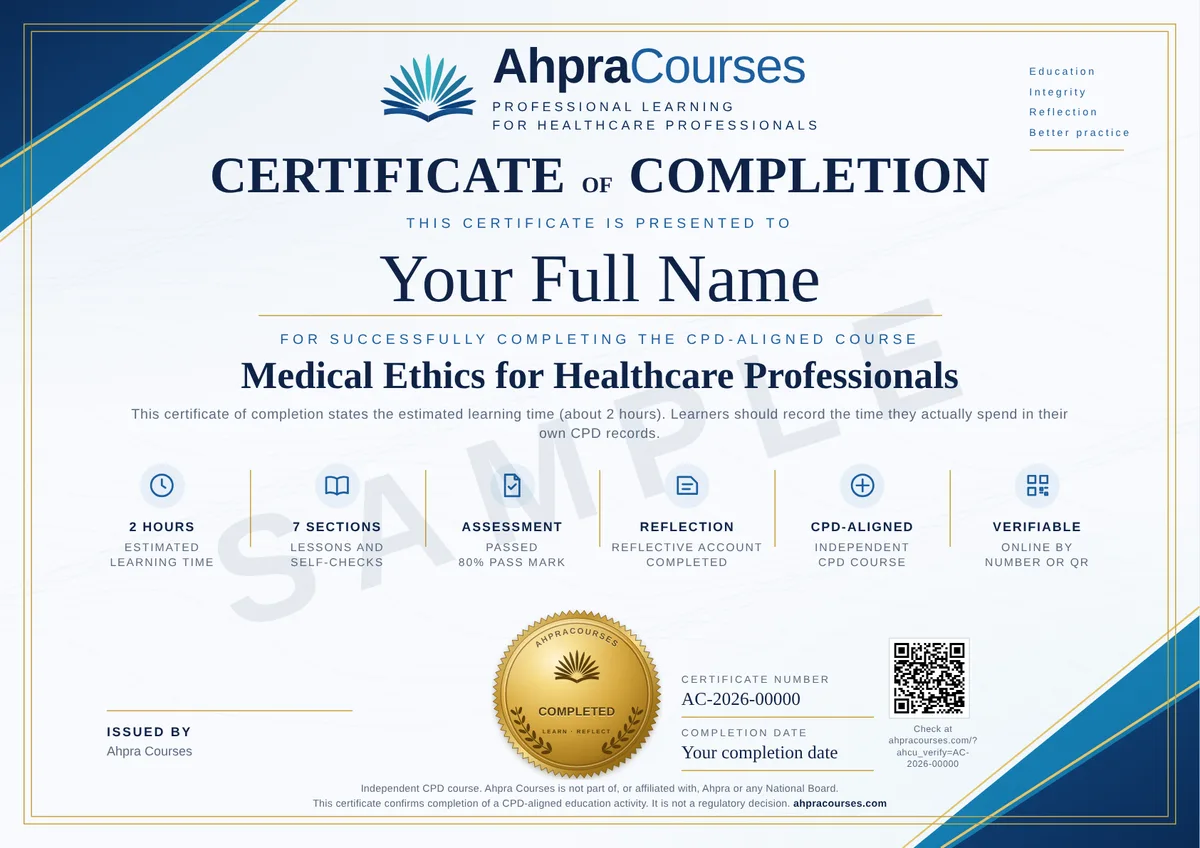
The certificate you receive

Sample certificate of completion for Medical Ethics for Healthcare Professionals from Ahpra Courses, showing the learner's name, the course title, an estimated learning time of about 2 hours, the completion date and a certificate number that can be checked online
Sample. Your certificate shows your name, the course title, the completion date and its own certificate number.

Complete the sections and the final assessment and your certificate becomes available to download. It names the course and shows when you finished and the estimated learning time. Your Board's CPD standard asks you to record what you actually did, so note your real time and what you learned.

How practitioners use it

  • Add it to your CPD portfolio with a short note on how the learning applies to your practice and your learning plan.
  • Provide it with a written response to Ahpra or a complaints body, alongside your reflection and evidence of what has changed.
  • Show it to a supervisor, clinical educator or practice manager who has asked you to complete ethics education.
  • Use it with a mentor or peer group as the starting point for case discussions.

Who this course is for

Nurses and midwives facing an ethics concern

Covert medication, consent in labour, refusal of care and speaking up about unsafe practice are common sources of ethical complaints. The course works through the NMBA codes, the ICN and ICM codes and the Decision-making framework (2020).

Pharmacists, dental and allied health practitioners

If you practise under the shared Code of conduct, the course shows what sections 1, 3, 4 and 8 ask of you when benefit, consent, confidentiality or money are in tension, with profession-specific examples.

Psychologists under the new code

The Psychology Board's first regulatory Code of conduct took effect on 1 December 2025. The course covers how it handles consent, confidentiality, boundaries and multiple relationships, and how it differs from the shared Code.

Practitioners asked to complete ethics education

If an employer, a Board decision or an undertaking requires ethics education, the course has a detailed curriculum and an assessment component. Where a condition applies, get Ahpra's approval before you enrol.

Dual registrants and multidisciplinary teams

A nurse who is also a midwife must meet both NMBA codes. Teams mixing professions work under different codes that say similar things in different words. The course maps them side by side.

Practitioners in rural, remote and solo practice

Where you are the only practitioner, dual relationships, conscientious objection and access to care raise sharper questions. The course addresses practising ethically without colleagues close at hand.

Anyone wanting ethics CPD with structure

Most learners have no complaint at all. They want a clear framework for the grey areas and learning that fits their Board's CPD requirements.

The concerns this course addresses

Working beyond competence or scope

Doing more good can tip into harm when a practitioner takes on a task they are not trained or authorised for, such as a cosmetic injectable, an extended procedure or an unfamiliar medicine. Boards expect practitioners to work within competence, train before moving into a new area and refer when care reaches its limit.

Shared Code 1.2 (Good care); Good medical practice 3.2; NMBA Decision-making framework for nursing and midwifery (2020); Dental Board scope of practice registration standard

Consent that was assumed, rushed or incomplete

Autonomy depends on information, capacity and freedom from pressure. Complaints arise when risks, alternatives or fees were not explained, when a procedure changed mid-treatment, or when a person felt unable to say no. The course covers material risks, off-label status and conflicts of interest as parts of consent.

Shared Code 4.2 (Informed consent); Good medical practice 4.5; NMBA codes (person-centred practice and informed consent); Psychology Board Code of conduct (informed consent)

Capacity, substitute decision-makers and covert treatment

Crushing medicines into food, restraining a distressed person, or deciding with family rather than with the patient all raise questions about capacity and legal authority. The course explains that capacity is presumed and decision-specific, the need for supported decision-making, and how lawful substitute consent works in each state.

Shared Code introduction (Substitute decision-makers); Good medical practice 1.4; state and territory guardianship and medical treatment legislation

Fairness, discrimination and cultural safety

Justice means care allocated by need, not by judgement about a person's behaviour, background or identity. Cultural safety is determined by Aboriginal and Torres Strait Islander individuals, families and communities. The course covers bias, conscientious objection and the National Law's cultural safety principle.

Shared Code 2 (Aboriginal and Torres Strait Islander health and cultural safety) and 3.1; Good medical practice 3.4 and 4.7; NMBA codes (cultural practice and respectful relationships)

Confidentiality against the duty to protect

A client discloses a plan to harm someone; a parent asks about a teenager's treatment; a colleague asks to see a record out of concern. The course explains the narrow exceptions to confidentiality, how to disclose only what is needed and how to record the decision.

Shared Code 3.3 (Confidentiality and privacy); Good medical practice 4.4; Psychology Board Code of conduct (privacy and confidentiality); Privacy Act 1988 (Cth)

Financial gain shaping advice

Recommending products you sell, extended treatment plans that serve a business model or referral arrangements can make advice look self-interested. The shared Code says treatment should be based on the best available information, not financial gain. Ahpra's 2026 interim guidance requires disclosure to each patient.

Shared Code 1.2 and 8.11 (Financial and commercial dealings); Good medical practice 10.12; Interim guidance: Managing financial or commercial conflicts of interest (2026)

Boundaries and dual relationships

Friendship, social media contact, business dealings or a sexual relationship with a current or former patient or client is an exploitation of the power imbalance. A sexual relationship with a current patient is never acceptable in any registered profession. The course covers warning signs and how to end or transfer care safely.

Shared Code 4.8 (Personal relationships) and 4.9 (Professional boundaries); Good medical practice 10.2; Psychology Board Code of conduct (boundaries and multiple relationships)

Loyalty to a colleague against patient safety

Knowing a respected colleague appears impaired, or watching a senior practitioner take an unsafe shortcut, is a common source of moral distress. The course explains the four kinds of notifiable conduct, the thresholds, the protections for good-faith notifiers and the alternatives to silence.

Guidelines: Mandatory notifications about registered health practitioners (2020); Shared Code 8.1 (Reporting obligations); Good medical practice 8.3

What the course covers

Seven sections take you from the ideas of healthcare ethics to what your own Board expects, then into dilemmas, the link with professionalism, the consequences of breaches and how to reflect and remediate. Examples are drawn from more than ten professions.

1Overview of Medical Ethics1 lesson

Explains ethics, law and regulation as three overlapping layers, sets out which code applies to each profession (including dual registrants), and introduces the four principles alongside duty, consequence, virtue and care ethics. Lesson: what is medical ethics.

  • 1.1 What is Medical Ethics
2Core Ethical Principles6 lessons

Pairs each principle with what the Boards expect: benefit and harm with competence, evidence and referral; autonomy with capacity, supported decisions and consent; justice with non-discrimination, need-based allocation and cultural safety. Lessons: beneficence and non-maleficence; what the Boards expect on beneficence and non-maleficence; autonomy; what the Boards expect on autonomy; justice; what the Boards expect on justice.

  • 2.1 Beneficence and Non-Maleficence
  • 2.2 What the National Boards Expect on Beneficence and Non-Maleficence
  • 2.3 Autonomy: Respecting Patients' Decisions
  • 2.4 What the National Boards Expect on Autonomy
  • 2.5 Justice: Treating Patients Fairly and Equitably
  • 2.6 What the National Boards Expect on Justice
3Handling Ethical Dilemmas in Practice2 lessons

Distinguishes true dilemmas from temptation, uncertainty, moral distress and disagreement, lists the warning signals, then teaches an eleven-step method, the four-box approach and practical tests for checking a decision. Lessons: identifying ethical dilemmas; managing ethical dilemmas.

  • 3.1 Identifying Ethical Dilemmas
  • 3.2 Managing Ethical Dilemmas
4Professionalism and Ethical Practice2 lessons

Shows how records, boundaries, conflicts of interest, CPD, reporting, open disclosure, advertising and insurance each protect an ethical principle, and what everyday ethical practice looks like on a shift. Lessons: the intersection of professionalism and ethical practice; how professionalism and ethical practice work together.

  • 4.1 The Intersection of Professionalism and Ethical Practice
  • 4.2 How Professionalism and Ethical Practice Work Together
5Consequences of Breaching Ethical Standards1 lesson

Covers the harm breaches cause, the parallel regulatory, employment, civil and criminal processes, the notification stages including immediate action under section 156, and the range of outcomes. Lesson: impacts of breaches.

  • 5.1 Impacts of Breaches
6Addressing a Breach: Reflection and Remediation3 lessons

Explains why insight matters, how to reflect using Ahpra's four-step reflective report, and five remediation steps, including the rules that apply when education is a condition. Lessons: why reflection matters; how to reflect effectively; remediation: steps to rebuild trust and skills.

  • 6.1 Why Reflection Matters
  • 6.2 How to Reflect Effectively
  • 6.3 Remediation: Steps to Rebuild Trust and Skills
7Conclusion and Takeaways1 lesson

Summarises the shared ethical core of every Board's code, flags the documents that changed in 2025 and 2026, and guides you in recording the learning. Lesson: conclusion and takeaways.

  • 7.1 Conclusion and Takeaways
✓Reflection, final assessment and certificate3 steps
  • Your reflective account, which you can download for your records
  • Final assessment: 20 questions, 80% to pass
  • Certificate of completion, dated and numbered

The four principles of healthcare ethics and how each National Board writes them into its code

Beneficence, non-maleficence, autonomy and justice are the most widely taught framework in Australian health education, and every National Board's code is built on them even where the words differ. Knowing the principle tells you why a rule exists. Knowing your Board's code tells you what you will be held to. A practitioner responding to a concern needs both.

Benefit and harm

Beneficence asks you to act for the person's good; non-maleficence asks you not to cause harm the benefit does not justify. Since almost every intervention carries risk, the two are applied together as a weighing exercise, and what counts as benefit depends on the person's goals. The shared Code of conduct expresses this in section 1.2 (good care), including working within competence, training before moving into a new area and recommending treatment on the best available information rather than financial gain. Good medical practice does the same in section 3.2. For nurses and midwives, the NMBA's Decision-making framework (2020) helps decide whether an activity is within scope.

Autonomy

An adult with capacity may refuse care, including care you think wise. Capacity is presumed, assessed for the particular decision at the particular time, and supported before it is judged absent. Autonomy does not create a right to demand treatment that is not clinically indicated. Every code requires informed consent: the shared Code at 4.2, Good medical practice at 4.5, and the NMBA and Psychology Board codes in their consent provisions.

Justice

Justice concerns fairness: allocating care by need, not discriminating, and not letting judgement about how a condition arose shape treatment. In Australia it also means culturally safe care. The National Scheme definition states that cultural safety is determined by Aboriginal and Torres Strait Islander individuals, families and communities, and since 2022 the National Law has included an objective and guiding principle about culturally safe services for Aboriginal and Torres Strait Islander Peoples.

Confidentiality, honesty and care

Confidentiality and truthfulness are sometimes treated as separate duties, and care ethics, influential in nursing and midwifery, adds attention to relationships and vulnerability. They matter because the strongest complaints often turn on them: a disclosure without a lawful basis, a misleading account after an error, a record changed after a complaint.

Why the code you follow matters in proceedings

A Board's code can be used in disciplinary proceedings as evidence of appropriate professional conduct, and conduct is judged against the version in force when it occurred. A paramedic's conduct in 2021 is measured against the paramedicine code then in force, not the shared Code that replaced it on 29 June 2022. The Psychology Board's code applies to conduct from 1 December 2025; before that, the Board used the APS Code of Ethics. Getting the right code, and the right version, is the first step in any credible response.

How to respond to an Ahpra notification about this kind of concern

Whatever your profession, an ethics notification usually begins with Ahpra asking what happened and what has changed. A careful response follows the same structure the course uses for dilemmas: facts, people, principles, standards, decision and review.

  1. Get advice from the right body for your profession

    Contact your professional indemnity insurer before responding. Nurses and midwives may also have advice and representation through their union; pharmacists, physiotherapists, psychologists and others through their professional association. Do not contact the person who complained.

    In the course: Section 5 explains each stage of the process and the parallel employment and complaints processes that may be running.

  2. Confirm which code and version applied

    Check whether you were covered by the shared Code, Good medical practice, the NMBA codes or the Psychology Board's code at the time of the events, and whether any profession-specific guideline also applied.

    In the course: Lesson 1.1 contains a table of which code applies to each profession and to dual registrants.

  3. Reconstruct the decision, not just the outcome

    Set out what you knew, who was involved, whether the person had capacity, which principles were in tension and what options were available at the time. Use the records and leave them unaltered.

    In the course: The structured method in lesson 3.2 doubles as a template for explaining a past decision clearly.

  4. Acknowledge the person's experience and your part

    Recognise how the patient, client or family experienced what happened, even if you see it differently, and identify your own role alongside any system factors.

    In the course: Lesson 6.2 and the reflection frame on this page show how to write about feelings and impact without becoming defensive.

  5. Show the change and how you will keep it

    Describe dated changes to your practice and attach evidence such as supervision notes, a new consent record, a team protocol or an audit. Explain how the change is built into your CPD plan.

    In the course: Lesson 6.3 sets out five remediation steps and what evidence each produces.

Answering with an account of what the rules say, rather than what you did and what you now do differently, leaves the reader unable to judge whether the risk has passed.

Before replying, seek advice from your professional indemnity insurer, your union or professional association, or a lawyer.

How this course helps with an Ahpra notification

It speaks your Board's language

A physiotherapist quoting Good medical practice, or a nurse citing the shared Code, signals to the reader that the practitioner does not know their own standard. Every lesson in Section 2 sets the principle beside the specific expectations of the shared Code, Good medical practice, the NMBA codes and the Psychology Board's code, so you can cite yours correctly.

It gives you a method you can show

The eleven-step approach in Section 3, from clarifying the facts through consultation and documentation to review, produces a record of reasoning. For a future dilemma, that record protects you. For a past one, rebuilding the decision in the same structure helps you see where it went wrong and explain it honestly.

It follows the reflective structure most Boards endorse

Ahpra's reflective report guidance, based on Gibbs' cycle, is endorsed by every National Board except the Medical Board. It has four parts: description, feelings and response, evaluation and analysis, and conclusion and change. Section 6 teaches each part with examples, and the frame on this page applies it to an ethics concern.

It is precise about education conditions

Many practitioners lose time by enrolling before their education is approved. The course explains Ahpra's rules for formal education: nominate with a detailed curriculum, wait for approval, provide evidence and a reflective report, and do not count the hours as CPD for that period.

Remediation evidence that carries weight

Carries weight

  • A reflective report in Ahpra's four-part structure that names your Board's code section and the ethical principles that were in tension
  • A written record of how you would now work through a similar dilemma, using a structured method and naming who you would consult
  • Supervision or mentoring notes showing ethics cases discussed over several months
  • A revised team or personal protocol, such as for consent with a substitute decision-maker or for covert administration
  • Evidence that you raised a system problem through the proper channel, such as an incident report or a request for an ethics consultation
  • Completion of targeted ethics education with an assessment, linked to your CPD learning plan
  • Feedback from a manager or clinical educator confirming changed practice

Carries little weight

  • A summary of the four principles copied from a textbook
  • Statements that you have always acted in the patient's best interests
  • Attributing the decision entirely to a senior colleague or a policy without examining your own role
  • Education in an unrelated clinical topic
  • Citing the wrong Board's code, or a version not in force at the time
  • Promises about future conduct with no supervisor, audit or system behind them

A remediation plan, phase by phase

  1. Days 1 to 14

    Pause, protect and get advice

    • Contact your insurer and your union or association
    • Stop the practice involved, whether that is a procedure, a medication practice or contact with a client
    • Speak with your manager about any immediate patient safety step needed
    • Write a private account of events while your memory is fresh
  2. Weeks 2 to 6

    Learn the standard and the principle

    • Complete the course, focusing on the sections that match your concern
    • Read your Board's code section and any profession-specific guideline in full
    • Identify the principles in tension and where your reasoning went wrong
    • If a condition applies, nominate education and mentoring to Ahpra and wait for approval
  3. Weeks 6 to 12

    Change and document

    • Introduce a specific change to your practice or team protocol
    • Arrange regular supervision or mentoring and keep notes
    • Draft your reflective report using the four-part structure
  4. Months 3 to 6

    Check the change is working

    • Audit a sample of relevant records or decisions
    • Ask your supervisor or manager for written feedback
    • Revise your reflection with what the audit and feedback showed
  5. Each year after

    Keep ethics in the plan

    • Include an ethics goal in your CPD learning plan
    • Take part in case review, peer groups or ethics forums
    • Check your Board's site for revised codes and guidelines

Writing your reflective statement

1Description

Give an objective, de-identified account: what happened, where, who was involved, what you and others did, and the outcome.

Example only: On a night shift I crushed a resident's regular medicines into yoghurt after she declined them, without speaking to her decision-maker or the GP.

2Feelings and response

Describe what you thought and felt before, during and after, and how you see it now.

Example only: At the time I felt relieved she had taken her medicines. Now I feel uncomfortable that I decided for her without asking whether she understood or who could lawfully consent.

3Principles and standards

Name the ethical principles in tension and the section of your Board's code that applied.

Example only: I put beneficence ahead of autonomy and dignity. My code's informed consent provisions, and the state law on substitute decision-makers, required a different process.

4Evaluation and analysis

Analyse why it happened, what the education taught you, and what was critical in the original situation.

Example only: A senior colleague suggested it and it had become routine on our unit. The course showed me the difference between a practical problem and an ethical one.

5Conclusion and change

State what you would do differently, the changes you have made and how you would respond if a colleague did the same.

Example only: I now escalate refusals to the nurse in charge and the GP, and our unit has adopted a covert administration protocol requiring a documented decision-maker consent and pharmacist review.

6Action plan

Set out the next steps, with dates, and how you will sustain the change.

Example only: I will present the protocol at our March team meeting and include capacity and consent in my CPD learning plan for this registration year.

The example sentences are fictional and show structure only. Your statement has to be your own honest account of what happened.

A weak and a strong response, side by side

Fictional example. The daughter of an aged care resident with dementia complains that RN T crushed her mother's medicines into food without telling anyone. The health complaints entity refers the matter to Ahpra and the NMBA.

Weak

The resident was refusing essential medicines and I acted in her best interests to prevent harm. Crushing medicines into food is common practice on our unit and was suggested by a senior nurse. The GP had charted the medicines and the resident's health would have deteriorated without them. I was working short-staffed and did not have time to call the family at 9 pm. I believe the daughter is unhappy with the facility generally and has focused on me. I do not think I breached any standard.

Strong

I accept that I gave the resident her medicines covertly without her consent or that of her substitute decision-maker, and without the GP's or pharmacist's review. I was trying to prevent harm, but I put that ahead of her right to decide and of the law on substitute consent, which my Code of conduct required me to respect. I have since completed ethics education on capacity and consent, discussed the case in supervision, and helped draft a unit protocol requiring documented decision-maker consent and pharmacist advice before any covert administration. The protocol and my supervisor's notes are attached.

Why the second one works: The strong response accepts the facts, names the competing principles and the standard, recognises the resident's rights and the decision-maker's role, and describes a system change as well as personal learning, with evidence. The weak response relies on good intentions, common practice and staffing, deflects onto the daughter and denies any breach.

Mistakes practitioners make when responding

Citing another profession's code

Quoting Good medical practice as an allied health practitioner, or the shared Code as a nurse, signals that you do not know your own standard. Check which code applied to you at the time.

Confusing a dilemma with a temptation

If the right course was clear and you took an easier one, describing it as a hard ethical dilemma reads as rationalisation. Be honest about which it was.

Relying on "best interests" alone

Good intentions do not answer a concern about consent or capacity. Explain how you assessed capacity and who had legal authority to decide.

Blaming the culture of the workplace

Unsafe routines and staffing problems are real, and naming them helps. Leaving out your own decision makes the response look like an attempt to avoid responsibility.

Starting education before approval

Where a condition requires education, Ahpra usually needs to approve the program first. Work done earlier may not count.

Writing reflection that never reaches change

A reflection that describes feelings at length but does not end with specific, dated changes is incomplete in the four-part structure most Boards endorse.

Staying silent about a colleague

Moral distress about a colleague's unsafe practice is common. Learn the mandatory notification thresholds and your workplace's escalation routes rather than doing nothing.

The code provisions this course works through

Because this course spans professions, the map shows the code sections most often engaged in an ethics concern, labelled by code. Find the one that applies to you.

Shared Code 1.2Good care

Lists the elements of good care, including current knowledge, training before moving into a new area, adequate records, weighing benefit and harm, giving enough information for informed choice, recommending treatment on the best available information rather than financial gain, and evidence-based use of therapeutic products.

In the course: Lesson 2.2 applies these to scope questions for pharmacists, dental practitioners, Chinese medicine practitioners and others.

Shared Code 4.2Informed consent

Requires understandable information, time for questions, consideration of capacity and any need for substitute consent, consent before examination or treatment covering material risks, discussion of fees and documentation of consent.

In the course: Lessons 2.3 and 2.4 cover capacity, supported decisions, young people and how consent is recorded.

Shared Code 3.3Confidentiality and privacy

Requires informed consent before disclosure where possible, access to records only when professionally involved or authorised, compliance with privacy and health records law, and written consent before sharing any person's information or images, even unnamed.

In the course: Lesson 3.1 uses confidentiality against protection of others as a core example of a true dilemma.

Shared Code 4.9Professional boundaries

Asks practitioners to recognise the power imbalance, avoid under- or over-involvement and conflicts, never use their position to pursue a sexual or exploitative relationship with a patient or people close to them, and take care with relationships with former patients.

In the course: Lesson 4.1 treats boundaries as a way professionalism protects autonomy and trust in every profession.

Good medical practice 3.4Decisions about access to medical care

Requires doctors to make access decisions free from bias, not to let views about a patient's behaviour affect care, to prioritise by clinical need, and to manage conscientious objection without impeding lawful treatment.

In the course: Lesson 2.6 sets this beside the shared Code and NMBA expectations on justice and cultural safety.

NMBA codes: person-centred practiceNurses' and midwives' duties of safe, person-centred care

The NMBA codes for nurses and for midwives ask practitioners to provide safe, evidence-based, person-centred care in partnership with the people they care for, practise within scope, obtain informed consent and respond to adverse events with open disclosure.

In the course: Lessons 2.2 and 3.2 apply this principle with the Decision-making framework and the ICN and ICM ethics codes.

Also relevant: Shared Code 2 Aboriginal and Torres Strait Islander health and cultural safety.; Shared Code 5.3 Never engage in, ignore or excuse discrimination, bullying or harassment.; Shared Code 8.2 Do not make vexatious notifications about other practitioners.; Good medical practice 3.2.4 Weigh benefit and harm in every clinical decision.; Psychology Board Code of conduct Specific standards on boundaries, multiple relationships and sharing information with AI tools.

How this applies in each profession

Nurses

Nursing and Midwifery Board of Australia

Ethics concerns about nurses often involve consent and capacity in aged care, covert medication, restrictive practices, speaking up about unsafe staffing and boundaries with patients. Nurses follow the Code of conduct for nurses (2018) and the ICN Code of ethics for nurses, with the Decision-making framework (2020) guiding scope and delegation.

Midwives

Nursing and Midwifery Board of Australia

For midwives the tension is often between a woman's informed choice and clinical advice, for example declining induction or monitoring. Midwives follow the Code of conduct for midwives (2018) and the ICM International Code of Ethics for Midwives. Dual registrants must meet both NMBA codes.

Medical practitioners

Medical Board of Australia

For doctors, the measuring stick is the Medical Board's code, Good medical practice, in its 2020 version. Ethics concerns commonly involve consent, certificates and reports, confidentiality, care for people close to them and conflicts of interest. The Medical Board has not endorsed Ahpra's Gibbs-based reflective report guidance, so doctors use their own reflective approach.

Pharmacists

Pharmacy Board of Australia

Pharmacists follow the shared Code of conduct and, from 1 October 2026, the Guidelines on the safe provision of pharmacy services including medicines and advice. Concerns include supplying against professional judgement, product sales and confidentiality at the counter. The PSA Code of Ethics (2026) is a professional, non-regulatory resource.

Psychologists

Psychology Board of Australia

The Code of conduct for psychologists, the Board's first regulatory code, applies to conduct from 1 December 2025. It is more prescriptive than the shared Code, particularly on boundaries, multiple relationships, consent that is revisited over time and sharing client information, including with AI tools.

Dental practitioners

Dental Board of Australia

Dentists, hygienists, therapists and prosthetists follow the shared Code and the scope of practice registration standard. Ethical concerns often involve treatment plans driven by cost or business pressure, consent to extensive work and cosmetic procedures, which since 2 September 2025 are also covered by the non-surgical cosmetic guidelines.

Physiotherapists and other allied health

Physiotherapy, Occupational Therapy, Podiatry, Optometry, Chiropractic and Osteopathy Boards

These professions share the 2022 Code of conduct. Common ethics concerns include long treatment plans of doubtful benefit, advertising claims, boundaries during hands-on treatment and caring for friends or family. Ahpra publishes profession-specific advertising examples for chiropractic and osteopathy.

Paramedics and Chinese medicine practitioners

Paramedicine Board; Chinese Medicine Board

Paramedics often face refusal of transport, capacity in emergencies and confidentiality at scenes; the shared Code replaced the paramedics' code on 29 June 2022. Chinese medicine practitioners must also meet the Guidelines for safe Chinese herbal medicine practice, revised from 1 December 2023.

What happens after a notification reaches Ahpra

Ahpra received 13,327 notifications in 2024/25, 19% more than the year before, and 22,658 were made nationally once NSW and Queensland are counted. Notifications rose in every profession except midwifery and Aboriginal and Torres Strait Islander health practice, and 58.9% raised more than one concern. Outside NSW and Queensland, the stages look like this whichever Board you are registered with.

  1. The notification is received

    Ahpra checks it meets the legal grounds, consults the state health complaints entity and refers it to your Board. In 2024/25, 27.7% of completed notifications were referred to or kept by a health complaints organisation.

  2. Assessment by Ahpra for your Board

    Ahpra reviews the concern, your history and practice setting, and usually contacts you to ask what has changed. In 2024/25, 19.7% of completed notifications closed through early determination with no further action. For nurses and midwives, regulatory decisions moved from state and territory boards to two national NMBA committees from September 2026.

  3. Immediate action where needed

    Where a Board reasonably believes the risk a practitioner poses is serious, it can propose suspension, conditions or an undertaking under section 156, after a show cause process. Ahpra took immediate action in 554 cases involving 315 practitioners in 2024/25.

  4. Investigation and assessments

    More serious or patterned concerns may be investigated, with power to require records and information. A health assessment or performance assessment may be required where impairment or unsatisfactory practice is possible.

  5. Board decision

    Options include no further action, a caution, an undertaking, conditions or referral to another entity. Restrictions remain until the Board is satisfied they are no longer needed.

  6. Panel or tribunal

    Panels hear matters in private and can impose conditions, cautions or reprimands, or suspension in health matters. Where a Board reasonably believes the conduct amounts to professional misconduct, it must refer the matter to the tribunal, which can cancel registration. Only 1.4% of closed notifications in 2024/25 led to loss of registration or disqualification.

Who handles your matter in New South Wales and Queensland

New South Wales. Each registered profession has a NSW Health Professional Council, supported by the Health Professional Councils Authority. The Council and the Health Care Complaints Commission consult on every complaint and agree who will manage it. Councils can ask for a response, interview the practitioner, require an assessment or hold an inquiry, and they consider whether the practitioner has reflected on what happened and acted to prevent a repeat. The HCCC prosecutes serious matters before NCAT. Mandatory notifications are still made to Ahpra.

Queensland. The Office of the Health Ombudsman receives all health service complaints, including about registered practitioners, and considers each one with Ahpra. In 2024/25 Ahpra reports that 1,936 notifications about registered practitioners were closed after joint consideration, with the OHO agreeing no regulatory action was needed, and that the OHO retained 714 for further action. The OHO generally keeps the most serious matters, has its own immediate action powers and prosecutes before QCAT.

Possible outcomes and what they mean for you

OutcomeWhat it isWhat it means for you
No further actionNo regulatory response is needed, often because the risk has already been dealt with. The notification stays on Ahpra's record.A clear reflective report and evidence of changed practice submitted early can support this result. Keep the changes in place.
Referral to another bodyThe matter is passed to a health complaints entity, an employer, Medicare, police or another body better placed to deal with it.Respond to that body with the same care. Its findings can come back to your Board.
CautionA formal written warning to deter repetition; usually not published.Treat it as a clear statement of the standard. Further concerns of the same kind will be read in light of it.
UndertakingA legally binding commitment you agree to, such as completing ethics education or practising under supervision; published and not appealable.Agree only after advice. Any education it requires must be approved before you begin.
ConditionsRequirements placed on your registration, published until removed.Nominate education, mentors or supervisors promptly and collect the evidence you will need to apply for removal.
ReprimandA formal rebuke recorded on the public register, imposed by a tribunal, or by a performance and professional standards panel.You can later apply to the Board for removal from the register.
Suspension or cancellationSuspension stops practice for a time; cancellation, by a tribunal only, ends registration and may include disqualification.Since 10 April 2026, re-registration after cancellation or disqualification requires a tribunal's reinstatement order.

If a condition or undertaking requires education

Where a Board has imposed a condition, or accepted an undertaking, that requires you to complete ethics education, the education generally has to be approved by Ahpra, on the Board's behalf, before you start. Under Ahpra's process for formal education, you nominate a program and provide a detailed curriculum; nominations without enough detail are not approved, and online programs are generally accepted only where they include interactive content or an assessment. Education finished before approval may not count.

Send Ahpra this course's outline, learning objectives, full lesson list, assessment method and estimated learning time, and wait for written approval before enrolling. On completion, provide the certificate and a reflective report; for every Board except the Medical Board, Ahpra's Gibbs-based four-part structure is the endorsed approach. A practice audit may follow. The hours used for the condition generally cannot also be claimed as CPD for that period.

Using this course as CPD

Each National Board sets its own CPD registration standard, so check yours. As examples of current requirements: the NMBA requires at least 20 hours a year for registered nurses, enrolled nurses and midwives, more for nurse practitioners and dual registrants, with records kept for at least five years; the Physiotherapy Board requires at least 20 hours a year; the Dental Board requires at least 60 hours over a three-year cycle, currently 1 December 2025 to 30 November 2028; the Pharmacy Board's standard has required at least 40 CPD credits in each CPD year; and the Medical Board requires 50 hours a year through a CPD home.

Most standards ask for more than attendance. The NMBA, for instance, expects you to identify learning needs by reflecting against your standards, plan activities to meet them and reflect on their value. Use the course reflective prompts for that purpose and record the time you actually spend. Ahpra and fourteen National Boards consulted from May to July 2026 on revised CPD and recency of practice standards. As at October 2026 those are proposals, and the current standards continue to apply.

Education completed to meet a condition generally cannot also count towards CPD for that registration period.

  • Check your own Board's CPD standard for hours, cycle and record-keeping rules.
  • Link the course to a learning need you identified by reflecting against your code or standards.
  • Record actual time, the certificate and a short note on how you will apply the learning.
  • Keep records for the period your Board requires; for the NMBA that is at least five years.
  • Do not count education used for a condition as CPD in the same period.

How this course is written and kept current

The course and this page were written from the codes and guidelines each National Board publishes, Ahpra's process and monitoring pages, the National Law as currently in force and the Australian Open Disclosure Framework (2026). Each profession's code, dates and section references were checked against the Board's current documents, with particular attention to the 2025 Psychology Board code and the Pharmacy Board guidelines that took effect on 1 October 2026. Statistics are taken only from the Ahpra and National Boards annual report 2024/25. The content is updated when any Board changes a code or guideline it relies on.

Code of conduct (shared Code, 2022)Good medical practice (Medical Board, 2020)Code of conduct for nurses; Code of conduct for midwives (NMBA, 2018)Code of conduct for psychologists (Psychology Board, 2025)Decision-making framework for nursing and midwifery (NMBA, 2020)Guidelines on the safe provision of pharmacy services (Pharmacy Board, 2026)Information sheet: Reflective reports (Education) (Ahpra)Ahpra and National Boards annual report 2024/25

Last reviewed: October 2026.

Key terms explained

Beneficence
The duty to act for the good of the person in your care, defined with them according to their goals.
Non-maleficence
The duty not to cause harm that the expected benefit does not justify, including harm from overtreatment or working beyond competence.
Autonomy
A capable adult's right to make decisions about their own care, including refusing treatment the practitioner recommends.
Justice
Fairness in care: allocation by need, non-discrimination and equitable, culturally safe access.
Ethical dilemma
A situation where two or more courses of action are each supported by a legitimate ethical reason and both cannot be fully honoured.
Moral distress
Knowing the right course but being unable to take it because of institutional constraints, such as staffing or a senior decision.
Supported decision-making
Helping a person make their own decision, for example with an interpreter, better timing or simpler information, before concluding they lack capacity.
Substitute decision-maker
The person the law of the relevant state or territory authorises to consent for someone who lacks capacity, such as a guardian or medical treatment decision maker.
Shared Code of conduct
The Code of conduct used by 12 National Boards since 29 June 2022, including pharmacy, dental, physiotherapy and paramedicine.
Dual registrant
A practitioner registered in two professions, such as nursing and midwifery, who must meet both codes.
Reflective report
A written account, often in Ahpra's four-part structure, explaining what happened, what was learned and what has changed.
Undertaking
A binding commitment a practitioner gives a Board to restrict or change their practice, usually published on the register.
Health complaints entity
A state or territory body, such as the HCCC in NSW or the Health Complaints Commissioner in Victoria, that deals with complaints about health services.

Frequently asked questions

Is this course suitable for my profession?

Yes, if you are registered under the National Law. It covers the codes for all 15 National Boards, with examples from more than ten professions. Social workers, who are not registered under the National Law, should choose our social work course instead.

How does completing it help with my notification?

Your Board decides on the risk it sees. The course helps you understand the standard, reflect credibly and plan changes you can evidence.

Can I use it for a condition on my registration?

Only if Ahpra approves it for your condition. Nominate it with the curriculum before you enrol and keep the written approval with your records.

Does the course explain which code applies to me?

Yes. Lesson 1.1 has a table of codes by profession, including dual registrants, and explains that conduct is judged against the code in force at the time.

I am a psychologist. Does it cover the new code?

Yes. It covers the Psychology Board's Code of conduct in force since 1 December 2025 and how it differs from the APS Code of Ethics the Board previously used.

How does it count for CPD?

It can count as CPD under your Board's standard if you are not using it for a condition. Record the time you actually spend and link it to a learning need you identified through reflection.

Does it include a reflective report template?

It teaches Ahpra's four-part reflective structure with examples and provides prompts. Write your report in your own words about your own events; a report that reads as a template carries less weight.

What is the difference between this course and the professional ethics course?

This course centres on the four principles and how each Board applies them, with a method for dilemmas. The professional ethics course takes a broader view of ethical conduct across practice. Both are listed below.

Does it cover open disclosure?

It explains open disclosure as one way professionalism puts honesty into practice, with reference to the June 2026 Australian Open Disclosure Framework. Our open disclosure course covers it in depth.

Should I tell my employer I am doing this course?

If the course relates to a workplace or regulatory concern, talk to your adviser about what to share. Many employers welcome evidence of targeted learning.

What support is available during a notification?

Ahpra lists services including Nurse & Midwife Support (1800 667 877), Dental Practitioner Support (1800 377 700), the Pharmacists' Support Service (1300 244 910) and doctors' health advisory services. Lifeline is on 13 11 14 and 13YARN on 13 92 76.

Do doctors have to include ethics in their CPD?

Yes. The Medical Board's CPD registration standard requires doctors to do CPD relevant to culturally safe practice, addressing health inequities, and professionalism and ethical practice, aligned with Good medical practice. These are not extra hours: each year you include at least one activity addressing each area within your 50 hours, through your CPD home. An ethics course such as this one can be recorded in your CPD home as an educational activity relevant to professionalism and ethical practice.

How long does the course take, and how long do I have access?

The estimated learning time is about 2 hours (about 120 minutes), covering the lessons, the section checks, your reflective account and the final assessment. People work at different speeds, so record the time you actually spend in your own CPD records. Your progress is saved to your account and you can return to the course and your certificate at any time.

How is the course assessed?

Lessons open in order. Each section closes with a graded check that you answer before moving on. The course ends with a 20-question final assessment, marked on our server, with a pass mark of 80%. If you do not pass, review the sections it points you to and try again.

Does completing the course decide the outcome of my matter?

No course can decide or predict the outcome of a notification, investigation, panel or tribunal. Decision-makers weigh all of the evidence, including your insight, your reflection and the changes you have made and sustained. The course is designed to support that learning and to give you a dated record of it.

Start today, finish at your own pace

Instant access after checkout. Work through 7 sections in order, write your reflective account, pass the final assessment and download your dated certificate.

Primary sources

Always read the current version on the publisher's website. This page is general information, not legal advice.

Course Content

1

Section 1 – Overview of Medical Ethics

  • 1.1 What is Medical Ethics

  • 1.2 Section 1 Self-Check

2

Section 2 – Core Ethical Principles

  • 2.1 Beneficence and Non-Maleficence

  • 2.2 What the National Boards Expect on Beneficence and Non-Maleficence

  • 2.3 Autonomy: Respecting Patients’ Decisions

  • 2.4 What the National Boards Expect on Autonomy

  • 2.5 Justice: Treating Patients Fairly and Equitably

  • 2.6 What the National Boards Expect on Justice

  • 2.7 Section 2 Self-Check

3

Section 3 – Handling Ethical Dilemmas in Practice

  • 3.1 Identifying Ethical Dilemmas

  • 3.2 Managing Ethical Dilemmas

  • 3.3 Section 3 Self-Check

4

Section 4 – Professionalism and Ethical Practice

  • 4.1 The Intersection of Professionalism and Ethical Practice

  • 4.2 How Professionalism and Ethical Practice Work Together

  • 4.3 Section 4 Self-Check

5

Section 5 – Consequences of Breaching Ethical Standards

  • 5.1 Impacts of Breaches

  • 5.2 Section 5 Self-Check

6

Section 6 – Addressing a Breach: Reflection and Remediation

  • 6.1 Why Reflection Matters

  • 6.2 How to Reflect Effectively

  • 6.3 Remediation: Steps to Rebuild Trust and Skills

  • 6.4 Section 6 Self-Check

7

Section 7 – Conclusion and Takeaways

  • 7.1 Conclusion and Takeaways

On call with Dr AI Alma