Reported to Ahpra Anonymously? What Practitioners Need to Know
When you do not know who raised a concern, the uncertainty can be harder than the allegation. Here is what Ahpra does with anonymous and confidential notifications, what you will be told, why you cannot pursue the notifier, and how vexatious notifications are handled.
In short
Anyone except a mandatory notifier can raise a concern with Ahpra anonymously, and anonymous notifications are uncommon: 146 in 2024/25. Ahpra still assesses them, but without a notifier to question it can be limited. Under section 152 of the National Law you are told the nature of the concern, but the notifier's name is shared only if it is necessary for you to respond. Good faith notifiers are protected from liability under section 237, and reprisals have been an offence since 1 December 2025. Vexatious notifications are rare, under 1% according to Ahpra-commissioned research, so the safest course is to answer the substance of the concern.
Key facts
- Anonymous notifications are allowed. Ahpra does not record the notifier's name. Mandatory notifications cannot be made anonymously.
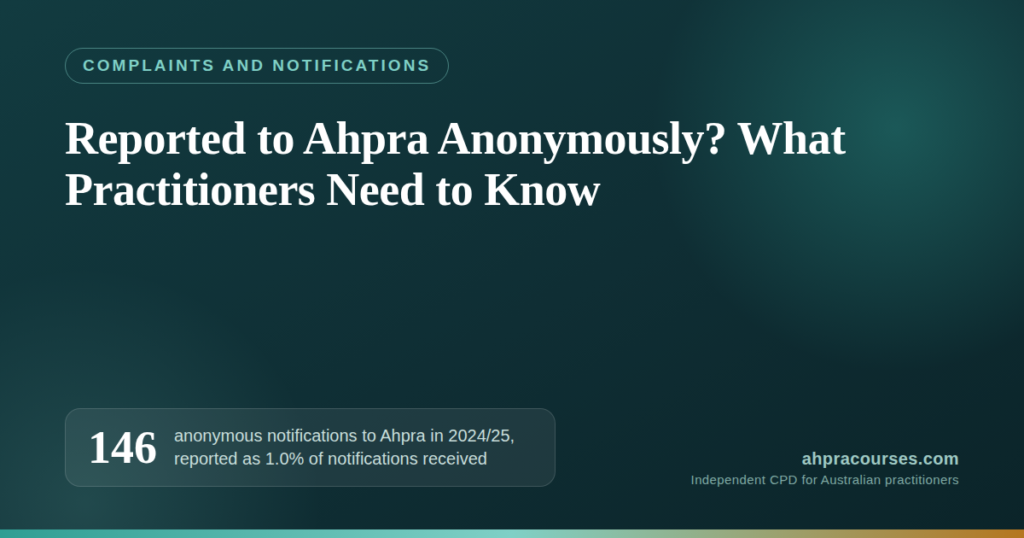
- 146 anonymous notifications reached Ahpra in 2024/25, which Ahpra reports as 1.0% of the 13,327 notifications it received.
- Section 152 of the National Law requires the National Board to tell you the nature of a notification as soon as practicable, with three limited exceptions.
- Section 237 protects people who notify in good faith from civil, criminal and administrative liability.
- Since 1 December 2025 reprisals against notifiers are an offence, with maximum penalties of $60,000 for an individual and $120,000 for a body corporate.
- Under 1% of notifications are vexatious, according to 2017 research commissioned by Ahpra. In 2024/25 a National Board found 53 notifications vexatious.
- 87.1% of notifications closed in 2023/24 resulted in no further regulatory action.
Can someone make an anonymous notification to Ahpra?
Yes. The Australian Health Practitioner Regulation Agency (Ahpra) accepts anonymous notifications from patients and the public, and does not record the notifier's name. Mandatory notifications by practitioners and employers cannot be anonymous. Anonymous notifications are uncommon: Ahpra received 146 in 2024/25, which it reports as 1.0% of notifications received.
Ahpra's own guidance states: "Notifications can be made anonymously, meaning we don't record your name as the notifier." It may give the notifier a pseudonym. It also states: "Mandatory notifications cannot be made anonymously." So if your notification came from a treating practitioner, a colleague or an employer under the mandatory reporting duties, the notifier's identity is known to Ahpra, even if it is not shared with you. Our guide to mandatory and voluntary notifications explains those duties.
Practitioners often use "anonymous" loosely to mean "I do not know who it was". Ahpra uses two different terms, and the difference matters for what Ahpra can do and what you may later learn.
| Question | Anonymous | Confidential | Named |
|---|---|---|---|
| Does Ahpra know who the notifier is? | No. The name is not recorded. | Yes, but the notifier has asked that it not be disclosed. | Yes. |
| Can Ahpra ask the notifier follow-up questions? | No, unless the notifier makes contact again. | Yes. | Yes. |
| Is the notifier's identity shared with you? | It cannot be, because Ahpra does not hold it. | Ahpra says it will not share personal information, but cannot fully guarantee this. | Only if necessary for you to respond, according to Ahpra. |
| Can it be a mandatory notification? | No. | Yes. | Yes. |
| Does the notifier get updates? | No, according to Ahpra. | Generally yes, as Ahpra can contact them. | Generally yes. |
Source: Ahpra, Can I be anonymous? (reviewed March 2025) and Ahpra notifications FAQs. In 2023/24 Ahpra reported 2,620 confidential and anonymous notifications combined.
This article covers Ahpra's process. In New South Wales and Queensland, complaints can be managed by other bodies with their own procedures; see how NSW and Queensland handle complaints. For the basics of the whole process, see how the notification process works.
What can Ahpra do with an anonymous notification?
Ahpra assesses an anonymous notification like any other, against the risk to the public, but it may find the concern hard or impossible to assess. Ahpra's FAQs say that remaining anonymous "may limit our ability to consider, investigate or take action" about the concerns raised, because it cannot go back to the notifier.
Ahpra cannot ask an anonymous notifier to explain a vague allegation, name dates or identify the patient involved.
Ahpra says it may be unable to gather information from other entities without the notifier's details.
An anonymous notifier does not receive updates or the outcome, so cannot add information later unless they make contact.
That does not mean an anonymous concern is ignored. In February 2026 Ahpra confirmed that during an investigation it may contact relevant parties, including employers and hospitals, for information such as patient records, witness statements and employment records. In practice, a specific anonymous allegation that can be checked against records may progress in the same way as a named one, while a vague allegation with nothing to test it against often has little to work with. Ahpra's vexatious notifications framework lists "Anonymous notifications that provide no specific details or supporting evidence" among its key indicators of possible vexatiousness, which is discussed below.
Will Ahpra tell you who made the notification?
Usually not, if the notifier asked to stay anonymous or confidential. Ahpra says: "We'll only tell the practitioner the notifier's name if it's necessary for them to respond." You will, however, be told the nature of the concern, and Ahpra says it cannot avoid sharing the patient's name with you, because you need it to respond.
Section 152 of the Health Practitioner Regulation National Law requires a National Board to give you written notice of a notification as soon as practicable. The notice must state the nature of the notification, the powers the Board may use and your procedural rights. The Board does not have to give notice if it reasonably believes doing so would prejudice an investigation, place a person's health or safety at risk, or place a person at risk of intimidation or harassment.
What you will normally be told
- That a notification has been made, with enough detail of the concern to respond to it
- The patient's name, where the concern involves a patient. Ahpra says: "We cannot avoid sharing the patient's name with the practitioner."
- The Board's possible powers and your procedural rights
- The notifier's name, only where it is necessary for you to respond
What may be withheld
- The identity of an anonymous or confidential notifier
- Notice altogether, for a time, if one of the section 152 exceptions applies
- Details that would identify a notifier where that is not needed for your response
- Note: Ahpra says confidential information may still be disclosed in legal proceedings or in response to a freedom of information request
Where Ahpra does decide a notifier's personal information has to be released to you, its guidance to notifiers says: "usually we'll let you know before we release any personal information to the practitioner."
Is that fair? The question was examined by the National Health Practitioner Ombudsman and Privacy Commissioner in a March 2020 review of confidentiality safeguards, requested by Ahpra after a notifier was seriously harmed by the practitioner they had reported. The review found that sharing a notifier's identity is preferable where possible, because it lets the practitioner respond in detail, but that relevant case law supports withholding identity for confidentiality reasons as long as the substance of the information is disclosed. It concluded that Ahpra's approach offers reasonable safeguards for notifiers and made 10 recommendations.
The practical point: you are entitled to know what you are answering, not who raised it. If the notice is too vague for you to respond properly, ask Ahpra in writing for further particulars of the concern, with your adviser's help.
Can you find out who reported you, or take action against them?
You should not try. The Health Practitioner Regulation National Law (section 237) protects anyone who notifies in good faith from civil, criminal and administrative liability, including in defamation, and since 1 December 2025 any reprisal against a notifier or witness is a criminal offence that can also lead to disciplinary action.
National Law, section 237(2)
"The person is not liable, civilly, criminally or under an administrative process, for giving the information."
Ahpra explains that this protection is deemed to include defamation, and that a good faith notification is not a breach of professional ethics or a departure from professional standards. The protection does not cover a notification made in bad faith. Ahpra's vexatious notifications framework states: "Vexatious notifications do not have good faith protections under the National Law." The framework states that a practitioner who makes a vexatious notification about another practitioner can face action affecting their own registration.
Since 1 December 2025 (4 December 2025 in South Australia) the National Law also makes it an offence to threaten, intimidate, dismiss, refuse to employ or otherwise discriminate against someone involved in a complaint, with maximum penalties of $60,000 for an individual and $120,000 for a body corporate. Our separate guide covers these protections for notifiers in depth.
Do
- Keep the matter confidential and discuss it only with your advisers and support services
- Keep treating the patient involved professionally, or arrange a proper transfer of care if the relationship cannot continue
- Tell your indemnity insurer, and follow advice on what to tell your employer
Avoid
- Asking colleagues, staff or patients who made the notification
- Contacting the person you suspect, directly or through others
- Changing how you treat, roster or refer someone because you suspect them
- Naming a suspected notifier in your response without evidence
Ahpra acknowledges in its guidance that it is sometimes possible to assume or guess a notifier's identity from the nature of the notification. Even if you think you know who it was, treat that belief as unconfirmed and do not act on it.
Speculating about identity also tends to weaken a response. A guess that turns out to be wrong can look like an attempt to deflect attention from the concern itself.
Responding to a notification when you do not know its source? Work through the process step by step and finish with dated evidence.
Get the Notification & Investigation Response ProgramHow rare are vexatious notifications to Ahpra?
Rare. Ahpra defines a vexatious notification as one "without substance, made with an intent to cause distress, detriment or harassment". Research commissioned by Ahpra in 2017 found vexatious complaints are less than 1% of notifications, and in 2024/25 a National Board found 53 notifications vexatious out of 125 assessed for vexatiousness.
Sources: Ahpra, Vexatious notifications; Ahpra annual report 2024/25, Notifications. Ahpra's vexatious notifications page also reports that 51% of vexatious notifications related mainly to conduct and 49% to performance.
The 2017 report, Reducing, identifying and managing vexatious complaints, was a literature review by researchers at the Centre for Health Policy. Ahpra summarises its central finding this way: "there is greater risk of people not reporting concerns than of people making truly vexatious complaints." In December 2020 Ahpra published a framework for identifying and dealing with vexatious notifications, the first of its kind in Australian health regulation. The National Health Practitioner Ombudsman reviewed it in December 2024, found that "truly vexatious notifications are rare", and made 17 recommendations, which Ahpra accepted. Ahpra released an updated framework in 2025.
Two points from the framework matter most if you suspect bad faith. First, motive is often hidden, so the test is whether there is a reasonable belief that the notifier intended to use the process to cause harm or distress. Second, a notification made with a harmful motive can still raise a genuine safety concern, so it is not dismissed for that reason alone.
Ahpra has published de-identified case studies showing how these principles play out:
A notifier alleged a registered nurse threatened a patient and posted about them online. The notifier could not provide evidence and had raised notifications about several other practitioners.
Found vexatious. No regulatory action.
A confidential notifier alleged a nurse accessed their records and took first aid equipment, then did not respond to Ahpra's requests. The nurse denied the concerns and pointed to a family dispute.
Found vexatious. No regulatory action.
A patient complained of comments about their weight and of exercises set against surgical advice. The physiotherapist reflected, completed an education module and had coaching on compassionate care.
Not vexatious. Closed with no further action.
The third case is the useful contrast. The concern was not vexatious, yet it still closed without action, because the practitioner engaged with the substance and showed what they had changed.
What can you do if you believe a notification is vexatious?
Raise it with Ahpra as part of a full, factual response, supported by evidence of context such as an existing dispute. Ahpra assesses a practitioner's concern about vexatiousness against its framework, and a National Board can decide to take no further action under section 151 of the National Law if it finds the notification vexatious.
Under the framework, any notification flagged by a practitioner should be assessed against the indicators. Ahpra may seek further information from the notifier and from you. Suspected vexatious notifications are escalated for managerial review before a recommendation goes to the Board. If the Board finds a notification vexatious, Ahpra notifies both parties with reasons, and repeat vexatious notifiers can be flagged so that more evidence is required before future notifications are considered.
The framework also warns decision makers that a practitioner's belief that a notification is vexatious can rest on denial of the concerns, lack of insight or disagreement with accepted standards. That is why the claim works best as a supporting point, not the centrepiece:
- Answer every concern on its merits first. The Board must deal with any genuine safety issue, whatever the notifier's motive.
- Set out objective context. A documented dispute, prior threats, a pattern of similar notifications or a business conflict are the kinds of relationship factors the framework recognises.
- Attach evidence, not opinion. Correspondence, records and dates carry weight. Speculation about who the notifier is does not.
- Keep the tone measured. Ahpra recognises that facing a vexatious notification is stressful; let your adviser review anything you write.
- Know your options afterwards. The National Health Practitioner Ombudsman can assist with complaints about how Ahpra and the National Boards handled a notification.
How should you respond when you do not know who complained?
Respond to the concern, not the person. A National Board is assessing whether there is a current risk to the public, so a strong response answers each allegation with records, explains your reasoning, and shows any reflection and changes you have made, whether the notifier is named, confidential or anonymous.
Our step-by-step guide on how to respond to an Ahpra notification covers deadlines, advice and structure, so this section focuses only on what changes when the source is unknown:
- Work from the notice, not from guesses. If an allegation is too vague to answer, ask for particulars rather than filling gaps with assumptions about who wrote it.
- Use your own records. Without a notifier to question, Ahpra often relies on clinical notes, correspondence and employer information. Make sure you have reviewed the same material.
- Show what you have done since. Ahpra's FAQs say it looks at how you have responded to the event, including accepting accountability, reflecting on your practice and describing how you would change it.
- Do not overstate. A response that dismisses an unknown notifier as malicious, without evidence, can read as a lack of insight.
If reflection is part of your response, our guide to writing a reflective statement explains how to structure it. National Boards do not accredit or endorse CPD providers; where education is required you usually nominate a course and the Board decides.
How many notifications close with no further action?
Most. Ahpra's annual report for 2023/24 states that 87.1% of closed notifications "resulted in no further regulatory action". In 2024/25, Ahpra closed 2,379 notifications (19.7%) at early determination with no further action, and just 1.4% of closed notifications led to loss of registration or disqualification.
2023/24: closed with no further regulatory action87.1%
2023/24: regulatory action, practitioner kept practising10.9%
2023/24: lost registration or disqualified2.0%
2024/25: lost registration or disqualified1.4%
Sources: Ahpra annual report 2023/24, Notifications; Ahpra annual report 2024/25, Notifications and Highlights. Figures cover notifications managed by Ahpra.
In 2024/25 Ahpra also reported that 3,353 completed notifications (27.7%) were referred to or retained by a health complaints organisation. These figures do not separate anonymous notifications, so they cannot tell you how an anonymous concern is likely to end. They do show that receiving a notification, from any source, is very different from being found to have done something wrong. Our guide to notification outcomes explains each possible result.
Whatever the source of a notification, Boards look for insight, reflection and remediation. Build structured, dated evidence of all three. You can browse every course and guide on the Ahpra Courses home page.
Get the Insight, Reflection & Remediation ProgramLearning that supports a measured response
Relevant courses
Two hours of structured CPD each, with a dated certificate. Choose learning that fits the concern you are answering. Completing a course does not determine any regulatory outcome.
Module on Reflection
- Structured models for reflective writing
- Separating facts, feelings and learning
- Recording what you would do differently
Module on Insight
- What insight means to a regulator
- Looking at a concern from the patient view
- Avoiding defensive or dismissive language
Ensuring Effective Communication as Healthcare Professionals
- Clear, respectful communication with patients
- Managing difficult conversations
- Communication factors behind many concerns
Professionalism for Healthcare Professionals
- Professional behaviour and public trust
- Responding to criticism professionally
- Standards peers and the public expect
Frequently asked questions
Can someone report me to Ahpra anonymously?
Yes. Ahpra accepts anonymous notifications and does not record the notifier's name. Mandatory notifications by practitioners and employers cannot be anonymous. In 2024/25 Ahpra received 146 anonymous notifications, reported as 1.0% of notifications received.
Can I find out who made a notification about me?
Usually not, if the notifier asked for anonymity or confidentiality. Ahpra says it only tells a practitioner the notifier's name if that is necessary for them to respond to the concerns raised.
Do I get the details of an anonymous notification?
You are told the nature of the notification so you can respond. Section 152 requires notice as soon as practicable, unless the Board reasonably believes notice would prejudice an investigation or put someone at risk.
Is an anonymous notification treated as vexatious?
Not automatically. Ahpra's framework lists anonymous notifications with no specific details or evidence as a key indicator, but a notification is vexatious only if it lacks substance and was made to cause distress, detriment or harassment.
How common are vexatious notifications to Ahpra?
Rare. Research commissioned by Ahpra in 2017 found vexatious complaints are less than 1% of notifications. In 2024/25, 125 notifications were assessed for vexatiousness and a National Board found 53 vexatious.
Can I sue the person who reported me to Ahpra?
Generally not if they acted in good faith. Section 237 of the National Law protects good faith notifiers from civil, criminal and administrative liability, including defamation. Get legal advice before taking any step against a notifier.
What happens if a practitioner retaliates against a notifier?
Since 1 December 2025 it is an offence to threaten, intimidate, dismiss, refuse to employ or otherwise discriminate against someone involved in a complaint. Maximum penalties are $60,000 for individuals, and disciplinary action can follow.
How should I respond if I think a notification is vexatious?
Answer every concern factually first. Then, with advice, set out objective context, such as an existing dispute, with evidence. Ahpra assesses the concern against its vexatious notifications framework, and the National Board decides.
Official sources
- Ahpra: Can I be anonymous?
- Ahpra: Notifications frequently asked questions
- Ahpra: Assessing notifications
- Ahpra: Vexatious notifications
- Ahpra: A framework for identifying and dealing with vexatious notifications (2025)
- Ahpra: Reducing, identifying and managing vexatious complaints (Centre for Health Policy, 2017)
- National Health Practitioner Ombudsman: Review of the vexatious notifications framework (2024)
- NHPOPC: Review of confidentiality safeguards for people making notifications (2020)
- Health Practitioner Regulation National Law (Queensland)
- Ahpra: Protections for notifiers (section 237)
- Ahpra: Greater protections for those who raise concerns (1 December 2025)
- Ahpra: National Law amendments
- Ahpra: Ahpra confirms crucial role in reporting concerns (24 February 2026)
- Ahpra: Annual report 2024/25, Notifications
- Ahpra: Annual report 2023/24, Notifications
- National Health Practitioner Ombudsman