Ahpra Supervision Condition: Levels, Supervisors, Reports and Removal
A supervision condition lets you keep working, but only inside a structure Ahpra can see. This guide explains the four levels, who can supervise you, the days when you must not practise, what reports need to show and how practitioners have moved from supervision back to independent practice.
Reviewed by the ahpracourses.com editorial team Updated
Level 1DirectSupervisor physically present
Level 2Indirect presentAvailable for the whole interaction
Level 3Indirect accessibleReachable and able to attend
Level 4RemoteContact at agreed intervals
The short answer
An Ahpra supervision condition means you must not practise except under a supervisor that Ahpra has approved, at the level written into your condition. Until that supervisor is approved and published on the register, most practitioners cannot see patients at all. Your condition also brings forms with deadlines, a senior person at each workplace, regular reports and a rule that changes must be reported within seven calendar days. Supervision ends through a review application under section 125 of the National Law, backed by recent supervisor reports and evidence that the original concerns have been addressed.
Your supervisor will report on the same things the original concern was about: assessment, clinical reasoning, safe care and how you respond to feedback. Our self-paced course Clinical Competence and Patient Safety in Australia gives you a structured way to work on those areas from week one, so your first supervision meetings have something concrete to review.
What does an Ahpra supervision condition actually say?
Ahpra uses standard restriction wording from its National Restrictions Library. Version 2.0 applies to restrictions imposed or accepted from 16 September 2024, so if your condition is newer than that date, the text on your notice will follow a fixed pattern. The most common form for conduct and performance concerns is called Supervised practice across entire practice area. Related versions limit supervision to defined procedures, defined patients or defined concerns and areas of care, and psychologists have their own professional supervision restriction because the Psychology Board does not use the general framework.
Supervision is one of the most common restrictions Ahpra manages. Its 2024/25 annual report lists a requirement to be supervised among the most common categories of restriction, at a time when 4,478 cases involving 4,475 practitioners were being actively monitored at 30 June. Reading the wording clause by clause tells you exactly what Ahpra will check. The parts below appear in the standard text for supervision across your whole practice.
The core rule. From the start date you must not practise except under the supervision of an approved registered health practitioner. The notice either names the date a supervisor was approved or states that no supervisor is currently approved, and it sets a level from 1 to 4.
The framework. You must comply with the Supervised practice framework as in force when the condition was imposed and as updated from time to time. That pulls the whole framework, including its seven day reporting rule, into your condition.
Forms with deadlines. You must give Ahpra an acknowledgement that you have read the condition, a supervisor nomination, an acknowledgement from each nominated supervisor, a nomination of a senior person at each practice location and an acknowledgement from each senior person.
Meeting frequency. Where included, you must meet the supervisor in person or by video, or consult by phone or secure messaging, at no less than the frequency stated.
The stop rule. You must cease practice if no supervisor is approved, if the approval has not yet been published, or if the supervisor is not available at the required level.
Not alone (Levels 1 and 2). You must not be the only registered health practitioner at any practice location, unless supervision by video call has been approved.
Reports. Once the supervisor is approved and published, you must provide reports from the supervisor and the senior person in the required format and on the stated timetable.
What does not count. Some conditions add that supervision does not include work in management, administration or policy development, so those hours cannot be used to show progress.
The exact timeframes appear in your own notice and monitoring plan rather than on the public restriction page, which uses placeholders. Write each deadline into your calendar on the day the notice arrives. If anything in the wording is unclear, ask your Ahpra case officer in writing so you have a dated answer to rely on. For a wider look at how conditions and undertakings differ, see our guide to conditions and undertakings on Ahpra registration.
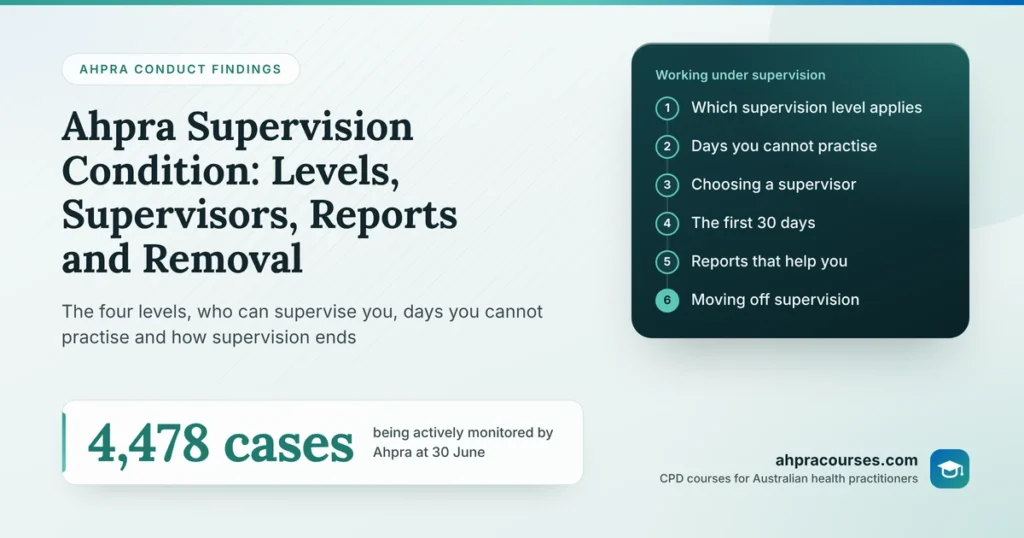
Visual summary: Ahpra Supervision Condition: Levels, Supervisors, Reports and Removal
Which of the four supervision levels applies to you?
The level decides how close your supervisor must be and who carries principal responsibility for each patient. The revised Supervised practice framework renamed the levels from 24 August 2026. Conditions imposed earlier used the names Direct, Indirect 1, Indirect 2 and Remote, and Ahpra's restriction page still explains both sets of names, so check which version your notice uses.
Level (name before 24 August 2026)
Where the supervisor is
Who holds responsibility
Review of your care
Level 1, Direct (Direct)
Always physically present while you provide care. Teleconference supervision is not permitted.
The supervisor takes direct and principal responsibility for every patient. You consult and follow directions before care is given.
Before and during care
Level 2, Indirect present (Indirect 1)
Available at the workplace, in person or by approved video call, for the whole patient interaction.
Shared between you and the supervisor. Protocols must let the supervisor step in.
Real time, with the ability to intervene
Level 3, Indirect accessible (Indirect 2)
Reachable by phone, video call or real-time secure messaging, and able to come to the workplace if asked.
You take primary responsibility.
Regular case review, which may happen after care
Level 4, Remote (Remote)
Not required at the workplace. Reachable at agreed intervals and when needed.
You take primary responsibility.
Regular case review, which may happen after care
Each step up the ladder hands more responsibility to you. Progression usually needs National Board approval, although some arrangements allow it at the supervisor's discretion if the Board agrees.
Your starting level reflects the purpose and the risk. The framework explains that more serious concerns call for closer supervision and more frequent, detailed reporting. A level is not a judgement on your worth as a clinician. It is the amount of oversight a Board considers enough to protect patients while the concern is being addressed.
On which days are you not allowed to practise?
This is the part of a supervision condition that catches people out, and it is where breaches most often begin. The standard wording and Ahpra's guidance set out several situations in which you must not see patients.
Do not practise when
The start date has passed and no supervisor has been approved and published on the public register.
At Level 1 or Level 2, a nomination has been sent but not yet approved. You must not recommence until the supervisor is published, even if the start date is still ahead.
Your approved supervisor is unavailable at the required level and no approved alternate supervisor can step in.
At Level 1 or Level 2, you would be the only registered health practitioner at the location, unless video supervision has been approved.
You would be working at a site that is not approved in your arrangement.
At Level 3 or Level 4 there is a little more room. If your start date has not yet passed, you may keep practising while a nomination is assessed. Once the start date passes without a published supervisor, you must stop.
One narrow exception exists. A medical emergency is an event where it is not possible or reasonable for a patient with a serious or life-threatening condition to be seen by another practitioner or transferred to the nearest hospital. If an emergency stops you complying, you must tell your case officer as soon as possible. Not telling Ahpra is treated as a breach in its own right.
A quick morning check. The answers come from your notice, the public register and your roster, not from what a manager tells you.
Who can be your supervisor, and who is a poor choice?
Ahpra approves only a supervisor who is suitably skilled and experienced to supervise and who can give independent information about your practice. The framework adds that a supervisor usually comes from your own profession, holds general or relevant specialist registration, has no conditions that would impair the role, completes any training the Board requires and signs the approved form. A Board can approve someone from another profession case by case, and it can approve more than one supervisor.
Signs of a strong nominee
Works in your field and setting, so the reports speak to the work you actually do
Has time in their week, because the framework expects supervisors to have adequate time for the role
Has supervised before or has completed supervisor training, and says so in the CV attached to the nomination
Is willing to tell Ahpra about concerns, including concerns about you
Can be available at your level on the days you work, or you have an approved alternate
Risky nominees
A close friend, relative or business partner, where a reasonable person would doubt the objectivity of reports
Someone you employ or pay in a way that could influence what they write
A colleague who only works on different days or at another site from you
Anyone with registration conditions that would limit supervision
A person who has not read your condition, the framework or the reasons it was imposed
Both you and the nominee must declare actual or perceived conflicts of interest, and Boards apply a reasonable person test to decide whether a conflict can be managed. Paying a supervisor is not banned. The supervisee bears the costs of the arrangement, and Ahpra cannot advise on what to pay, so put the fee and the expected time in writing at the start.
If you will share patient records with a supervisor who works outside your practice, Ahpra's guidance says you need documented, informed patient consent under Australian Privacy Principle 6, and the supervisor must protect those records under Principle 11. Build a consent step into your process before the first case review.
What should you do in the first 30 days?
The opening weeks set the tone for everything Ahpra reads later. Late forms, a rejected nominee or an unclear roster in the first month can follow you to the review application. The sequence below keeps you in control.
Read the notice and the framework. Note the start date, the level, the meeting frequency, the report timetable and every deadline. Ask for anything unclear in writing.
Send the acknowledgement form confirming you have read and understood the condition, inside the stated timeframe.
Approach two possible supervisors, not one. Give each a copy of the condition, the framework and an honest account of why it was imposed.
Nominate a primary supervisor and, if you can, an alternate. Attach the CV and the supervisor's signed acknowledgement. An approved alternate is what lets you keep working when the primary is on leave.
Nominate a senior person at every practice location and send their acknowledgement.
Check the register. Do not treat an email from a manager as approval. Approval dates and your level appear on the public register.
Set up a supervision log recording each meeting, the cases discussed, feedback given and what you changed. This becomes the raw material for every report and for your later review application.
If a nomination is not approved, Ahpra generally gives another opportunity to nominate someone else or fix the shortfall. If the start date has passed while you wait, you must not practise in the meantime, so starting early matters.
14 hours
Give your supervisor progress to report from the first meeting
Five courses on assessment, clinical reasoning, scope, safe care and learning from incidents, about 14 hours in total
Self-paced online, with a dated certificate per course and a structured reflection you can share
Suits practitioners on performance-related supervision who want a plan their supervisor can follow
Many practitioners are surprised that a supervision condition involves a second person. Ahpra's restriction asks you to nominate a senior person at each practice location, defined as another person senior by position or experience. Where possible it should be another registered health practitioner, but it can be a practice principal, a practice manager or another senior person.
What they provide
Rosters, pay slips, appointment diaries and billing information, and on request clinical records or audit logs.
Why Ahpra asks
Their records let Ahpra compare when you worked with when your supervisor was available, which is how gaps are found.
If no one is senior to you
Tell Ahpra. Another registered practitioner, a practice manager or a third party may be able to provide the information instead.
The framework lists other monitoring sources too, including Medicare data review, roster or appointment diary review and employer reports. In practice this means your appointment book is evidence. If it shows sessions on a day your supervisor was on leave, expect a question.
What goes into supervisor reports, and how do you make them useful?
Reports are written by your supervisor in the approved form, on the timetable in your condition. The framework expects them to be honest, accurate and objective, and where you have more than one supervisor, the primary contact prepares a report that brings in feedback from the others where feasible. Your job is not to write the report. Your job is to make sure your supervisor has real material to report on.
Before each report is due, check that your log shows
Meetings held at or above the frequency in your condition, with dates
Cases discussed that link to the original concern, not only easy cases
Feedback your supervisor gave and the specific change you made after it
Learning completed, with certificates and a short note on how it changed your practice
Any incident, complaint or near miss, and how it was handled
Sessions or sites where supervision was not available, and what you did instead
The framework also places duties on the supervisor. They must keep adequate written records, assign only tasks within your competence, and notify Ahpra immediately if your health, conduct or clinical performance puts the public at risk. That duty is the reason a friendly supervisor is not a safe supervisor. A report that later proves to be uncritical can harm both of you.
How you take feedback matters as much as the feedback itself. In one Queensland tribunal review of conditions, [2023] QCAT 262, supervisors and mentors at two practices had reported defensiveness and reluctance to accept advice, and one supervisor withdrew. The tribunal still imposed conditions covering supervised practice, education, mentoring and audit. Showing that you invite and act on criticism is part of what a report should be able to record. Our guide to demonstrating insight to Ahpra explains what that looks like on paper.
What happens when a supervision condition is breached?
A breach is treated as a conduct issue of its own, separate from whatever led to the condition. The published outcomes below show the range. Practitioners are not named here.
Tribunal, Queensland
Dentist, [2025] QCAT 2
A dentist with conditions requiring supervision for implant and fixed prosthodontic procedures breached them on 25 occasions between September 2020 and March 2021. He worked without a supervisor, under a nominee who had not been approved, and under a supervisor after being told her nomination was rejected. The tribunal found professional misconduct, reprimanded him, imposed a fine of $15,000 and suspended his registration for two months. Admissions, later insight and completed education were taken into account.
Tribunal, Queensland
Psychologist, [2025] QCAT 235
A psychologist was required to have one hour of supervision each fortnight for at least six months and to nominate supervisors by a set date. She did not comply despite at least nine opportunities, and later sent an attachment Ahpra could not open and did not follow up. The tribunal found professional misconduct and imposed a reprimand, noting that a reprimand is not a trivial penalty.
Panel, South Australia
Psychologist, panel summary 2022.0907
A performance and professional standards panel considered allegations that a psychologist had not complied with conditions requiring supervision and a reflective practice report, even though Ahpra staff had repeatedly followed up. The panel reprimanded the practitioner and imposed conditions.
The common thread is not one dramatic decision. It is a run of missed deadlines, unapproved arrangements and silence when Ahpra asked questions. If you have already slipped, read our guide to what happens after a breach of Ahpra conditions and contact your case officer before Ahpra contacts you.
How do you move down a level or come off supervision?
Section 125(1) of the National Law lets a registered practitioner apply to the National Board to change or remove a condition. Ahpra forwards the application, and the Board or its delegate decides, after considering any submissions you make. You can apply once the review period in your condition has ended, or earlier if there has been a material change in your circumstances, such as completed supervision or remedial education, a new job or a new principal place of practice.
FormARCD-00
Application for review of conditions or undertaking, from Ahpra's common forms page
Reports4 weeks
Third-party reports should be dated within the preceding four weeks
Decision time4 to 12 weeks
Typical range Ahpra gives, with priority for restrictions that stop you practising
If refusedAppealable
A refusal is an appealable decision to the responsible tribunal
For supervision, Ahpra's evidence list asks for a supervisor report, evidence that you have addressed the concerns and, where relevant, evidence of completed supervision hours. Psychology restrictions also need a reflective report. Ahpra will not request reports on your behalf, so ask your supervisor early and give them your log so the report can be specific.
Progression to a less intensive level often happens inside the condition rather than by a full review. The framework says progression usually needs National Board approval, and some arrangements let the supervisor decide if the Board has agreed. Ask your supervisor to comment on readiness for the next level in each report so the evidence builds over time. Our step-by-step guide on getting Ahpra conditions removed covers the full application.
Worked scenario: a physiotherapist starting at Level 2
Hypothetical, for illustration only
Priya, a physiotherapist, receives a notice after a performance assessment. Her condition requires Level 2 supervision across her practice, monthly meetings and reports every three months. She works three days a week at a private clinic and one day at an aged care service.
Week 1. She reads the notice twice, lists every deadline and sends her acknowledgement. She realises the aged care site has no other physiotherapist on her day, so at Level 2 she cannot work there until that changes.
Weeks 2 to 3. She asks two senior colleagues at the clinic. One agrees to be primary supervisor and the other to be alternate. Both receive the condition, the framework and the assessor's findings. She nominates the practice manager as senior person.
Week 6. Both supervisors appear on the register. She tells the aged care service she cannot work there for now and adjusts her roster in writing.
Months 1 to 6. She keeps a log, chooses cases that link to the assessor's findings, and completes structured learning on assessment and clinical reasoning. Her supervisor's reports describe changes, not just attendance.
Month 6. With two reports supporting progression, the Board approves Level 3. She later applies under section 125 with a fresh report, her log summary and her learning evidence.
Nothing in this scenario guarantees an outcome. It shows the habits that make a supervision condition easier to manage: early nominations, an alternate, a clean roster and reports grounded in real cases.
For practitioners working under supervision
Learning your supervisor can build on
Each course is self-paced, about 2 hours, with a dated certificate. Use the one closest to the concern behind your condition. Completing a course supports your evidence and does not determine any regulatory outcome.
Can I keep working while Ahpra assesses my supervisor nomination?
It depends on your level and start date. At Level 1 or Level 2 you must not recommence practice until a supervisor is approved and published on the register. At Level 3 or Level 4 you may keep practising while the nomination is assessed only if the start date has not yet passed.
Does a supervision condition appear on the public register?
Yes. Ahpra states that the dates a supervisor is approved and the level of supervision appear on the public register, which is why you should check the register rather than rely on an email before you start work.
Who pays for supervision under an Ahpra condition?
The supervisee bears the costs of the arrangement, including any payment to the supervisor. Ahpra and the National Boards cannot advise on what to pay, so agree the fee and the time involved in writing at the start.
What happens if my supervisor leaves or goes on leave?
You must nominate a new supervisor. If an alternate supervisor is already approved, you can keep practising while the new nomination is assessed. If not, you must stop practising until a new supervisor is published, subject to the start date rules for Levels 3 and 4.
How quickly must I tell Ahpra about a change in my supervision?
The Supervised practice framework asks you to tell Ahpra within seven calendar days if your circumstances or your supervisor's circumstances change, unless your condition states a different timeframe.
Can my supervisor be from a different profession?
Supervisors usually come from the same profession, but a National Board may approve a supervisor from another profession case by case if they are suitably skilled to supervise the work you do.
Do psychologists follow the same supervision rules?
No. The Supervised practice framework does not apply to psychologists. Psychologists with a supervision requirement have a separate professional supervision restriction and should read the Psychology Board's supervision guidance.
How long does a review of a supervision condition take?
Ahpra says review applications may take four to twelve weeks, and it prioritises applications about restrictions that currently stop you practising. Incomplete applications take longer, so send recent reports with the form. You can browse every course and guide on the Ahpra Courses home page.
Notified over missing S8 stock or drug register discrepancies? How Ahpra and the NMBA assess diversion, when immediate action applies and 6 real outcomes.
Tell me your profession and what's happening at work or with Ahpra. I'll ask a few questions, show you the course that fits on screen, and enrol you on the call if you wish. Enrolled learners can study their course with me, one-to-one.
Dr AI Alma is an AI tutor, not a person or a registered health practitioner, and does not give legal or clinical advice. The call uses your microphone.
Dr AI AlmaReady
You are talking to Dr AI Alma, an AI tutor, not a person. Brief notes are kept to help you. Please don't name patients or colleagues. Privacy