
In short
An AHPRA case discussion is a formal but non-compulsory conversation, usually by phone or video, between you, an Ahpra officer and your representative if you choose to have one. It moves from your current practice to the events, your reflections and the actions you have taken since. No decision is made on the day. Afterwards the officer usually asks for follow-up information, may contact your workplace, and the matter continues to a report and a National Board decision.
Is a case discussion an interview, a hearing or something else?
It is a structured conversation. Ahpra describes it as a formal, non-compulsory discussion where an Ahpra officer gathers information about your practice, your reflections and the actions you have taken since the events in the notification.
That definition matters, because practitioners often walk in expecting either a friendly chat or a cross-examination. It is neither. It is formal because what you say becomes part of the information the National Board relies on. It is non-compulsory because you are invited, not ordered, to take part. Ahpra says its preference is to gather information by discussing things with you and then following up in writing, because that saves time and resolves concerns sooner.
A case discussion is
- A chance to explain events in your own words
- A record that informs the Board's decision
- An opportunity to show insight and change
- Usually held by phone or video
- Something you can attend with representation
A case discussion is not
- A hearing, and no finding is made on the day
- A decision by the investigator about your registration
- An informal catch-up you can treat casually
- A debate with the person who raised the concern
- The end of the investigation
For where the case discussion sits in the wider sequence, see our guide to the full AHPRA investigation process.
Who takes part in the discussion?
Usually a small group: you, the Ahpra officer handling the matter, and your representative if you choose to have one.
The person who made the notification does not attend. The case discussion is between you and Ahpra, and the notifier's account is gathered separately.
What happens during the discussion, stage by stage?
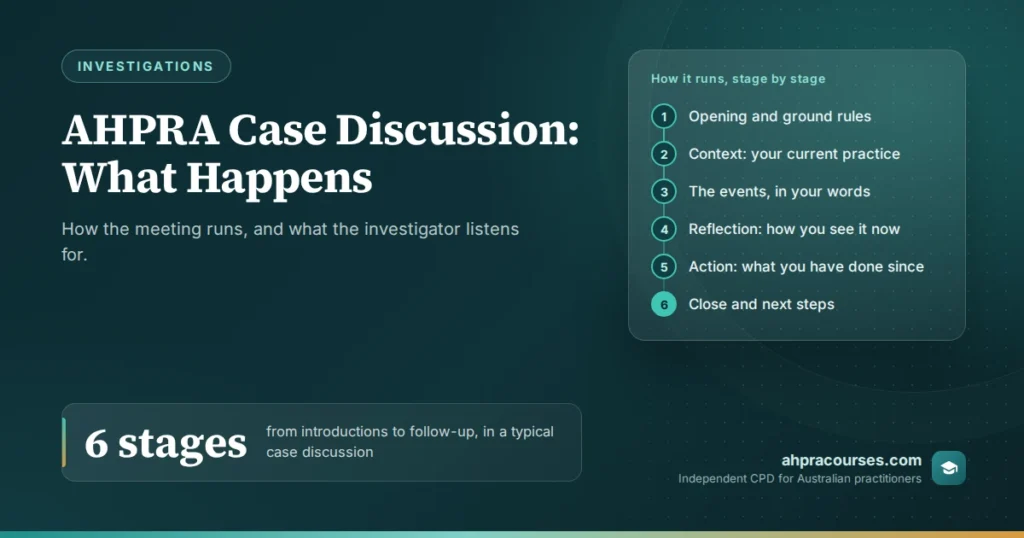
Most case discussions follow a recognisable shape, moving from context to the events to what has changed.
Every matter is different, and the officer will adapt the conversation to the concern. The sequence below reflects the areas Ahpra says it covers: your practice, your reflections, and your actions in response to the events.
- OpeningIntroductions and the ground rulesThe officer confirms who is present, explains why the discussion is happening, how the information will be used, and that you may pause to consult your representative.
- ContextYour current practiceWhere you work, your role, your scope, typical caseload, supervision arrangements and any changes since the events. This sets the background for everything else.
- The eventsWhat happened, in your wordsYou will be taken through the concern. Expect to be asked about decisions, timing, who else was involved and what your records show.
- ReflectionHow you now see itQuestions shift to understanding: the impact on the patient, what contributed, and what you would do differently. This is where insight is tested.
- ActionWhat you have done sinceLearning completed, changes to your practice or systems, supervision, and how you know the changes are working.
- CloseFollow-up and next stepsThe officer will usually explain what follow-up information is needed to confirm what you described, and what happens next.
Specific questions vary with the type of concern, and preparation is a separate topic. What matters here is that more than half of the conversation is typically about the present: your practice now, your understanding now and your actions since.
What is the investigator actually listening for?
Four things run under almost every question, whatever the concern.
Is your account accurate and consistent?
The officer will have your written response, the records and other material in front of them. They are noticing whether your spoken account matches. A practitioner who corrects an earlier error openly is far more credible than one whose story drifts. This is why the discussion links closely to the other evidence an investigator gathers.
Do you understand the impact on the patient?
Practitioners under stress naturally focus on the effect on themselves. The officer is listening for whether you can step into the patient's position and describe what the event meant for them.
Do you own your part without blaming others?
Systems, staffing and workload are often genuine contributors and it is fair to describe them. The difference lies in describing them as context while still taking ownership of your own decisions.
Is the risk lower now than it was then?
Boards act to protect the public in the present. Concrete evidence of change, such as completed learning, a new process or supervision feedback, answers this directly. Vague promises do not.
Insight is the theme investigators probe most. Learn how to recognise and articulate it before you are asked.
Start the Module on InsightHow is a case discussion different from other AHPRA meetings?
Practitioners sometimes confuse the case discussion with later stages. The table compares them.
| Meeting | Compulsory? | Who leads | Purpose | Decision on the day? |
|---|---|---|---|---|
| Case discussion | No, but encouraged | Ahpra officer or investigator | Gather your account, reflections and actions | No |
| Show cause response | Optional, but your only chance before action | National Board | Respond to proposed action under s179 | No, the Board decides later |
| Performance assessment | Yes, if required under s170 | Independent assessor | Test how you practise against the standard | No, a report follows |
| Panel hearing | Yes, once referred | Panel of practitioners and a community member | Decide whether findings are made | Findings are made by the panel |
It is non-compulsory. Should you still take part?
In most cases, taking part is the better path, but it is a decision to make with your adviser.
Ahpra says it encourages practitioners to participate. If you decline, the matter continues: the investigator can gather information in other ways, including by written notice, which is not optional. You also lose the opportunity to explain context and show insight in a conversation rather than on paper.
- Reasons to attend: you can explain context, correct misunderstandings early, and show reflection and change in your own words.
- Reasons to pause: parallel police or coronial proceedings, or legal advice that a written response is safer in your circumstances.
- Middle ground: your adviser may suggest timing changes, a written statement first, or narrowing the topics.
What happens after the discussion ends?
The investigation continues. The discussion is one input, not the conclusion.
- Follow-up requests. Ahpra says the officer will ask for follow-up information to confirm the actions you described, such as certificates, policies or records.
- Workplace contact. Ahpra says this may include speaking to your workplace to gather information. Expect it, and avoid describing changes your workplace cannot confirm.
- Investigation report. The investigator prepares a report for the National Board containing the relevant information collected.
- Board decision. The Board decides whether to take no further action or some form of regulatory action. If it proposes relevant action, you receive a show cause notice first.
Our guide to the possible outcomes of a notification explains each of the decisions open to the Board.
Turn what you say at the case discussion into documented evidence: insight, reflection and remediation in one structured program.
Get the Insight, Reflection & Remediation ProgramOn the day: what helps and what hurts
Small practical choices during the call make a real difference to how your account comes across.
Helps
- A quiet, private room and a reliable connection
- Your response, timeline and certificates within reach
- Short, direct answers, then stopping
- Saying "I don't recall" or "I'd need to check the notes" when that is true
- Asking for a question to be repeated if it is unclear
- Pausing to speak privately with your representative
- Offering to send evidence of the changes you describe
Hurts
- Joining from a ward, car or shared space
- Guessing at dates or details to fill a silence
- Long speeches that drift from the question
- Criticising the notifier or colleagues
- Describing changes your workplace cannot confirm
- Contradicting your written response without explaining why
- Treating the call as informal because it is by phone
After the call, write down any follow-up items the officer mentioned, agree deadlines with your adviser, and send what was requested promptly. A fast, complete follow-up closes the loop on everything you said.
Three moments that change how a case discussion goes
These short examples are illustrative composites, not real cases. Each shows how a single moment shapes the information the Board later reads.
A pharmacist answers every question by reading from pages of notes. When the officer asks a simple follow-up about what changed in the dispensary, there is no answer on the page.
The lesson: notes help with dates and facts, but reflection has to be understood, not recited. Investigators can tell the difference.
A GP spends most of the discussion explaining why the patient's complaint is exaggerated. Some points are fair, but the officer hears little about the patient's experience.
The lesson: you can disagree with facts calmly and briefly. The rest of the time is better spent on what you understand and what you have changed.
A nurse describes the escalation error, its effect on the patient, the targeted learning completed and a new handover checklist her unit adopted. She offers to send the certificate and the checklist.
The lesson: specific, verifiable actions give the officer exactly what the follow-up stage needs to confirm.
The thread through all three is the framework of insight, reflection and remediation. If you have already prepared a written reflective statement, the discussion is your chance to show that the understanding behind it is genuine. You can browse every course and guide on the Ahpra Courses home page.
Courses for this stage
Courses that support you before and after a case discussion
Structured CPD you can complete now and refer to when the officer asks what you have done since the events.
Module on Insight
- Understand what genuine insight looks like
- Describe impact on the patient clearly
- Avoid defensive framing
Module on Reflection
- Structure honest, specific reflection
- Link reflection to changed practice
- Produce dated evidence
How to Deal with a Notification or Investigation
- Know what each stage involves
- Engage with Ahpra confidently
- Meet deadlines and requests
Ensuring a Mistake or Misconduct is Not Repeated
- Identify contributing factors
- Build safeguards into practice
- Show the risk has reduced
Frequently asked questions
What is an AHPRA case discussion?
Ahpra describes it as a formal, non-compulsory discussion where an Ahpra officer gathers information about your practice, your reflections and the actions you have taken in response to the events raised in the notification.
Is an AHPRA case discussion compulsory?
No. It is non-compulsory, although Ahpra encourages participation. If you decline, the investigation continues and information may be gathered in other ways, including formal written notices that you are required to comply with.
Can I bring someone to the case discussion?
Yes. Ahpra confirms you can have representation, for example from your professional indemnity insurer or professional association. Your representative and you receive information about the process before the discussion takes place.
Does the notifier attend the case discussion?
No. The case discussion is between you and Ahpra, with your representative if you have one. The notifier's account is gathered separately as part of the assessment or investigation of the concern.
Is a decision made at the case discussion?
No. The officer gathers information but does not decide the outcome. The investigator later prepares a report for the National Board, and the Board decides whether any regulatory action is needed.
How is a case discussion usually held?
Ahpra says its preference is to discuss matters with you and then follow up in writing, and discussions are commonly held by phone or video. Confirm the format and expected length with the officer beforehand.
What happens after the case discussion?
The officer usually asks for follow-up information to confirm the actions you described and may speak to your workplace. The investigation then continues to a report and a decision by the National Board.
What does the investigator focus on during the discussion?
Mainly whether your account is accurate and consistent, whether you understand the impact on the patient, whether you take ownership of your decisions, and whether the risk is lower now than when the events occurred.