Bundle & save Studying more than one course? Save 15% on 3, 22% on 5 and 30% on 10 or more, taken off in your cart.
Free Course AdvisorQuestions about which course fits your case?
Ahpra Courses

A course on claims, fees and commercial interests for health practitioners in Aotearoa

Financial Integrity in Practice for Health Practitioners in New Zealand

Last updated

Every invoice to ACC, every capitation register, every Special Authority application and every quote to a patient is a statement that you are professionally responsible for. Funders in New Zealand pay largely on trust, so most financial concerns begin with a system no one checked or a rule no one read, and only some with dishonesty. This course teaches the claiming rules, the review tools funders use and the systems that keep your claims, fees and interests defensible.

  • 3 hours, CPD-aligned
  • Written to your responsible authority's code
  • 8 sections with graded checks
  • 20-question final assessment
  • Dated, verifiable certificate
  • Self-paced on any device
  • 1-to-1 AI tutor, Dr AI Alma
Enrol now, NZ$120Bulk buy from NZ$85 a course

Dated certificate with a number anyone can verify

61CPD courses for New Zealand practitioners
16Professions covered
24/7Self-paced, online, any device
NZ$120Per course, no subscription

What has prompted you to look at this course?

At a glance

Who it is for
Doctors, nurses, nurse practitioners, midwives, pharmacists, dental practitioners, physiotherapists, chiropractors, osteopaths, podiatrists and other HPCA-registered practitioners, plus practice owners and managers who design claiming systems
Regulators covered
Every HPCA responsible authority, plus HDC, PCCs and the Tribunal, alongside the funders whose rules you claim under: ACC, Health NZ and Pharmac
Format
Online and self-paced: seven teaching sections and a conclusion (8 sections, 23 lessons), with cases drawn from general practice, physiotherapy, maternity, pharmacy and dental practice
Assessment
Five questions on ACC, capitation, Pharmac or fees after each of sections 1 to 7, a 20-question final on claiming scenarios (pass at 80%), and a reflection on your own billing systems
Certificate
Certificate of completion stating learning time and date, with an online verification number and QR code
Learning time
About 3 hours
Best taken with
Probity and Honesty in Practice, and Clinical Documentation and Record Keeping, since records are the evidence behind every claim
Learning time
About 3 hours, self-paced, online on any device. Progress is saved to your account.
Price
NZ$120 for one course. Bundles: 5 courses for NZ$545, 10 courses for NZ$850.

In short

In New Zealand health practice, money comes from ACC, Health New Zealand | Te Whatu Ora, Pharmac-funded supply, insurers, employers and patients themselves, and each stream has its own rules. A claim is a professional representation: dishonest or careless claiming can be charged as conduct likely to bring discredit to the profession under s 100(1)(b) of the HPCA Act 2003, and a fraud conviction is a separate ground under s 100(1)(c). Right 2 of the Code of Rights protects patients from financial exploitation and Right 6 entitles them to know the costs of each option. This course teaches the claiming rules practitioners actually need, how funders review and recover, how to manage fees and commercial interests, and how to correct an error properly.

The certificate you receive

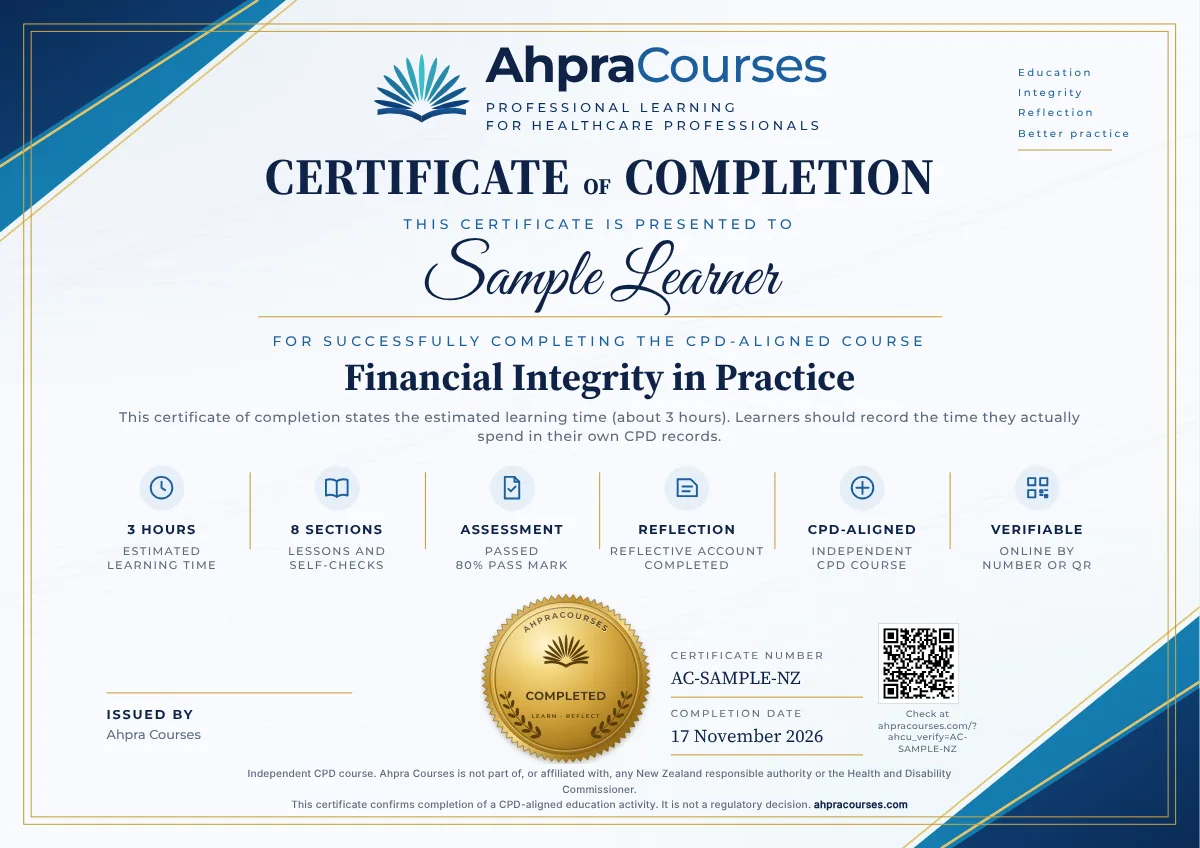
Sample certificate of completion for Financial Integrity in Practice for Health Practitioners in New Zealand from Ahpra Courses, showing the learner's name, the course title, an estimated learning time of about 3 hours, the completion date and a certificate number that can be checked online
Sample. Your certificate shows your name, the course title, the completion date and its own certificate number.

Pass the final assessment and complete the reflective account, then download your certificate of completion. The certificate lists the course, date and learning time, and a funder, employer or authority can check it online through its number or QR code. Log the hours you really spent, alongside one change you made to your claiming or fee processes.

How practitioners use it

  • Add it to your recertification record with a note on the claiming or fee practice you changed.
  • Include it in a response to ACC, a funder audit, your responsible authority or a PCC as evidence of learning completed.
  • Use it when you introduce a new claiming procedure, to show staff the standard the practice is working to.
  • Share it with your practice owner, manager or board when proposing a self-audit or conflicts register.
  • Keep it with your remediation evidence if repayment or disclosure has been required.

Who this course is for

General practitioners and nurse practitioners

ACC lodgement and certification, enrolment and capitation, and Special Authority applications all carry declarations. The course shows where each can go wrong and how to keep them accurate.

Physiotherapists, chiropractors and osteopaths

ACC treatment invoicing, time-based billing and treating family or colleagues are frequent sources of concern. Section 2 sets out the rules plainly.

Midwives

Lead maternity carer care is claimed in modules, and transfers of care mean claims must be divided correctly. Section 3 covers maternity claiming and the conversations that prevent disputes.

Pharmacists and pharmacy owners

Community pharmacy claims, prescription endorsements and contracted services rely on accurate declarations. Section 4 covers pharmacy claiming and commercial influence.

Dental practitioners

Private fees, estimates, changing treatment plans and insurer claims bring Right 6 and Right 2 into daily practice. Section 6 covers informed financial consent.

Practice owners and managers

Delegating claims to staff or software does not delegate accountability. Section 7 shows how to build written rules, checks and safe ways for staff to raise concerns.

Practitioners under review

If ACC, a funder, your authority or a PCC is looking at a financial matter, the course helps you understand the process and show insight and correction.

The concerns this course addresses

ACC invoices that do not match the records

ACC expects invoices within two months of the service where possible and will not accept them later than 12 months after it. It reviews invoices for unusual patterns, may request clinical records and may contact clients to confirm services were provided. Time billed must reflect treatment actually given for the covered injury.

ACC: How to invoice us; How we support quality and resolve issues

Registers and claims that drift

Capitation follows the enrolment register and maternity care is paid in modules, so an inaccurate register or a duplicated module claim is a financial integrity issue even when no one intended it. Agree and record who claims what when care transfers.

Health NZ PHO Services Agreement; Primary Maternity Services Notice 2021

Declarations that funding criteria are met

A Special Authority application or prescription endorsement states that the patient meets the funding criteria. Adjusting a result or history to fit the criteria, however well meant, is a false declaration. Advocate openly for access instead.

Pharmac Pharmaceutical Schedule general rules; code of conduct of your authority

Fees and informed financial consent

Right 6(1)(b) of the Code of Rights includes the costs of each option in the information a patient is entitled to. Give estimates before treatment, seek agreement again when costs change, and never seek financial agreement from someone sedated or distressed.

Code of Rights Rights 2, 6 and 7

Ownership, referral and product sales

Owning a service you refer to, selling products or receiving industry payments are not banned, but they must be disclosed and managed so the patient has accurate information, real alternatives and a free choice. Inducements for referral are not acceptable.

Medical Council: Doctors and health-related commercial organisations; Pharmacy Council Code of Ethics principle 4

Finding and correcting an error

If you find a claiming problem, stop the practice, preserve records, work out its scope, take advice, disclose to the funder and repay. Self-disclosure early is usually viewed more favourably than discovery by audit.

ACC: How we support quality and resolve issues; HPCA Act s 100

When the regulator or police are involved

ACC's responses to serious concerns include notifying a regulator, referral to police and prosecution. A responsible authority may refer a financial matter to a PCC, and the Tribunal can find professional misconduct or act on a relevant conviction.

ACC: How we support quality and resolve issues; HPCA Act ss 67, 80, 100 and 101

Systems that claim correctly

Most claiming problems are prevented by written rules, named ownership of each claim type, checked software defaults, separation of duties and regular self-audit. Staff also need a safe way to raise concerns.

Course section 7; Protected Disclosures (Protection of Whistleblowers) Act 2022

What the course covers

Eight sections and 23 lessons follow each funding stream in turn, then fees, interests and the systems that keep claims accurate. A knowledge check closes each of sections 1 to 7.

1Following the money in New Zealand health practice3 lessons

Following the money. Why financial integrity is a professional standard and how s 100 of the HPCA Act applies, a map of who pays for what in New Zealand practice, and the difference between error, waste, abuse and fraud using ACC's own descriptions.

  • 1.1 Why financial integrity is a professional standard, not just an accounting task
  • 1.2 The funding map: who pays for what
  • 1.3 Error, waste, abuse and fraud: drawing the lines
2ACC: lodgement, certification and invoicing4 lessons

ACC. Lodging claims and certifying incapacity honestly, explaining when a condition is not accident-related, invoicing rules and time limits, accurate time-based billing, treating family, colleagues and yourself under ACC, and what to do when ACC asks questions.

  • 2.1 Lodging claims and certifying incapacity honestly
  • 2.2 Invoicing ACC: the rules that trip up honest providers
  • 2.3 Treating family, colleagues and yourself on ACC
  • 2.4 When ACC asks questions
3Health NZ funding: capitation, maternity and contracted programmes3 lessons

Health NZ funding. Enrolment, capitation and the accuracy of the register, audit and recovery provisions in agreements, lead maternity carer modules and dividing claims at transfer, and contracted programmes such as acute care funding.

  • 3.1 Enrolment, capitation and the accuracy of the register
  • 3.2 Maternity modules and other episode-based claims
  • 3.3 Contracted programmes and the payment details problem
4Pharmac, prescriptions and pharmacy claiming3 lessons

Pharmac, prescriptions and pharmacy claiming. Special Authority and endorsements as declarations with financial weight, community pharmacy claiming for services actually provided, and commercial influence on prescribing and dispensing.

  • 4.1 Special Authority and endorsements: declarations with financial weight
  • 4.2 Community pharmacy claiming
  • 4.3 Prescribing, dispensing and commercial influence
5Ownership, self-referral and commercial interests3 lessons

Ownership, self-referral and commercial interests. The Medical Council statement on health-related commercial organisations, equivalent standards across the professions, product sales at cost plus reasonable handling, research and consultancy, and working in both public and private practice.

  • 5.1 The Medical Council statement on health-related commercial organisations
  • 5.2 Commercial interests across the professions
  • 5.3 Working in both public and private practice
6Fees, patients' money and personal financial conduct3 lessons

Fees, patients' money and personal conduct. Informed financial consent under Right 6, changing costs, advertising prices under the Fair Trading Act 1986, accurate insurer claims, debt collection kept apart from complaints, employer resources and honest practising certificate declarations.

  • 6.1 Honest fees and informed financial consent
  • 6.2 Advertising prices, insurers and debt
  • 6.3 Employer resources, patients' money and personal finances
7Systems, investigations and putting things right3 lessons

Systems, investigations and putting things right. Building a practice that claims correctly, self-audit, finding a problem and the steps to correct, repay and disclose, protected disclosures, how funders and regulators respond, and showing insight.

  • 7.1 Building a practice that claims correctly
  • 7.2 Finding a problem: correcting, repaying and speaking up
  • 7.3 How the system responds, and how to show insight
8Conclusion and key points1 lesson

Conclusion and key points. A short set of rules to carry into every claim, quote and commercial decision, with the reflective account linking the course to your own systems.

  • Conclusion and key points
✓Reflection, final assessment and certificate3 steps
  • Your reflective account, which you can download for your records
  • Final assessment: 20 questions, 80% to pass
  • Certificate of completion, dated and numbered

Why claims, fees and interests are professional conduct issues in New Zealand

Public and private funders in New Zealand rely heavily on practitioners' own statements. ACC pays on the basis of lodgements, certificates and invoices; Health NZ pays on enrolment registers, maternity module claims and contracted service claims; pharmacy is paid on claims for medicines and services supplied; insurers rely on stated diagnoses and fees. Each of those statements is made by, or under the authority of, a registered practitioner. That is why financial matters are treated as professional conduct, not just accounting.

The legal hooks

Dishonest claiming fits within s 100(1)(b) of the HPCA Act, under which the Tribunal can find professional misconduct where conduct brought, or was likely to bring, a profession into discredit. A relevant conviction is a separate ground under section 100(1)(c), and section 67 requires convictions to be notified to the responsible authority. For financial dishonesty the s 101 options run from censure, a fine of up to $30,000 and costs, through conditions or suspension of up to three years, to cancellation. On the patient side, Right 2 of the Code of Rights protects against financial exploitation, which clause 4 defines to include abuse of a position of trust and undue influence, and Right 6(1)(b) requires an explanation of the costs of each option.

Error, waste, abuse and fraud

ACC describes waste as carelessness about policies or procedures and abuse as negligence or failure to exercise proper duties, including manipulating policies or procedures. Fraud adds dishonesty. These categories matter because the response differs: education and a letter of expectation for a careless pattern, recovery and closer scrutiny for abuse, and regulator notification or police referral for suspected fraud. Practitioners often move between categories without noticing, for example when a software default that over-bills is discovered and left in place.

How funders review

ACC reviews invoices for unusual patterns and volumes, may request clinical records, may contact clients to confirm the services they received and may carry out a formal investigation. It can recover overpayments and, for serious concerns, impose additional invoicing requirements, notify a regulator, refer to police or prosecute. Health NZ agreements include audit and recovery provisions. A clean set of records that matches every claim is the best protection.

Fees, insurers and patients' money

Private practice brings its own risks. Patients are entitled to know the cost of each option before they choose, and to be asked again if the cost changes during treatment. A health insurance claim has to show the diagnosis, procedure and fee as they really were, even when a patient asks for something different to improve their cover. Debt collection must be kept separate from complaints, so an invoice is never used to pressure someone who has raised a concern. Practitioners who hold patients' money, act under a power of attorney or accept gifts or bequests face additional restrictions in several codes, and every authority asks for honest answers on practising certificate declarations.

Putting it right

When a practitioner finds a problem and corrects it promptly, with disclosure and repayment, the matter usually looks very different from one discovered by audit. The course sets out the sequence: stop, preserve, scope, take advice, disclose, repay, record and fix the system.
How to respond to a complaint or notification about this kind of concern

If ACC, a funder, your responsible authority or a PCC has raised a financial concern, these steps help you respond accurately and show integrity. Each is linked to a section of the course.

  1. Take advice first

    Speak to your indemnity provider or lawyer, and an accountant if repayment is involved. Do not contact patients about the review without advice.

    In the course: Section 7 explains how funders and regulators respond and what you can expect at each step.

  2. Preserve everything

    Keep clinical records, appointment books, invoices and software logs exactly as they are. Do not tidy or complete notes after the event.

    In the course: Section 7 covers preserving evidence and why altered records change the nature of a concern.

  3. Work out the scope

    Identify which claims are affected, over what period, and why: a misunderstood rule, a software default, a staff practice or a decision you made.

    In the course: Sections 2 to 4 set out the rules for each funding stream so you can test your claims against them.

  4. Disclose and repay where owed

    Tell the funder what you found and propose repayment. Be honest about uncertainty rather than understating it.

    In the course: Section 7 sets out the steps of correcting, repaying and disclosing an error.

  5. Fix the system and show it

    Write the rule down, assign ownership, change software defaults, introduce checks and audit again. Give dates and evidence.

    In the course: Section 7 and the reflective account turn the changes into evidence of insight.

Never create, complete or change clinical notes to support an invoice after a funder or regulator has raised questions. Records that do not match what happened turn a claiming error into dishonesty.

This page is general information, not legal, tax or accounting advice. Before responding to ACC, Health NZ, a responsible authority or a PCC about a financial matter, get advice from your indemnity provider, a lawyer and, where repayment is involved, an accountant.

How this course helps with a complaint or notification

It teaches the actual claiming rules

Rather than restating that honesty matters, the course explains the rules for ACC, Health NZ, maternity and pharmacy claims that practitioners most often misunderstand.

It covers fees and interests together

Private fees, insurer claims, ownership and product sales are treated alongside public funding, because patients and regulators see them as one picture.

It shows how to correct an error

The course gives a clear sequence for finding, scoping, disclosing and repaying, which is often the difference between a supported correction and a disciplinary charge.

It is built for practice owners as well

Section 7 helps owners and managers design claiming systems with clear ownership, checks and a safe way for staff to raise concerns.

Remediation evidence that carries weight

Carries weight

  • A written claiming procedure for each funding stream, with named owners
  • A self-audit comparing a sample of claims with clinical records, before and after changes
  • Correspondence showing voluntary disclosure and agreed repayment
  • Evidence that software defaults were checked and corrected
  • A conflicts of interest register and the disclosure wording used with patients
  • Standard written estimates and records of financial consent for private treatment
  • A reflective account linking the concern to your code and the Code of Rights
  • Staff training records on the new procedure, with a way to raise concerns

Carries little weight

  • Statements that everyone bills this way
  • Blaming a practice manager or software for claims made in your name
  • A promise to be more careful without a changed system
  • General CPD unrelated to claiming or fees
  • Testimonials about clinical skill
  • Records completed after a funder raised questions
  • Repayment made without any explanation of the cause
  • Disclosure only after an audit found the problem

A remediation plan, phase by phase

  1. Days 1 to 7

    Stop and preserve

    • Stop the claiming practice in question
    • Preserve records, invoices and software logs unchanged
    • Contact your indemnity provider and lawyer
  2. Weeks 1 to 4

    Scope and disclose

    • Identify affected claims and the period
    • Disclose to the funder with a proposed correction
    • Agree repayment where money is owed
  3. Weeks 4 to 10

    Rebuild the system

    • Write claiming rules and assign named owners
    • Check and correct software defaults
    • Train staff and set up a way to raise concerns
  4. Months 3 to 6

    Audit and reflect

    • Audit a sample of claims against records
    • Complete the reflective account with evidence
    • Report progress to the funder or authority if asked
  5. Every year

    Keep it clean

    • Repeat the self-audit
    • Review the conflicts of interest register
    • Update procedures when funder rules change

Writing your reflective statement

1The streams I claim from

List the funding streams you claim from and who in your practice prepares each claim.

Example only (Physiotherapist J, a fictional clinic owner): We invoice ACC for most clients, a few insurers, and private fees. Reception creates invoices from the booking system.

2The rule I had wrong

Which rule did you misunderstand or not know?

Example only: The booking system billed the standard appointment length even when I treated for less time. I had assumed the default was correct.

3The standard engaged

Which part of your code and the Code of Rights applies?

Example only: My Board's code expects honest claiming, and ACC expects time billed to match treatment actually given for the covered injury.

4What I did about it

Describe how you scoped, disclosed and corrected the problem.

Example only: I audited six months of invoices, disclosed the overbilling to ACC with a schedule, and agreed repayment.

5What I changed

What system change prevents a repeat, and from when?

Example only: Since August the system requires the treating physiotherapist to enter actual treatment minutes before an invoice can be created.

6How I will know

Describe the audit or check you will run.

Example only: A colleague will compare 20 invoices with treatment notes every quarter for the next year.

The example sentences are fictional and show structure only. Your statement has to be your own honest account of what happened.

A weak and a strong response, side by side

Fictional: Dr W, a GP and part-owner of a skin clinic, referred many patients there for lesion removal without mentioning his interest. A patient found out and complained.

Weak

The clinic provides excellent care and patients are better off going there. My shareholding is small and has no bearing on my referrals. Other GPs refer there too. I do not think a disclosure would have made any difference to the patient.

Strong

I accept that I did not tell patients about my ownership interest or explain the alternatives, including public services and other providers, and their costs. The Medical Council expects doctors to disclose such interests and to make clear the choice is the patient's, and Right 6 entitles patients to know their options and costs. I now give every patient a written disclosure and a list of alternatives before referral, I have reviewed my referrals for the past year with a colleague, and I have recorded my interest on the practice's conflicts register.

Why the second one works: The strong response accepts the specific failure, identifies the standard, and shows a verifiable change. The weak response defends the clinic's quality, which was not the issue, and dismisses the patient's right to know.

Mistakes practitioners make when responding

Trusting software defaults

A default that bills a standard item regardless of time or service will produce inaccurate claims under your name.

Reshaping a history for ACC

Record what the patient actually reported; explain when a condition is not accident-related.

Rolling certificates forward

Each incapacity certificate should reflect a fresh assessment.

Massaging Special Authority criteria

Advocate openly for access instead of adjusting results to fit funding rules.

Quoting after the fact

Costs should be discussed before treatment and agreed again if they change.

Invoicing to answer a complaint

Keep fees and complaints separate. An invoice must never be used to pressure a complainant.

Assuming disclosure is enough

Patients also need accurate information about alternatives and a free choice.

Waiting for the audit

Errors you find should be disclosed and corrected promptly.

The code provisions this course works through

These are the provisions most often engaged when a practitioner's financial conduct is questioned.

Code of Rights, Right 2Freedom from financial exploitation

Every consumer has the right to be free from discrimination, coercion, harassment, and sexual, financial or other exploitation.

In the course: Section 6 applies this to fees, debt and dealings with patients' money.

Code of Rights, clause 4Meaning of exploitation

Clause 4 counts abuse of trust, breach of a fiduciary duty and undue influence as exploitation, which can include selling or steering a patient for your own gain.

In the course: Section 5 uses this when ownership or product sales could influence a patient.

Code of Rights, Right 6(1)(b)Costs of each option

Patients are entitled to an explanation of the options, including the expected risks, side effects, benefits and costs of each.

In the course: Section 6 turns this into informed financial consent.

HPCA Act s 100(1)(b) and (c)Discredit and convictions

Inflated or false claims can amount to professional misconduct because they are likely to bring a profession into discredit; a relevant conviction is a separate ground for discipline.

In the course: Section 1 explains why claims are professional conduct and section 7 how the system responds.

Pharmacy Council Code of Ethics, principle 4Honesty and conflicts

Avoid conflicts by not accepting incentives, gifts, hospitality or referrals, and declare and manage any conflict that remains.

In the course: Sections 4 and 5 apply this to pharmacy and, by analogy, other professions.

Also relevant: HPCA Act s 67 Notification of convictions to the responsible authority; HPCA Act s 101 Penalties, including fines up to $30,000 and costs; Fair Trading Act 1986 Accurate price and funding claims in advertising

How this applies in each profession

Doctors

Medical Council of New Zealand

The Council's statement on health-related commercial organisations governs ownership, product sales and industry payments.

Physiotherapists

Physiotherapy Board of New Zealand

ACC treatment invoicing and accurate recording of time are the most common financial risks.

Pharmacists

Pharmacy Council of New Zealand

Principle 4 of the Code of Ethics covers incentives, gifts, hospitality and conflicts in business arrangements.

Midwives

Midwifery Council of New Zealand

Maternity module claims must be divided correctly when care transfers between lead maternity carers.

Dentists and oral health practitioners

Dental Council of New Zealand

Private fees, changing treatment plans and insurer claims make informed financial consent central.

Chiropractors

New Zealand Chiropractic Board

ACC claims must relate only to treatment actually provided to the client named.

Nurse practitioners

Nursing Council of New Zealand

Prescribing, Special Authority applications and ACC certification carry the same declarations as for doctors.

What happens after a complaint or notification in New Zealand

A financial concern can move through funder, complaint and regulatory routes at the same time. This is how those routes usually connect.

  1. Funder review

    ACC or Health NZ notices unusual patterns, requests records, contacts clients or audits claims. Outcomes range from education and a letter of expectation to recovery of overpayments.

  2. Serious funder concern

    Where concerns are serious, ACC may impose extra invoicing requirements, notify the responsible authority, refer to police or prosecute.

  3. Patient complaint to HDC

    A patient who believes they were misled about costs or exploited can complain to HDC, which may resolve, refer, take no further action or investigate.

  4. Responsible authority

    The authority receives notifications from funders, HDC, employers and courts, including notice of convictions under s 67, and decides whether to refer to a PCC.

  5. Professional Conduct Committee

    A PCC looks into the claiming or fee conduct and decides between no further steps, conciliation and a charge; it can also recommend a competence review or counselling.

  6. Criminal process

    Where police prosecute, a conviction can found a separate disciplinary ground under s 100(1)(c), in addition to any professional misconduct charge.

  7. Tribunal

    The Tribunal hears charges, usually in public, decides whether a ground is proved, and then decides penalty, costs and name suppression. An appeal to the High Court must be filed within 20 working days of being told of the decision.

Who handles your matter: the HDC, your responsible authority and the Tribunal

Funders such as ACC and Health NZ deal with the accuracy of claims under their own legislation and contracts. They can review, recover and refuse further claims, and they can notify your responsible authority.

HDC deals with complaints from patients about the service they received, including how costs were explained and whether they were exploited. It applies the Code of Rights.

Your responsible authority, such as the Medical Council, Nursing Council, Pharmacy Council, Dental Council or Physiotherapy Board, deals with your fitness to remain registered and practise. It may refer a financial matter to a PCC.

Dishonest claiming that reaches a charge, whether laid by a PCC or the Director of Proceedings, is heard by the Health Practitioners Disciplinary Tribunal, the only body able to impose s 101 penalties.

Possible outcomes and what they mean for you

OutcomeWhat it isWhat it means for you
Funder: education or letter of expectationACC provides support and education or a letter setting out what it expects.Treat it as a warning and fix the system immediately.
Funder: performance improvement planACC sets out improvements you must make within a period.Meet every element and keep evidence of each change.
Funder: recoveryThe funder recovers overpayments, sometimes by withholding future payments.Agree a schedule and understand the cause so it does not recur.
HDC: recommendations or breach findingHDC may recommend an apology, a refund or practice changes, and may find a breach after investigation.Complete the recommendations and report back.
Authority: no further action or educationThe authority closes the matter, sometimes with learning to complete.Record the learning in your recertification evidence.
PCC: chargeThe PCC determines a charge should be laid before the Tribunal.Disclosure, repayment and system change are relevant to penalty.
Tribunal penaltiesUnder s 101 the Tribunal can cancel registration, suspend it or impose conditions for up to 3 years each, censure, fine up to $30,000 and order costs.Dishonesty is treated seriously; genuine insight and correction still matter.

If a condition or undertaking requires education

After a financial concern, an authority or the Tribunal may impose conditions such as not owning or managing a practice, not submitting claims without a second signatory, practising only as an employee, or completing education on ethics and record keeping. Interim conditions can be imposed while an investigation is pending under s 69 of the HPCA Act.

If you must complete education as a condition, ask your authority in writing whether a particular course meets it before enrolling. This course can support insight and system change, but only the authority decides what satisfies an order.

Using this course as CPD

Expect about three hours of learning that counts as professional development in any HPCA profession. It fits a recertification goal on professional conduct, practice management or quality improvement, and its reflective account asks you to examine your own claiming, fee and interest systems, which can lead naturally into an audit activity.

Requirements differ between responsible authorities. Doctors in the general scope record continuing medical education and an annual audit under Inpractice; nurses confirm 60 hours of professional development across the three years before each APC renewal; pharmacists record learning goals and reflection in MyRecert. A claims-against-records self-audit following this course can count towards audit or quality improvement elements where your authority recognises them.

  • Record the hours you actually spent
  • Turn the reflective account into a self-audit of your own claims
  • Link the course to a professional development goal on practice systems
  • Share the learning with staff who prepare claims
  • Check your own authority's recertification rules

How this course is written and kept current

The course and page draw on the HPCA Act 2003, the Code of Rights, ACC's published provider guidance on invoicing and on quality and issue resolution, Health NZ and Pharmac funding documents, responsible authority codes and statements on commercial interests, HDC's complaint process, Tribunal procedures, and published Tribunal decisions on financial matters described without naming practitioners. Fictional cases are labelled.

Invoicing time limits, review and recovery tools, section numbers and penalty maximums were checked against ACC's pages and the legislation in November 2026. Funding rules change often, so the page is reviewed when ACC, Health NZ or Pharmac change their rules, and at least once a year.

Health Practitioners Competence Assurance Act 2003 (ss 67, 80, 100, 101)Code of Health and Disability Services Consumers' Rights (Rights 2, 6 and 7; clause 4)ACC: How to invoice usACC: How we support quality and resolve issuesACC: Understanding your responsibilitiesPharmacy Council: Code of Ethics 2018 (principle 4)Medical Council: Doctors and health-related commercial organisationsHDC: About the complaint processHDC: Referral to the Director of ProceedingsHealth Practitioners Disciplinary Tribunal: Hearing procedures

Last reviewed: November 2026.

Key terms explained

Claim
Any request for payment or declaration that triggers funding, including invoices, lodgements, endorsements and register entries.
Lodgement
Submitting an ACC claim stating that an accident caused an injury.
Time-based billing
Charging by the time actually spent treating the covered condition.
Capitation
Funding paid per enrolled patient, which depends on an accurate enrolment register.
Maternity module
A defined part of lead maternity care that is claimed as a unit under the Primary Maternity Services Notice.
Special Authority
A Pharmac funding approval that requires the prescriber to declare the patient meets set criteria.
Endorsement
A notation on a prescription stating that a funding condition is met.
Waste
In ACC's description, carelessness regarding policies or procedures.
Abuse
In ACC's description, negligence or failure to exercise proper duties, including manipulating policies or procedures.
Informed financial consent
A patient's agreement to costs given after an honest explanation of the fees for each option.
Conflict of interest
Any personal or financial stake, such as ownership of a clinic or pharmacy, that might sway your judgement or look as though it does.
Self-disclosure
Telling a funder or authority about an error you found before it is discovered by audit.
Protected disclosure
Telling an appropriate person or authority about serious wrongdoing, such as systematic false claiming, in a way the Protected Disclosures (Protection of Whistleblowers) Act 2022 protects.

Frequently asked questions

How long do I have to invoice ACC?

ACC generally expects providers to invoice within two months of the date of service, and invoices must reach ACC within 12 months of the service. For treatment injury claims the 12 months runs from when the treatment injury was determined.

What can ACC do if it has concerns about my invoices?

ACC may review your invoices, request clinical records, contact clients to verify services and carry out a formal investigation. Responses range from education, a letter of expectation or a performance improvement plan, to recovering overpayments, extra invoicing requirements, notifying your regulator, police referral or prosecution.

Can I bill ACC for the standard appointment length?

Only if you actually spent that time treating the covered injury. Time-based billing should reflect the time spent, recorded accurately, and your records should match your invoices.

Is a billing error professional misconduct?

Not usually on its own. Genuine errors corrected promptly are treated very differently from dishonesty. A pattern of careless claiming that you ignore, or records altered to support claims, can become a conduct matter under s 100 of the HPCA Act.

I found I have been over-claiming. What should I do?

Stop the practice, preserve your records, work out the scope, take advice, disclose to the funder and offer repayment, then fix the system that caused it. Funders and authorities generally see a practitioner who reports and repays an error before an audit finds it in a better light.

Do I have to tell patients the cost before treatment?

Yes. Right 6(1)(b) of the Code of Rights includes the costs of each option in the information a patient is entitled to. Give a written estimate before treatment and seek agreement again if costs change significantly.

Can I refer patients to a service I own?

Generally yes, if you disclose the interest, give accurate information about alternatives and their costs, and make clear the patient can choose. Accepting inducements for referral is not acceptable.

Can I treat my family under ACC?

Treating family, colleagues or yourself raises objectivity concerns under your authority's code, and claims for that care face particular scrutiny. Check your authority's statement and ACC's guidance, and arrange another provider wherever possible.

What penalties apply to financial misconduct?

Section 101 of the HPCA Act lets the Tribunal censure, fine up to $30,000, order costs, impose conditions or suspend (each for no more than three years), or cancel registration. Criminal penalties are separate.

Can staff raise concerns about claiming safely?

Practices should give staff a clear internal way to raise concerns. Serious wrongdoing can also be reported under the Protected Disclosures (Protection of Whistleblowers) Act 2022, which protects people who report in good faith.

Can I adjust a Special Authority application so my patient gets funding?

No. A Special Authority application or prescription endorsement declares that the funding criteria are met. Adjusting a result, history or date to fit the criteria is a false declaration even when the motive is kind. Explain the criteria to the patient, use funded alternatives where suitable, apply when the criteria are genuinely met, and advocate openly through the proper channels if you think the rules are wrong.

Will this course resolve an ACC or funder review?

No. It helps you understand the rules and show insight and change, which are relevant to how reviews end, but the funder decides the outcome of its own review.

How long does the course take, and how long do I have access?

The estimated learning time is about 3 hours (about 180 minutes), covering the lessons, the section checks, your reflective account and the final assessment. People work at different speeds, so record the time you actually spend in your own CPD records. Your progress is saved to your account and you can return to the course and your certificate at any time.

How is the course assessed?

Lessons open in order. Each section closes with a graded check that you answer before moving on. The course ends with a 20-question final assessment, marked on our server, with a pass mark of 80%. If you do not pass, review the sections it points you to and try again.

Does completing the course decide the outcome of my matter?

No course can decide or predict the outcome of a notification, investigation, panel or tribunal. Decision-makers weigh all of the evidence, including your insight, your reflection and the changes you have made and sustained. The course is designed to support that learning and to give you a dated record of it.

Start today, finish at your own pace

Instant access after checkout. Work through 8 sections in order, write your reflective account, pass the final assessment and download your dated certificate.

Primary sources

Always read the current version on the publisher's website. This page is general information, not legal advice.

On call with Dr AI Alma