Bundle & save Studying more than one course? Save 15% on 3, 22% on 5 and 30% on 10 or more, taken off in your cart.
Free Course AdvisorQuestions about which course fits your case?
Ahpra Courses

A course on safe, coordinated teamwork for New Zealand practitioners, including those whose collaboration or conduct towards colleagues has been questioned

Teamwork and Collaboration for Health Practitioners in New Zealand

Last updated

When care falls between practitioners or services, the Health and Disability Commissioner asks what each person did to co-operate. This course teaches the everyday habits that prevent those gaps: role clarity, individual accountability, well-run meetings, reliable handoffs between organisations, partnership with patients and whānau, healthy team culture and constructive conflict. It also shows how to respond, reflect and evidence change if your teamwork is the subject of a complaint, a notification or an employer process.

  • 3 hours, CPD-aligned
  • Written to your responsible authority's code
  • 8 sections with graded checks
  • 20-question final assessment
  • Dated, verifiable certificate
  • Self-paced on any device
  • 1-to-1 AI tutor, Dr AI Alma
Enrol now, NZ$120Bulk buy from NZ$85 a course

Dated certificate with a number anyone can verify

61CPD courses for New Zealand practitioners
16Professions covered
24/7Self-paced, online, any device
NZ$120Per course, no subscription

Which of these matches your situation?

At a glance

Who it is for
Anyone registered under the HPCA Act 2003 who works in a team, from doctors, nurses and midwives to pharmacists, dental teams, paramedics and allied health, as well as team leaders, charge nurses, practice managers and clinical educators
Regulators covered
The Health and Disability Commissioner and Director of Proceedings; all responsible authorities, especially the Medical, Nursing, Midwifery, Pharmacy and Dental Councils; professional conduct committees; and the Health Practitioners Disciplinary Tribunal
Format
Online and self-paced: Seven teaching sections, 21 lessons and a conclusion, with fictional team cases from wards, theatres, general practice, maternity, mental health, pharmacy, dental, aged care and rural services
Assessment
A five-question self-check at the close of sections 1 to 7, a 20-question final assessment with an 80% pass mark, and a four-part written reflection
Certificate
Certificate of completion with the estimated learning time, carrying a verification number and QR code for online checking
Learning time
About 3 hours
Best taken with
Clinical Handover and Patient Safety, which goes deeper into the handoffs where most teamwork failures start
Learning time
About 3 hours, self-paced, online on any device. Progress is saved to your account.
Price
NZ$120 for one course. Bundles: 5 courses for NZ$545, 10 courses for NZ$850.

In short

Right 4(5) of the Code of Health and Disability Services Consumers' Rights gives every consumer the right to co-operation among providers to ensure quality and continuity of services. Every responsible authority's code adds duties to respect colleagues, communicate openly, refer safely and act on unsafe practice. When collaboration breaks down, the HDC can find individuals, organisations or both in breach, and conduct towards colleagues can lead to a professional conduct committee or the Tribunal. Good teamwork rests on agreed roles, individual accountability within shared decisions, meetings that record options, dissent and owners, reliable links between services, real partnership with patients and whānau, and a culture where anyone can speak up. Each skill is taught through fictional New Zealand team cases, and the course shows how to prove change if your teamwork is ever questioned.
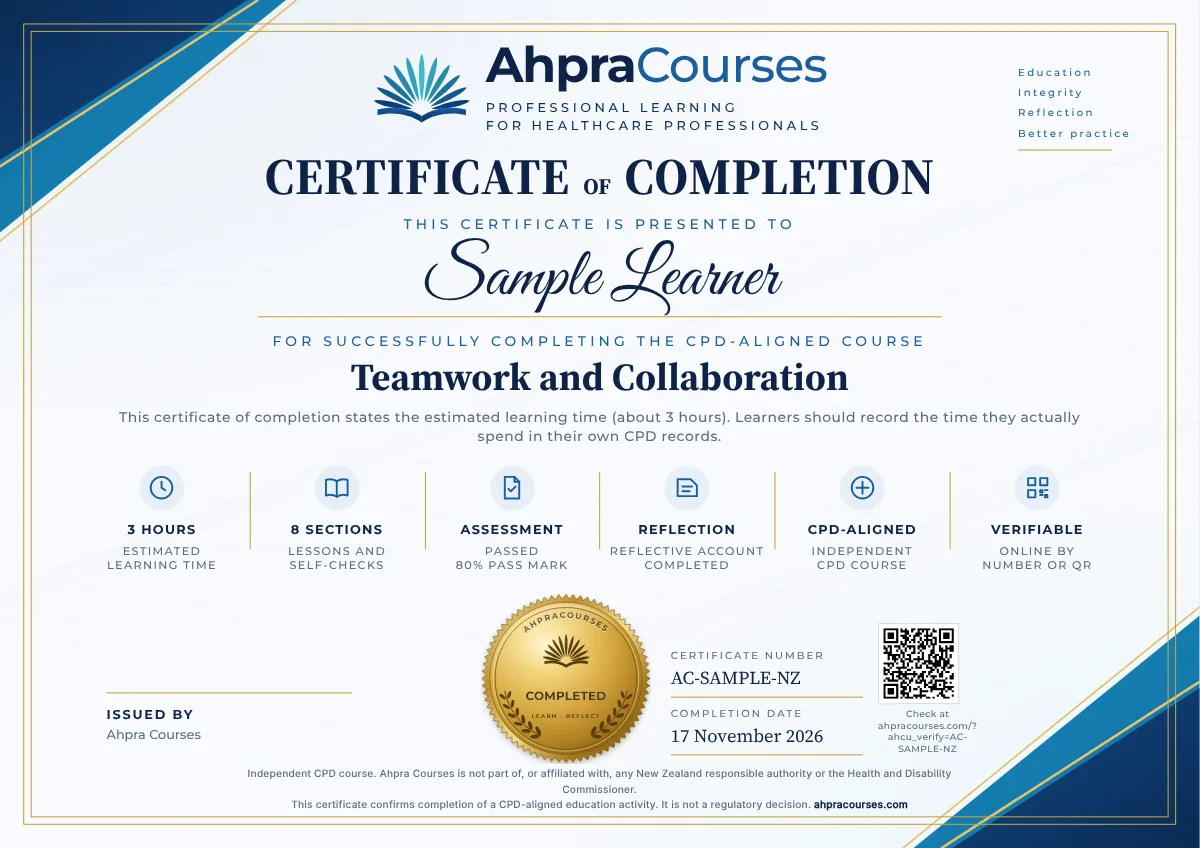
The certificate you receive

Sample certificate of completion for Teamwork and Collaboration for Health Practitioners in New Zealand from Ahpra Courses, showing the learner's name, the course title, an estimated learning time of about 3 hours, the completion date and a certificate number that can be checked online
Sample. Your certificate shows your name, the course title, the completion date and its own certificate number.

Pass the final assessment and complete the reflection to download your certificate of completion. The certificate names the course, the estimated learning time and your pass, and a manager can confirm it online through its number or QR code. Log the time you really spent in your own CPD record.

How practitioners use it

  • Log it in your recertification record under a goal on teamwork, communication or leadership.
  • Provide it with your response to an HDC recommendation that you undertake training on co-operation or communication.
  • Give it to your employer as part of an agreed plan after a workplace concern about conduct towards colleagues.
  • Include it with multisource feedback and supervisor reports if a professional conduct committee asks what you have done.
  • Use it in a team or unit improvement project as evidence of shared learning.

Who this course is for

Practitioners named in a complaint about coordination

When an HDC complaint concerns lost referrals, conflicting advice or a plan no one owned, the course shows what reasonable co-operation looks like and how to describe your own part honestly.

Practitioners whose conduct towards colleagues has been raised

Concerns about tone, rudeness or bullying are taken seriously by employers and authorities. The course explains why such behaviour harms patients and how to show insight and lasting change, including through multisource feedback.

Team leaders and senior clinicians

Leaders set the culture. The course covers onboarding, flattening hierarchy, running huddles and debriefs, and responding to incivility without letting seniority excuse it.

Practitioners working across services

General practice, pharmacy, aged care, hospital, community, iwi and kaupapa Māori providers all hold part of the picture. The course covers named contacts, closed referral loops, agreed coordinators and sharing information within the privacy rules.

Practitioners in newer or overlapping roles

Nurse practitioners, pharmacist prescribers, oral health practitioners and others work where scopes overlap. Role clarification conversations prevent gaps and duplication.

Practitioners involved in ongoing conflict

The course distinguishes useful task conflict from damaging relationship conflict and gives structured, interest-based ways to resolve recurring disagreements.

Internationally qualified practitioners and new graduates

New Zealand teams have their own expectations about hierarchy, speaking up, whanaungatanga and whānau involvement. The course makes them explicit.

The concerns this course addresses

Patients falling between services

Referrals not received, results not followed up, discharge plans not passed on and medicines changed by several prescribers without reconciliation are classic co-operation failures. Each practitioner is expected to take reasonable steps for their part and to close the loop.

Code of Rights Right 4(5); Medical Council Good medical practice (Working with colleagues)

Unclear roles and overlapping scopes

Scopes of practice set outer limits, but teams still need to agree locally who does what. Where roles overlap, assumptions fill the gap and tasks are missed or duplicated.

HPCA Act scopes of practice; authority standards of competence

Going along with a decision you doubted

A team decision does not remove your individual accountability. Raise concerns at the time, escalate if risk remains and record that you did. Silence is rarely a defence when harm follows.

Your authority's code of conduct; Code of Rights Right 4(2)

Conflict that has turned personal

Disagreement about the task can improve care. Recurring relationship conflict erodes communication and puts patients at risk. Structured, interest-based conversations and facilitated processes can repair working relationships.

Medical Council: Unprofessional behaviour; Nursing Council Code of Conduct

Incivility, bullying and harassment

Behaviour that intimidates or demeans colleagues reduces information sharing and makes errors more likely. It engages professional codes and employment and health and safety law, and in serious cases can lead to a conduct process.

Health and Safety at Work Act 2015; Employment Relations Act 2000; HPCA Act s 100

A colleague who may be unsafe

Concerns about a colleague's competence, health or conduct need to reach someone who can act. The HPCA Act provides notification routes, including section 34 for competence and section 45 for health.

HPCA Act ss 34 and 45; Medical Council: Concerns about another doctor

Patients and whānau left outside the team

Plans made about people without them, or without their support persons, often fail. Patients decide; meetings recommend. Right 8 protects the right to support, and whānau hui can change plans for the better.

Code of Rights Rights 6, 7 and 8

Showing change after a teamwork concern

Insight means naming your own part, its effect on colleagues and patients, and specific changes others can see. Multisource feedback, supervision and audit of team processes give credible evidence over time.

HPCA Act ss 38, 80 and 101

What the course covers

Seven teaching sections and 21 lessons move from what makes a team, through roles and accountability, everyday collaboration, culture and conflict, to harmful behaviour and what happens when teamwork becomes a regulatory concern. Every teaching section closes with a team scenario check, and a conclusion draws the course together.

1Teams and collaboration in Aotearoa health care3 lessons

Teams and collaboration in Aotearoa health care. What turns a group into a team, multidisciplinary versus interprofessional working, why patients, whānau and kaiāwhina belong inside the team, how fragmented care harms Māori, Pacific, disabled and rural people most, and what each code requires.

  • 1.1 What turns a group of practitioners into a team
  • 1.2 Why collaboration is a safety, quality and equity issue
  • 1.3 What the codes and standards require of you
2Roles, scopes and accountability inside teams3 lessons

Roles, scopes and accountability. Matching scopes to real roles, agreeing responsibilities where scopes overlap, role clarification conversations, why individual accountability survives a team decision, how to raise and record dissent, and delegation to students, new graduates and unregulated staff.

  • 2.1 Knowing your role and your colleagues' roles
  • 2.2 Individual accountability in team decisions
  • 2.3 Direction, delegation, students and the unregulated workforce
3Interprofessional collaboration in everyday practice3 lessons

Interprofessional collaboration in everyday practice. Preparing, chairing and recording multidisciplinary meetings, bringing the patient's goals into the room, the seams between organisations where patients get lost, sharing information within the privacy code, and working with whānau as partners.

  • 3.1 Multidisciplinary meetings and shared care plans
  • 3.2 Collaborating across services, organisations and sectors
  • 3.3 Patients and whānau as partners in the team
4Building team culture: whanaungatanga, inclusion and shared routines3 lessons

Building team culture. How culture forms from small repeated acts, whanaungatanga and manaakitanga as practical values, welcoming locums and internationally qualified colleagues, cultural safety and cultural load between colleagues, hierarchy, and huddles, briefings and debriefs.

  • 4.1 How team culture forms, and how to shape it
  • 4.2 Inclusion, hierarchy and cultural safety between colleagues
  • 4.3 Team routines that build shared understanding
5Disagreement and conflict in health teams3 lessons

Disagreement and conflict. Task, process and relationship conflict, structural sources of conflict in New Zealand services, early warning signs, a step-by-step approach to clinical disagreement that keeps the patient central, escalation, and interest-based and facilitated approaches.

  • 5.1 Where conflict comes from
  • 5.2 Resolving clinical disagreements safely
  • 5.3 Conflict skills for working relationships
6Behaviour that harms teams, and teams under strain3 lessons

Behaviour that harms teams, and teams under strain. The continuum from incivility to bullying and harassment, the legal and professional frameworks, actions for bystanders, targets and leaders, responding to a colleague who may be unsafe, and supporting each other under pressure and after harm.

  • 6.1 Incivility, bullying and harassment as team and safety issues
  • 6.2 When a colleague's practice or conduct worries you
  • 6.3 Teams under pressure, and supporting each other after harm
7When teamwork becomes a regulatory concern: accountability, insight and improvement3 lessons

When teamwork becomes a regulatory concern. How the HDC weighs individual and organisational responsibility, how authorities and the Tribunal deal with conduct towards colleagues, the evidence reviewers look at, genuine insight versus its counterfeits, and measuring and improving teamwork.

  • 7.1 How HDC, responsible authorities and the Tribunal look at teamwork failures
  • 7.2 Insight and remediation when your teamwork is questioned
  • 7.3 Measuring and improving how your team works
8Conclusion and key points1 lesson

Conclusion and key points. A drawing together of the course into the habits that make co-operation reliable, from role clarity to recorded dissent and real partnership with whānau.

  • Conclusion and key points
✓Reflection, final assessment and certificate3 steps
  • Your reflective account, which you can download for your records
  • Final assessment: 20 questions, 80% to pass
  • Certificate of completion, dated and numbered

Co-operation as a consumer right: how New Zealand judges teamwork when care goes wrong

New Zealand is unusual in making co-operation a right. Right 4(5) of the Code of Health and Disability Services Consumers' Rights says every consumer has the right to co-operation among providers to ensure quality and continuity of services. Right 4(2), on services that meet legal, professional, ethical and other relevant standards, and Right 4(4), on minimising potential harm, sit beside it. Together they mean a breakdown in teamwork is not just an organisational problem. It can be a breach of a patient's rights by the individuals involved.

The duty reaches inside a single organisation as well as across organisations. A ward team that never agrees who will chase a result, a general practice and pharmacy that each assume the other will reconcile medicines, and a hospital team that discharges without telling the GP about a changed plan can all fall short. When the HDC reviews such a case it looks at what each provider did, and it can find individual practitioners, the organisation, or both in breach.

What reasonable co-operation looks like

Reviewers tend to ask practical questions. Did you know what your role was, and did you do it? Did you communicate clearly with the next person in the chain, by a route that would reach them? Did you check that critical information had arrived? If you disagreed with a plan, did you say so, escalate if needed and record it? Was the patient, and their whānau where appropriate, part of the decision? Records of reasonable steps are often the best evidence a practitioner has.

Conduct towards colleagues

How practitioners treat each other is also a professional matter. Every authority's code expects respect for colleagues and prohibits bullying and harassment, and the Health and Safety at Work Act 2015 and employment law apply in the workplace. Concerns about behaviour can lead to employer processes and notifications to the authority. A professional conduct committee may recommend education or counselling, and serious or persistent conduct can lead to a charge under section 100 of the HPCA Act.

Why culture matters to safety

Teams where junior staff, kaiāwhina or whānau feel unable to speak up miss the information that would have prevented harm. Hierarchy decides who leads, not whose information counts. Practices such as role clarification, briefings, huddles, debriefs and structured conflict conversations make it easier for everyone to contribute, and they leave a visible trail of good practice.

How to respond to a complaint or notification about this kind of concern

If a complaint, notification or workplace process has questioned your teamwork or your conduct towards colleagues, these steps give you a constructive path. The relevant part of the course is named against each step.

  1. Get advice and gather the record

    Ring your indemnity insurer, union or professional body early. Collect the notes, messages, referral letters and meeting records that show what you did, when and who you told.

    In the course: Section 3 explains what good meeting and referral records contain, so you can see what your record shows.

  2. Map who was responsible for what

    Work out the roles each person held, where they overlapped and where the gap appeared. Be honest about your own part rather than focusing on others.

    In the course: Section 2 covers roles, overlapping scopes and why individual accountability survives a team decision.

  3. Acknowledge the effect on the patient and colleagues

    Describe in plain terms what the breakdown meant for the patient, whānau and colleagues. Where behaviour is in question, describe how it was experienced, not just what you intended.

    In the course: Sections 6 and 7 explain how harmful behaviour affects teams and what genuine insight looks like.

  4. Make specific changes others can see

    Choose one or two changes a colleague would notice, such as role clarification with new team members, recording dissent at meetings, or a direct call to a named contact in another service.

    In the course: Sections 3, 4 and 5 give practical routines for meetings, team culture and conflict.

  5. Evidence change over time

    Arrange multisource feedback, supervision or coaching, and audit of a team process you have changed. Review progress at three and six months.

    In the course: Lessons 7.2 and 7.3 show how to plan remediation and measure teamwork improvement.

Do not discuss the complaint with colleagues in a way that could look like pressure on witnesses, and do not alter or add to records after the event without clearly dating and explaining the entry.

This teamwork page gives general information and is no substitute for legal advice. Get advice from your indemnity insurer or medical defence organisation, union, professional association or a lawyer before you take part in an HDC, authority, professional conduct committee or employer process.

How this course helps with a complaint or notification

It turns a vague duty into specific habits

Right 4(5) is short. The course translates it into habits you can practise daily: agreeing roles, closing referral loops, recording owners and dates, and checking that information has arrived.

It is honest about hierarchy and conflict

Teamwork fails less often from lack of goodwill than from hierarchy, unclear roles and unresolved conflict. The course gives practical tools for each, including how to disagree away from the patient and then speak with one voice.

It brings whānau and kaupapa Māori services into the team

Collaboration in Aotearoa includes whānau, iwi and kaupapa Māori and Pacific providers. The course shows how to involve them as partners, using whanaungatanga and manaakitanga as working values.

It gives you a credible route to show change

If your teamwork or conduct is questioned, Section 7 and the reflection help you describe your own part, avoid blaming others and plan evidence such as multisource feedback that reviewers find persuasive.

Remediation evidence that carries weight

Carries weight

  • Multisource feedback from colleagues across roles, repeated after a period of change
  • A supervisor's or coach's report describing specific behaviours that have changed
  • Meeting records you now keep that show options, dissent, owners and dates
  • Audit of a team process, such as referral follow-up or discharge communication, before and after
  • A role clarification agreement or team charter you helped develop
  • A reflection that names your own part and its effect without blaming others
  • Evidence of an appropriate apology or restorative conversation, made with advice
  • Completion of targeted learning matched to the concern

Carries little weight

  • Statements that the other person was difficult or the system was to blame
  • Character references from friends rather than colleagues who work with you
  • A list of clinical courses unrelated to teamwork or conduct
  • Promises to "communicate better" with no specific change
  • Feedback gathered only from people you chose because they agree with you
  • Changes that last until the process ends
  • Avoiding the colleague concerned instead of repairing the working relationship
  • A reflection written in the passive voice that never says "I"

A remediation plan, phase by phase

  1. Weeks 1 to 2

    Understand

    • Get advice and read the concern carefully
    • Gather the records and map roles and handoffs
    • Identify your own part honestly, separate from others
  2. Weeks 2 to 6

    Learn and plan

    • Complete targeted learning such as this course
    • Agree a plan with a supervisor or coach focused on specific behaviours
    • Arrange a baseline of multisource feedback where conduct is in question
  3. Weeks 6 to 12

    Change

    • Introduce one or two visible routines, such as role clarification or recorded dissent
    • Repair working relationships through a facilitated or restorative conversation where appropriate
    • Audit a team process you have changed
  4. Months 3 to 6

    Evidence

    • Repeat multisource feedback and compare
    • Write a reflection linking the learning to observed change
    • Share what you learned at a team meeting or peer group
  5. Ongoing

    Sustain

    • Keep teamwork goals in your development plan
    • Use huddles and debriefs to keep the team's shared picture current
    • Mentor newer colleagues on speaking up and role clarity

Writing your reflective statement

1What happened in the team

Describe the episode by role and setting only, including how information moved and where co-operation broke down.

Example only (Hemi, a fictional community pharmacist): A patient with heart failure was discharged on a reduced diuretic dose. The GP restarted the old dose a week later, and I dispensed both without querying either prescriber.

2My own part

Identify what you did or did not do, without focusing on others.

Example only: I noticed the dose change but assumed the GP had seen the discharge summary. I did not contact either prescriber or ask the patient which dose he was taking.

3The effect

Describe what the breakdown meant for the patient, whānau and colleagues.

Example only: He took both doses, became dehydrated and was readmitted. His daughter told us she had been confused by three different instructions in ten days.

4The obligations involved

Name the standards and rights that applied.

Example only: Right 4(5) gave him the right to co-operation among his providers, and the Pharmacy Council Code of Ethics expects pharmacists to collaborate with other health professionals in the patient's interest.

5What I now do differently

Describe one or two changes colleagues could see.

Example only: I now call the prescriber about any unexplained dose change in high-risk medicines, and our pharmacy has a named contact at the local practice for medication queries.

6The evidence

Say what a colleague or auditor will be able to see.

Example only: Our pharmacy now logs prescriber contacts. Over three months I made 14 calls about dose changes; the practice manager has confirmed the named contact arrangement.

7Keeping it going

Explain how the change will last.

Example only: I have added medication reconciliation at transfer of care to my learning goals and will review the call log with my peer group each quarter.

The example sentences are fictional and show structure only. Your statement has to be your own honest account of what happened.

A weak and a strong response, side by side

Fictional: Dr K, a senior surgeon in a regional hospital, has been notified to the Medical Council after several nurses and a junior doctor reported that he regularly shouted at staff in theatre and dismissed safety concerns. His employer has already started a process. He is asked to respond.

Weak

Theatre is a high-pressure environment and I hold high standards because patient lives depend on them. Some staff are oversensitive and I have never intended to upset anyone. I have an excellent surgical record and many colleagues will vouch for me. I will go on a communication course if I have to, but I don't accept that anything I did put a patient at risk.

Strong

I accept that on several occasions I raised my voice at staff in theatre and dismissed concerns, and that this made colleagues afraid to speak up, which is itself a risk to patients. I have read the reports carefully and recognise the incidents described. Since March I have worked with an executive coach, apologised individually to the staff involved through a facilitated process, and introduced a theatre briefing where I ask the most junior person to speak first. A repeat multisource feedback survey in August showed improvement in the areas raised, and I attach it with my coach's report. I know this needs to be sustained and have asked for a further survey in six months.

Why the second one works: The strong response names specific behaviour and its effect on safety, accepts responsibility, describes concrete changes that others can observe and provides independent evidence of improvement. The weak response justifies the behaviour by pressure and standards, questions the complainants, relies on reputation and treats learning as a concession.

Mistakes practitioners make when responding

Assuming someone else will act

Where roles overlap, assumptions fill the gap. Agree who owns each task and write it down.

Staying silent in a meeting

If you doubt a plan, say so at the time, escalate if needed and record it. Agreement by silence leaves you accountable.

Sending information without checking it arrived

A referral or result sent is not the same as one received. Close the loop for anything critical.

Disagreeing in front of the patient

Discuss clinical disagreements away from the patient, then give them a consistent plan.

Excusing behaviour by pressure

Workload explains stress; it does not excuse demeaning colleagues. Reviewers do not accept it as a defence.

Leaving whānau out

Plans made without the patient and their support persons often fail. Bring them in early.

Ignoring a worrying colleague

Concerns about competence, health or conduct should reach someone who can act. Use the routes your workplace and the HPCA Act provide.

Choosing your own feedback panel

Feedback only from supporters is not credible. Ask a range of colleagues, including those who raised concerns where appropriate.

The code provisions this course works through

These are the provisions most often engaged when collaboration breaks down or conduct towards colleagues is questioned. The course applies each one to everyday team situations.

Code of Rights, Right 4(5)Co-operation among providers

Every consumer has the right to co-operation among providers to ensure quality and continuity of services.

In the course: Section 1 introduces this right and Section 7 shows how the HDC applies it to individuals and organisations.

Code of Rights, Right 4(2)Services that meet standards

Patients are entitled to services that meet legal, professional, ethical and other relevant standards.

In the course: Section 2 links this to your own accountability within team decisions.

Code of Rights, Rights 6, 7 and 8Information, informed choice and support

Patients are entitled to the information a reasonable consumer would expect, to an informed choice and informed consent, and to support people being present.

In the course: Section 3 shows why meetings recommend but patients decide, and how to involve whānau.

HPCA Act ss 34 and 45Notifying concerns about a colleague

Section 34 covers notification that a practitioner's practice may be below the required standard of competence; section 45 covers inability to perform required functions because of a mental or physical condition.

In the course: Section 6 explains when and how to use these routes.

HPCA Act s 100Grounds for discipline

Covers professional misconduct, including conduct that brought, or was likely to bring, discredit to the profession.

In the course: Section 7 explains how conduct towards colleagues can reach a professional conduct committee and the Tribunal.

Also relevant: Health and Safety at Work Act 2015 Duties to manage risks to workers, including psychosocial harm from bullying; Code of Rights, Right 10 Providers must facilitate fair, simple, speedy and efficient resolution of complaints; HPCA Act s 101 Tribunal penalties, including censure, fines, conditions and suspension

How this applies in each profession

Doctors

Medical Council of New Zealand

Good medical practice includes a section on working with colleagues, and the Council has separate statements on unprofessional behaviour and on concerns about another doctor.

Nurses

Nursing Council of New Zealand

The Code of Conduct includes a principle on working respectfully with colleagues, and the 2025 standards of competence emphasise collaboration and whanaungatanga.

Midwives

Midwifery Council of New Zealand

Lead maternity carers depend on clear transfer of clinical responsibility between midwives, obstetric and neonatal teams. The Code of Conduct addresses inter-professional relationships.

Pharmacists

Pharmacy Council of New Zealand

The Code of Ethics 2018 expects pharmacists to collaborate with other health professionals in patients' interests, which includes querying unexplained changes with prescribers.

Dentists and oral health practitioners

Dental Council of New Zealand

The Standards Framework includes standards on working with colleagues and referral, which matter in practices where dentists, hygienists, therapists and assistants share care.

Paramedics

Te Kaunihera Manapou Paramedic Council

Handover to emergency departments and coordination with primary care and other emergency services are where teamwork most often succeeds or fails.

Allied health practitioners

Other responsible authorities under the HPCA Act

Physiotherapists, occupational therapists, dietitians and others frequently work in multidisciplinary teams where role clarification and shared care plans prevent gaps.

What happens after a complaint or notification in New Zealand

A teamwork failure can be looked at by several bodies, often at the same time. Once a complaint or notification is made about teamwork, this is the usual path.

  1. Complaint or notification

    A patient or whānau complains to the provider or the HDC, an employer or colleague notifies the authority, or an adverse event review identifies a breakdown in co-operation.

  2. HDC assessment

    After considering the complaint, the HDC can take no further action, send it back to the provider or to an advocate, recommend an apology or changes, refer it to the authority or investigate.

  3. HDC investigation and findings

    A formal investigation looks at what each provider did. The Commissioner may find individuals, organisations or both in breach of the Code and make recommendations. Serious breaches may be referred to the Director of Proceedings.

  4. Referral to the responsible authority

    The authority considers competence, conduct and health questions. It generally waits while the HDC is dealing with a matter before acting on the same complaint.

  5. Competence review or PCC

    Competence concerns may lead to a review and orders under section 38. Conduct concerns, including behaviour towards colleagues, may be referred to a professional conduct committee.

  6. Tribunal

    A PCC or the Director of Proceedings may bring a charge. The Tribunal decides whether it is proved and what penalty is appropriate.

  7. Employer processes

    Alongside these, an employer may run its own process under the employment agreement and its health and safety duties.

Who handles your matter: the HDC, your responsible authority and the Tribunal

The Health and Disability Commissioner focuses on the patient. In a teamwork case it asks whether each provider took reasonable steps to co-operate and communicate, and it may find an organisation in breach for system failures as well as, or instead of, an individual.

Your responsible authority focuses on your competence, conduct and fitness to practise. It can review competence, refer conduct to a professional conduct committee and set conditions.

The Director of Proceedings makes an independent decision, after a serious breach finding, on proceedings before the Tribunal, the Human Rights Review Tribunal or both.

The Health Practitioners Disciplinary Tribunal hears charges and has power to censure, fine up to $30,000, set conditions or suspend for up to three years, cancel registration and award costs.

Possible outcomes and what they mean for you

OutcomeWhat it isWhat it means for you
HDC: no further actionNo further action is needed, often because the team has already fixed the problem or expert advice found the care reasonable.Changes already made to team processes support this outcome. Keep them in place.
HDC: provider resolution or advocacyThe complaint is returned to the provider to resolve with the complainant, or passed to an advocate.Engage openly, involve the team and report the outcome as required.
HDC: breach finding with recommendationsAn investigation ends in a breach finding, for example of Right 4(5), with recommendations such as an apology, training or system changes.Complete each recommendation with evidence and dates. Organisational findings still call for individual reflection.
Referral to the Director of ProceedingsRare and reserved for serious breaches. The Director independently decides whether to bring proceedings.Get legal advice. Evidence of insight and remediation remains relevant.
Authority: no further action or educationYour authority may close the matter, send an educational letter or recommend learning.Treat any guidance as a goal in your development plan.
PCC recommendationsA professional conduct committee may recommend counselling, education, conciliation or a charge.Multisource feedback and supervisor reports are strong evidence at this stage.
Tribunal penaltiesIf a charge is proved: censure, a fine of up to $30,000, conditions or suspension for up to three years, cancellation, and costs.Sustained, evidenced change in how you work with colleagues is relevant to penalty.

If a condition or undertaking requires education

Where teamwork or conduct towards colleagues is the concern, conditions or programmes often focus on behaviour rather than knowledge: coaching or mentoring, supervision, multisource feedback at set intervals, and education on communication or professionalism. They may come from a competence order, a professional conduct committee recommendation, an employer agreement or a Tribunal penalty.

Before relying on this course for a requirement, send the outline to whoever set it and check it fits. Combine it with feedback from colleagues and a supervisor's or coach's report, because reviewers will want to see that behaviour changed, not just that learning was completed.

Using this course as CPD

Teamwork and collaboration fit readily into New Zealand recertification. Doctors can link the course to a professional development plan goal and discuss it at peer review or with a collegial provider; nurses can count it as professional development relevant to their scope and link it to the standards of competence on collaboration; pharmacists can use it towards a learning goal and critical reflection; and dental practitioners can connect it to standards on working with colleagues in their plan.

Check your authority's current requirements, which differ and change over time. If a competence programme, a condition or a professional conduct committee requires this learning, ask whether it can also count for routine recertification.

  • Link the course to a goal on collaboration, leadership or communication
  • Use the course reflection as written evidence of learning
  • Pair the course with multisource feedback to measure change
  • Discuss a team case from the course at your peer group
  • Log the time you actually spent

How this course is written and kept current

The course and this page draw on the Code of Health and Disability Services Consumers' Rights, particularly Right 4(5), the HPCA Act 2003, responsible authority codes and standards on working with colleagues, the Medical Council statements on unprofessional behaviour and concerns about another doctor, the Health and Safety at Work Act 2015 and employment law, and national guidance on learning from harm.

We checked the Code of Rights, HDC outcomes, the Director of Proceedings' role and Tribunal penalties against the HDC's own guidance and the legislation. The HPCA Act may change under a Government Bill introduced in 2026; this page will be updated if it passes. All cases are fictional and no real practitioner is described.

Code of Health and Disability Services Consumers' Rights (Rights 4, 6, 7, 8 and 10)Health Practitioners Competence Assurance Act 2003 (ss 34, 45, 68 to 83, 100 and 101)HDC: Possible outcomes of a complaintHDC: Referral to the Director of ProceedingsHDC: What if a complaint is made about me?Medical Council of New Zealand: Good medical practiceNursing Council of New Zealand: Code of ConductPharmacy Council of New Zealand: Code of Ethics 2018Dental Council: Health Practitioners Disciplinary Tribunal guidance

Last reviewed: November 2026.

Key terms explained

Right 4(5)
The Code of Rights right of every consumer to co-operation among providers to ensure quality and continuity of services.
Interprofessional working
Practitioners from different professions planning and delivering care together, rather than in parallel.
Role clarification
A conversation in which team members agree who does what, especially where scopes overlap.
Individual accountability
The principle that each practitioner remains answerable for their own part, even in a team decision.
Recorded dissent
A note that a concern was raised about a team decision, by whom and how it was resolved.
Closing the loop
Confirming that critical information, such as a referral or result, has been received and acted on.
Whanaungatanga
Relationships and a sense of belonging, built through shared experience and connection.
Manaakitanga
Care, hospitality and respect shown to others, upholding their mana.
Kaiāwhina
The non-regulated health and disability workforce who support patients and teams.
Task, process and relationship conflict
Disagreement about what to do, how to do it, or between people personally; the last is usually the most harmful.
Multisource feedback
Structured feedback from colleagues across roles, often repeated to show change.
Huddle
A short, regular team meeting to share the current picture, risks and priorities.

Frequently asked questions

What does Right 4(5) of the Code of Rights require?

It gives every consumer the right to co-operation among providers to ensure quality and continuity of services. In practice that means knowing your role, communicating with the next person in the chain, checking critical information has arrived, and taking reasonable steps when you see a gap. It applies within a single organisation as well as between them.

Can I be found in breach for a team failure?

Yes. When the HDC investigates a breakdown in co-operation, it may find individual practitioners, the organisation or both in breach. Records showing the reasonable steps you took for your part are often the most important evidence you have.

If the team made the decision, am I still accountable?

Yes. A team decision does not remove your individual professional accountability for your own part. If you disagree, raise it at the time, escalate if risk remains and record that you did and how it was resolved.

How should I handle a clinical disagreement with a colleague?

Discuss it away from the patient, use evidence and the patient's goals as the reference point, and listen for the other person's interests. If you still disagree and risk remains, escalate through a known route. Once a decision is made, give the patient a consistent plan.

Can complaints about how I treat colleagues affect my registration?

They can. Every code expects respect for colleagues, and serious or persistent behaviour such as bullying can be referred to a professional conduct committee and, in serious cases, charged before the Tribunal. Employer processes may run alongside.

What should I do if I am worried about a colleague's practice?

Make sure the concern reaches someone who can act, usually a manager or clinical lead first. Where there is a risk of harm, the HPCA Act provides notification routes to the authority, including section 34 for competence and section 45 for health. Get advice if unsure.

Can I share patient information with other providers in the team?

Generally yes, for the purpose of the patient's care, under the Health Information Privacy Code 2020. Share what is necessary, use secure routes and tell the patient where appropriate. Different rules may apply to some sensitive information.

How do I involve whānau without overriding the patient?

Ask the patient who they want involved and how. Right 8 protects their right to have support persons present. Whānau often hold important knowledge, but the patient makes the decisions about their own care where they are competent to do so.

What is multisource feedback and why is it useful after a concern?

It is structured feedback from colleagues across different roles. Repeated after a period of change, it gives independent evidence that behaviour has improved, which reviewers find more persuasive than self-report or references from friends.

Does an organisational finding mean I have nothing to reflect on?

No. Even where the HDC finds a system failure, each practitioner can usually identify something within their own control that would have helped. Reflecting on that shows insight and protects future patients.

Will this course resolve a complaint about my teamwork?

Targeted learning combined with feedback, supervision and visible changes is the kind of evidence decision-makers consider, but each body reaches its own decision on the facts.

How long does the course take, and how long do I have access?

The estimated learning time is about 3 hours (about 180 minutes), covering the lessons, the section checks, your reflective account and the final assessment. People work at different speeds, so record the time you actually spend in your own CPD records. Your progress is saved to your account and you can return to the course and your certificate at any time.

How is the course assessed?

Lessons open in order. Each section closes with a graded check that you answer before moving on. The course ends with a 20-question final assessment, marked on our server, with a pass mark of 80%. If you do not pass, review the sections it points you to and try again.

Does completing the course decide the outcome of my matter?

No course can decide or predict the outcome of a notification, investigation, panel or tribunal. Decision-makers weigh all of the evidence, including your insight, your reflection and the changes you have made and sustained. The course is designed to support that learning and to give you a dated record of it.

Start today, finish at your own pace

Instant access after checkout. Work through 8 sections in order, write your reflective account, pass the final assessment and download your dated certificate.

Primary sources

Always read the current version on the publisher's website. This page is general information, not legal advice.

On call with Dr AI Alma