Bundle & save Studying more than one course? Save 15% on 3, 22% on 5 and 30% on 10 or more, taken off in your cart.
Free Course AdvisorQuestions about which course fits your case?
Ahpra Courses

A law-grounded ethics course for New Zealand practitioners, for everyday decision-making, recertification and responding to an ethical concern

Ethics and Ethical Standards for Health Practitioners in New Zealand

Last updated

Ethics in New Zealand health care is practical judgement shaped by law: the Code of Rights, Te Tiriti o Waitangi, the HPCA Act and the standards your responsible authority sets. This course gives you a structured way to reason through difficult decisions, then applies it to consent and capacity, culturally safe care with whānau, fair use of limited resources, conscientious objection and end-of-life decisions, including the End of Life Choice Act 2019. It ends with how an ethical lapse becomes a regulatory concern and how to show insight.

  • 3 hours, CPD-aligned
  • Written to your responsible authority's code
  • 10 sections with graded checks
  • 20-question final assessment
  • Dated, verifiable certificate
  • Self-paced on any device
  • 1-to-1 AI tutor, Dr AI Alma
Enrol now, NZ$120Bulk buy from NZ$85 a course

Dated certificate with a number anyone can verify

61CPD courses for New Zealand practitioners
16Professions covered
24/7Self-paced, online, any device
NZ$120Per course, no subscription

What brings you to this course?

At a glance

Who it is for
Practitioners on the register of any of the 18 responsible authorities under the HPCA Act 2003, from doctors, nurses and midwives to oral health practitioners, pharmacists, psychologists, physiotherapists and paramedics
Regulators covered
The responsible authorities and their ethical codes, looking closely at the Medical, Nursing, Midwifery, Dental and Pharmacy Councils and the Psychologists Board; the Health and Disability Commissioner; Professional Conduct Committees; and the Health Practitioners Disciplinary Tribunal
Format
Online and self-paced: ten sections, ending with a conclusion and a reflective account, and 24 lessons built on fictional ethical dilemmas from hospital wards, community services, general practice and aged care
Assessment
An ethics quiz of four or five questions closing each of sections 1 to 8, a 20-question final assessment (80% to pass) and a five-prompt ethical reflection
Certificate
A certificate of completion naming this ethics course and its estimated learning time, with a verification number and QR code
Learning time
About 3 hours
Best taken with
Informed Consent and Communication and Cultural Safety and Health Equity, which go further into two of the course's main themes
Learning time
About 3 hours, self-paced, online on any device. Progress is saved to your account.
Price
NZ$120 for one course. Bundles: 5 courses for NZ$545, 10 courses for NZ$850.

In short

Ethics is the everyday practice of deciding what is right to do for a particular person in particular circumstances. In New Zealand it is shaped by four layers: legislation and the Code of Rights set the legal floor; Te Tiriti o Waitangi makes equity for Māori an ethical obligation; section 118 of the HPCA Act gives each responsible authority the job of setting professional standards; and employer policy operates within these. Autonomy, beneficence, non-maleficence and justice each line up with particular rights in the Code, and a structured framework helps you balance them and write down why you decided as you did. This course applies that approach to consent and capacity, whānau involvement, resource allocation, conscientious objection and end-of-life care, and explains how an ethical lapse is handled by the HDC, your authority and the Tribunal.

The certificate you receive

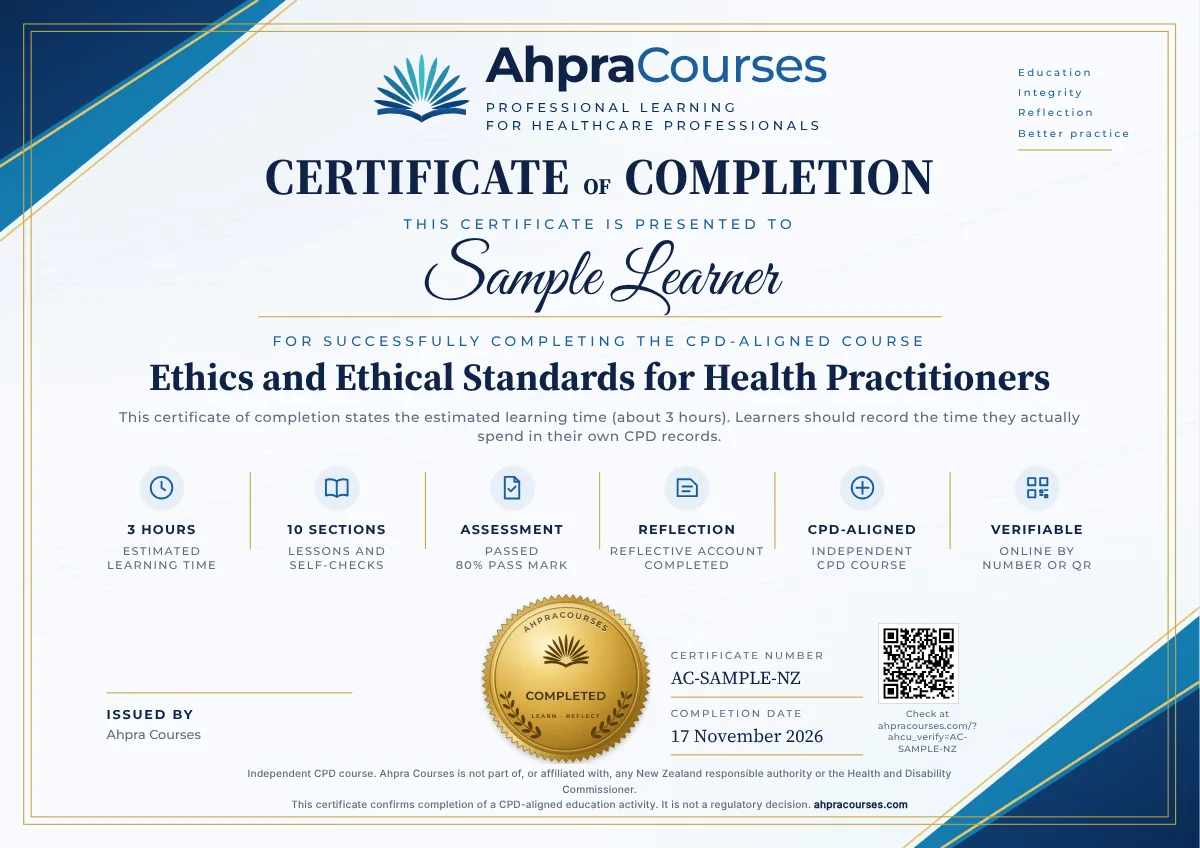
Sample certificate of completion for Ethics and Ethical Standards for Health Practitioners in New Zealand from Ahpra Courses, showing the learner's name, the course title, an estimated learning time of about 3 hours, the completion date and a certificate number that can be checked online
Sample. Your certificate shows your name, the course title, the completion date and its own certificate number.

Once you pass the final assessment and write the reflective account on your ethical reasoning, your certificate of completion can be downloaded. Your ethics certificate records the course, its estimated learning time and your result, and can be verified online through its number or QR code. Record your actual time in your own portfolio.

How practitioners use it

  • File it in your recertification portfolio as ethics and professional development, alongside your reflective account.
  • Attach it to your reply to the HDC or your authority when the way you made a decision has been challenged.
  • Use it to support an ethics learning goal in your professional development plan.
  • Share it with a supervisor or peer group when discussing a difficult case and how you reasoned through it.
  • Keep it with notes on any practice changes as part of a remediation file.

Who this course is for

Practitioners whose decisions have been questioned

Many complaints are about judgement rather than technique: what information was given, who was involved, why a choice was made. The course helps you explain your reasoning and identify where it could have been stronger.

Practitioners facing consent and capacity dilemmas

The Code of Rights presumes competence and protects the right to refuse. The course works through uncertain competence, best-interests care, advance directives and refusal using the specific rights involved.

Practitioners working with whānau and communities

Collective decision-making is valued by many Māori and Pacific families. The course shows how to support it while keeping consent and privacy with the individual where they want that.

Practitioners making allocation decisions

Waiting lists, staffing and budget limits force choices. The course covers fair allocation at the bedside and how clause 3 of the Code treats resource constraints.

Practitioners with conscientious objections

New Zealand law sets specific duties when you object to providing contraception, sterilisation, abortion or assisted dying. The course explains exactly what you must do.

Practitioners caring for people at the end of life

Withdrawing treatment, symptom relief and the End of Life Choice Act raise different ethical and legal questions. The course separates them clearly.

Practitioners meeting recertification requirements

Ethics is part of every recertification programme. The course provides structured learning and a reflective account you can adapt for your portfolio.

The concerns this course addresses

When an ethical decision is challenged

Ethical concerns often reach the HDC as complaints about communication, consent or respect. A clear record of how you weighed the options, who you consulted and why you decided as you did is strong evidence that you took reasonable actions.

Code of Rights clause 3; HPCA Act ss 100 and 101

Consent, competence and refusal

Under Right 7(1) a service can be given only with informed consent, unless the law says otherwise. Right 7(2) presumes every consumer competent unless there are reasonable grounds to think otherwise, and a competent person may refuse treatment even when others disagree.

Code of Rights Rights 6 and 7, including 7(1), 7(2) and 7(7)

Whānau, culture and individual rights

Supporting whānau involvement is part of culturally safe care, but the person decides who is involved and what is shared. Raise it early, write down what the person wants and come back to it as things change.

Code of Rights Rights 1, 5 and 8; Medical Council Cultural safety (2019)

Fair allocation of limited resources

Clause 3 of the Code takes a provider's resource constraints into account, but it does not excuse failures within your control, such as poor communication. Allocate on need and benefit, be honest about limits and escalate unsafe constraints.

Code of Rights clause 3; Medical Council Resource constraints (2018)

Conscientious objection

Section 174 of the HPCA Act sets duties where a practitioner objects to providing reproductive health services, including telling the person about the objection and how to access the closest provider. An objection never permits obstruction or abandonment.

HPCA Act s 174; End of Life Choice Act 2019

End-of-life decisions

Withdrawing treatment that no longer helps is ethically accepted. Assisted dying is lawful only under the End of Life Choice Act 2019, which bars practitioners from raising it first and sets tight eligibility rules and safeguards.

End of Life Choice Act 2019; Medical Council End of Life Choice Act statement (2021)

Reflection for recertification

Ethical reflection should be specific: an actual situation, the standard that applied, what you would change and how you would tell that the change worked. General statements about valuing ethics are not reflection.

Authority recertification requirements

Conflicts of interest and dual loyalties

Employers, commercial partners and colleagues can pull against the patient's interests. Declare conflicts, avoid treating people close to you, and stay accountable for your own judgement, including when using AI tools.

Medical Council Commercial organisations (2023); Artificial intelligence in patient care (2026)

What the course covers

Ten sections and 24 lessons build from foundations and a decision framework to specific ethical areas, then to accountability and a final reflective account. Every section from 1 to 8 finishes with a brief knowledge check.

1Ethics in Aotearoa New Zealand: foundations and framework3 lessons

Lessons: What ethics means for a New Zealand health practitioner; Law, Code of Rights, professional codes and policy; How an ethical lapse becomes a regulatory concern. The four layers that shape ethical obligations and why employer policy cannot override the law or professional standards.

  • 1.1 What ethics means for a New Zealand health practitioner
  • 1.2 Law, Code of Rights, professional codes and policy: the four layers
  • 1.3 How an ethical lapse becomes a regulatory concern
2Ethical principles, theories and decision-making3 lessons

Lessons: The four principles, read through the Code of Rights; Ethical theories and Māori values; A practical ethical decision-making framework. Autonomy, beneficence, non-maleficence and justice mapped to rights, several ethical lenses including whanaungatanga, manaakitanga and mana, and a seven-step method.

  • 2.1 The four principles, read through the Code of Rights
  • 2.2 Ethical theories and Māori values: different lenses on the same problem
  • 2.3 A practical ethical decision-making framework
3The codes of New Zealand's responsible authorities3 lessons

Lessons: Responsible authorities and the Medical Council's standards; Nursing Council and Midwifery Council codes; Dental, Pharmacy and allied health codes compared. What each authority's code says about ethics, the section 118 functions, and the themes the codes share.

  • 3.1 Responsible authorities and the Medical Council's standards
  • 3.2 Nursing Council and Midwifery Council codes
  • 3.3 Dental, Pharmacy and allied health codes compared
4The Code of Health and Disability Services Consumers' Rights3 lessons

Lessons: The Code of Rights as the ethical floor; Communication, information and consent; Teaching, research, support and complaints. Clause 3, the reasonable consumer standard in Right 6(2), the parts of Right 7, and Rights 8, 9 and 10.

  • 4.1 The Code of Rights as the ethical floor
  • 4.2 Communication, information and consent: Rights 5, 6 and 7
  • 4.3 Teaching, research, support and complaints: Rights 8, 9 and 10
5Te Tiriti o Waitangi, cultural safety and equity3 lessons

Lessons: Te Tiriti o Waitangi and health equity as ethical obligations; Cultural safety; Whānau, tikanga and culturally grounded decision-making. The Hauora report principles, cultural safety as defined by the patient, and supporting collective decisions while respecting individual consent.

  • 5.1 Te Tiriti o Waitangi and health equity as ethical obligations
  • 5.2 Cultural safety: what it is and what it asks of you
  • 5.3 Whānau, tikanga and culturally grounded decision-making
6Justice, resource allocation and conscientious objection3 lessons

Lessons: Resource allocation and justice at the bedside; Conscientious objection in New Zealand law; Conflicts of interest, dual loyalties and new technology. Fair allocation, the section 174 duties, objection under the End of Life Choice Act, and accountability when using AI.

  • 6.1 Resource allocation and justice at the bedside
  • 6.2 Conscientious objection in New Zealand law
  • 6.3 Conflicts of interest, dual loyalties and new technology
7End-of-life ethics and law in New Zealand2 lessons

Lessons: Ethics at the end of life; The End of Life Choice Act 2019 in practice. Withholding and withdrawing treatment, advance directives, symptom relief, the Act's eligibility criteria and safeguards, and the rule against initiating discussion.

  • 7.1 Ethics at the end of life: decisions about treatment
  • 7.2 The End of Life Choice Act 2019 in practice
8When ethics becomes a regulatory concern: accountability and remediation2 lessons

Lessons: When ethics becomes a conduct or competence concern; Insight, reflection and remediation after an ethical concern. The HDC and HPCA pathways, the Tribunal's two-stage test and penalties, and targeted remediation.

  • 8.1 When ethics becomes a conduct or competence concern
  • 8.2 Insight, reflection and remediation after an ethical concern
9Conclusion and key points1 lesson

Lesson: Conclusion and key points. A practical checklist: know which rights a decision engages, presume competence, give the information a reasonable consumer would need, ask how the person wants decisions made, and allocate fairly.

  • Conclusion and key points
10Reflection1 lesson

Lesson: Your reflective account. Five prompts help you describe a real ethical decision, the standard your authority's code expected, the change you will make and by when, how you will check it is working, and what you would now do differently.

  • Your reflective account
✓Reflection, final assessment and certificate3 steps
  • Your reflective account, which you can download for your records
  • Final assessment: 20 questions, 80% to pass
  • Certificate of completion, dated and numbered

How law, Te Tiriti and professional codes combine to shape ethical practice in Aotearoa

Ethical theory is universal, but the standards New Zealand practitioners are judged against are local. Four layers combine. Legislation sets binding rules, from the HPCA Act to the End of Life Choice Act 2019. The Code of Health and Disability Services Consumers' Rights contains ten rights binding every provider, and under clause 3 a provider who took reasonable actions in the circumstances is not in breach, although the provider has to prove it. Section 118 of the HPCA Act makes each responsible authority set the standards of clinical competence, cultural competence and ethical conduct for its profession. Employer policy then operates within those limits and cannot override them.

Principles and rights

The familiar four principles map onto the Code. Autonomy appears in Right 7, which allows services only with informed consent except where the law provides otherwise, and in the presumption of competence. Beneficence and non-maleficence appear in Right 4, which requires reasonable care and skill and services that minimise potential harm. Justice appears in Right 2's protection against discrimination and in the attention to equity required by Te Tiriti. Right 6(2) sets a consumer-centred test for information: the information that a reasonable consumer in that person's situation would need to make an informed choice.

Te Tiriti and cultural safety

Te Tiriti o Waitangi makes equity for Māori an ethical duty rather than an optional extra. In its Hauora report the Waitangi Tribunal set out the principles of tino rangatiratanga, equity, active protection, options and partnership for primary care. Cultural safety asks you to look at your own culture, assumptions and power, and accepts that only the patient can say whether care felt safe. The Medical Council's cultural safety statement and other authorities' standards build this into professional expectations.

Hard cases

Some areas have specific law. Section 174 of the HPCA Act sets what a practitioner must do when objecting to providing contraception, sterilisation or abortion services: tell the person of the objection and how to access the contact details of the closest provider. The End of Life Choice Act 2019 sets eligibility criteria and safeguards, stops practitioners from raising assisted dying first, and requires an objecting attending medical practitioner to tell the person they can ask the SCENZ Group for a replacement. In each area the ethical question is how to respect conscience without obstructing the patient.

When ethics becomes regulation

Ethical lapses usually reach regulators as complaints about consent, communication, respect or fairness. The HDC assesses them under the Code; responsible authorities consider competence and conduct; and the Tribunal may find professional misconduct under section 100. A recorded, reasoned decision is often the best protection, and insight shown through specific change is what decision-makers look for when something has gone wrong.
How to respond to a complaint or notification about this kind of concern

If a decision you made has been questioned on ethical grounds, these steps help you respond clearly. Each step below links to the ethics lesson that helps most.

  1. Get advice and secure the record

    Ring your indemnity provider, union or professional association before you answer an ethics concern. Obtain the clinical record, including any notes of discussions with the patient, whānau and colleagues, and keep it unaltered.

    In the course: Section 8 explains the HDC and HPCA pathways and what to expect at each.

  2. Reconstruct your reasoning

    Describe the facts as you saw them then, the options you weighed, who you spoke to and why you made the choice you did. Be honest about what you did not consider.

    In the course: Section 2 provides the seven-step framework, which works as well for review as for making a decision.

  3. Identify the rights and standards involved

    Identify the rights in the Code of Rights and the parts of your authority's code that applied, and test your decision against them.

    In the course: Sections 3 and 4 map the authority codes and the Code of Rights in detail.

  4. Acknowledge the person's experience

    Recognise how the decision affected the patient and their whānau, including any cultural dimension, and apologise where communication or respect fell short.

    In the course: Section 5 covers cultural safety and working with whānau and tikanga.

  5. Show what you have learned

    Describe specific changes, such as documenting decision-making conversations, seeking ethics advice earlier or revising how you involve whānau, and how someone could check them.

    In the course: Section 8 and the reflective account in Section 10 help you plan and document remediation aimed at the actual gap.

Do not add notes to the record after a complaint to show reasoning you did not record at the time. If you need to explain your thinking, do it in your response and be clear about when it is written.

The information here is general and should not be taken as legal advice. If the HDC, your responsible authority or your employer has questioned an ethical decision you made, talk to your indemnity provider or medical defence organisation, your union or professional association, or a lawyer before replying.

How this course helps with a complaint or notification

It ties ethics to New Zealand law

Every principle is linked to a specific right, section or standard, so your reasoning can be explained in the terms the HDC and your authority use.

It gives you a method you can record

The seven-step framework (name the issue, establish the facts, identify obligations, hear the voices, list options, decide, record) makes decisions quicker and leaves a short record that shows your reasoning.

It takes Te Tiriti seriously

Equity, cultural safety and whānau involvement are treated as ethical obligations in their own right, with practical guidance on supporting collective decisions while respecting individual rights.

It is precise about hard cases

Conscientious objection and assisted dying have specific legal duties. The course sets them out exactly so that you can act on conscience without obstructing care.

Remediation evidence that carries weight

Carries weight

  • A contemporaneous note of how a difficult decision was reached, including options and who was consulted
  • A reflective account that names the specific rights and standards involved
  • Evidence of seeking ethics advice, for example from a colleague, an ethics committee or a professional body
  • A revised approach to consent or whānau involvement, with the date it began
  • Peer or supervisor feedback on decision-making over time
  • An audit of records showing documented consent discussions after a change
  • Targeted education on the area of concern with a reflection on its effect
  • A clear, written process for managing a conscientious objection, shared with your team

Carries little weight

  • Statements that you acted in good faith with no explanation of reasoning
  • Reasoning added to the record after a complaint without clear dating
  • Reliance on employer policy that conflicts with the Code or professional standards
  • General references to cultural sensitivity without specific actions
  • Ethics certificates unrelated to the concern
  • Criticism of the patient's or whānau's choices
  • Claims that resource limits explain every shortfall
  • Assurances of change without any way to check them

A remediation plan, phase by phase

  1. Week 1

    Prepare

    • Get advice and diary deadlines
    • Secure the full record unaltered
    • Write down your reasoning as you now recall it, dated today
    • Identify the rights and standards involved
  2. Weeks 2 to 4

    Analyse

    • Apply the seven-step framework to the decision in hindsight
    • Identify the voices you did not hear, including whānau
    • Consider how culture and power affected the decision
    • Discuss the case with a senior colleague or supervisor
  3. Weeks 4 to 8

    Change

    • Introduce a short template for recording difficult decisions
    • Agree a route for seeking ethics advice quickly
    • Revise how you ask patients about whānau involvement
    • If you object to a service, write down how you will meet your legal duties
  4. Months 2 to 4

    Evidence

    • Complete targeted education and reflect in writing
    • Have a peer look over a sample of your written decision records
    • Write a reflective account linked to the Code of Rights
    • Collect feedback from colleagues on your decision-making
  5. Ongoing

    Sustain

    • Bring difficult cases to peer review regularly
    • Keep ethics learning in your development plan
    • Review your approach when law or standards change
    • Mentor others in structured ethical reasoning

Writing your reflective statement

1The situation

Describe the ethical situation factually, without identifying anyone.

Example only (Dr S, a fictional hospital doctor): An older man with early dementia refused a hip operation. His daughters wanted it done and asked me to persuade him.

2The rights and standards involved

Name the specific rights in the Code and the standards of your authority that applied.

Example only: Right 7(2) presumes he is competent unless there are reasonable grounds otherwise, Right 7(3) protects his right to take part in decisions to the extent he can, and Right 7(7) protects refusal.

3How I reasoned

Describe the options you weighed, who you talked to and why you chose as you did.

Example only: I assessed his understanding of the operation and the risks of not having it, spoke with the team and met with him and his daughters together, at his request.

4What fell short

Identify honestly where your process or communication was weaker than it should have been.

Example only: I did not record my assessment of his capacity in enough detail, and I did not ask him early enough how he wanted his daughters involved.

5The impact

Describe how the situation affected the patient, whānau and team.

Example only: His daughters felt shut out, and he felt pressured. The team was unclear who could make the decision.

6What I have changed

Describe specific changes with dates and how they could be checked.

Example only: Since April I use a structured capacity note and ask every patient early how they want family involved. My consultant reviewed 15 records in June and all included both.

7How I will sustain it

Explain how the change will continue and be reviewed.

Example only: I bring one decision-making case to peer review each quarter and have added capacity assessment to my development plan for this year.

The example sentences are fictional and show structure only. Your statement has to be your own honest account of what happened.

A weak and a strong response, side by side

Fictional: Dr F, a general practitioner who visits an aged residential care facility, is the subject of an HDC complaint after a resident's whānau say that when the resident asked him about assisted dying, he told her he would not help and walked away.

Weak

I have a strong personal belief that assisted dying is wrong and I am entitled to my conscience. The resident was clearly depressed and I did not think she understood what she was asking. I did not want to encourage her. Her whānau were not present at the time and have misunderstood what happened. I have looked after residents in this facility for many years and always treat them with respect.

Strong

I accept that when the resident asked me about assisted dying, I said I could not help and left the room, without telling her who she could speak to. I understand that under the End of Life Choice Act, as her doctor with a conscientious objection, I had to tell her about the objection and that she could ask the support and consultation group for the contact details of a replacement doctor. I did not do this, and I can see that she was left distressed and without information she was entitled to. I apologise to her and her whānau. I have since agreed a written process with the facility manager so that if I object, the resident is told the same day how to reach the group. I have also completed education on the Act and end-of-life care.

Why the second one works: The strong response accepts what happened, names the specific legal duty, acknowledges the impact on the resident and whānau, apologises and shows a system change. The weak response asserts conscience without addressing the duty that comes with it, questions the resident's competence without assessment and criticises the whānau.

Mistakes practitioners make when responding

Deciding without recording reasoning

A good decision with no record of how it was reached is hard to defend. A few lines on options, consultation and reasons are enough.

Assuming incompetence

The Code presumes competence. Disagreement with your advice is not evidence that a person lacks capacity.

Letting whānau decide for a competent adult

Supporting collective decision-making is good practice, but the competent person decides who is involved and has the final say.

Using resource limits as a blanket excuse

Clause 3 considers resource constraints, but communication, honesty and documentation remain within your control.

Objecting without meeting the legal duty

A conscientious objection must be accompanied by the steps the law requires, and never by obstruction, delay or moralising.

Raising assisted dying first

The End of Life Choice Act forbids practitioners from initiating discussion about assisted dying with a person.

Following policy that conflicts with standards

Employer policy cannot override the Code of Rights or your authority's standards. Raise the conflict through the right channels.

Treating culture as a checklist

Cultural safety is about examining your own assumptions and asking the person what matters to them, not applying generalisations.

The code provisions this course works through

Ethical decisions are judged against the Code of Rights, the HPCA Act and any legislation that governs the situation. These provisions recur throughout the course.

Code of Rights, Right 7Informed choice and consent

Services need the consumer's informed consent, except where a law or the Code provides otherwise; a presumption of competence; participation to the extent of a person's competence; best-interests care when the person cannot consent; and the right to refuse.

In the course: Sections 2 and 4 apply each part of Right 7 to real dilemmas.

Code of Rights, Right 6Right to be fully informed

Consumers are entitled to the information a reasonable consumer in their situation would expect, covering options, risks, side effects, benefits and costs.

In the course: Section 4 uses the reasonable consumer standard to plan consent conversations.

Code of Rights, clause 3Reasonable actions

A provider has not breached the Code if it acted reasonably in the circumstances, taking into account the clinical situation and the resources it had. The onus is on the provider.

In the course: Section 6 applies clause 3 to resource allocation decisions.

HPCA Act s 118Functions of authorities

Under section 118 every responsible authority sets clinical, cultural and ethical conduct standards for its own profession.

In the course: Section 3 compares the standards each authority has set.

HPCA Act s 174Reproductive health services

Sets out what a practitioner who objects on grounds of conscience to contraception, sterilisation or abortion services must do, including telling the person how to reach the closest provider.

In the course: Section 6 sets out what this duty requires in practice.

Also relevant: End of Life Choice Act 2019 Eligibility, safeguards and the rule against initiating discussion; HPCA Act ss 100 and 101 Grounds for discipline and penalties; Code of Rights, Right 8 The right to have support persons present

How this applies in each profession

Doctors

Medical Council of New Zealand

Good medical practice (2021) sits alongside statements on informed consent, cultural safety, resource constraints and the End of Life Choice Act. A statement on artificial intelligence in patient care was updated in March 2026.

Nurses

Nursing Council of New Zealand

The 2025 standards of competence for registered nurses are built around six pou, including a Māori health focus and cultural safety. A revised Code of Conduct was released in draft for consultation in January 2026.

Midwives

Midwifery Council of New Zealand

Midwives work in partnership with women and whānau, which makes informed choice, cultural safety and respectful decision-making central to the Midwifery Council's Code of Conduct.

Dentists and oral health practitioners

Dental Council of New Zealand

The current framework sets 28 professional standards under five headings, including patient interests and public trust and confidence. The Council consulted on a revised standards framework in 2026, so confirm which ethics standards apply to the period in question.

Pharmacists

Pharmacy Council of New Zealand

The Code of Ethics has seven principles, starting with making the patient's health and wellbeing the first priority and including protecting professional independence, judgement and integrity.

Psychologists

New Zealand Psychologists Board

The Code of Ethics for Psychologists Working in Aotearoa New Zealand (2002) is still the main guide, because implementation of the revised Code of Conduct was put on hold.

Physiotherapists

Physiotherapy Board of New Zealand

Recertification includes a reflection on Māori culture and practice, which links directly to the Te Tiriti and cultural safety content in Section 5.

What happens after a complaint or notification in New Zealand

An ethical concern usually arrives as a complaint about consent, communication or respect. This is the usual path, though most matters end before the later stages.

  1. Concern raised

    A patient or whānau member raises the issue with you, your service or the HDC, or a colleague raises it with your employer or authority.

  2. Provider response

    Right 10 duties apply: acknowledge it within 5 working days, decide within 10 working days of that, explain any extension and give progress updates at least monthly. Many ethical concerns are resolved here with explanation and apology.

  3. HDC assessment

    The Commissioner assesses the complaint against the Code, may seek your response and clinical advice, and decides on an outcome ranging from no further action to formal investigation.

  4. Authority consideration

    Your authority may receive a referral from HDC or a direct concern, and considers whether it raises competence, conduct or health issues.

  5. Competence review

    If your decisions point to a wider gap in practice, the authority may review your competence and order a programme or conditions.

  6. Professional Conduct Committee

    An ethics concern about conduct can go from the authority to a PCC, which investigates and then lays a charge or makes recommendations.

  7. Tribunal

    The HPDT hears the charge, applies its two-stage test and picks a penalty under section 101.

Who handles your matter: the HDC, your responsible authority and the Tribunal

The Health and Disability Commissioner decides whether a provider respected the consumer's rights under the Code, including consent, information, respect and dignity. HDC usually assesses an ethics complaint first and can make recommendations or, after an investigation, find a breach.

Your responsible authority sets ethical standards for your profession under section 118 and considers whether a concern shows a problem with your competence or conduct. The authority can review competence, set conditions and send conduct matters to a PCC.

The Health Practitioners Disciplinary Tribunal considers charges laid by a PCC or by HDC's Director of Proceedings and decides whether the conduct is professional misconduct.

Some ethical questions, such as assisted dying, also involve specific bodies and processes set by their own legislation.

Possible outcomes and what they mean for you

OutcomeWhat it isWhat it means for you
Resolved with the providerThe person accepts your explanation, apology or change, and the complaint ends.Record what you learned and any change you made. This is often the best outcome for everyone.
HDC: no further action or commentsHDC closes the complaint, sometimes with educational comments.Treat the comments as feedback and record your reflection on them.
HDC: recommendationsHDC recommends steps such as an apology, further education or a change of policy, and checks they happen.Carry out each recommendation by its deadline and keep proof that you did.
HDC: breach opinionFollowing an investigation, HDC finds the Code was breached, makes recommendations and may refer the matter further.Engage with the provisional opinion and build remediation around the findings.
Competence programme or conditionsAfter a competence review, your authority orders a programme or conditions to address decision-making or other gaps.Follow the programme exactly and gather evidence of changed practice.
Tribunal: censure, fine or conditionsWhere a charge is proved, the Tribunal can censure you, fine you up to $30,000 or set conditions of up to 3 years, and it usually orders costs.Insight and remediation are relevant to which orders are made.
Suspension or cancellationAt the serious end the Tribunal can suspend registration for up to 3 years or cancel it.These are reserved for serious matters. Sustained, documented change is central to any return.

If a condition or undertaking requires education

If an ethical concern exposes a broader gap, the authority may review competence and, under sections 38 and 40 of the HPCA Act, order a competence programme or conditions. Programmes may include supervision, education on consent or cultural safety, and assessment of decision-making. PCC recommendations accepted by the authority and Tribunal orders under section 101 can also include conditions for up to three years.

The body that sets a programme or condition decides its content. If you hope this course will be considered, send the outline and get written agreement first. Keep a record of how you applied the learning, because reviews focus on what has changed in practice.

Using this course as CPD

Ethics is a core part of professional development in every New Zealand recertification programme. Nurses need 450 practice hours and at least 60 hours of professional development relevant to their scope in the three years before APC renewal. Physiotherapists complete 100 hours of CPD over every three practising years and write three reflections, one on Māori culture and their practice. Doctors have to stay enrolled in a recertification programme throughout their registration. Pharmacists record learning goals and a critical reflection in MyRecert, and psychologists set an annual learning plan within the Board's continuing competence programme.

The reflective account in Section 10 is written so you can adapt it straight into your portfolio. If your authority has required ethics education, it decides what counts, so confirm before relying on this course.

  • Log the time the course really took, not the estimate
  • Adapt the Section 10 reflective account for your portfolio, de-identified
  • Link the course to an ethics or cultural safety learning goal
  • Bring a difficult case to your peer group after completing the course
  • Check your authority's current requirements, which differ between professions

How this course is written and kept current

The ethical standards on this page and in the course were checked against New Zealand primary material: the HPCA Act 2003, including sections 100, 101, 118 and 174; the Code of Health and Disability Services Consumers' Rights and HDC guidance; the End of Life Choice Act 2019; Medical Council statements including Good medical practice, Informed consent, Cultural safety, Resource constraints, End of Life Choice Act and Artificial intelligence in patient care; the codes of the Nursing, Midwifery, Dental and Pharmacy Councils and of the Psychologists Board; and HDC guidance for providers.

We checked section numbers, statement dates and penalties against the official sources in November 2026. The Psychologists Board paused implementation of a revised Code of Conduct in 2026, so the 2002 Code of Ethics remains the main guiding document for psychologists. All cases are fictional.

Health Practitioners Competence Assurance Act 2003 (reprint as at 10 July 2026)Code of Health and Disability Services Consumers' Rights (1996)End of Life Choice Act 2019Medical Council: Good medical practice (November 2021) and Informed consent (June 2021)Medical Council: Cultural safety (October 2019) and Resource constraints (September 2018)Medical Council: Artificial intelligence in patient care (March 2026)Pharmacy Council: Code of EthicsPsychologists Board: Core competencies and Code of EthicsDental Council: Standards frameworkManatū Hauora: Responsible authorities under the HPCA Act

Last reviewed: November 2026.

Key terms explained

Autonomy
Respect for a person's right to decide about their own care, protected by Right 7 of the Code.
Beneficence
Acting in the person's best interests and promoting their wellbeing.
Non-maleficence
Avoiding harm, reflected in Right 4's requirement to minimise potential harm.
Justice
Fairness in treatment and in the allocation of resources, including equity for Māori.
Reasonable consumer standard
Right 6(2): the information a reasonable consumer in that person's situation would want before choosing.
Presumption of competence
Right 7(2): every consumer is presumed competent to make an informed choice unless there are reasonable grounds to believe otherwise.
Advance directive
A written or oral instruction about future care, recognised by Right 7(5) in accordance with the common law.
Cultural safety
Care in which practitioners reflect on their own culture and power, and which the patient experiences as safe.
Te Tiriti o Waitangi
The founding agreement whose principles shape equity and partnership obligations in health care.
Conscientious objection
Refusing to provide a lawful service on grounds of conscience, subject to the duties set by law.
Clause 3
The clause in the Code that protects a provider who took reasonable actions in the circumstances.
Section 118
The HPCA Act provision setting the functions of responsible authorities, including setting standards.
SCENZ Group
The Support and Consultation for End of Life in New Zealand group set up under the End of Life Choice Act 2019.

Frequently asked questions

What ethical standards apply to health practitioners in New Zealand?

Several layers apply together. Every provider must respect the ten rights in the Code of Health and Disability Services Consumers' Rights. Your responsible authority's code and statements set the professional standard, under section 118 of the HPCA Act. Specific legislation, such as the End of Life Choice Act 2019, governs particular areas. Te Tiriti o Waitangi shapes equity and partnership obligations. Employer policies must operate within these and cannot override them.

How do the four principles fit with the Code of Rights?

Autonomy is reflected in Right 7, which requires informed consent and presumes competence. Beneficence and non-maleficence appear in Right 4, which requires reasonable care and skill and services that minimise potential harm. Justice appears in Right 2's protection against discrimination and in the equity obligations of Te Tiriti. Mapping principles to rights helps you explain your reasoning in the terms HDC and your authority use.

What if a patient refuses treatment I think they need?

A competent person has the right to refuse services under Right 7(7), even if you or their family disagree. Check they have the information a reasonable consumer in their position would need, confirm they understand it, explore their reasons and offer other options. If there are reasonable grounds to doubt competence, assess it properly rather than assuming. Record the discussion carefully, including what you advised and why.

How should I involve whānau in decisions?

Ask the person early how they want decisions made and who they want involved, and record their answer. Many Māori and Pacific patients value collective decision-making, and supporting it is part of culturally safe care. But consent and privacy belong to the individual unless the law provides otherwise. Revisit the person's wishes if circumstances change, and meet tikanga-based requests where reasonably practicable, explaining honestly when they cannot be met.

Can I refuse to provide a service on grounds of conscience?

In some areas, yes, but the law sets duties. Under section 174 of the HPCA Act, a practitioner who objects to providing contraception, sterilisation or abortion services must tell the person about the objection and how to access the contact details of the closest provider. The End of Life Choice Act 2019 has its own requirements. An objection never permits obstruction, delay, moralising or abandoning the person, and does not override the duty to help in an emergency.

Can I talk to a patient about assisted dying?

Under the End of Life Choice Act 2019 a health practitioner must not raise assisted dying with a person or suggest it to them. If the person raises it, you can respond. If you are the person's attending medical practitioner and have a conscientious objection, you must tell them about it and that they can ask the support and consultation group for the contact details of a replacement practitioner. Eligibility and safeguards are set out in the Act, and your authority may have specific guidance.

How does the Code treat limited resources?

Under clause 3 a provider is not in breach if it took reasonable actions in the circumstances, and those circumstances include the provider's resource constraints. But clause 3 does not excuse failures that are within your control, such as poor communication, missing documentation or not escalating an unsafe situation. Allocate fairly on need and expected benefit, be honest with patients about limits, and record your reasoning.

What is cultural safety?

Cultural safety asks practitioners to examine their own culture, assumptions, biases and power, and how these affect care. It recognises that the patient, not the practitioner, decides whether care was culturally safe. It goes beyond cultural awareness or knowledge of other cultures. The Medical Council's cultural safety statement and the standards of other authorities, including the Nursing Council's 2025 standards of competence, build it into professional expectations.

What happens if my ethical decision-making is questioned?

Most concerns go first to the provider or the Health and Disability Commissioner, which assesses them under the Code of Rights. Your authority may look at whether there is a competence or conduct issue, and the most serious matters can go to a Professional Conduct Committee and the Tribunal. A contemporaneous record of your reasoning is valuable. Get advice before you respond and focus on insight and specific changes.

Does this course count for recertification?

Every recertification programme in New Zealand has room for ethics learning, but each authority sets its own rules. You can log the time you spend, adapt the reflective account for your portfolio and link the course to a learning goal. If an authority has ordered ethics education as part of a programme or condition, only that authority can say whether this course satisfies it.

How long does the course take, and how long do I have access?

The estimated learning time is about 3 hours (about 180 minutes), covering the lessons, the section checks, your reflective account and the final assessment. People work at different speeds, so record the time you actually spend in your own CPD records. Your progress is saved to your account and you can return to the course and your certificate at any time.

How is the course assessed?

Lessons open in order. Each section closes with a graded check that you answer before moving on. The course ends with a 20-question final assessment, marked on our server, with a pass mark of 80%. If you do not pass, review the sections it points you to and try again.

Does completing the course decide the outcome of my matter?

No course can decide or predict the outcome of a notification, investigation, panel or tribunal. Decision-makers weigh all of the evidence, including your insight, your reflection and the changes you have made and sustained. The course is designed to support that learning and to give you a dated record of it.

Start today, finish at your own pace

Instant access after checkout. Work through 10 sections in order, write your reflective account, pass the final assessment and download your dated certificate.

Primary sources

Always read the current version on the publisher's website. This page is general information, not legal advice.

On call with Dr AI Alma